Who Owns the Undersea Cables on the Ocean Floor?
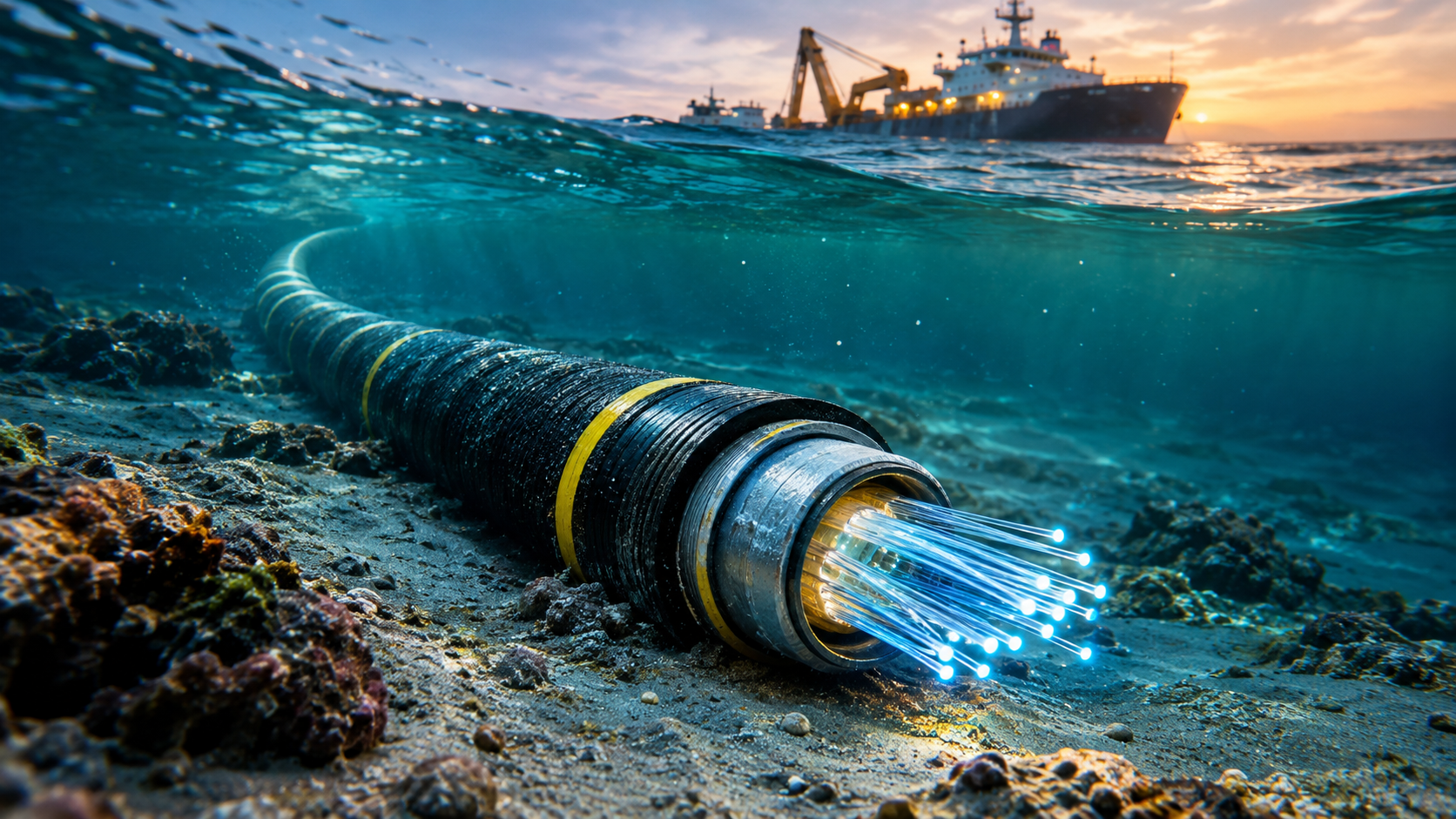
Every time you send an email, stream a movie, or join a video call, your data travels beneath the ocean. Undersea cables carry over 99% of international data traffic. These fiber-optic networks form the backbone of global internet connectivity.
Satellites support remote connections, but they cannot replace submarine fiber infrastructure. These underwater networks connect continents, businesses, governments, and billions of internet users.
Understanding who owns these hidden networks matters more than ever. Ownership influences bandwidth availability, network security, and international connectivity. It also determines how companies manage critical infrastructure during geopolitical conflicts or natural disasters.
Building undersea cables requires enormous investment and specialized engineering. Individual systems can cost hundreds of millions of dollars. Consequently, major telecommunications companies, technology giants, and international consortia dominate this industry.
In this guide, we explore who owns the world’s undersea cables. You will discover which companies control major global networks and India’s international connections. We will also examine Tata Communications’ role and explain whether the internet could survive without these underwater networks.
Who owns the most undersea cables?
No single company owns most of the world’s undersea cables. Instead, ownership is distributed among telecommunications operators, technology companies, and international consortia.
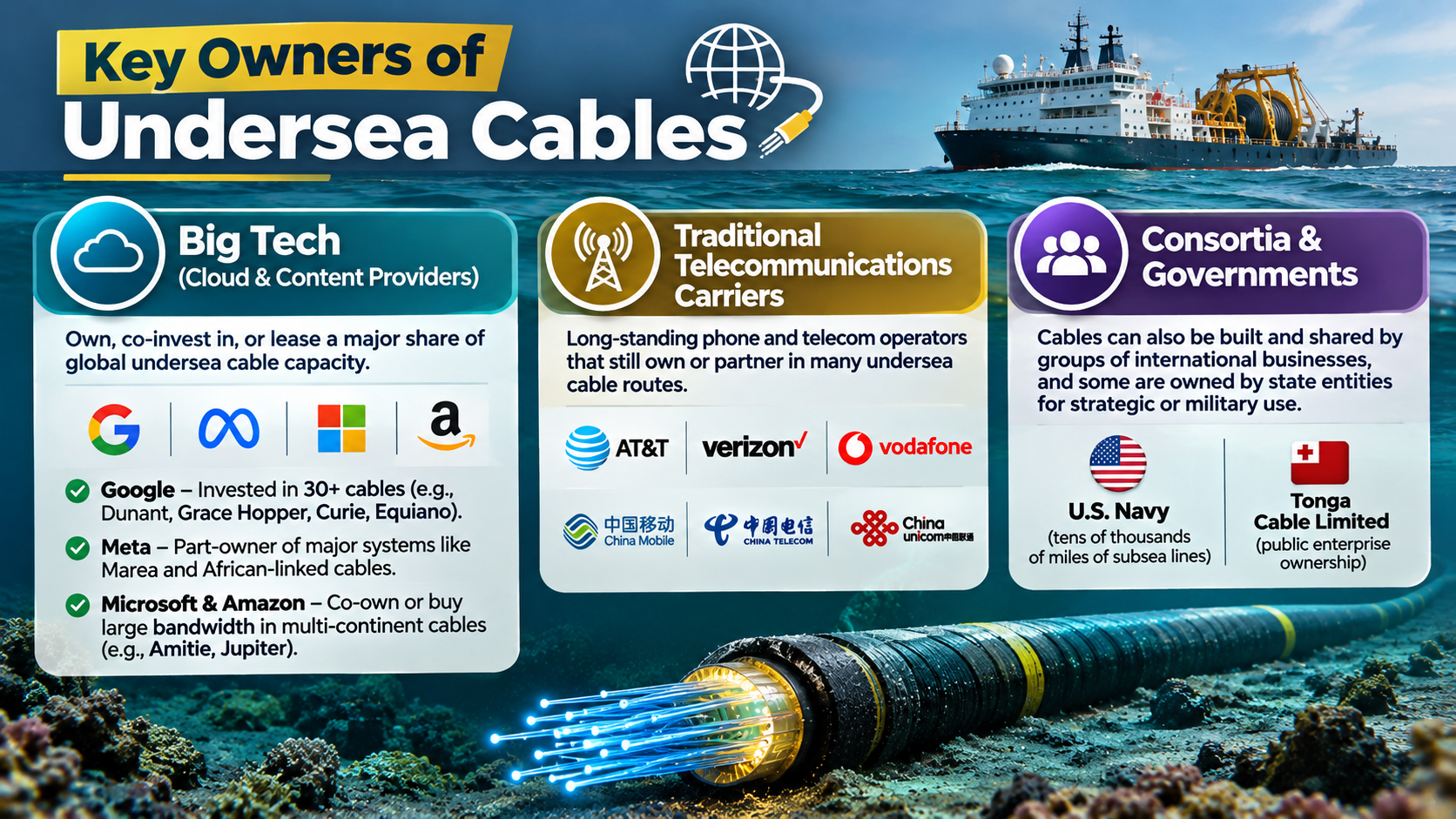
Major technology companies, including Google, Meta, Amazon, and Microsoft, increasingly invest in submarine cable infrastructure. Their investments support cloud computing, content delivery, artificial intelligence, and international data transfers.
Google is one of the largest individual technology investors in submarine cables. It owns several private cable systems and participates in multiple international consortiums. Meta also invests heavily in projects such as 2Africa and other regional networks.
Amazon and Microsoft participate through ownership stakes, partnerships, and capacity agreements. Their involvement helps secure reliable connectivity for cloud platforms and digital services.
Traditional telecommunications companies remain important owners and operators. These include AT&T, Orange, China Telecom, and other international carriers. Their established networks continue supporting major global communication routes.
There is no definitive universal ranking of ownership. Companies may own entire cables, share ownership, or purchase long-term transmission capacity. These arrangements make the global ownership structure more complicated than it first appears.
The Shift From Telecom Consortia to Big Tech
Traditionally, telecommunications companies built submarine cables through international consortiums. Several operators contributed money and shared construction expenses. They also received access to the network’s transmission capacity.
However, the industry has gradually changed. Large technology companies now invest directly in submarine cable projects. Their enormous data requirements make infrastructure ownership increasingly attractive.
Google, Meta, Amazon, and Microsoft need reliable international connectivity. Their services depend on moving massive amounts of information between data centers. Emerging technologies, such as floating, wave-powered data centres, are also exploring new ways to combine ocean infrastructure with digital computing. Owning cable infrastructure gives these companies greater control over network capacity and routing.
This approach also reduces dependence on external bandwidth providers. Companies can plan routes around their data centers and major customer markets. They can also improve network redundancy and manage capacity more efficiently.
However, traditional consortium ownership has not disappeared. Many modern submarine cables still involve multiple telecommunications and technology companies.
The industry now operates through several business models:
-
Private ownership: One company finances and controls an entire cable.
-
Consortium ownership: Multiple organizations share construction costs and ownership.
-
Capacity agreements: Companies purchase or lease transmission capacity without owning the entire cable.
These different arrangements explain why submarine cable ownership is increasingly complex.
Who owns undersea cables in India?
India’s international submarine cable infrastructure involves several domestic telecommunications companies and international partners. Major Indian participants include Tata Communications, Bharti Airtel, Reliance Jio, Sify Technologies, and BSNL.
These companies participate in different parts of the industry. Some own cable landing stations, while others invest in submarine cable systems or provide international connectivity.
Most international cables involve partnerships between multiple organizations. Indian operators collaborate with foreign telecommunications companies and technology providers. These partnerships help distribute construction expenses and expand international bandwidth.
Mumbai and Chennai are India’s primary submarine cable landing hubs. Other coastal cities, including Kochi, Tuticorin, and Thiruvananthapuram, also support international connections.
India’s regulatory framework governs how submarine cables enter its territorial waters. Operators must obtain the necessary permissions and security clearances. Cable landing stations must also comply with applicable telecommunications licensing requirements.
Importantly, owning a landing station does not automatically mean owning the entire submarine cable. A company may operate the Indian landing infrastructure while sharing ownership with international partners.
Strict Regulations on Indian Cable Landing Stations
India treats submarine cable infrastructure as critical telecommunications infrastructure. Therefore, companies must follow licensing, security, and operational requirements before establishing cable landing facilities.
The Department of Telecommunications (DoT) oversees the relevant licensing framework. The Telecom Regulatory Authority of India (TRAI) provides recommendations and regulates specific aspects of telecommunications infrastructure.
International operators cannot simply bring submarine cables into India without regulatory approval. They must work through eligible Indian licensees and satisfy applicable requirements.
TRAI’s 2023 recommendations addressed ownership and control of submarine cable assets. They also discussed the responsibilities of licensed operators involved in cable landing activities.
The regulatory framework covers several important areas:
-
Licensing: Eligible operators must hold the required telecommunications authorisation.
-
Security clearances: Relevant government approvals are necessary for submarine cable operations.
-
Asset ownership: Applicable requirements address ownership and control within Indian territorial waters.
-
Landing facilities: Cable landing stations must follow regulatory and access requirements.
These rules help protect India’s international communication infrastructure. They also establish accountability among domestic operators and international cable partners.
Would the Internet Work Without Undersea Cables?
The internet would face a massive international connectivity crisis without undersea cables. These networks carry most of the world’s intercontinental data traffic. Therefore, they play a critical role in keeping countries, businesses, and people connected.
However, the entire internet would not completely collapse. Domestic networks could continue operating, while some international connections could rely on satellites and alternative communication routes.
Nevertheless, losing submarine cables would severely disrupt global digital services. For example, businesses would struggle to access overseas servers and cloud platforms. Similarly, international banking, video conferencing, email, and cross-border communication would experience major interruptions.
The overall impact would depend on which cables failed and where the damage occurred. Countries with several independent connections could redirect some traffic. On the other hand, regions that depend on fewer international routes would face more serious disruptions.
Satellites could provide alternative connectivity for certain services. However, their total capacity cannot match the enormous bandwidth delivered by submarine fiber networks.
Modern undersea cables use fiber-optic technology to transmit vast amounts of information. Moreover, they offer low latency and reliable international connectivity. As a result, these underwater networks remain essential to the global digital economy.
Why Satellites Cannot Carry Global Internet Traffic
Satellites provide valuable internet connectivity, particularly in remote regions. However, they cannot replace the capacity and performance of modern submarine fiber-optic cables.
The biggest differences involve bandwidth, latency, and overall network capacity. Unlike satellite connections, submarine cables use multiple fiber pairs to transmit enormous amounts of information simultaneously.
Meanwhile, satellite networks face several technical limitations. Their available spectrum, orbital capacity, and network architecture restrict the amount of traffic they can handle.
Low-Earth-orbit (LEO) systems have improved satellite internet considerably. Consequently, users can now access faster connections than traditional satellite services provide. Even so, their combined capacity remains far below global international internet requirements.
Another important advantage of submarine cables is predictable performance. Fiber-optic signals travel through protected underwater infrastructure with relatively low latency. Therefore, these cables remain the preferred choice for high-volume international data transmission.
Nevertheless, satellites continue serving several important purposes:
-
Connecting remote islands and isolated communities.
-
Providing internet access to ships and aircraft.
-
Supporting emergency communication during natural disasters.
-
Connecting locations without reliable terrestrial infrastructure.
Ultimately, satellites and submarine cables serve different purposes. While satellites provide connectivity in difficult-to-reach locations, submarine cables handle the majority of international data traffic. Both technologies complement each other rather than compete directly.
Does Tata Own Undersea Cables?
Yes, Tata Communications owns and operates a major global submarine fiber network. Over the years, the Indian telecommunications company has established extensive international connectivity infrastructure.
According to Tata Communications, its subsea optical fiber network spans more than 500,000 kilometers. Additionally, the company states that its network carries approximately 30% of the world’s internet routes.
Tata Communications describes its infrastructure as the world’s only wholly owned subsea network encircling the globe. Through this network, the company supports international businesses, telecommunications operators, and enterprise customers.
However, this does not mean Tata exclusively owns every submarine cable carrying its traffic. Instead, the company also participates in international cable consortiums and partnerships.
Its infrastructure includes major systems associated with the Tata Global Network (TGN). Together, these networks connect important business and telecommunications markets across multiple continents.
Tata’s position highlights the importance of long-term infrastructure investment. Furthermore, its subsea network provides international connectivity for customers across more than 200 countries and territories.
How Tata Built Its Subsea Empire
Tata Communications expanded its international telecommunications presence through strategic acquisitions and infrastructure investments. One particularly important milestone came in 2005, when Tata acquired Tyco Global Network.
This acquisition gave Tata access to extensive international submarine cable infrastructure. As a result, the company strengthened its position in the global telecommunications market and gained access to important transoceanic routes.
Following the acquisition, Tata continued expanding and upgrading its infrastructure. Modern optical transmission technologies helped increase network capacity and improve international connectivity.
The company’s strategy focused on connecting major international business markets. Consequently, its infrastructure now supports cloud services, enterprise networks, and international telecommunications requirements.
Tata’s subsea network offers several important advantages:
-
Global reach: Connections across major international telecommunications markets.
-
Network ownership: Greater operational control over its wholly owned infrastructure.
-
Capacity expansion: Regular upgrades support increasing international data requirements.
-
Business connectivity: Infrastructure supports enterprises and telecommunications providers.
Today, Tata continues investing in international connectivity. As cloud computing and digital services expand, reliable submarine infrastructure becomes increasingly important for businesses worldwide.
How Many Undersea Cables Are There in India?
India’s historical official submarine cable count was approximately 17 international systems across 14 distinct cable landing stations. However, this figure should not be considered a definitive count for November 2026.
Earlier industry assessments reported these figures. Since then, new cable deployments and infrastructure projects have changed India’s international connectivity landscape.
By 2025, reporting identified 18 international submarine cables across 23 distinct landings. However, these figures can differ depending on whether individual landing points, cable systems, and domestic connections are counted separately.
Today, India’s submarine cable network connects the country with Europe, the Middle East, Southeast Asia, and other international markets. Among these connections, Mumbai and Chennai remain the primary international cable landing hubs.
Meanwhile, several newer systems are expanding India’s international connectivity. These include India-Europe-Xpress (IEX), SEA-ME-WE 6, and 2Africa. India’s March 2026 government reporting listed these systems as under commissioning rather than fully operational.
Once these projects become operational, they will increase India’s international bandwidth capacity. Furthermore, they will help support the country’s growing cloud computing, artificial intelligence, and digital services industries.
Why Mumbai and Chennai Dominate Cable Landings
Mumbai and Chennai serve as India’s two most important international submarine cable landing hubs. Their coastal locations provide convenient access to major global telecommunications routes.
First, Mumbai occupies a strategic position along India’s western coastline. Its geographic location supports international connections toward the Middle East, Africa, and Europe.
Meanwhile, Chennai provides important connections toward Southeast Asia and the wider Asia-Pacific region. Its eastern coastal position makes it a useful gateway for international routes across the Bay of Bengal.
Another important factor is the availability of established telecommunications infrastructure. Both cities have data centers, terrestrial fiber networks, and major business markets. Consequently, they provide suitable locations for international cable landing facilities.
Their importance comes from several factors:
-
Mumbai: Provides important international routes toward Europe, Africa, and the Middle East.
-
Chennai: Supports connectivity toward Singapore and Southeast Asian markets.
-
Existing infrastructure: Established landing facilities simplify network expansion.
-
Business demand: Large commercial markets generate substantial international data traffic.
However, concentrating too many cables in a small number of coastal regions also creates risks. For instance, cable damage or infrastructure disruptions can affect international connectivity. Understanding how underwater internet cables avoid breaking helps explain the engineering and protective measures used to maintain these critical connections.
Therefore, expanding landing infrastructure into additional coastal cities can improve network resilience. It can also reduce dependence on a limited number of international gateways.
Final Thoughts
Undersea cables are essential to the modern digital world. They connect continents, support international businesses, and keep billions of people connected. Although most internet users never see these underwater networks, they depend on them every day.
Ownership is shared among major technology companies, telecommunications operators, and international consortiums. Companies like Google, Meta, and Tata Communications continue investing in submarine cable infrastructure to meet growing data demands.
For India, expanding undersea cable connections is particularly important. More international routes can improve network capacity, strengthen connectivity, and support the country’s growing digital economy.
To understand the global submarine cable network better, explore the TeleGeography Submarine Cable Map. It provides a visual overview of cable routes, landing stations, and international connections.
As cloud computing, artificial intelligence, and online services continue expanding, the importance of undersea cables will only increase. These hidden fiber-optic networks will remain the foundation of global internet connectivity for years to come.