
What Are Nanobubbles? Everything You Need to Know About Microscopic Gas Cavities
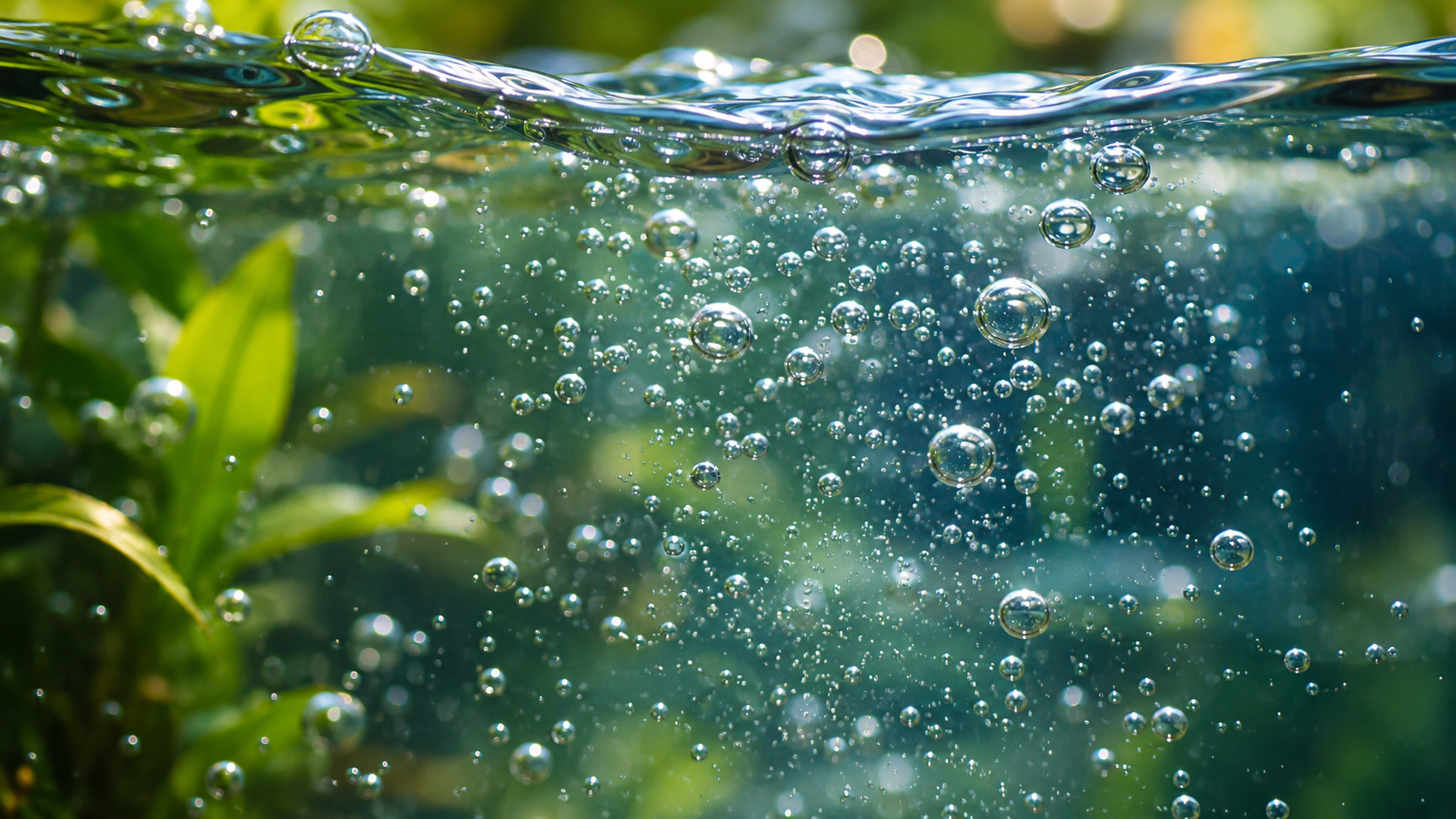
Understanding what are nanobubbles is becoming increasingly important across water treatment, agriculture, aquaculture, and industrial applications. According to research published in the National Center for Biotechnology Information, nanobubbles are extremely small gas-filled cavities found in liquids. They are generally defined as bubbles smaller than 1 micrometer, although some definitions use a diameter below 200 nanometers.
Their microscopic size gives them different properties from ordinary bubbles. Traditional bubbles quickly rise to the surface and release their gas into the atmosphere. However, nanobubbles can remain dispersed in water for extended periods under suitable conditions. Their behavior depends on factors such as gas composition, water chemistry, temperature, and surface charge.
This technology offers several potential advantages for modern industries. It can improve gas transfer, support oxidation processes, and help manage water quality. Traditional aeration systems often lose gas before it dissolves completely. Nanobubble technology aims to reduce these losses and improve treatment efficiency.
In this guide, we explore how nanobubbles work, what they contain, and how manufacturers produce them. We also examine their applications in water purification and modern nanotechnology. Finally, we discuss the factors that influence the price of a nanobubble generator.
Do nanobubbles really work?
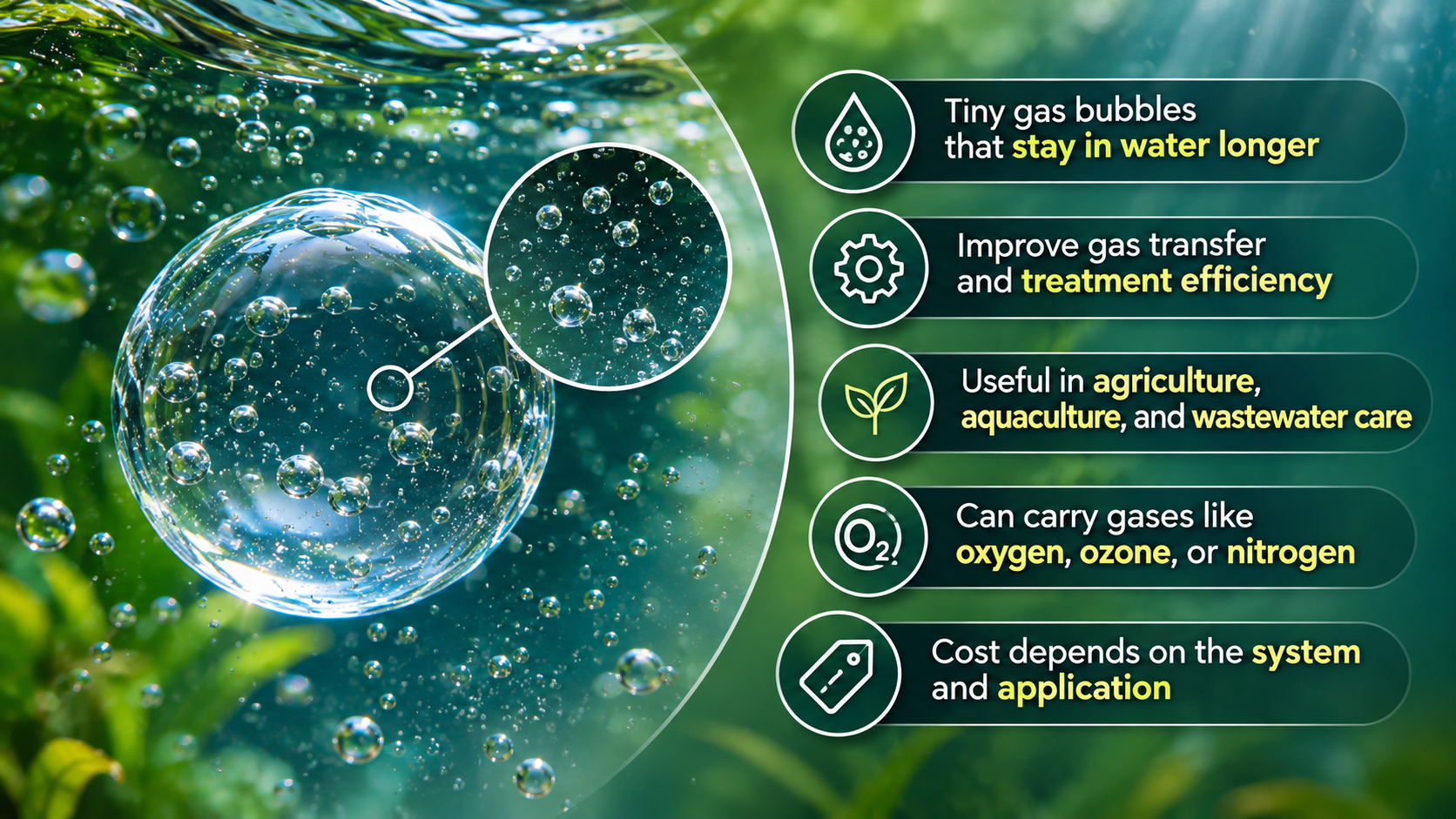
Yes, nanobubbles have demonstrated useful results in several scientific studies and commercial applications. Their effectiveness depends on the gas used, water conditions, generator design, and intended application. Research has explored their potential in agriculture, aquaculture, wastewater treatment, and industrial cleaning.
One important advantage is their ability to remain suspended in water longer than conventional bubbles. This can increase gas dissolution and improve oxygen availability. Oxygen nanobubbles may support aquatic organisms and plant root development when properly applied. Ozone nanobubbles can also support oxidation and disinfection processes.
Their negatively charged surfaces may influence interactions with suspended particles and microorganisms. However, this does not mean they automatically remove every contaminant. Results depend on the specific treatment conditions and water composition.
Nanobubble technology also requires proper equipment and monitoring. Its performance should be evaluated against conventional treatment methods. This helps determine whether the technology provides measurable improvements in efficiency, water quality, or operating costs.
Proven Industrial Performance
Nanobubble technology has attracted attention in commercial wastewater treatment and agricultural operations. In wastewater facilities, oxygen nanobubbles can improve oxygen availability for microorganisms. These microorganisms help break down organic waste during biological treatment. Better oxygen transfer may support treatment performance under suitable operating conditions.
Some facilities also investigate nanobubble systems to reduce energy consumption. However, actual savings depend on existing aeration equipment, wastewater characteristics, and system design. Claims of universal energy reductions should be treated cautiously.
Hydroponic growers also explore oxygen nanobubbles to improve dissolved oxygen around plant roots. Adequate oxygen supports root respiration and nutrient absorption. It may also help reduce conditions associated with root diseases. Similarly, aquaculture operators use oxygen-enriched water to support fish health and maintain suitable water conditions.
These applications demonstrate the technology’s potential. However, results vary between installations. Operators should compare dissolved oxygen levels, energy consumption, treatment performance, and maintenance requirements before investing in commercial systems.
What are nanobubbles made of?
Nanobubbles consist primarily of a microscopic gas-filled region surrounded by the surrounding liquid. Their composition depends on the gas introduced during production. Common options include oxygen, ozone, nitrogen, carbon dioxide, and ordinary atmospheric air.
The gas core determines many of the bubble’s intended functions. For example, oxygen supports applications requiring increased dissolved oxygen. Ozone is used in oxidation and disinfection processes. Nitrogen can help reduce oxygen exposure in certain industrial and food-processing applications.
Nanobubbles also have an important surface property called zeta potential. This describes the electrical potential near the particle’s slipping plane in a liquid. Many nanobubble systems exhibit a negative zeta potential under particular water conditions. This surface charge can influence interactions between bubbles, dissolved ions, and suspended particles.
Their stability is influenced by several factors. These include temperature and its measurement across different temperature scales, pH, dissolved substances, gas composition, and water chemistry. Therefore, not every nanobubble behaves identically in different environments. Understanding its composition helps determine the most suitable application.
Choosing the Right Gas Core
Choosing the correct gas depends on the intended application. Different gases produce different chemical and physical effects. Therefore, manufacturers and operators must consider treatment requirements before selecting a nanobubble generator.
Common gas choices include:
- Oxygen: Oxygen nanobubbles support applications requiring improved dissolved oxygen. Aquaculture, hydroponics, and wastewater treatment are common examples.
- Ozone: Ozone nanobubbles support oxidation and microbial disinfection. They are investigated for water treatment and certain food-processing applications.
- Nitrogen: Nitrogen helps displace oxygen in selected industrial processes. It can also support applications requiring controlled gas environments.
- Carbon dioxide: Carbon dioxide nanobubbles can influence water chemistry and pH. They may be useful in agricultural and specialized industrial applications.
- Air: Air-based systems provide a mixture of atmospheric gases. They are commonly considered for general aeration and water management.
Selecting the wrong gas can reduce treatment effectiveness. For example, ozone requires careful concentration control because excessive exposure can damage sensitive organisms and materials. Operators should match gas selection with safety requirements, water quality, and the desired treatment outcome.
Do nanobubbles exist?
Yes, nanobubbles exist, and researchers have investigated their physical properties using advanced measurement techniques. However, their stability and behavior generated considerable scientific debate. Classical bubble physics suggests that very small gas cavities should dissolve rapidly because of their high internal pressure and surface tension.
Researchers have explored several possible explanations for their observed persistence. These include surface charge, dissolved gas conditions, and interactions between gas and surrounding liquid molecules. Their exact stabilization mechanisms remain an active research area.
Scientists use specialized instruments to investigate nanobubble size, concentration, and behavior. Common techniques include nanoparticle tracking analysis, dynamic light scattering, and atomic force microscopy. Cryogenic electron microscopy can also provide useful structural information under appropriate conditions.
However, detecting nanobubbles requires careful interpretation. Other particles, impurities, and measurement artifacts can produce similar signals. Researchers therefore combine multiple measurement methods to improve confidence in their findings. This helps distinguish genuine nanobubbles from other nanoscale structures in water.
How to produce nano bubbles?
Manufacturers produce nanobubbles using specialized generators that combine gas and liquid under controlled physical conditions. These machines use different mechanical processes to create extremely small gas cavities. The selected production method influences bubble size, concentration, gas transfer, and overall system performance.
Four common approaches include hydrodynamic cavitation, pressurized dissolution, membrane diffusion, and ultrasonic techniques. Each method uses a different mechanism to introduce and disperse gas within a liquid.
Hydrodynamic cavitation is widely investigated for industrial applications. A pump moves water through specially designed passages, nozzles, or venturi systems. Changes in pressure and fluid velocity help generate and disperse gas cavities.
Pressurized dissolution uses elevated pressure to increase gas dissolution in water. When the pressure decreases, dissolved gas can form microscopic bubbles under suitable conditions. Membrane diffusion introduces gas through specialized porous membranes. Ultrasonic systems use high-frequency sound waves to influence bubble formation and behavior.
The best production method depends on the application. Important considerations include energy consumption, water flow capacity, maintenance requirements, and the desired bubble characteristics. Industrial operators should also evaluate generator performance under actual operating conditions.
How can nanobubble technology be used for water purification?
Nanobubble technology can support water purification by improving gas transfer, oxidation, and certain treatment processes. Its effectiveness depends on the gas used and the contaminants present. Oxygen and ozone nanobubbles have attracted particular attention in wastewater treatment and water quality management.
Oxygen nanobubbles can increase dissolved oxygen levels. This supports aerobic microorganisms that break down organic waste during biological treatment. Ozone nanobubbles introduce an oxidizing gas that can react with certain organic compounds and microorganisms. These reactions may help reduce specific pollutants and microbial contamination. Understanding the differences between physical and chemical changes helps explain how these treatment processes work.
Nanobubbles can also influence suspended particles and surface interactions. Their electrical properties may affect how particles behave in water. Under suitable conditions, this can support processes such as flotation and separation. However, nanobubbles do not automatically attract or remove every heavy metal or dissolved contaminant.
Water treatment facilities can combine nanobubble systems with conventional filtration, biological treatment, and oxidation methods. This integrated approach may improve treatment performance. Regular monitoring remains essential to ensure that the treated water meets the required quality standards.
Chemical-Free Disinfection Power
Nanobubble technology can support disinfection without relying entirely on conventional chemical dosing. However, describing the process as completely chemical-free would be misleading. The treatment mechanism depends on the gas selected and the operating conditions.
Ozone nanobubbles are particularly relevant because ozone is a powerful oxidizing agent. It can damage bacterial cell structures and react with certain microorganisms. Under suitable conditions, ozone treatment may reduce microbial contamination and help control unwanted organic compounds.
Cavitation and bubble collapse can also generate localized physical and chemical effects. These effects may contribute to the formation of reactive species under specific conditions. However, hydroxyl radical production is not guaranteed in every nanobubble system.
Ozone treatment requires careful monitoring because excessive concentrations can create safety risks. It may also produce unwanted oxidation byproducts depending on water composition. Therefore, treatment facilities must evaluate ozone concentration, contact time, and water quality.
Nanobubble-based disinfection works best as part of a properly designed treatment system. It should not replace validated disinfection procedures without sufficient performance testing.
How is nanotechnology used in water treatment?
Nanotechnology improves water treatment by using materials and structures at extremely small scales. These materials can interact with pollutants that conventional treatment methods may struggle to remove. Nanobubbles represent one application, but several other nanomaterials also support modern purification systems.
Common examples include carbon nanotubes, nanoscale zero-valent iron, and specialized nanofiltration membranes. Each technology serves a different purpose. Carbon-based nanomaterials can provide surfaces for contaminant adsorption. Nanoscale zero-valent iron can support the treatment of certain groundwater pollutants through chemical reactions.
Nanofiltration membranes use extremely small pores to separate selected dissolved substances from water. They can help remove certain organic compounds, multivalent ions, and other contaminants. Their performance depends on membrane properties and operating conditions.
Nanomaterials can also offer high surface-area-to-volume ratios. This provides more opportunities for chemical interactions with pollutants. However, their use requires careful consideration of cost, durability, regeneration, and potential environmental risks.
Combining nanomaterials with conventional filtration and nanobubble technology can support advanced water treatment strategies. These approaches may improve contaminant removal and treatment efficiency. However, each application requires independent testing to confirm its effectiveness and safety.
What is the price of a nano bubble generator?
The price of a nano bubble generator varies considerably depending on its capacity, technology, construction materials, and intended application. Small laboratory and pilot-scale systems generally cost less than large industrial installations. Commercial buyers should also consider installation, maintenance, and operating expenses.
Several factors influence the total equipment cost:
- Water flow capacity: Systems designed to process larger water volumes generally require more powerful pumps and components.
- Generator technology: Hydrodynamic cavitation, membrane-based systems, and other production methods have different manufacturing costs.
- Construction materials: Stainless steel and corrosion-resistant components can increase equipment prices.
- Gas supply: Some systems require additional oxygen concentrators, ozone generators, or specialized gas delivery equipment.
- Automation: Advanced monitoring systems and automated controls can increase the initial investment.
Small commercial systems for hydroponics, aquaculture, and ponds may fall within a few thousand dollars. Larger agricultural and industrial systems can cost tens of thousands of dollars. Municipal wastewater installations may require customized equipment and engineering.
These figures are broad purchasing estimates, not verified current market quotations. Actual prices vary between manufacturers and regions. Before purchasing, request a detailed quotation covering flow rate, bubble concentration, energy consumption, warranty, installation, and maintenance.
Comparing these factors provides a more realistic picture of the total cost of ownership. A cheaper generator may not deliver the required treatment performance. Therefore, buyers should evaluate long-term operating efficiency rather than focusing only on the initial purchase price.
Conclusion
Understanding what are nanobubbles reveals why so many industries are rethinking how they treat and manage liquids. Far from being a theoretical curiosity, these microscopic gas cavities physically exist and deliver proven results in real-world operations. By trapping gases like oxygen and ozone underwater for weeks, they dramatically outperform traditional aeration while cutting energy and chemical expenses.
From purifying municipal drinking water to boosting crop yields in vertical farms, this technology offers a clean, sustainable path forward. Modern mechanical generators make producing these tiny spheres reliable and accessible, with equipment options fitting everything from small research labs to massive wastewater facilities.
If you manage water quality, agriculture, or industrial cleaning, now is the time to explore nanoscale aeration. Evaluate your current chemical and energy costs, and consider testing a compact generator to see how this breakthrough can improve your water efficiency.