
The Complete Guide to Choosing an Income-Driven Repayment Plan
Managing federal student loan debt can become difficult when standard payments consume too much of your income. An income-driven repayment plan can make federal loans more manageable by connecting your payment to factors such as income and family size. You can review current federal repayment options through Federal Student Aid.
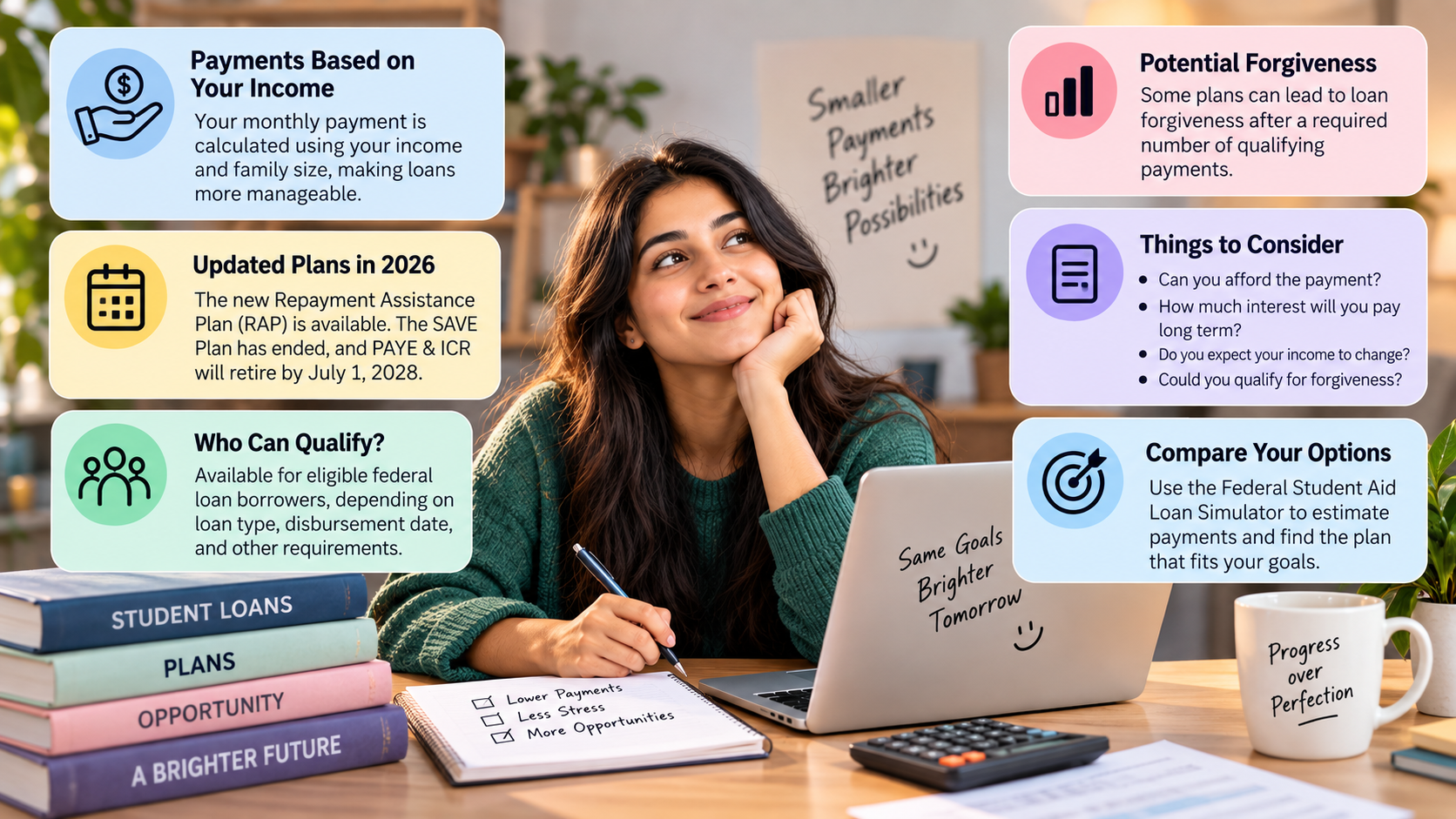
Federal student loan repayment rules have changed significantly in 2026. The available plans now depend on your loan type, disbursement date, and other eligibility requirements. The Repayment Assistance Plan (RAP) is now available, while the SAVE Plan ended in March 2026. PAYE and ICR are also scheduled to retire no later than July 1, 2028. Check the latest Federal Student Aid repayment guidance and Student Loan Guidelines 2026 before choosing a plan.
Understanding these rules matters before choosing a repayment strategy. An IDR plan may lower your monthly obligation and help you avoid delinquency or default. However, a smaller payment can also mean a longer repayment period and higher interest costs.
This guide explains how an income-driven repayment plan works, who may qualify, how forgiveness works, and what to do when payments remain unaffordable. For personalized estimates, borrowers can also use the Federal Student Aid Loan Simulator to compare repayment options.

Is it smart to do an income-driven repayment plan?
Choosing an income-driven repayment plan can make sense when your standard payment does not fit your budget. These plans generally calculate payments using your income, family size, loan type, and applicable federal rules. A lower monthly obligation can free money for housing, food, emergency savings, or other high-priority expenses.
However, a lower payment does not automatically mean a lower total cost. A longer repayment period can allow interest to accumulate for more years. Your best option therefore depends on both your current cash flow and expected future income. Building a clear personal financial plan for wealth can help you balance debt repayment with longer-term financial goals.
Before enrolling, compare the estimated payment and total repayment cost. Also consider whether you may qualify for student loan forgiveness or Public Service Loan Forgiveness.
An IDR plan may be particularly useful when:
- Your income is relatively low compared with your federal loan balance.
- Your monthly payment is difficult to afford.
- You expect your income to change substantially.
- You are pursuing a qualifying forgiveness program.
Balancing Immediate Savings Against Long-Term Interest
An IDR plan can provide immediate payment relief, but that benefit comes with a potential trade-off. Lower payments may extend the time needed to repay your federal student loans. During that period, interest may continue to increase your overall repayment cost. If you want to reduce your balances more aggressively, paying off debt faster can help shorten the repayment period and limit interest costs.
For example, a borrower with a modest current income may benefit from a lower required payment today. However, someone expecting rapid salary growth may eventually pay substantially more than they would under a faster repayment strategy.
Compare both sides before choosing:
- Monthly affordability: Can you comfortably make the required payment?
- Total interest: How much could the loan cost over time?
- Future income: Is your salary likely to increase?
- Forgiveness: Could you benefit from qualifying forgiveness?
- Career plans: Might you qualify for Public Service Loan Forgiveness?
The cheapest plan today is not necessarily the cheapest plan overall. Use the federal repayment calculator to compare your available options before making a decision.
What is an income-driven repayment plan?
An income-driven repayment plan is a federal student loan repayment option that bases your required payment on factors such as income and family size. Instead of relying only on your original balance and a fixed repayment schedule, the calculation considers your financial circumstances.
Your available plans depend on your federal loan types and when those loans were first disbursed. In 2026, eligible borrowers may encounter plans such as Income-Based Repayment (IBR), Pay As You Earn (PAYE), Income-Contingent Repayment (ICR), and the new Repayment Assistance Plan (RAP). Not every borrower qualifies for every option.
You generally must provide updated income information during annual recertification. Your payment can therefore change when your income or family circumstances change.
Some IDR plans can eventually provide forgiveness after a required number of qualifying payments. The exact timeline depends on the plan and borrower circumstances.
Which is the best income-driven repayment plan?
There is no single best income-driven repayment plan for every borrower. Your ideal option depends on your loan types, disbursement dates, income, family size, and long-term repayment goals.
The current federal system includes the Repayment Assistance Plan (RAP) and other IDR options for borrowers who meet specific requirements. IBR remains available for qualifying borrowers. PAYE and ICR may still apply to certain older loans, but both plans are scheduled to end no later than July 1, 2028.
This makes the timing of your loans especially important. A plan that appears attractive today may require you to switch plans later.
When comparing options, consider:
- Your current monthly payment.
- Your expected income growth.
- Your loan balance and interest rate.
- Your eligibility for forgiveness.
- Your expected repayment period.
- Whether your plan is scheduled to end.
Use the federal repayment calculator rather than choosing a plan based solely on its advertised payment percentage.
Are IDR loans forgiven after 20 years?
Some federal student loans can receive forgiveness after 20 or 25 years of qualifying repayment, depending on the applicable income-driven repayment plan and borrower circumstances. The exact forgiveness period is not identical across every plan.
For example, qualifying IBR borrowers may receive forgiveness after 20 years if they meet the definition of a new borrower under the applicable rules. Other IBR borrowers may face a 25-year repayment period. PAYE generally uses a 20-year period, while ICR generally uses 25 years. These older plans are scheduled to be retired no later than July 1, 2028.
RAP has different repayment rules, including a longer potential repayment period.
You must also maintain eligibility and satisfy the requirements for qualifying payments. Annual income recertification remains important for IDR borrowers.
Do not assume that simply making payments for 20 years guarantees forgiveness. Your plan, loan history, qualifying payments, and federal rules determine whether and when a remaining balance can be discharged.
Monitoring Policy Changes Regarding the Forgiveness Tax Bomb
Tax treatment can make student loan forgiveness more complicated than the advertised repayment period suggests. A forgiven balance may potentially create a federal or state tax obligation, depending on the law in effect when the discharge occurs.
That matters because borrowers pursuing IDR forgiveness may be planning over several decades. Tax rules can change during that period, making today’s assumptions unreliable for a future discharge.
Instead of assuming forgiven debt will always be tax-free, monitor official federal and state guidance as your forgiveness date approaches. Keep records of your repayment history and projected balance so you can estimate potential financial consequences.
You should also distinguish IDR forgiveness from Public Service Loan Forgiveness (PSLF). Public Service Loan Forgiveness: Complete Guide explains the separate eligibility requirements and considerations for borrowers pursuing PSLF, which generally provides federal tax-free forgiveness under current federal rules.
If you expect a substantial balance to be forgiven, consider speaking with a qualified tax professional before the discharge occurs. That can help you understand whether you may need to prepare for additional taxes.
What if I can’t afford my IDR student loan payment?
If you cannot afford your current income-driven repayment plan payment, do not simply stop paying. Contact your federal loan servicer and request a review of your repayment options. If your financial circumstances have changed, you may be able to update your income information rather than waiting for your normal annual recertification. Reviewing good financial habits that build wealth can also help you adjust your broader money-management strategy when payments become difficult.
A job loss, salary reduction, or change in family circumstances can affect your payment calculation. Depending on your plan and circumstances, providing updated information may result in a lower required payment.
Keep documentation of your income and household changes. Respond promptly to communications from your servicer so you do not accidentally miss important deadlines.
If you are already struggling to make payments, review whether another eligible repayment plan provides better protection. You may also need to consider whether deferment or forbearance is appropriate.
Do not assume that an unaffordable bill will automatically become a zero-dollar payment. The result depends on your plan, income, loan type, and applicable federal rules.
Requesting Temporary Forbearance While Recalculating Payments
Forbearance can temporarily pause or reduce required federal student loan payments when you meet applicable requirements. It can be useful when you need short-term relief, but it should not automatically be your first choice.
Interest may continue to accrue during a forbearance period. That can increase your outstanding balance and raise your long-term repayment cost. For this reason, forbearance is generally better viewed as temporary financial relief rather than a permanent repayment strategy.
If your income has fallen, first determine whether updating your IDR information could produce a more sustainable monthly payment. Ask your servicer what documentation is required and whether your request can be processed before your next payment deadline.
Keep written records of your request and any confirmation you receive. Do not assume that submitting an application automatically stops your payment obligation.
If a temporary pause is necessary, understand its start and end dates. Resume payments or change plans promptly when the forbearance period ends.
Which loans are not eligible for IDR?
Not every student loan qualifies for an income-driven repayment plan. Private student loans are not eligible for federal IDR programs because they are issued by private lenders rather than the federal government.
Parent PLUS Loans also have significant restrictions. A Parent PLUS Loan cannot be directly repaid under the federal IDR plans. Certain older federal loans may require consolidation into a Direct Consolidation Loan before becoming eligible for specific repayment options.
Loan eligibility also depends on when the loan was disbursed. Federal rules changed substantially on July 1, 2026, so borrowers with older and newer loans may have different options.
Default status can also affect your ability to enroll in an IDR plan. You may need to resolve the default through an eligible federal process before accessing certain repayment options.
Because eligibility rules are complex, check your exact loan types through your StudentAid.gov account before consolidating or changing plans. Consolidation can affect interest, payment counts, and future repayment options.
Unlocking Access Through the Federal Direct Consolidation Process
Federal consolidation can sometimes make an otherwise ineligible loan eligible for a particular repayment option. However, consolidation is not a universal solution, and borrowers should understand the consequences before proceeding.
For example, certain older FFEL Program loans may need to be consolidated into a Direct Consolidation Loan to access specific IDR plans. Parent PLUS borrowers also face special rules, and consolidation does not automatically make every repayment plan available.
Timing matters as well. Federal rules changed on July 1, 2026, including restrictions affecting Parent PLUS loans and certain consolidation loans. A consolidation strategy that worked under older rules may no longer produce the same result.
Before consolidating, compare:
- Your current interest rates.
- Your existing qualifying payment history.
- Your forgiveness eligibility.
- The repayment plans available after consolidation.
- Any capitalization or other financial consequences.
Check the federal consolidation and repayment tools before submitting an application. If forgiveness or PSLF is part of your strategy, verify how consolidation could affect your qualifying payment history.
Frequently Asked Questions
How often do I need to recertify my income-driven repayment plan?
You must recertify your income and family size every twelve months. Your loan servicer will notify you before the deadline arrives. Missing your annual recertification deadline can cause your monthly payments to jump back up to the standard ten-year repayment amount, and unpaid interest might capitalize onto your loan balance.
Can I switch between different income-driven repayment plans later?
Yes, you can change your repayment plan at any time through the Federal Student Aid portal, provided you qualify for the new program. Switching can help if your income changes significantly or if marriage alters your tax strategy. Check whether unpaid interest will capitalize before finalizing a plan switch.
Do zero-dollar payments count toward loan forgiveness?
Yes, a zero-dollar payment counts as an on-time monthly payment toward your 20- or 25-year cancellation requirement. If your calculated discretionary income yields a zero-dollar obligation, your servicer credits your account with a qualifying payment each month. This benefit keeps low-income borrowers progressing toward debt relief without spending money.
Does enrolling in an income-driven repayment plan hurt my credit score?
Enrolling in an IDR program does not harm your credit rating. Credit bureaus do not view income-adjusted payments negatively on consumer credit reports. In fact, lowering your required monthly payment helps prevent missed payments and delinquencies, which protects and strengthens your credit profile over time.
Conclusion
Managing higher education debt requires selecting a repayment path that reflects your actual earning capacity. Enrolling in an income-driven repayment plan provides strong financial safeguards by aligning monthly payments with discretionary cash flow. Whether your primary goal is finding immediate room in your budget, avoiding default, or pursuing debt forgiveness after two decades of payments, these federal frameworks give borrowers reliable options.
Take time to assess your specific loan types, career prospects, and household goals before committing to a strategy. Remember that you hold the legal right to update your income information whenever financial setbacks occur. Take control of your student loans today by reviewing your account details on the Federal Student Aid platform and finding the repayment structure that best supports your financial future.