
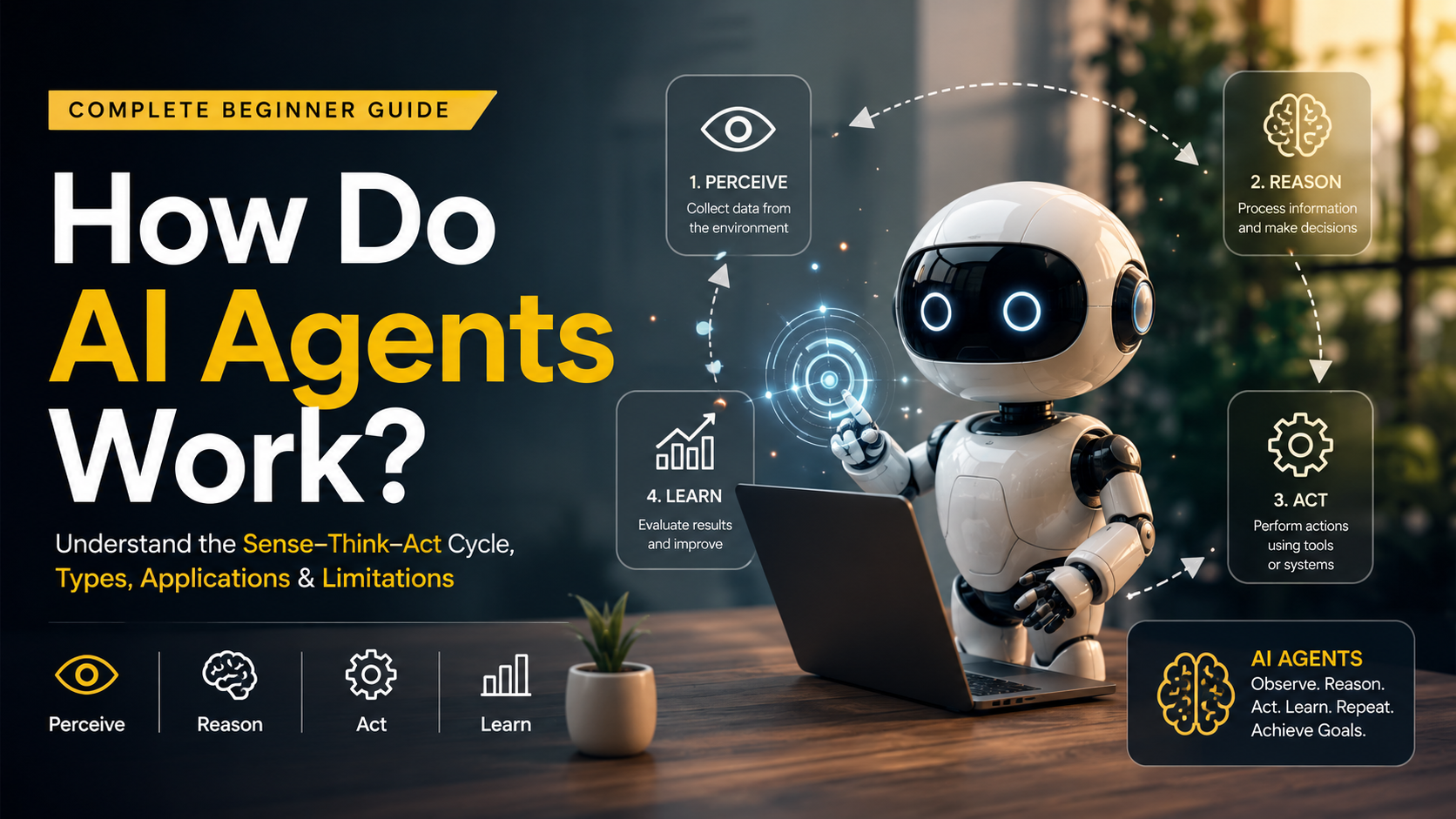
How Do AI Agents Work? Complete Beginner Guide
Understanding how AI agents work provides a useful foundation for modern artificial intelligence. These systems can perceive information, make decisions, and take actions toward specific goals. Unlike traditional software, they can respond to changing conditions instead of following only fixed instructions. For readers who want a broader introduction, what agentic AI is and how it works provides additional context.
Modern machine learning models have made autonomous software more capable. OpenAI’s practical guide to building agents explains how agents can independently perform tasks and use external tools to complete workflows. This provides useful context for understanding how modern AI agents operate.
This guide explains how AI agents operate in simple terms. It covers their core sense-think-act cycle, major types, practical applications, and common limitations. You will also learn how AI agents differ from traditional software.
Finally, we examine whether ChatGPT is an AI agent. This distinction matters because conversational AI can gain agent-like abilities when connected to tools, APIs, memory, and execution systems.
How Exactly Do AI Agents Work?
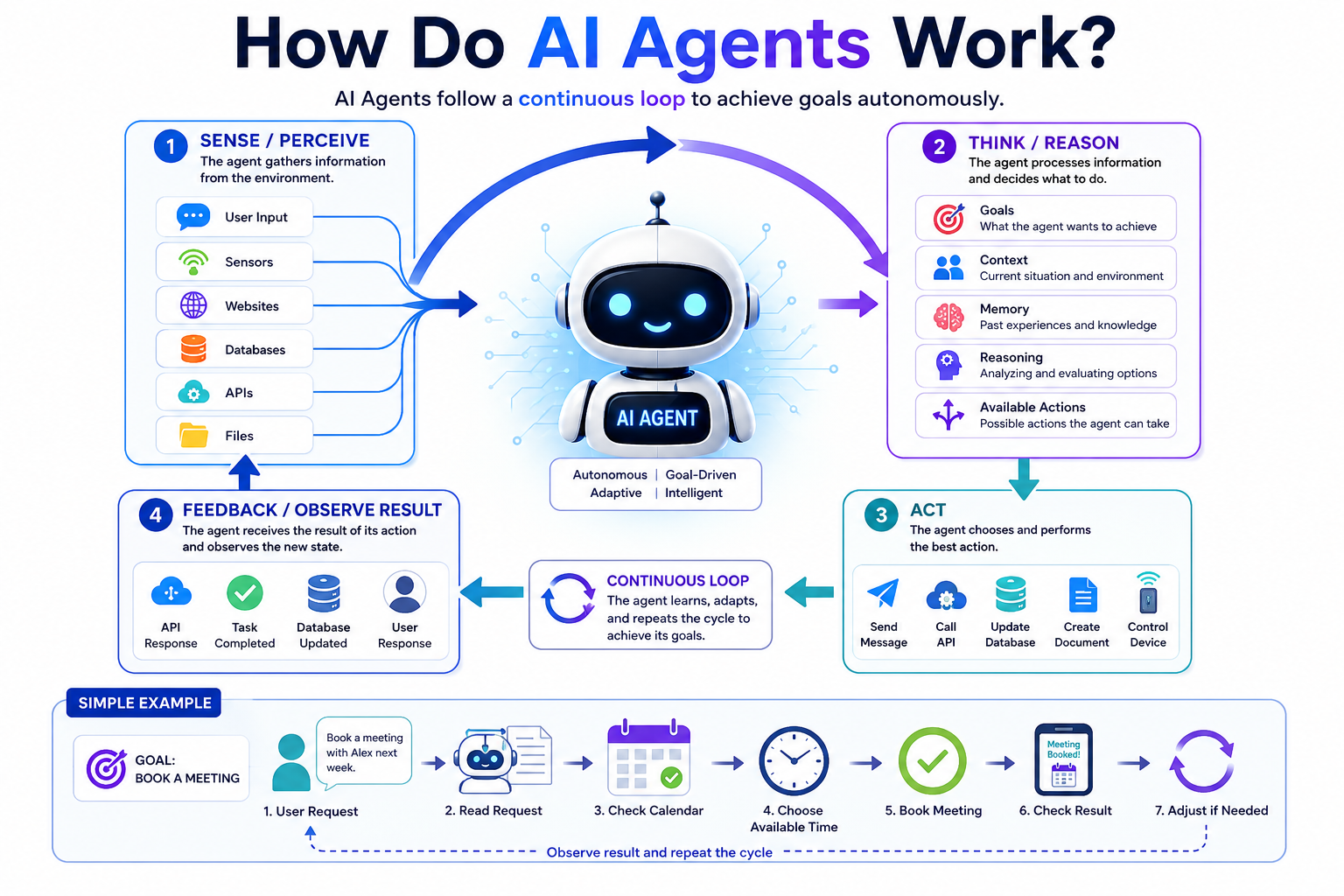

AI agents work through a continuous process of perception, reasoning, and action. First, an agent receives information from its environment. That information can come from sensors, databases, user inputs, websites, APIs, or other software systems.
Next, the agent processes the available information. Its reasoning system compares the current situation with its goals and available options. Depending on its design, this process may use rules, algorithms, machine learning models, or large language models.
The agent then selects an action based on its objectives. It might send a message, update a database, control a device, or call another software tool. The action changes the environment in some way.
The agent observes the new results and repeats the process. This feedback loop allows it to respond when conditions change. Some systems also learn from previous outcomes and improve future decisions, forming the foundation of agentic AI systems that operate through autonomous feedback loops.
In simple terms, an AI agent observes, reasons, acts, and evaluates repeatedly until it reaches its goal or requires human input.
The Sense-Think-Act Cycle
The sense-think-act cycle describes the basic operating pattern behind many AI agents. It begins when the system senses or receives information from its environment. Sensors may capture physical data, while software agents can receive text, files, database records, or API responses.
During the thinking stage, the agent interprets that information. It identifies relevant details, considers its current state, and compares possible actions with its goals. More advanced systems may use machine learning or language models to support this reasoning process.
The final stage is action. The agent uses an actuator or software output to affect its environment. A physical robot might move an arm, while a digital agent could create a document or submit information through an API. New approaches are also exploring tactile interfaces for controlling AI agents and giving users more direct control over autonomous systems.
The cycle then starts again. New feedback becomes the next input, allowing the agent to adjust its behavior.
This process supports autonomous decision-making because the system does not need a person to approve every individual action. Human supervision can still remain important for safety, accuracy, and accountability.
What Are the 7 Types of AI Agents?
AI agent classifications describe systems according to their decision-making abilities. One useful framework includes seven categories. Each type offers a different approach to perception, planning, and action.
- Simple reflex agents respond to current inputs using condition-action rules.
- Model-based reflex agents maintain an internal state when some information remains hidden.
- Goal-based agents select actions that help achieve defined objectives.
- Utility-based agents compare possible outcomes using a performance measure.
- Learning agents improve their behavior through experience and feedback.
- Hierarchical agents divide complex objectives into smaller tasks and subtasks.
- Multi-agent systems use multiple agents that cooperate or compete within an environment.
These categories help explain how AI agent architecture can become more sophisticated. A simple reflex agent may work well in a predictable environment. More advanced systems may need memory, planning, learning, or coordination.
Modern AI applications can also combine several approaches. For example, an autonomous system might use goals, utility calculations, learning, and multiple specialized agents together.
Complexity in AI Agent Architecture
AI agent architecture becomes more complex as the environment becomes less predictable. A simple reflex system can work effectively when every situation has a clear response. However, it may struggle when important information is missing or conditions change unexpectedly.
Model-based agents address some of these limitations by maintaining an internal representation of the environment. Goal-based systems add another layer by considering future actions rather than reacting only to current inputs.
Utility-based architectures go further by comparing possible outcomes. They can balance competing factors such as cost, speed, risk, or efficiency. Learning agents can then improve their decisions by using experience and feedback.
Developers choose an architecture based on the application’s goals and constraints. Computational resources, available data, safety requirements, and environmental complexity all influence that decision.
Modern systems may combine multiple architectures instead of using one category alone. This approach can support more capable autonomous workflows while keeping individual components specialized.
The key principle is simple: greater environmental complexity usually requires more sophisticated reasoning and memory.
What Are the Uses of AI Agents?
AI agents can automate tasks that require repeated decisions, information processing, or interaction with other systems. Their applications span many industries and continue to expand as AI technology improves.
In customer service, agents can answer common questions and route complex issues to human representatives. In supply chain operations, they can monitor inventory, identify disruptions, and support logistics planning.
Healthcare systems can use AI-assisted software to analyze records and support clinical workflows. However, high-stakes decisions still require appropriate professional oversight. Financial institutions can use automated systems for fraud detection, risk analysis, and other time-sensitive processes.
AI agents can also support software development, research, scheduling, document processing, and business operations. Autonomous vehicles use related AI technologies to interpret sensor data and make navigation decisions. These capabilities are increasingly connected to AI chatbots and business automation workflows that can handle multi-step tasks.
Common applications include:
- Customer support and virtual assistance
- Supply chain and inventory management
- Fraud detection and financial analysis
- Research and information gathering
- Workflow and business process automation
- Robotics and autonomous navigation
The value of an AI agent comes from its ability to combine perception, reasoning, and action within a practical workflow.
Transforming Enterprise Automation
AI agents can change enterprise automation by handling workflows that involve several connected steps. Traditional automation often follows predetermined rules. Agentic systems can evaluate information, choose between actions, and respond to changing conditions.
For example, an agent could review incoming requests, identify priorities, gather information from multiple systems, and prepare a report. It could then schedule a follow-up or request human approval when necessary.
This flexibility can reduce repetitive work and help employees focus on higher-value activities. It can also connect tools that previously required manual coordination.
However, businesses need appropriate controls before deploying autonomous systems. Access permissions, monitoring, testing, data protection, and human oversight can reduce operational risks.
Effective enterprise AI does not mean removing people from every process. Instead, organizations can assign routine decisions to software while keeping humans responsible for important judgments, reflecting the distinction between AI agents and human co-workers in the workplace.
The strongest implementations usually combine automation with supervised autonomy. Agents handle well-defined workflows, while people manage exceptions and strategic decisions.
This approach can improve productivity without treating autonomous software as infallible. Clear objectives and measurable performance standards also make it easier to evaluate whether an agent delivers meaningful business value.
What Are the 5 Types of Agents in AI?
A classic classification of AI agents identifies five major types. These categories provide a foundational way to understand how intelligent systems make decisions.
Simple reflex agents use condition-action rules. They respond to current inputs without maintaining memory of previous situations. This design works best in predictable environments.
Model-based reflex agents maintain an internal state. This allows them to account for parts of the environment that they cannot directly observe.
Goal-based agents use explicit objectives to determine which actions can produce a desired result. They consider possible future states rather than responding only to current inputs.
Utility-based agents evaluate possible outcomes using a utility function or performance measure. They can compare alternatives and select an option that offers greater expected value.
Learning agents improve their performance through experience. They can use feedback to modify how they respond to future situations.
These five categories remain useful for understanding AI agent fundamentals. Modern systems can combine several characteristics, especially when they use planning, memory, tools, and machine learning together.
Evolution of Reflex and Utility Models
Basic reflex architectures are among the simplest forms of intelligent software. They respond immediately when specific conditions occur. This approach can be fast and efficient, but it has important limitations.
A reflex agent usually cannot reason effectively about information it cannot currently observe. It may also struggle when several possible actions could produce different long-term outcomes.
Model-based systems improve this design by maintaining information about the environment. Goal-based agents add planning by considering actions that can move the system toward a desired state.
Utility-based agents introduce another important capability. Instead of asking only whether an action reaches a goal, they can compare different outcomes. The system can then select an option that provides greater expected value.
For example, an agent might need to balance speed against cost. A utility-based approach can evaluate both factors before selecting a solution.
Learning agents extend these capabilities further by adapting through experience. Together, these developments show how AI agent architecture can progress from simple reactions toward more flexible decision-making.
Modern agentic systems may combine these ideas to handle complex, multi-step tasks.
Is ChatGPT an AI Agent?
ChatGPT is primarily a conversational AI system that generates responses based on user inputs and its available capabilities. In its basic form, it does not independently pursue goals without an initiating instruction or defined task.
This distinction separates a language model from a fully autonomous AI agent. A traditional chat interaction is usually reactive. The user provides an input, and the system produces an output.
However, a language model can become part of an agentic system when developers connect it to additional components. These may include external tools, APIs, memory, planning mechanisms, browsers, databases, or code execution environments.
With these capabilities, a system can break a task into steps and perform actions beyond generating text. It may gather information, use software tools, evaluate results, and continue working toward a defined objective.
Therefore, whether ChatGPT qualifies as an AI agent depends on the specific implementation and capabilities being discussed.
The important distinction is between the underlying conversational model and a broader agent system built around it. Tool integration can provide the action and feedback mechanisms required for more autonomous workflows.
The Role of Tool Integration
Tool integration helps bridge the gap between language generation and autonomous action. A language model can understand instructions and produce useful responses. External tools allow the surrounding system to do more than generate text.
For example, an agent can use a calculator for numerical operations. It can access a database to retrieve information or call an API to perform an action. A browsing tool can provide access to current information when appropriate. This ability to combine different inputs and tools also connects with multimodal AI systems that process multiple forms of information.
An agentic workflow can follow several steps:
- Interpret the user’s objective.
- Create or select an appropriate plan.
- Choose the required tools.
- Execute individual actions.
- Review the results.
- Continue, adjust, or request human input.
This loop gives the system greater practical capability. The language model can act as a reasoning and coordination component, while external tools provide specialized functions.
However, tool access also creates additional risks. Permissions should be limited, actions should be monitored, and important decisions may require human approval.
The combination of models, tools, memory, planning, and feedback is therefore central to many modern agentic AI systems.
Frequently Asked Questions About AI Agents
Do AI agents require human intervention to function?
Most advanced systems operate with a high degree of autonomy, requiring human intervention primarily for initial goal-setting, ethical oversight, or handling edge cases. Once deployed, they execute repetitive or complex analytical tasks independently, though supervised autonomy remains standard practice in critical domains like finance and healthcare to ensure safety and accuracy.
How do multi-agent systems communicate with each other?
Multi-agent systems communicate using standardized protocols, shared data blackboards, or direct message passing. These mechanisms allow individual entities to share environmental observations, negotiate task division, and coordinate cooperative behaviors to solve large-scale problems that exceed the processing capacity of any single isolated software unit.
Can an AI agent learn from its past mistakes?
Learning agents utilize machine learning algorithms to update their internal parameters based on historical feedback and environmental rewards. By analyzing previous errors, these systems adjust their decision-making strategies, ensuring they perform more efficiently and avoid repeating past failures during subsequent execution cycles.
What is the difference between traditional software and an AI agent?
Traditional software executes rigid, hardcoded instructions sequentially without adapting to external changes. In contrast, an AI agent perceives its environment, reasons dynamically, and chooses actions independently to achieve a specific goal, demonstrating flexibility and adaptability that conventional programming cannot achieve on its own.
Conclusion: The Future of AI Agents
Understanding how AI agents work reveals the connection between perception, reasoning, action, and feedback. These systems can range from simple reflex programs to complex architectures that use learning, planning, tools, and multiple agents.
Their practical applications are expanding across customer service, business automation, research, finance, logistics, software development, and robotics. The most useful systems are not necessarily the most autonomous. They are the ones designed around clear goals, reliable data, appropriate tools, and suitable human oversight.
It is also important to distinguish conversational AI from complete agentic systems. A language model can generate useful responses without acting autonomously. When developers add tools, memory, planning, and execution loops, the resulting system can perform much more complex tasks.
As AI technology continues to develop, understanding these foundations will help users evaluate new tools more effectively. AI agents can streamline repetitive workflows and support complex decisions, but they still require thoughtful design.
The future of autonomous software will likely focus on useful, controlled, and goal-directed AI, rather than autonomy for its own sake.