
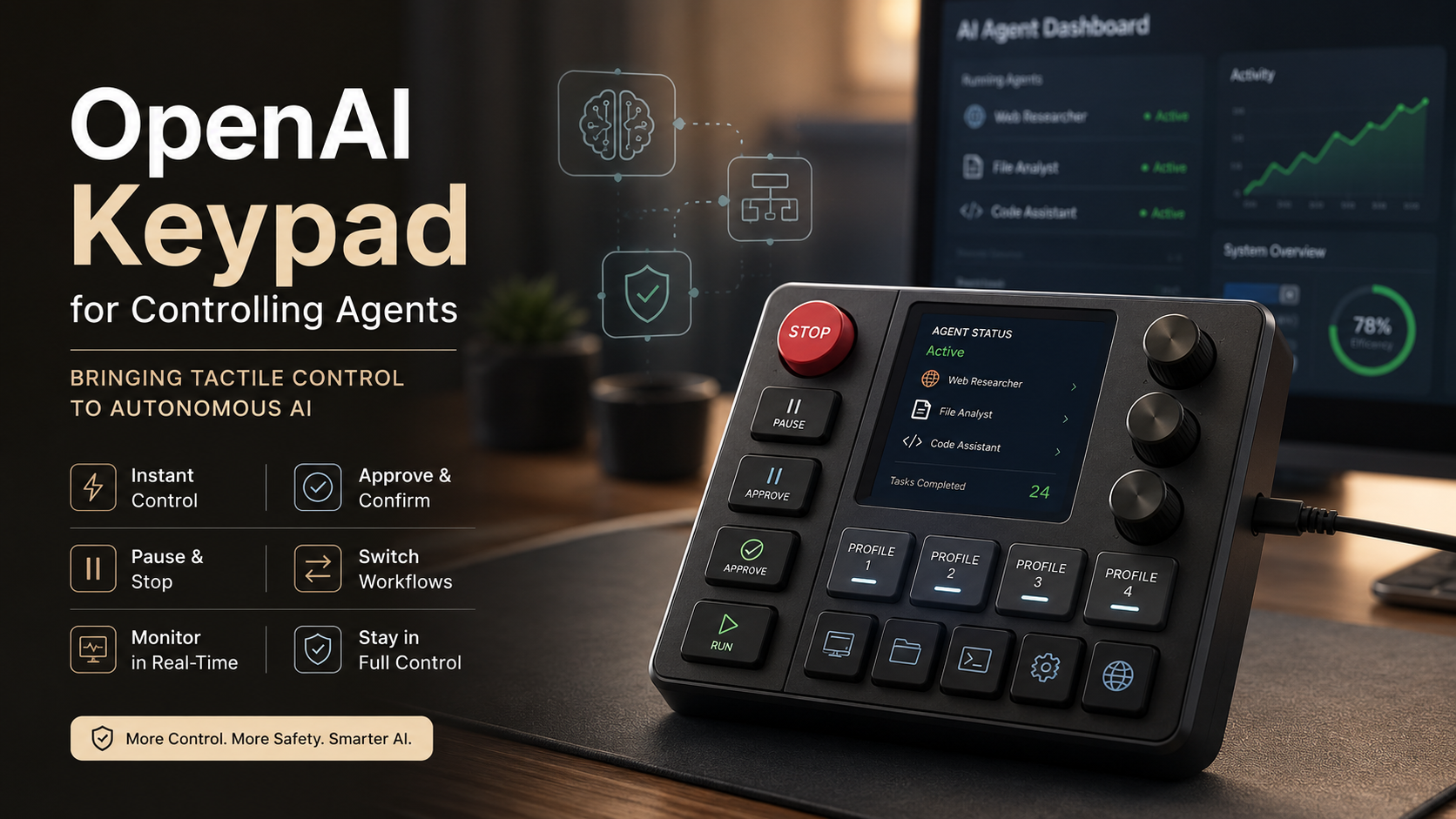
OpenAI Keypad for Controlling Agents: Bringing Tactile Control to Autonomous AI
The OpenAI keypad for controlling agents represents a new approach to managing autonomous AI workflows through physical hardware controls. As AI agents become more capable, users need faster and more reliable ways to monitor, approve, and guide automated actions.AI development continues to evolve through advanced models and agent-based systems, including technologies from OpenAI.
As these systems become more autonomous, users need better ways to monitor and control their actions. A concept like an OpenAI keypad for controlling agents introduces a new approach: combining AI software with a dedicated physical interface.
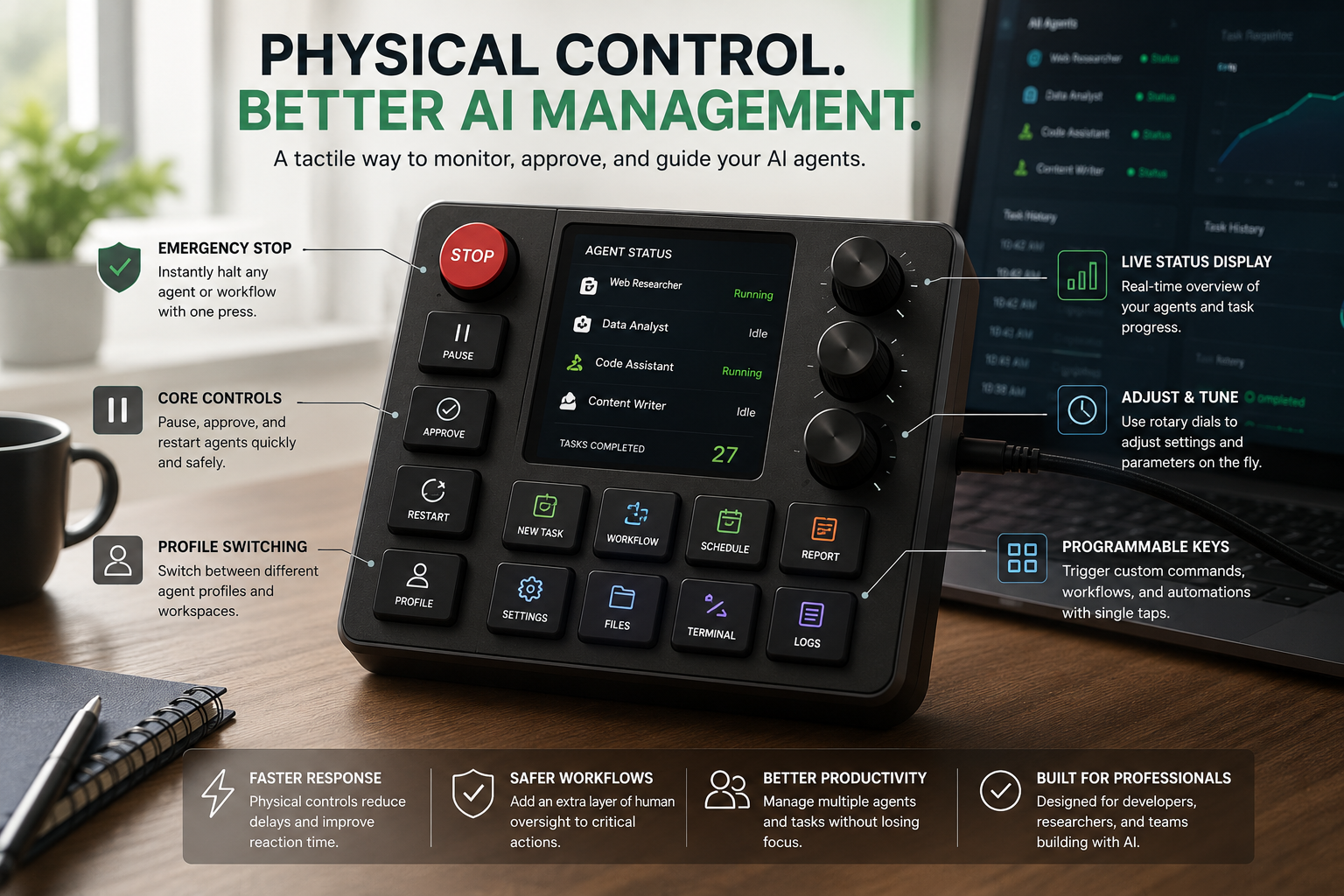
Instead of relying only on dashboards, browser tabs, or keyboard shortcuts, a physical controller could provide faster access to important commands. Users could pause tasks, approve actions, trigger workflows, or adjust settings with a single button press.
This type of hardware could improve the relationship between humans and AI agents. It creates a direct connection between digital automation and physical control.
A dedicated AI control device may become especially useful for developers, researchers, and businesses managing multiple autonomous workflows.
In this article, we explore how an AI keypad could work, why physical controls matter, and how tactile hardware may shape the future of agent management.

Who Owns 51% of OpenAI?
OpenAI does not have a traditional ownership structure where one company or individual owns exactly 51% of the organization. Instead, OpenAI operates through a unique structure that combines a nonprofit organization with a commercial entity.
The nonprofit side of OpenAI maintains control over the company’s mission and long-term direction. Its board oversees important decisions related to safety, research priorities, and responsible artificial intelligence development.
This structure was created to ensure that AI progress focuses on broad human benefits rather than only financial returns. Unlike many technology companies, OpenAI’s governance model does not rely on a single majority shareholder controlling all decisions.
Microsoft is one of OpenAI’s largest strategic partners and has invested billions of dollars into the company. However, Microsoft does not own 51% of OpenAI. Its relationship with OpenAI is based on investment, cloud infrastructure support, and technology collaboration.
The Unique Nonprofit Governance Model
OpenAI’s nonprofit foundation plays a central role in maintaining oversight of its artificial intelligence development. The board has authority over major decisions and helps guide how advanced AI systems are created and deployed.
This governance approach aims to balance two important goals: innovation and safety. Building powerful AI requires significant resources, but responsible development requires careful planning and strong safeguards.
The nonprofit structure helps prevent short-term business goals from becoming the only priority. It allows OpenAI to consider wider social impacts, including privacy, security, and responsible AI adoption.
Key elements of this model include:
- Mission-focused oversight: The nonprofit board protects OpenAI’s original mission.
- Safety considerations: AI development includes research into risks and limitations.
- Responsible deployment: Systems are released with safeguards designed to reduce harmful use.
As AI agents become more capable, governance models like OpenAI’s will continue to influence how society manages advanced technology.
What Is an OpenAI Code Agent?
An OpenAI code agent is an advanced AI-powered software system designed to help developers write, debug, test, and manage code with minimal manual effort. These AI agents use large language models to understand natural language instructions and convert them into functional programming solutions across different projects and repositories.
Unlike traditional coding assistants that only provide suggestions, modern AI code agents can handle complete development workflows. They can analyze existing codebases, identify problems, create new features, generate tests, and suggest improvements. This allows developers to focus more on planning, reviewing, and making important technical decisions.
Code agents can integrate with development environments, version control platforms, and software tools. This enables them to work within real engineering workflows instead of operating as standalone chat systems.
Key capabilities of AI code agents include:
- Writing and explaining source code.
- Finding and fixing software bugs.
- Creating automated tests.
- Refactoring outdated code.
- Understanding large and complex codebases.
- Assisting with software development tasks.
By automating repetitive programming work, OpenAI code agents improve developer productivity and reduce the time required to complete software projects. They act as powerful assistants that help engineering teams build, maintain, and improve applications more efficiently.
The Evolution of Automated Software Engineering
The evolution of automated software engineering has transformed how developers build and maintain modern applications. Earlier automation tools focused on simple tasks, such as code completion and syntax suggestions. Today, advanced AI systems can understand project requirements, analyze existing architecture, and generate production-ready code.
Modern AI coding agents reduce the cognitive effort required for repetitive development tasks. They can review large codebases, recommend better design patterns, create unit tests, and assist with complex refactoring processes.
These capabilities are changing collaboration between junior and senior developers. New developers can learn faster by receiving real-time guidance, while experienced engineers can spend more time on architecture, strategy, and innovation.
AI-driven development tools now help connect business requirements with technical implementation. Developers can describe desired features in natural language, and AI agents can assist in turning those ideas into working software.
As these systems continue to improve, the role of developers is shifting. Instead of manually writing every line of code, engineers increasingly focus on directing AI tools, reviewing generated solutions, and ensuring software quality.
This shift represents a major step toward more efficient, collaborative, and intelligent software development workflows.
Why Did Elon Musk Leave OpenAI?
Elon Musk left the OpenAI board in February 2018. The primary reason cited was a possible conflict of interest with his work at Tesla, especially Tesla’s growing focus on artificial intelligence and autonomous driving technology.
At that time, Tesla was expanding its self-driving research and competing for top AI talent. Reports also described differences between Musk and other OpenAI leaders regarding the organization’s direction, research approach, and long-term strategy.
Musk originally helped establish OpenAI as a nonprofit research organization focused on ensuring that artificial general intelligence would benefit humanity. However, OpenAI later created a capped-profit structure to attract investment and access the computing resources needed for advanced AI development.
This transition reflected broader disagreements about how AI organizations should balance funding, openness, safety, and commercialization. Musk’s departure became part of a larger debate about the future of artificial intelligence governance and responsible AI development.
Divergent Visions on Artificial General Intelligence Safety
The discussion around artificial general intelligence (AGI) safety involves different perspectives on how advanced AI systems should be developed and controlled. Early leaders in the AI field often shared similar goals but differed on the best methods for achieving them.
One major debate focuses on open access versus controlled development. Some researchers argue that transparency and open research can improve safety by allowing more people to examine AI systems. Others believe advanced AI models require careful restrictions to reduce potential risks.
Commercialization has also become a key point of discussion. Building powerful AI systems requires significant computing resources, specialized talent, and long-term investment. Some organizations view commercial partnerships as necessary to continue AI research at a global scale.
At the same time, critics argue that commercial pressures can create challenges for transparency and safety practices. These discussions continue as AI systems become more capable and widely used across industries.
The debate highlights a central challenge in AI development: creating powerful technologies while ensuring they remain safe, reliable, and beneficial for society.
What Is an AI Keyboard?
An AI keyboard is a software application or smart typing tool that uses artificial intelligence to improve how people write and communicate. Unlike traditional keyboards, these tools use AI models to understand user input and provide helpful features such as autocomplete suggestions, grammar corrections, text predictions, and rewriting options.
In addition, AI-powered keyboards can understand context and adapt to different writing styles. They can help users draft emails, create messages, improve sentences, and generate content without switching between multiple applications.
Moreover, AI keyboards are available on smartphones, tablets, and desktop devices. Many of them integrate directly into messaging apps, productivity tools, and browsers. As a result, users can access AI assistance while typing and complete writing tasks more efficiently.
Common features of AI keyboards include:
- Smart text suggestions based on writing patterns.
- Grammar and spelling improvements for clearer communication.
- Instant rewriting tools to adjust tone or writing style.
- Content generation assistance for messages, emails, and notes.
- Context-aware recommendations based on conversations or documents.
Overall, AI keyboards combine traditional typing with artificial intelligence to create a smarter productivity experience. They help users write faster, communicate more effectively, and reduce the effort required for everyday digital tasks.
Boosting Productivity With Smart Text Generation
Smart text generation has become one of the most valuable features in modern AI keyboards. Through these capabilities, users can create, edit, and improve written content directly from their typing interface. Instead of manually rewriting sentences or correcting mistakes, users can rely on AI-powered suggestions for faster communication.
For example, professionals often use these tools to draft emails, summarize information, and adjust messages for different audiences. Additionally, an AI keyboard can help make a message more professional, friendly, or concise within seconds.
Because of this flexibility, these features are especially useful for people who write frequently throughout the day. Business users, students, content creators, and customer support teams can save time by reducing repetitive writing tasks.
Furthermore, modern AI keyboards can improve accuracy by identifying spelling mistakes, suggesting better wording, and predicting the next words in a sentence. Consequently, users experience smoother writing across different platforms.
As artificial intelligence continues to develop, smart text generation is becoming a practical everyday tool. Ultimately, it helps users communicate faster while maintaining better quality and consistency in their digital conversations.
Is There a ChatGPT Keyboard?
Currently, OpenAI has not released an official physical keyboard branded as a ChatGPT keyboard for desktop computers. However, several software and hardware solutions provide similar functionality by allowing users to access AI assistants directly while typing.
For instance, third-party developers have created AI keyboard applications, software extensions, and programmable hardware devices that connect with conversational AI tools. Through these solutions, users can generate text, improve writing, create prompts, and automate repetitive tasks.
Similarly, many AI keyboard apps on mobile devices integrate language models directly into the typing experience. Therefore, users can access AI features inside messaging apps, email applications, and other writing platforms without opening a separate chatbot window.
Common ways users create a ChatGPT-style keyboard experience include:
- Mobile AI keyboard apps with built-in writing assistants.
- Desktop software tools that add AI features to existing keyboards.
- Programmable macro devices that trigger custom AI commands.
- API-based integrations that connect AI models with personal workflows.
As demand for AI-powered productivity tools grows, developers continue exploring ways to combine traditional keyboards with intelligent assistants. Ultimately, these solutions bring conversational AI closer to everyday writing and make digital communication more efficient.
Exploring Custom Hardware and Software Integrations
Beyond software solutions, custom hardware and software integrations allow users to create personalized AI-powered workflows. Programmable devices, shortcut tools, and automation platforms can connect with AI systems to complete specific tasks quickly.
For example, many advanced users create custom setups by assigning physical buttons or keyboard shortcuts to common AI commands. With a single key press, users can open an AI assistant, generate a writing prompt, summarize text, or start an automated workflow.
Additionally, these integrations are especially useful for professionals who perform repetitive digital tasks. Developers, writers, designers, and business users can customize their tools based on their daily requirements.
Benefits of AI keyboard integrations include:
- Faster access to AI assistants.
- Reduced repetitive manual actions.
- Personalized productivity workflows.
- Improved efficiency across applications.
By combining programmable hardware with AI software, users can build flexible command centers that match their working style. In this way, these systems represent the growing connection between traditional computing accessories and advanced artificial intelligence tools.
As AI technology continues to evolve, custom keyboard integrations may become a more common way for people to interact with digital assistants. Therefore, the future of typing may involve closer collaboration between users, keyboards, and intelligent AI systems.