
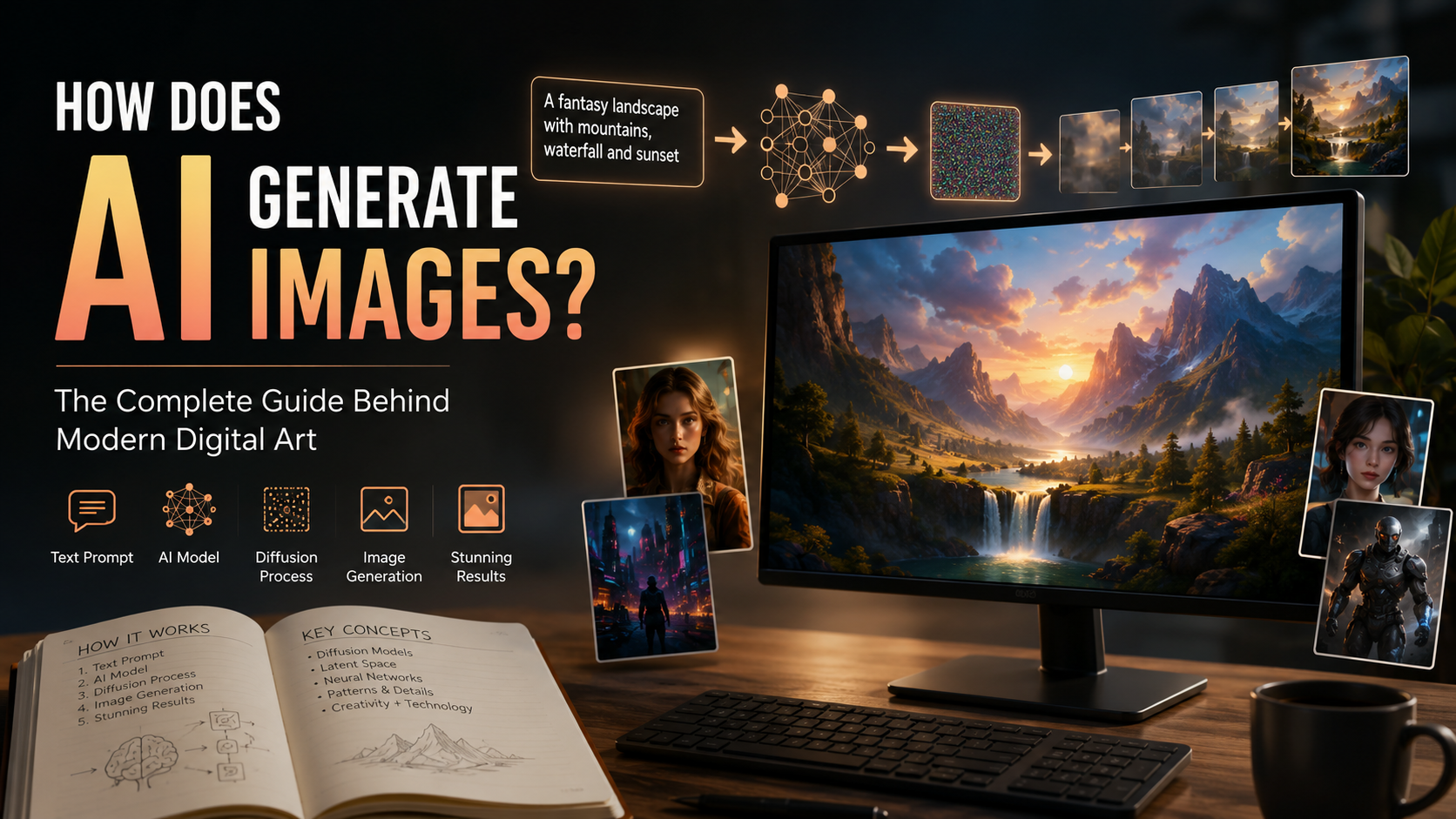
How Does AI Generate Images: The Complete Guide Behind Modern Digital Art
How Does AI Generate Images? It starts with a simple text prompt and ends with a detailed digital image within seconds. Modern AI image generators have transformed digital creation. They allow almost anyone to create illustrations, portraits, concepts, and realistic scenes with simple instructions.
Understanding how does AI generate images can help you use these tools more effectively. It can also help you judge whether an image is authentic or AI-generated. As creative platforms evolve through research from pioneers like OpenAI, knowing the mechanics behind synthetic media becomes essential for creators and casual observers alike. Exploring the best AI tools for image generation can also help creators understand the capabilities of modern image-generation platforms.
Modern systems use machine learning models trained on large collections of images and related information. These models learn patterns involving objects, colors, shapes, textures, composition, and visual styles.
This guide explains how AI image generation works in simple terms. It also covers how AI creates people, what the so-called 30% rule actually means, what AI images look like, and how to spot synthetic visuals online.

How Does AI Generate Images From Text Prompts?
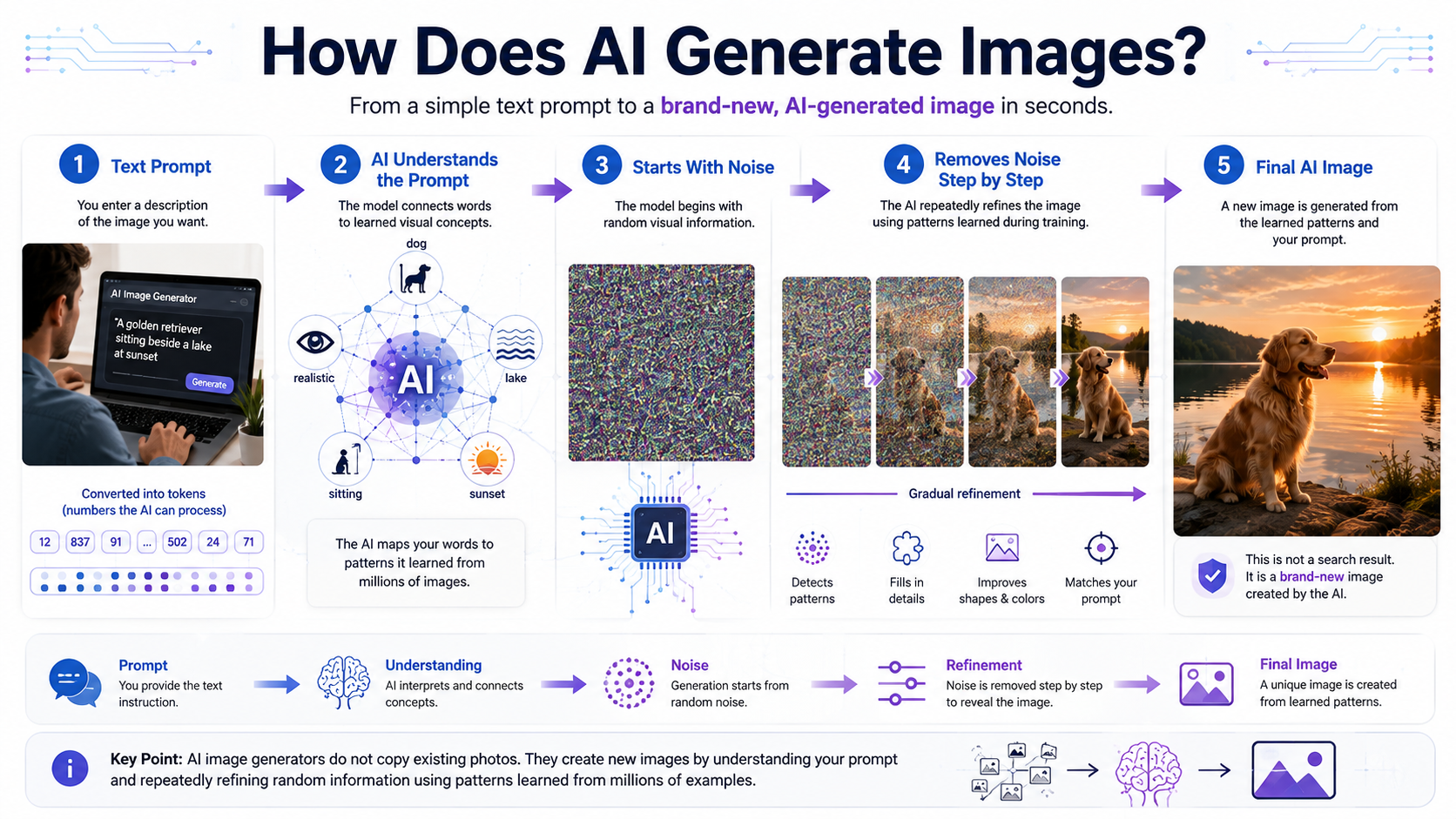
AI image generation usually starts with a text prompt. You describe what you want, and the model converts that description into information it can process. The system then uses learned relationships between language and visual patterns to create an image.
Many modern image generators use diffusion models or related generative architectures. During training, these models learn how images can be represented and how visual features relate to text descriptions.
During generation, the model typically begins with random noise or another starting representation. It then repeatedly transforms that representation toward an image that matches the prompt.
For example, a prompt such as “a golden retriever sitting beside a lake at sunset” gives the model several concepts. It must combine the dog, lake, lighting, environment, and composition into one coherent result.
The final image is produced after multiple computational steps. More advanced systems can also follow instructions about style, aspect ratio, composition, and image editing.
Understanding the Diffusion Process Behind AI Images
The diffusion process is central to many modern AI image generators. The basic idea involves learning how to reverse a controlled process that adds noise to images.
During training, an image can be gradually corrupted by adding different amounts of noise. The model learns patterns that help it predict how the original visual information can be recovered.
When generating an image, the process works in the opposite direction. The model starts from noisy information and repeatedly predicts a cleaner version.
At each step, the system uses the prompt to guide the generation toward the requested concepts. Thousands of mathematical operations may occur during this process, depending on the model and settings. This step-by-step process helps explain how does AI generate images from simple text prompts into detailed visual results.
The result is not usually a photograph retrieved from a database. Instead, the model generates a new visual arrangement based on patterns it learned during training, using approaches that differ from other generative architectures such as generative adversarial networks (GANs).
This process explains why AI-generated images can look highly detailed while still containing unusual details, especially when the prompt involves complicated objects or scenes.
How Does AI Generate Images of People?
Generating realistic people is a challenging task because human faces and bodies contain many interconnected details. AI models learn visual patterns involving facial features, skin, hair, clothing, poses, lighting, and backgrounds.
When you ask an AI image generator for a portrait, it does not normally look up a photograph and simply copy it. Instead, it generates visual information based on patterns learned during training.
The model represents information in a mathematical latent space. This representation allows it to create relationships between different visual concepts. A prompt can therefore influence characteristics such as age, clothing, pose, expression, and environment.
Realistic people also require consistent proportions. The model must generate features that work together across the entire image.
However, AI-generated people are not always anatomically perfect. Problems can still appear in hands, fingers, teeth, eyes, ears, jewelry, and complex poses.
Modern models have improved considerably, but they do not use a simple database of human anatomy to check every generated pixel. Their results come primarily from learned patterns and the model’s generation process.
What Is the 30% Rule in AI?
The 30% rule in AI is often described online as a copyright guideline. It supposedly claims that changing or adding at least 30% of an AI-generated or existing work can create a new copyrightable work.
However, there is no universal 30% copyright rule that automatically determines whether an AI-generated image is protected. Copyright law generally does not work by applying a fixed percentage of changes.
Instead, copyright protection depends on the laws of the relevant country and the specific circumstances. Human creativity and authorship can be especially important when evaluating AI-assisted work.
For example, simply entering a prompt may not provide enough human creative control in some jurisdictions. By contrast, substantial human editing, arrangement, or other creative contributions may support a copyright claim.
The legal treatment of AI-generated content continues to develop. Different countries and courts may reach different conclusions.
Therefore, creators should not rely on a “30% rule” as a guaranteed legal test. For important commercial or legal questions, consult a qualified copyright professional in the relevant jurisdiction.
Copyright and Legal Issues Surrounding AI-Generated Images
Copyright and AI image generation remain complicated areas of law. The key question is often not simply whether AI created an image. It can also involve how much human creativity contributed to the final work.
In the United States, for example, the U.S. Copyright Office has stated that copyright protects human-authored expression. Purely AI-generated material may therefore face limitations when someone seeks copyright protection.
Human involvement can change the analysis. An artist might substantially edit an AI-generated image, combine it with original artwork, select and arrange elements creatively, or use AI as one part of a larger creative process.
The legal situation differs internationally. Some countries have different standards and approaches to AI-assisted works.
Creators should also consider other legal issues. These can include trademarks, publicity rights, privacy, licensing terms, and the use of copyrighted training material.
Because the rules continue to evolve, avoid treating general online claims as legal advice. Always check the current law and platform terms before using AI-generated images commercially.
What Do AI-Generated Images Look Like?
AI-generated images can look almost identical to photographs, illustrations, or professionally designed artwork. Their appearance depends heavily on the model, prompt, settings, and editing process.
Some generated images have a polished or cinematic appearance. Others can closely reproduce the visual characteristics of photography, painting, animation, or graphic design.
Older image generators often produced obvious problems. These included strange hands, distorted faces, unreadable text, and unnatural objects.
Modern systems have improved significantly. As a result, visual clues are becoming less reliable. An image that looks “too perfect” is not automatically AI-generated.
You may still notice unusual details in some synthetic images. These can include inconsistent reflections, strange background objects, incorrect text, unusual fingers, or impossible physical relationships.
However, none of these signs proves that an image was created by AI. Human-created photographs can also contain unusual artifacts, editing mistakes, or compression problems.
The safest approach is to combine visual inspection with source verification, reverse image searches, provenance information, and reliable context.
How to Recognize Fake AI-Generated Images?
Recognizing AI-generated images and deepfakes requires more than looking for strange hands. Modern generators can produce highly convincing faces and realistic scenes.
Start by examining areas that contain fine details. Hands, fingers, teeth, ears, jewelry, signs, and small background objects can sometimes reveal inconsistencies.
Next, check whether lighting and shadows make physical sense. Look for reflections that do not match their surroundings or objects that appear to have conflicting light sources.
Text can also provide useful clues. AI-generated signs, labels, logos, and documents may contain misspelled or nonsensical characters. However, newer models are becoming much better at rendering text.
You can also inspect the image’s origin. Ask where it first appeared, who posted it, and whether a trustworthy source confirms the event or subject.
Useful checks include:
- Reverse image search to find earlier versions or related images.
- Metadata inspection when metadata is available.
- Content provenance information when supported.
- Context verification through reputable sources.
- AI detection tools as supporting evidence, not definitive proof.
No single method is completely reliable. Combining several checks provides a stronger assessment.
Using Reverse Image Search and Metadata to Verify Images
Reverse image search can help investigate suspicious images. Tools such as Google Lens and TinEye can sometimes identify earlier appearances, related images, or websites that published the same visual.
However, reverse image search is not a foolproof AI detector. A newly generated image may have no searchable history. An edited image may also produce incomplete or misleading results.
Metadata can provide additional information about a file. Depending on how the image was created or downloaded, metadata might contain details about software, dates, or other technical information.
Metadata also has important limitations. Social media platforms often remove metadata during upload. Users can also modify or remove metadata themselves.
Some AI systems and content platforms support provenance technologies or credentials. These can provide stronger information about an image’s creation and editing history when available.
AI detection tools can also be useful, but their results should not be treated as definitive. Detection accuracy varies across models, image types, compression levels, and editing methods.
For important claims, combine technical checks with source verification and contextual evidence.
Frequently Asked Questions
What is a text prompt in generative media?
A text prompt is a written instruction or description that you type into an application to guide the creation of digital visuals. It acts as a direct command, telling the neural network what subjects, styles, colors, and compositions to include in the final output. Crafting effective prompts requires descriptive vocabulary, clear subject placement, and specific stylistic keywords to achieve the desired artistic result.
Can generative models create videos as well as pictures?
Yes, advanced video generation models have evolved rapidly, allowing users to create moving sequences from simple text prompts or static reference pictures. These systems apply similar diffusion principles across sequential frames to maintain temporal consistency, realistic motion, and smooth transitions over time. This technology is transforming filmmaking, animation, and digital marketing by drastically reducing production timelines for content creators.
Why do early models struggle with human hands?
Early neural networks struggled with human hands because hands appear in countless varied positions, angles, and overlapping configurations within training data. Unlike rigid objects, hands lack a fixed geometric structure, making it difficult for algorithms to predict correct joint placements and finger counts. Modern architectures have significantly improved through targeted dataset training and specialized anatomy-checking layers.
Are synthetic pictures copyrighted by the creators?
Copyright offices in many jurisdictions currently rule that purely algorithmic creations without significant human artistic intervention cannot receive copyright protection. Because the machine generates the output autonomously from a prompt, the law often views the work as lacking human authorship. However, if an artist heavily edits, paints over, or combines the output with original work, copyright eligibility increases significantly.
Conclusion
Understanding how does AI generate images makes modern visual technology easier to use and evaluate. Most systems rely on learned relationships between text and visual information. Many modern generators use diffusion-based processes to transform noise into detailed images.
AI can now create realistic people, landscapes, illustrations, product concepts, and many other visual styles. Yet realistic appearance does not guarantee authenticity.
When evaluating an image, inspect its details and investigate its source. Reverse image searches, metadata, provenance information, and detection tools can all provide useful clues. None should be treated as perfect on its own.
It is also important to avoid outdated claims, such as the idea that changing 30% of an image automatically creates copyright protection. AI copyright law remains complex and continues to develop.
As generative technology advances, critical thinking and source verification will become increasingly important. Understanding how these systems work helps creators use them responsibly and helps viewers make better judgments about what they see online.
For a broader understanding of synthetic media, learning the clear signs a video is AI-generated can also help viewers identify manipulated or artificially created content.