
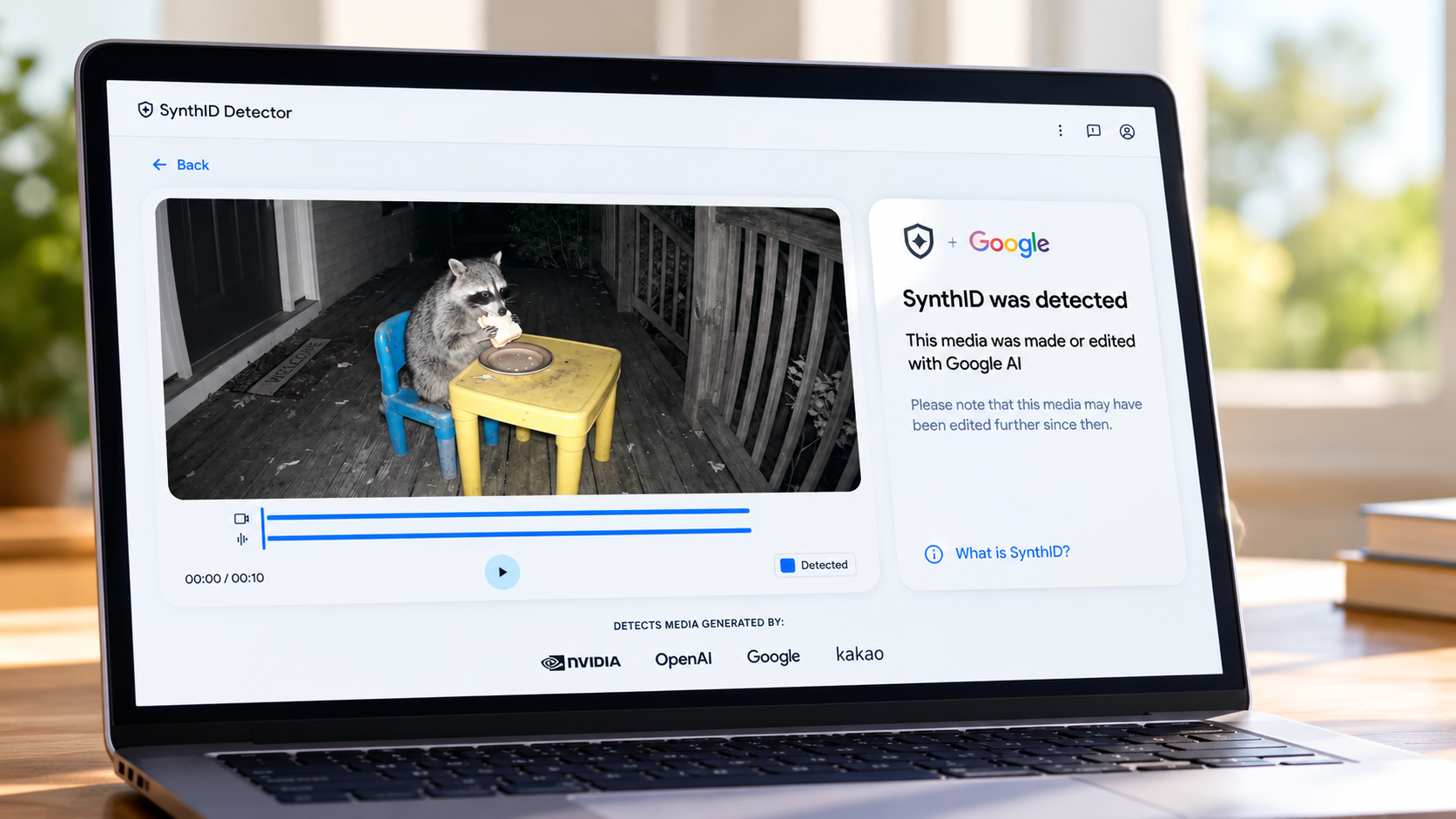
How the New Google AI Detector Website Changes Digital Content
Artificial intelligence now makes it easier to create text, images, audio, and videos at scale. However, identifying AI-generated content remains a challenge. Google’s SynthID Detector offers a way to check supported media for invisible digital watermarks. The tool helps users investigate whether certain content was created using AI. Google expanded public access to the SynthID Detector in October 2026.
The Google AI detector is relevant to publishers, SEO professionals, journalists, and everyday internet users. It provides additional context when checking digital media. However, it cannot identify every piece of AI-generated content. Its results depend on whether supported watermarking technology was used.
Website owners also need to understand how AI-generated content affects search rankings. Google does not automatically penalize content simply because AI helped create it. Instead, its policies focus on originality, usefulness, accuracy, and compliance with spam guidelines.
This guide explains how Google detects AI-generated content, how SynthID watermarking works, and how to use the detector. It also explores Google Search’s AI Overviews and explains what website owners should know about SEO.


Does Google Detect AI-Generated Content?
Yes, Google uses systems to identify AI-generated media and detect spam across its services. However, these are different processes. The SynthID Detector checks supported media for digital watermarks, while Google Search uses ranking and spam-detection systems to evaluate web pages. To understand the technology behind these tools, explore what generative AI is and how it creates new content.
According to Google Search Central, using AI to create content is not automatically against its guidelines. The main concern is whether publishers produce helpful, original content or generate large volumes of pages primarily to manipulate search rankings.
Google’s ranking systems evaluate the usefulness and relevance of web pages. Publishing AI-generated articles without meaningful research, original insights, or editorial review can create quality problems. Such content may perform poorly in search results.
The important distinction is that AI detection and SEO evaluation serve different purposes. A watermark can provide evidence of AI involvement, but it does not establish whether an article is accurate, useful, or suitable for publication.
How SpamBrain Targets Low-Quality Automation
Google uses SpamBrain, an AI-based spam prevention system, to help identify websites that violate its spam policies. It can help detect scaled content abuse, including situations where publishers create large amounts of unoriginal content to manipulate search rankings.
However, SpamBrain does not simply penalize every website that uses automation. Google’s policies focus on the purpose and value of published content, regardless of how it was produced.
To reduce SEO risks, publishers should review AI-assisted articles carefully before publishing them. Check facts, add relevant examples, include original insights, and remove repetitive passages. Make sure each article answers the reader’s actual question.
Google also encourages publishers to demonstrate experience, expertise, authoritativeness, and trustworthiness, commonly known as E-E-A-T. These qualities help guide content evaluation, although E-E-A-T is not a single direct ranking factor. Useful content should provide clear answers, reliable information, and meaningful value beyond what existing pages already offer.
Is It Possible to Detect AI-Generated Content?
Yes, but detection accuracy depends on the method and the content being examined. Some tools analyze writing patterns and estimate whether a passage resembles machine-generated text. Others look for digital watermarks or content provenance information. For another perspective on synthetic media, explore how deepfake technology works and how to detect it.
Traditional AI text detectors may examine statistical patterns, including how predictable words and phrases appear. These methods can produce false positives, incorrectly labeling human-written content as AI-generated. They can also miss AI-written text that has undergone substantial editing.
Digital watermarking offers another approach. Instead of relying only on writing style, a detector searches for a signal embedded during content generation. Google’s SynthID technology uses this method across supported media formats.
A Google AI detector based on SynthID therefore works differently from a general-purpose text classifier. It looks for evidence associated with supported watermarking systems rather than deciding authorship solely from how content reads.
However, no detection method provides complete certainty in every situation. A positive result can support an assessment of AI involvement, while a negative result does not prove that humans created the content.
The Role of SynthID Watermarking
Google DeepMind developed SynthID to embed imperceptible digital watermarks into AI-generated content. The technology supports images, audio, video, and text. These watermarks are designed to remain detectable even when content undergoes certain common transformations.
For images, SynthID embeds information into the image itself. audio and video, it uses watermarking methods suited to those media. For text, the system modifies token-selection probabilities during generation to introduce a detectable signal without significantly changing the meaning. To understand how AI creates visual content in the first place, read how AI generates images.
Unlike ordinary metadata, an embedded watermark does not rely solely on a separate file label. This can make it more resilient when content is shared or edited.
However, SynthID is not foolproof. Extensive rewriting, translation, or other transformations can reduce detection confidence, particularly for text. Its effectiveness also depends on whether the content contains a compatible watermark.
The SynthID Detector helps users check supported content for these signals. It should be treated as a verification aid rather than a universal AI detection system.
How to Use Google AI Detector?
Using Google’s SynthID Detector involves submitting supported media for verification. The tool is designed to help users investigate whether content contains a SynthID watermark. Its current public rollout focuses on images, video, and audio, including supported content from Google AI and participating partners.
Follow these steps:
- Open the official detector: Access Google’s SynthID verification platform through its official website.
- Choose your media: Select a supported image, video, or audio file you want to investigate.
- Upload the file: Follow the platform’s instructions to submit your content for analysis.
- Review the results: Check whether the detector identifies a SynthID watermark and whether it highlights specific portions of the media.
- Interpret the findings carefully: Treat the result as evidence of possible AI involvement, not definitive proof of the entire content’s origin.
The detector’s supported formats and capabilities may change over time. Do not assume that every text passage, file type, or AI-generated item can be checked.
Best Practices for Accurate Scanning
The quality of your input can affect how useful a verification result is. Whenever possible, use the original file rather than a heavily edited, compressed, or shortened version. Avoid unnecessary transformations before uploading the content.
For images and videos, retain the highest-quality source available. For audio, use a clear recording with minimal processing. Follow the detector’s current file-size, format, and upload requirements. When checking suspicious footage, compare the detector’s findings with clear signs that a video is AI-generated.
Remember that a detector can only identify watermarks it supports. Content created using an incompatible AI tool may not produce a positive result. Likewise, extensive editing can weaken or remove detectable signals.
Do not interpret a negative result as proof that a person created the media. It only means the detector did not establish the presence of a detectable watermark under the conditions tested.
For text, check whether the current interface explicitly supports text analysis before attempting to submit a passage. A reliable verification process combines technical results with source checks, publication history, and contextual evidence. This approach is more dependable than trusting a single detector score.
Are Google Searches All AI Now?
No, Google Search still includes traditional organic results alongside AI-powered features. Depending on the query, users may see AI Overviews, website links, local results, shopping listings, videos, and other search features.
AI Overviews provide summarized answers for certain searches. They use generative AI to help users understand topics and explore information more quickly. Their appearance depends on the query and Google’s search systems.
Traditional organic listings remain important. Websites can continue attracting visitors through relevant content, useful resources, and strong SEO fundamentals. Search results may also include links to sources referenced by AI-generated summaries.
The presence of AI Overviews does not mean every search uses a generated answer. Nor does it mean Google has stopped directing users to websites.
Users may also have access to search filters that emphasize particular result types. Available filters and their placement can vary by device, location, and search interface.
For publishers, the practical response is to create content that answers questions clearly and provides information worth exploring further. Original research, accurate explanations, and relevant examples can help distinguish a page from a generic summary.
Balancing AI Overviews and Organic Links
Google’s AI Overviews are designed to help users explore complex questions and discover relevant information. They can summarize key points while providing links to sources for further reading. However, the way these summaries appear can affect how users interact with traditional search results.
Website owners should not assume that appearing in an AI Overview guarantees more traffic. Some users may click through to cited sources, while others may find the summary sufficient. The outcome depends on the query, the information provided, and the user’s needs.
To improve visibility, continue applying established SEO practices. Organize articles with descriptive headings, answer important questions directly, and support claims with reliable sources. Include original examples, useful comparisons, and practical details that generic summaries may not provide.
Avoid publishing multiple near-identical pages simply to target slight variations of the same keyword. Google’s spam policies warn against scaled content created primarily to manipulate search rankings.
Ultimately, useful, original, people-first content remains central to sustainable SEO. AI search features may change how people discover information, but accuracy, relevance, and reader value remain essential.