
How to Help Sensory-Sensitive Students Succeed in School
Learning how to help sensory-sensitive students starts with understanding how classroom environments can affect them. Classrooms are busy spaces filled with bright lights, noisy hallways, moving desks, and constant social activity. While many learners handle these inputs easily, some neurodivergent students can become overwhelmed by sensory stimuli.
Understanding neurodiversity helps educators and caregivers create spaces that respect individual needs. Supporting sensory-sensitive students requires patience, careful observation, and practical environmental adjustments. According to guidance from the Child Mind Institute, sensory processing challenges can occur when the nervous system has difficulty receiving and responding to sensory information.
Every child responds to sound, texture, movement, and light differently. Some students withdraw when noise increases, while others seek intense movement to stay alert. Recognizing the difference between sensory overload and sensory seeking is essential.
This guide explores practical ways to support sensory-sensitive students. It covers calming techniques, sensory-seeking behavior, early signs, and sensory processing stages. These strategies can help educators create classrooms where students feel safer, calmer, and ready to learn.

How to calm a sensory-seeking child?
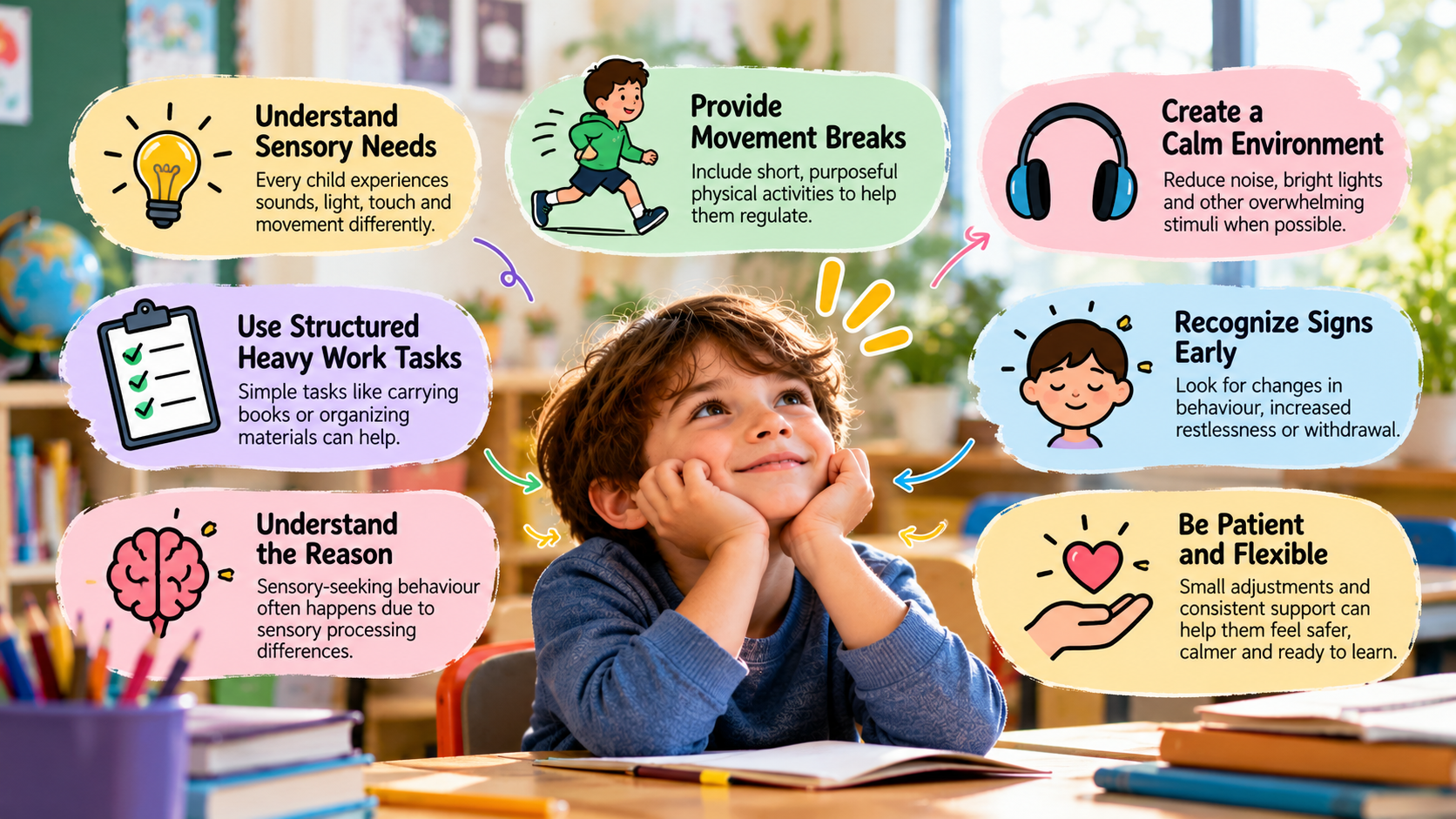
Calming a sensory-seeking child starts with providing structured sensory input rather than demanding immediate stillness. Sensory-seeking students may move, jump, touch objects, or make repetitive movements because they need stronger input to feel organized and alert. Understanding how the brain processes sensory information can also help educators recognize these behaviors, as explained in Classification of Human Brain: Structure & Stages.
Providing appropriate physical activities can help meet this need. Activities such as carrying books, pushing against a wall, pulling resistance bands, or squeezing a firm stress ball can provide useful proprioceptive input. These activities give the body predictable feedback.
Teachers can also build short movement opportunities into the school day. A student might deliver materials, organize classroom supplies, or complete another safe physical task before returning to academic work.
The goal is not to eliminate movement. Instead, the goal is to provide purposeful sensory input that supports regulation. Consistent routines can help students understand when movement is appropriate and make transitions into learning easier.
Use Structured Heavy Work Breaks
Schedule short heavy work breaks before activities that require extended sitting or concentration. Simple classroom tasks can provide useful physical input without disrupting learning.
Students might wipe tables, stack lightweight chairs, carry books, push a sturdy object, or organize classroom materials. These activities engage muscles and joints while giving the student a structured reason to move.
Some students may also benefit from tools such as resistance bands attached safely to a chair. A weighted lap pad may help certain students, but it should be used appropriately and with professional guidance when needed.
Keep these breaks predictable. For example, offer a short movement activity before reading, mathematics, or another demanding lesson.
Observe how the student responds. If the activity makes the student more restless, reduce the intensity or try a different strategy.
The purpose is regulation, not punishment or exhaustion. Structured movement can help educators help sensory-sensitive students transition from physical activity to focused classroom participation.
What causes kids to be sensory-seeking?
Sensory-seeking behavior can occur when a child actively looks for stronger or more frequent sensory experiences. The behavior is not necessarily deliberate defiance or poor discipline. Instead, the child may be trying to reach a comfortable level of alertness.
Some children may seek movement, touch, pressure, sound, or visual stimulation. They might spin, bounce, chew objects, crash into cushions, or constantly touch classroom materials.
Sensory processing differences can occur alongside conditions such as autism or ADHD, although sensory-seeking behavior alone does not establish a diagnosis. Children can also have different sensory preferences without having a specific developmental condition.
A student who appears constantly active may be trying to regulate their attention. Another student may seek strong pressure because it feels organizing or calming.
Understanding the purpose behind the behavior helps educators respond more effectively. Instead of immediately stopping safe sensory behaviors, consider what input the student may be seeking. Then provide an appropriate and structured alternative that supports classroom participation and helps create a more supportive learning environment, similar to approaches discussed in How to Make Students Feel Valued in Modern Classrooms.
The Role of Neurological Under-Responsiveness
Under-responsiveness occurs when a child may not notice or react to sensory information as readily as others. This can make ordinary classroom input feel insufficient for maintaining alertness.
A student may therefore seek additional movement, pressure, or other sensory experiences. They might rock in their chair, tap objects, move around the classroom, or frequently touch nearby materials.
These behaviors can sometimes help the student become more alert and organized. However, the specific sensory need differs from child to child. A strategy that helps one student may overwhelm another.
Teachers should observe patterns rather than making assumptions. Look at when the behavior occurs, what happens immediately before it, and whether the behavior changes after sensory input.
Providing safe movement opportunities can sometimes support attention during instruction. Classroom jobs, brief stretching, resistance activities, and movement breaks are possible options.
If sensory needs significantly affect daily functioning, educators and caregivers can seek guidance from an occupational therapist or another qualified professional. Individual assessment is important because sensory processing needs are not identical for every child.
What are some calming techniques for sensory overload?
Calming techniques for sensory overload should focus on reducing stimulation and restoring a sense of safety. Overload can happen when sensory input becomes too intense or difficult for a student to manage.
Start by identifying and reducing obvious triggers. Teachers might lower harsh lighting, reduce unnecessary classroom noise, or move the student away from a crowded area. Noise-reducing headphones may also help some students.
Use a calm voice and simple instructions. During intense distress, avoid lengthy explanations or repeated questions. The student may not be ready to process complex language while overwhelmed.
Slow breathing can also support relaxation. Visual prompts, such as pretending to blow bubbles, can make breathing exercises easier for younger students.
Some students may benefit from predictable pressure or calming sensory tools. However, physical contact should never be forced, and weighted products should be used carefully.
The most effective approach is individualized. Watch for early signs of overload and respond before distress becomes severe. A consistent plan can help students return to learning without treating sensory overload as deliberate misbehavior, while also supporting the confidence students need to participate in class. Strategies for building confidence in students can complement these classroom approaches.
How to help a child with sensory sensitivity?
To help sensory-sensitive students, start by identifying the specific sounds, textures, movements, lights, or situations that cause discomfort. Sensory sensitivity means ordinary input may feel unusually intense or difficult for some students.
Create an environment where students can communicate discomfort without embarrassment. Simple choices can help. For example, a student might choose between different seating options or use headphones during particularly noisy activities. Creating a classroom where students feel respected and heard is also central to making students feel valued in modern classrooms.
Environmental adjustments can also make classrooms more comfortable. Consider reducing harsh lighting, allowing flexible seating, or providing advance warnings before loud events. Transitions to cafeterias, assemblies, playgrounds, or fire drills may require additional preparation.
Avoid assuming that every sensory-sensitive student needs the same accommodations. One child may struggle with noise, while another may react strongly to touch or bright light.
Teachers can work with families and qualified professionals when sensory difficulties interfere with participation. An occupational therapist may help identify appropriate strategies.
The goal is not to remove every sensory challenge. Instead, educators should reduce unnecessary barriers while helping students participate safely and confidently in everyday school activities.
Provide Anticipatory Warnings and Adaptive Tools
Advance warnings can help sensory-sensitive students prepare for changes in their environment. Sudden transitions may be particularly difficult when they involve loud sounds, crowded spaces, or unfamiliar activities.
Tell students before a fire drill, assembly, cafeteria transition, or other noisy event. Visual schedules and countdowns can make upcoming changes easier to understand.
Adaptive tools may also reduce unnecessary discomfort. Depending on the student’s needs, options can include noise-reducing headphones, desk dividers, flexible seating, seamless clothing, or personal volume adjustments. When students use digital devices as part of their learning, educators should also consider cyber safety for students to support safe participation in technology-rich classrooms.
Introduce one accommodation at a time when possible. This makes it easier to determine whether the tool actually helps.
Students should also have an appropriate way to communicate when something feels overwhelming. A simple hand signal, visual card, or agreed-upon phrase can work well.
Remember that accommodations should support participation rather than isolate the student. Discuss strategies with families and relevant professionals when sensory difficulties are persistent.
Small environmental changes can protect a student’s attention and reduce unnecessary stress. They can also help students become more independent in managing their sensory needs.
What age do sensory issues start?
Sensory differences can become noticeable during infancy and early childhood, although the timing varies considerably between children. Some signs may appear during feeding, bathing, dressing, movement, or responses to everyday sounds.
A baby may strongly react to certain textures or become distressed around particular sounds. A toddler may resist hair washing, dislike specific clothing materials, or react strongly to movement.
As children enter preschool, sensory demands often increase. Group activities, playground equipment, classroom noise, and unfamiliar textures can reveal difficulties that were less obvious at home.
However, these behaviors do not automatically indicate a sensory processing disorder or another diagnosis. Many children have temporary sensitivities or individual preferences.
Parents and educators should focus on patterns and functional impact. Consider whether sensory responses consistently interfere with eating, sleeping, dressing, communication, learning, or participation. Tracking these patterns over time can also help educators understand changes in student performance and identify areas where additional support may be needed.
Early observation can help families discuss concerns with appropriate professionals. When support is needed, individualized assessment can guide useful strategies.
The most important step is to avoid labeling a child based on one behavior. Look at the broader pattern and how sensory responses affect everyday activities.
What are the 5 stages of sensory processing?
Sensory processing describes how the nervous system receives, organizes, and responds to information from the environment and the body. Different professional frameworks describe these processes in different ways, so the five-stage model should not be treated as a universal clinical standard.
One simplified model describes reception, modulation, integration, organization, and response. Reception occurs when sensory systems detect information such as sound, light, touch, or movement.
Modulation involves adjusting responses to sensory information. Integration combines information from different sensory systems to create a meaningful experience.
Organization involves interpreting and using that information to guide behavior. Finally, response refers to the resulting physical, emotional, or behavioral action.
For example, a student may hear a ball approaching, judge its movement, coordinate visual and body information, and move their hands to catch it.
Sensory difficulties can occur when a child struggles with processing or responding to certain inputs. Understanding these steps can help educators observe behavior more carefully.
However, individual sensory processing patterns vary. Professional assessment is appropriate when sensory challenges significantly interfere with learning or everyday functioning.
Conclusion
Creating a supportive environment to help sensory-sensitive students begins with shifting our perspective from viewing behavior as defiant to understanding it as neurological communication. Classrooms present rich, dynamic learning experiences, but they also bring unexpected sensory obstacles that can derail a child’s focus and emotional regulation. By distinguishing between sensory-seeking urges and sensory-defensive distress, educators and parents can intervene before dysregulation escalates.
Simple, targeted accommodations make a significant impact. Incorporating heavy work exercises, reducing ambient sensory triggers, and designing predictable quiet zones allow neurodivergent learners to feel grounded and safe. Remember that sensory processing is a complex developmental journey that evolves over time. When schools adopt sensory-informed practices, students gain the tools and space they need to thrive both socially and academically. Take time today to audit your physical learning space, observe individual triggers, and implement supportive routines that foster inclusion for every unique learner. Teachers can also use teacher reflection questions after every lesson to evaluate whether classroom strategies are supporting different student needs.