
School Assessment System Explained: A Complete Guide
Understanding a modern school assessment system is essential for educators, parents, and students who want to track academic progress accurately. Testing today is no longer just about memorizing facts for a final exam. Instead, educational institutions use diverse evaluation frameworks to measure understanding, foster growth, and improve teaching strategies. The U.S. Department of Education emphasizes that effective data-driven evaluations are critical for closing achievement gaps and ensuring equity across classrooms. This guide breaks down how these evaluation models function, why they matter, and how they shape the future of student learning.
By looking closely at classroom practices, we see that evaluation is an ongoing dialogue rather than a final judgment. When schools implement a structured approach to tracking performance, they gain the ability to pinpoint exact learning hurdles before they become major obstacles. This foundational understanding allows communities to shift their focus from mere grading to genuine student development.
Understanding the Modern School Assessment System
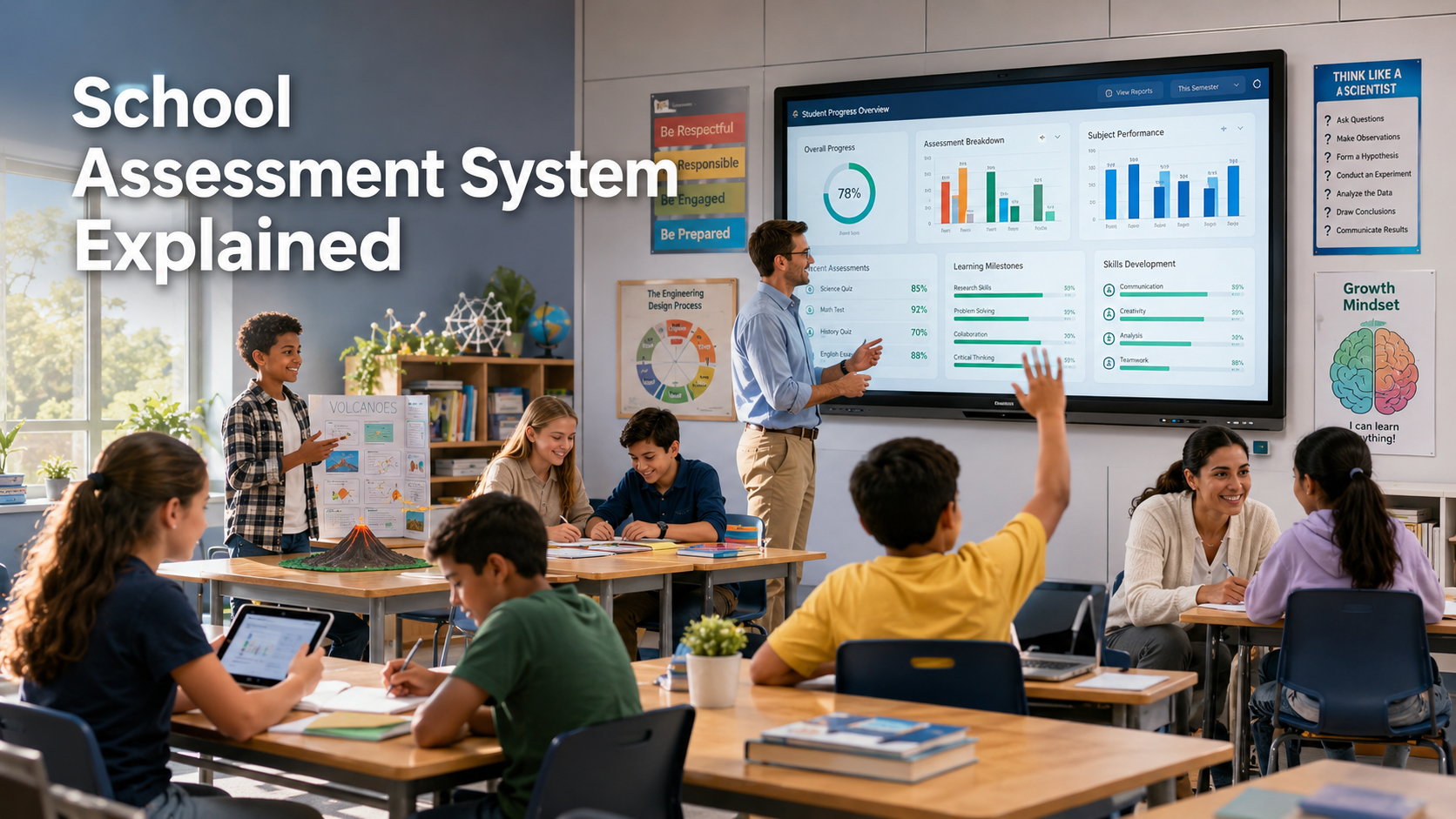
A comprehensive school assessment system consists of a structured network of evaluations designed to measure student learning at different stages. Instead of relying on a single test, schools use quizzes, assignments, projects, presentations, and final exams. This approach gives teachers a complete picture of each student’s progress.
Project-based learning also plays an important role in modern assessments. Practical activities help students apply classroom concepts in real-world situations. For example, Class 10 students can strengthen their scientific understanding through hands-on experiments and innovative projects. You can explore these best science project ideas for Class 10 students to encourage creativity, critical thinking, and practical learning.
A balanced assessment system allows teachers to measure both knowledge and practical skills. It also reduces the pressure of depending on one final exam. Students who struggle with written tests often perform better in projects, presentations, or classroom activities. Using different assessment methods creates a fairer learning environment.
This continuous evaluation process helps teachers identify learning gaps early. They can provide extra support to struggling students while challenging advanced learners. As a result, schools promote steady academic growth and help every student reach their full potential.
Diagnostic, Formative, and Summative Evaluations
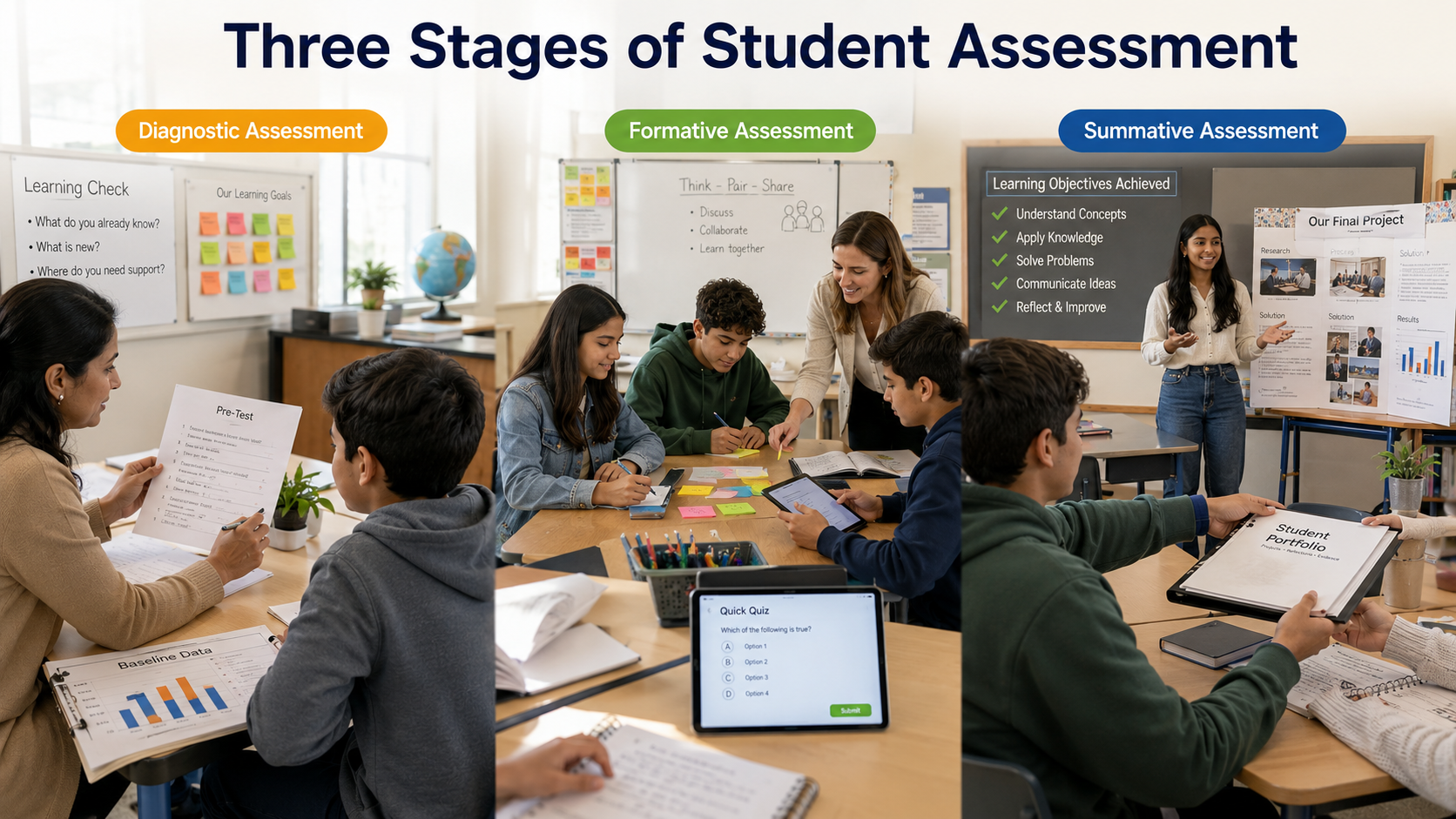
To truly understand how a student assessment setup works, we must look at the three primary types of evaluations used in classrooms today. Each serves a unique purpose during the academic year, acting as a guidepost for both teaching strategies and student progress. When these three models are integrated seamlessly, they form a continuous loop of feedback that drives classroom success from the very first day of school to the final dismissal.

1. Diagnostic Assessments: The Starting Point
Teachers administer diagnostic tests before learning begins. These quick checks help educators identify what students already know and where gaps exist. For example, a pre-test before a unit on fractions reveals which concepts require the most instructional time. By establishing this clear baseline, teachers avoid wasting time on topics the class has already mastered, allowing them to focus energy on areas that need immediate attention. This proactive step ensures that no student is left behind from the very start of a new academic term.
2. Formative Assessments: Monitoring Daily Progress
Formative evaluations happen continually during daily lessons. They are low-stakes checks, meaning they usually do not carry heavy grading weight. Examples include exit tickets at the end of class, think-pair-share group activities, or short classroom polls. These quick checks give teachers immediate feedback. If half the class fails an exit ticket, the teacher knows to review the concept the next day. This constant adjustment prevents minor misunderstandings from snowballing into major learning deficits before the final exam arrives.
3. Summative Assessments: Measuring Final Outcomes
Summative assessments occur at the end of an instructional unit or school year. They measure total learning growth against established academic standards. End-of-unit exams, final portfolios, and state standardized tests are all primary examples of summative evaluations. These assessments provide the definitive data that school districts and parents need to verify that a student has met required benchmarks. They offer a concrete look back at what was achieved, ensuring accountability and confirming readiness for the next grade level.
The Vital Role of Rubrics and Standardized Testing
Consistency is a major challenge in grading across different classrooms and schools. Therefore, a modern evaluation framework relies heavily on rubrics and standardized metrics to ensure fairness and objectivity for every student involved. Without these standardized tools, grading can become subjective, leading to confusion and frustration for parents and students who are trying to navigate their educational journey clearly.
Clear Expectations with Rubrics
A rubric is a scoring guide that outlines exactly what a student must achieve to earn a specific grade. By breaking down assignments into clear criteria, teachers eliminate guesswork. Students know precisely how their essays, presentations, or science projects will be evaluated before they even begin. This transparency empowers students to take ownership of their work, as they can self-assess their progress against the rubric guidelines. Consequently, the final grade becomes a fair reflection of effort and skill rather than a surprise.
Measuring Growth via Standardized Tests
While classroom tests measure daily progress, standardized tests offer a broader view. They compare school performance against state or national averages. Consequently, district leaders can use this data to allocate resources to schools that need additional support. These large-scale tests ensure that educational standards remain high across different regions. While they are just one piece of the puzzle, they provide the objective data necessary to ensure that every school is delivering a quality education to its students.
FREQUENTLY ASKED QUESTIONS
What is the primary purpose of a school assessment system?
The primary purpose of a school assessment system is to measure student understanding accurately. It also guides daily instruction and improves academic outcomes across schools. Instead of simply assigning final grades, a well-designed assessment system provides teachers with useful and actionable data. Teachers use this information to adjust their lessons and teaching methods. They can support struggling students while continuing to challenge advanced learners.
Assessment data also keeps parents informed about their child’s strengths, weaknesses, and academic progress throughout the school year. School administrators and education boards use this data to evaluate the effectiveness of their curriculum and teaching strategies. They can identify areas that need improvement and make informed decisions.
A balanced assessment system combines daily classroom activities, ongoing progress checks, and end-of-year exams. This approach ensures that one poor test result does not define a student’s overall performance. Instead, it creates a continuous cycle of feedback, personalized learning, and steady academic growth. As a result, students receive the support they need to reach their full potential.
How do formative and summative assessments differ?
Formative and summative assessments differ primarily in their timing, stakes, and overall role within the instructional lifecycle. Formative assessments occur continuously throughout the active learning process to monitor daily progress. A helpful analogy is to think of formative evaluation as a chef tasting a soup while it is still simmering on the stove; this taste test allows the chef to adjust the seasonings and ingredients before the final dish is served to the public. In a classroom, formative tasks include low-stakes activities like exit tickets, verbal class discussions, or short polls that carry little to no weight toward a student’s official grade.
Conversely, summative assessments take place at the definitive end of an instructional unit, semester, or academic school year to measure overall competency. Following the culinary analogy, a summative evaluation is the guest eating the final meal and rendering a permanent judgment. Summative tasks include high-stakes events like standardized exams, final research papers, or end-of-unit chapter tests. While formative tools are designed to shape and improve ongoing learning, summative tools strictly verify whether a student has met specific state standards or grade-level benchmarks.
Why do modern schools use rubrics for grading?
Modern schools rely heavily on detailed rubrics to ensure that grading remains consistently fair, deeply transparent, and objective across multiple classrooms and distinct grade levels. A rubric functions as an explicit blueprint that defines the exact performance criteria and quality standards required to earn specific scores before a student even begins an assignment. For instance, instead of merely giving a subjective grade on a research project, a teacher uses a rubric to break the total score down into distinct categories, such as grammatical precision, structural organization, historical accuracy, and original critical analysis.
This granular breakdown effectively removes subjective personal bias from the evaluation process, making it perfectly clear to both students and parents why a specific grade was ultimately earned. Furthermore, rubrics provide learners with highly actionable feedback rather than a simple, ambiguous number at the top of a page. By highlighting precise strengths and weaknesses, students can easily discover where they excel and which specific academic skills require more focused effort in the future. This structural clarity significantly reduces stressful grading disputes, eliminates classroom confusion, and fosters a collaborative, trustworthy relationship between teachers and learners.
Can a student assessment framework accommodate different learning styles?
A modern, well-designed student assessment framework is intentionally built to accommodate a wide variety of diverse learning styles by offering multiple, flexible pathways for individuals to demonstrate their true subject-matter knowledge. Educational researchers recognize that traditional multiple-choice exams do not accurately capture the intelligence or capability of every child. Consequently, comprehensive school systems actively blend performance-based tasks, oral presentations, collaborative group challenges, and creative digital portfolios alongside conventional written tests.
This pedagogical variety ensures that visual, auditory, kinesthetic, and hands-on learners all have equal opportunities to showcase their authentic understanding in a format that aligns with their natural cognitive strengths. By diversifying classroom evaluation methods, schools dramatically reduce debilitating test anxiety and create a far more inclusive, equitable learning environment. Furthermore, this multifaceted approach validates real-world skills like creative problem-solving, artistic expression, and verbal communication, proving that a student’s intellect cannot be measured solely through rote memorization or filled-in bubbles on a standardized worksheet.
How does standardized testing fit into local school evaluations?
Standardized testing plays an important role in local school evaluations. It provides a reliable, external benchmark for measuring educational performance and school accountability. Classroom quizzes and teacher-created tests show how a student performs within a specific class. In contrast, standardized tests compare a student’s knowledge with state or national averages. This broader comparison helps schools understand how they perform beyond the classroom.
District leaders, policymakers, and school administrators use standardized test data to identify curriculum gaps and measure academic progress. They also track achievement differences between student groups. The results help determine which schools need additional funding, teacher training, or instructional support.
Standardized exams should not be the only measure of a student’s ability or future potential. However, they remain an important tool for evaluating overall school performance. They help maintain consistent educational standards across different regions. As a result, a high school diploma from an underfunded rural community can represent the same core knowledge and academic readiness as one earned in an affluent suburban neighborhood.
CONCLUSION
A robust school assessment system is far more than a tool for calculating final report card grades. It is a dynamic, multi-layered framework that guides teachers, supports students, and keeps parents informed throughout the learning journey. By balancing diagnostic baseline checks, informal formative monitoring, and comprehensive summative exams, modern schools create a holistic view of student capability. When implemented correctly, this data-driven approach removes guesswork from the classroom. It ensures that instructional time is used efficiently and that every student receives the exact level of support they need to thrive in their daily studies.
Ultimately, a balanced evaluation framework transforms testing from a source of anxiety into a powerful catalyst for academic growth. As education continues to evolve, the methods we use to measure success must remain flexible, fair, and focused on student development. By embracing a diverse school assessment system, educational communities can guarantee that they are preparing students not just to pass exams, but to succeed in the real world. This commitment to continuous improvement lies at the very heart of a truly successful school system.