Adaptive vs Personalized Learning: A Practical Guide for Educators
Modern classrooms no longer rely on a rigid, one-size-fits-all model. Educators now use digital tools and flexible teaching methods to support different learning needs. When comparing adaptive vs personalized learning, however, the terms can become confusing.
Although they are related, they describe different approaches to education. Adaptive learning relies heavily on technology and data. Software analyzes student performance and automatically adjusts content, difficulty, pacing, or support. Personalized learning is broader. It gives learners greater influence over their goals, learning paths, activities, and ways of demonstrating knowledge. For a broader understanding of how intelligent systems use data to make decisions, see What Is Machine Learning & How Does It Work.
Understanding this distinction helps schools choose appropriate instructional strategies and educational technology. The U.S. Department of Education provides resources on modern approaches that support individualized student learning. Adaptive tools can provide immediate feedback and targeted practice. Personalized learning can give students greater ownership of their education.
This guide explains the main differences between adaptive and personalized learning. It also covers classroom examples, disadvantages, the four pillars of personalized learning, and the benefits of adaptive teaching.
What are the key differences between adaptive learning and personalized learning?
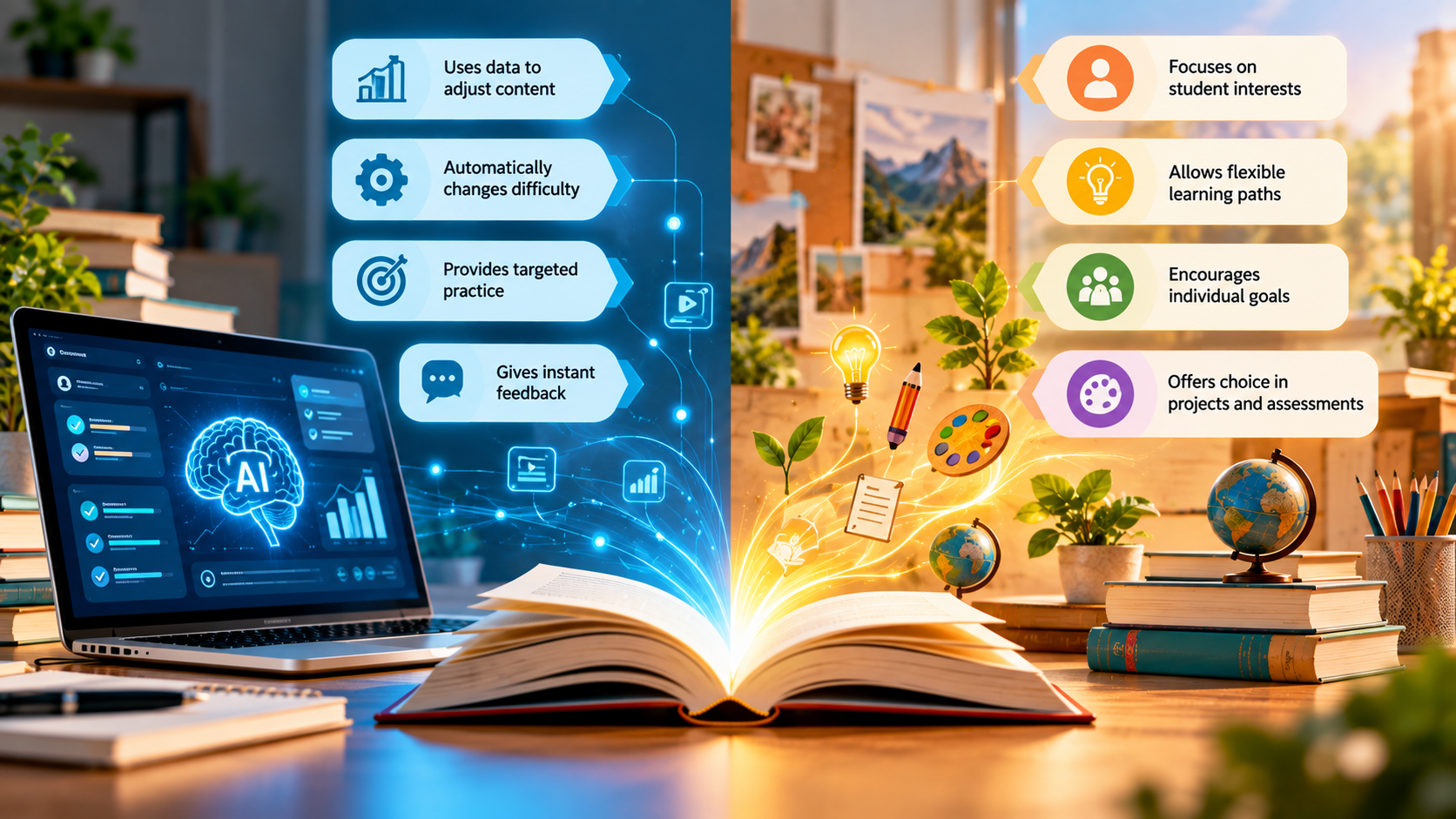
The main difference between adaptive vs personalized learning involves control, scope, and delivery. Adaptive learning is primarily a technology-supported approach. Software uses student performance data to adjust content, difficulty, pacing, or instructional support. These changes can happen automatically as the learner interacts with the platform.
Personalized learning is a broader educational approach. It can include technology, but technology is not required. Instead, educators consider each learner’s needs, interests, goals, strengths, and preferred ways of learning.
For example, an adaptive platform may give easier questions after identifying repeated mistakes. A personalized classroom may allow that student to choose a project topic, learning resources, and presentation format.
The approaches can also work together. Adaptive technology can provide data and individualized practice within a personalized classroom.
Therefore, adaptive learning is usually narrower and more automated. Personalized learning covers a wider instructional experience and gives students greater participation in learning decisions.
Can you give me an example of personalized learning?
A practical example of personalized learning can occur in a high school environmental science classroom. Instead of giving every student the same worksheet, the teacher establishes common learning objectives and allows students to choose how they investigate them. This approach connects closely with broader personalized learning in education, where instruction can be shaped around individual student needs and goals.
One student might create a website examining local watershed quality. Another could write an illustrated book about regional pollinators. A third might conduct soil tests in the school garden. Each project can address the same required science concepts while allowing different interests and abilities.
Students may also choose research questions, organize parts of their schedules, and select appropriate presentation formats. The teacher provides guidance, feedback, resources, and assessment criteria throughout the project.
This approach demonstrates why personalized learning extends beyond simply changing question difficulty. It can involve student choice, flexible pathways, individual goals, and varied demonstrations of mastery.
Technology may support the process, but the central feature remains the learner’s active role in shaping the educational experience.
What is an example of adaptive learning?
A clear example of adaptive learning can be found in digital mathematics platforms such as DreamBox or ALEKS. A student may begin working on fraction division while the system records responses and performance patterns. Teachers looking for additional digital resources can also explore Best Math Learning Platforms for other options.
Suppose the student answers several complex questions correctly. The platform may determine that additional basic practice is unnecessary. It can then introduce more challenging problems or related concepts.
If the student repeatedly makes errors, the system can move in the opposite direction. It may provide simpler exercises, visual explanations, hints, or additional practice before introducing new material.
The important feature is automatic adjustment. The learner does not need to wait for a teacher to review every response before receiving another activity.
The system uses available performance data to determine what content or support should appear next. This creates an ongoing instructional feedback loop.
Adaptive learning can therefore provide individualized practice and immediate feedback while allowing teachers to monitor broader patterns across their students.
Automated Remediation and Instant Feedback Loops
One major feature of adaptive learning is its ability to provide automated remediation. Traditional instruction may require a teacher to review assignments before identifying a student’s misunderstanding. An adaptive platform can respond during the learning activity itself.
For example, repeated mistakes with fraction operations may trigger additional practice or explanatory material. Correct responses may allow the learner to move forward without completing unnecessary exercises.
This creates a continuous feedback loop. The system collects performance information, interprets it according to its programmed model, and adjusts subsequent activities.
The process can save instructional time, especially when students have different levels of prior knowledge. Teachers can also use platform data to identify learners who may need additional support.
However, automated feedback should not replace teacher judgment. Software may recognize patterns in answers without understanding every reason behind a student’s performance.
The most useful approach combines instant digital feedback with teacher observation, discussion, and targeted human support.
What are the disadvantages of adaptive learning?
Adaptive learning can provide useful differentiation, but it also has limitations. One concern is the potential reduction in face-to-face interaction. If students spend too much class time working independently on screens, opportunities for discussion, collaboration, and group problem-solving may decrease.
Another limitation involves what software can measure effectively. Adaptive platforms work particularly well with skills that can be represented through measurable performance data. They may be less effective at evaluating creativity, complex communication, ethical reasoning, collaboration, or other nuanced competencies.
Access can also create equity concerns. Students need appropriate devices, software, connectivity, and technical support to use many adaptive systems effectively. This is particularly relevant when schools rely on a growing range of educational apps for students and other digital learning resources.
There is also a risk of overdependence on automated guidance. Students may become accustomed to following system-generated recommendations rather than setting goals or evaluating their own mistakes.
For these reasons, adaptive technology works best as part of a broader instructional strategy. Teacher guidance, collaboration, discussion, and student agency should remain important parts of the learning experience.
The Problem of Algorithmic Bias and Isolation
Adaptive software depends on the data, rules, and instructional models built into the system. This creates the possibility of algorithmic bias. A platform may interpret an unusual solution as an error even when the student’s reasoning demonstrates genuine understanding.
The quality of the learning experience also depends on how the system was designed and tested. Poorly designed algorithms may provide unsuitable difficulty levels, repetitive activities, or feedback that does not address the learner’s actual misunderstanding.
Student isolation presents another concern. Excessive screen-based learning can reduce opportunities for classroom discussion, teamwork, presentations, and peer learning.
These concerns do not mean adaptive technology is inherently unsuitable. Instead, they highlight the importance of balanced implementation.
Teachers can review student performance, discuss mistakes directly, and combine digital activities with collaborative work. Regular human interaction also gives students opportunities to develop communication and social skills.
The goal should be to use automation where it adds value without allowing technology to replace human teaching and meaningful classroom interaction.
What are the four pillars of personalized learning?
The four pillars commonly associated with personalized learning provide a framework for designing learner-centered education. The first is learner profiles. These profiles bring together information about a student’s strengths, needs, interests, progress, and learning goals.
The second pillar is personal learning paths. Students can follow pathways that reflect their current knowledge, goals, and pace instead of following exactly the same sequence as every classmate.
The third pillar is competency-based progression. Students move forward when they demonstrate understanding or mastery rather than simply completing a fixed amount of seat time.
The fourth pillar is a flexible learning environment. Teachers can adjust schedules, learning spaces, grouping arrangements, resources, and instructional methods to support different learners. This flexibility can also be considered within the broader range of types of alternative education, where learning environments may differ from traditional classroom models.
Together, these pillars shift education away from a single standardized pathway. They encourage educators to consider both academic progress and individual learner needs.
The exact implementation can differ between schools, but the overall goal remains consistent: creating learning experiences that are more responsive to individual students.
What are the benefits of adaptive teaching?
Adaptive teaching can help educators respond to differences in student knowledge, performance, and learning pace. Instead of giving every learner identical activities, teachers can adjust instruction according to observed needs.
For students who already understand a concept, additional repetitive practice may be unnecessary. Adaptive approaches can help them move toward more challenging material. Students who need additional support can receive targeted practice before progressing.
Technology can also reduce some routine instructional tasks. Automated assessments and performance reports may help teachers identify patterns without manually reviewing every response.
This information can support targeted small-group instruction. For example, a teacher may notice that several students struggle with the same mathematical concept and plan a focused lesson for that group.
Adaptive teaching can also provide students with timely feedback. Immediate information helps learners recognize mistakes while the material is still fresh. Digital tools can support this process, and teachers can explore the future of online education to understand how technology is continuing to shape learning experiences.
However, these benefits depend on implementation quality. Adaptive tools should complement teacher expertise rather than replace it. The strongest approach combines data-driven differentiation, human feedback, collaboration, and student agency.
FREQUENTLY ASKED QUESTIONS
Can adaptive learning tools support a personalized learning curriculum?
Yes, adaptive learning tools can frequently serve as powerful components inside an adaptive vs personalized learning curriculum. While personalized learning provides the overarching educational vision—emphasizing student agency, flexible pacing, and self-directed projects—adaptive tools handle targeted skill development. A student might use an adaptive application for thirty minutes to reinforce essential mathematics facts, then spend the rest of the day applying those skills toward an open-ended community design project.
Does adaptive learning eliminate the need for classroom teachers?
No, adaptive technology cannot replace human educators. Algorithmic software manages content delivery and mechanical skill drills, but it cannot mentor learners, teach empathy, facilitate ethical debates, or inspire creative expression. Teachers use software data to inform instruction, focusing their energy on high-impact interventions, project guidance, and emotional support that automated software cannot provide.
Which approach works better for special education students?
Both models offer distinct advantages for exceptional learners. Adaptive software automatically breaks complex tasks into tiny, digestible steps, reducing cognitive overwhelm for students with processing delays. Meanwhile, personalized learning models enable neurodivergent learners to leverage unique personal strengths, choose custom sensory workspaces, and showcase mastery through alternative presentation media tailored to their individual education programs.
CONCLUSION
Modern education must balance foundational academic standards with individual student interests. Comparing adaptive vs personalized learning reveals that these two strategies are complementary rather than conflicting. Adaptive learning leverages algorithmic intelligence to adjust pacing, diagnose skill gaps, and reinforce fundamental knowledge with minimal manual overhead. Conversely, personalized learning establishes a holistic, human-centered environment that champions student choice, critical inquiry, and authentic agency.
Instead of choosing one methodology over the other, forward-thinking institutions combine the best qualities of both frameworks. Educators can deploy adaptive software to handle mechanical differentiation and rapid skills diagnostics. Meanwhile, they can direct overall classroom culture toward personalized learning, guiding students through meaningful real-world projects and collaborative discussions.
By grounding instructional technology in human mentorship and individual student ownership, schools can build vibrant, inclusive spaces where every child thrives. Take time to audit your current instructional toolkit today, identify where automated assistance can free up classroom hours, and empower your students with greater agency across their daily learning journeys.