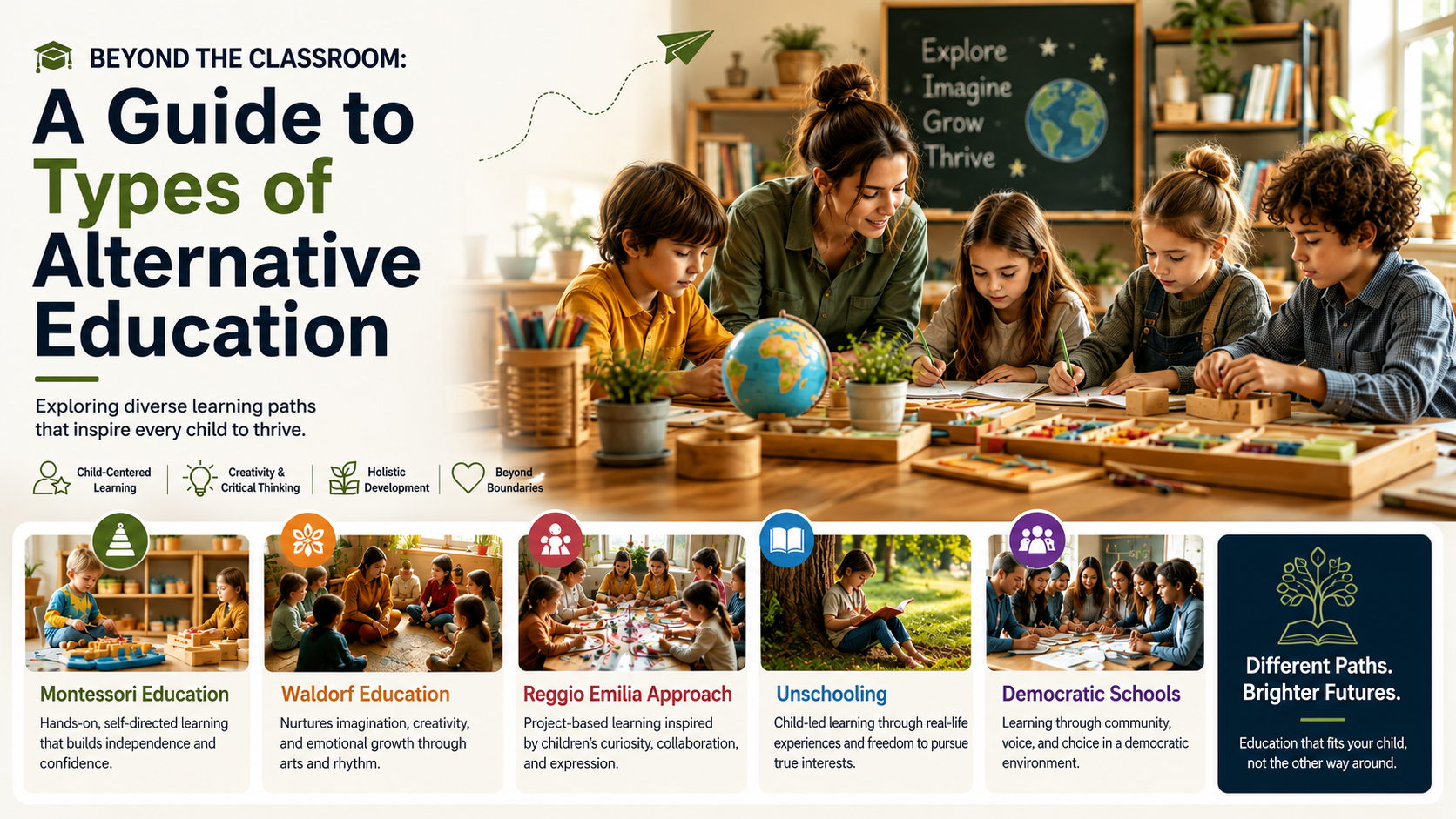
Beyond the Classroom: A Guide to Types of Alternative Education
Types of alternative education offer excellent paths to academic success outside traditional school models. Today, millions of families explore these diverse frameworks to better suit their children’s unique learning styles, emotional needs, and personal interests. Indeed, according to data tracked by the National Center for Education Statistics (NCES), non-traditional educational models are rapidly gaining traction. Consequently, parents actively seek environments that foster creativity and critical thinking over standardized testing. Understanding these non-traditional approaches helps you make an informed choice for your child’s developmental journey. However, standardized systems often struggle to accommodate children who learn at varying paces, prompting this major societal shift.
Choosing the right educational path matters because a one-size-fits-all approach often leaves unique minds behind. Therefore, this article breaks down the most prominent alternative school models. We explore their core philosophies and help you evaluate which environment allows your child to truly thrive. By expanding your horizons beyond the neighborhood public school, you unlock a lifelong love for learning. In addition, every child deserves an environment that celebrates their strengths rather than punishing their differences. This reality makes the exploration of alternative setups incredibly valuable for modern parents.
Understanding the Rise of Alternative Schooling
Traditional education heavily relies on age-based grading, standardized curricula, and desk-bound lectures. While this structure works for many students, others find it highly restrictive and stressful. For instance, the rigid focus on high-stakes testing stifles natural curiosity. It turns learning into a chore rather than an adventure. In contrast, alternative education frameworks completely flip the script by focusing entirely on the individual student. These progressive models prioritize experiential learning, self-paced progression, and emotional development over rote memorization. As a result, students in these environments develop a stronger sense of independence and a genuine, lifelong love for learning.
Furthermore, the modern workforce increasingly rewards creativity, adaptability, and critical problem-solving skills. Therefore, alternative models explicitly design their daily activities to nurture these crucial traits. When children explore subjects deeply without the constant pressure of numerical ranking, they build authentic confidence. Ultimately, this realization among parents and developmental psychologists fuels a massive global movement. Families choose educational models that honor the natural psychology of childhood growth. Consequently, this shift successfully paves the way for a more diverse and supportive academic landscape globally.
Exploring the Main Types of Alternative Education
To find the right fit, you must look closely at how different progressive methodologies operate in practice. Here are the most widely recognized alternative models available today.
Montessori Education
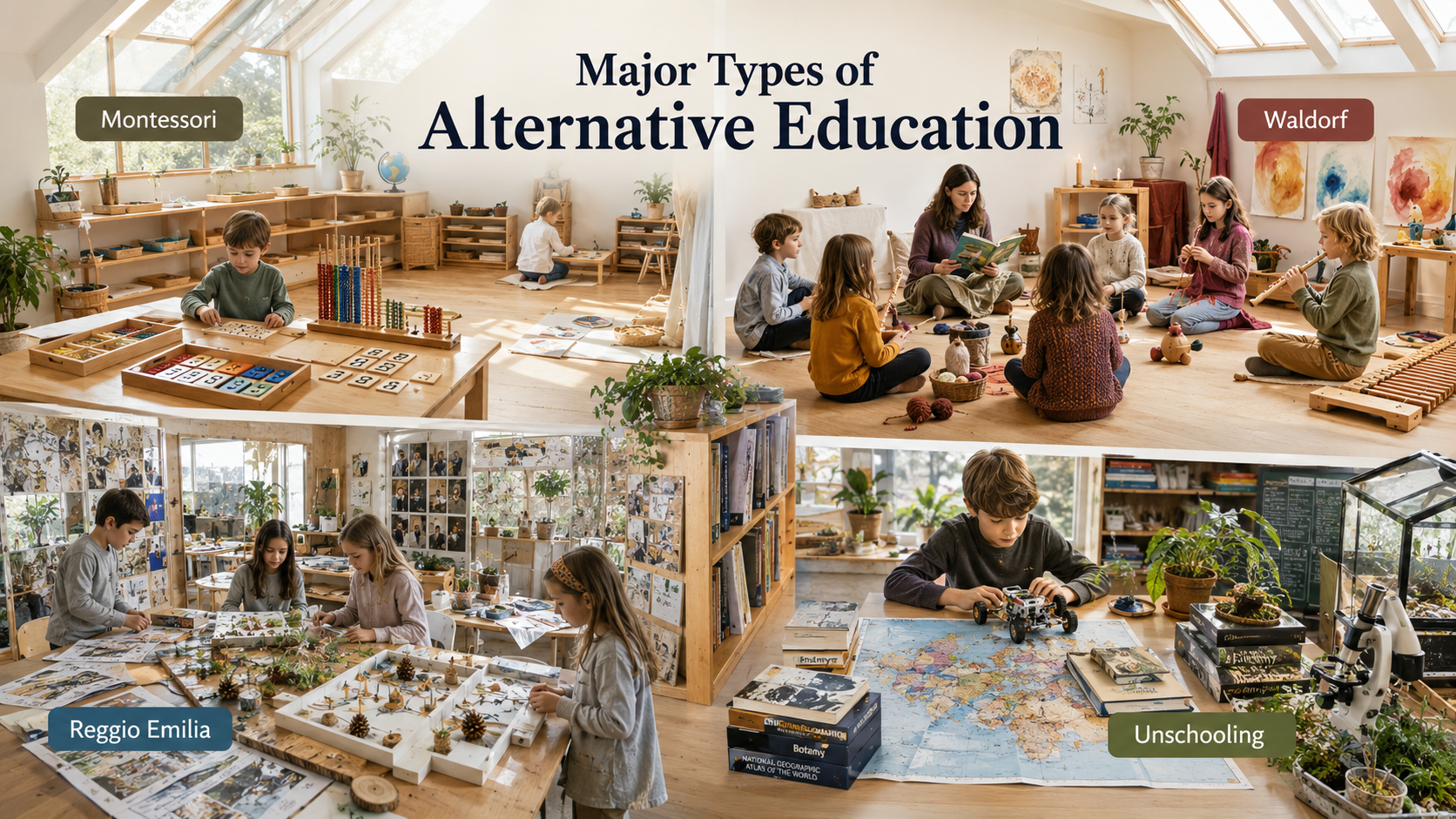
Dr. Maria Montessori founded this approach, which relies heavily on self-directed activity and hands-on learning. Specifically, students work in mixed-age classrooms and choose from a meticulously prepared environment of educational materials. Teachers act as guides rather than lecturers. Thus, this setup allows children to discover concepts at their own natural pace. Moreover, the mixed-age setting fosters a unique community dynamic where older children happily mentor younger peers. This interaction beautifully reinforces their own knowledge. Furthermore, tactile materials help abstract concepts, like geometry or fractions, become physically tangible. This experience deeply anchors a child’s understanding before they transition to abstract thinking. Therefore, it provides an excellent environment for independent children who thrive when given choices and personal autonomy.
Waldorf Education
Rudolf Steiner created the philosophy behind Waldorf education, which integrates arts, academics, and practical skills into a holistic curriculum. The system follows distinct developmental stages. For example, it focuses heavily on imaginative play in early childhood and analytical thinking in adolescence. Notably, schools discourage digital media and technology in the early years. Instead, this restriction fosters deep sensory engagement with the real world. Additionally, students often stay with the same teacher for multiple years, creating a stable and supportive emotional bond. By emphasizing storytelling, handcrafts, gardening, and music alongside traditional math and science, Waldorf education builds well-rounded individuals. Consequently, students graduate as emotionally resilient and socially responsible citizens.
Reggio Emilia Approach
Educators in Italy originated this student-centered philosophy, which views children as powerful, capable learners full of potential. The curriculum does not come from a predetermined textbook. Instead, it emerges organically from the children’s natural questions, group projects, and collaborative interests. Furthermore, classrooms utilize natural light, mirrors, and organic materials. The system treats the physical environment as a vital “third teacher.” Teachers view art as a primary language through which children express their developing thoughts. Meanwhile, documentation of student work remains highly detailed. This allows children, teachers, and parents to review the learning journey together. Thus, this model excels at fostering deep collaboration, community involvement, and highly creative problem-solving skills from a very young age.
Unschooling and Democratic Schools
Unschooling takes homeschooling a step further by eliminating formal curricula, grades, and rigid schedules entirely. Instead, learning happens naturally through life experiences, personal hobbies, community interactions, and everyday problem-solving driven completely by the child’s curiosity. Similarly, democratic schools give students an equal say in school governance and their own daily schedules. Obviously, this practice promotes ultimate personal autonomy. In these environments, a child might spend days reading, building a computer, or exploring nature. The core belief states that humans are natural learners. Therefore, children seek out the skills they need, such as literacy and numeracy, when those skills become relevant to their personal goals.
Benefits of Non-Traditional Learning Environments
Stepping away from conventional schooling offers distinct advantages for a child’s long-term development. These innovative spaces highlight why different types of alternative education succeed. Typically, alternative environments maintain smaller student-to-teacher ratios. This structure ensures that each child receives personalized attention and mentorship tailored to their specific needs. Consequently, it prevents students from falling through the cracks or becoming bored by a slow-moving curriculum. Additionally, the lack of rigid grading systems shifts the focus from external rewards to internal satisfaction. This change successfully eliminates school-induced anxiety.
-
Tailored Pace: Students skip what they know and spend extra time on difficult concepts.
-
Intrinsic Motivation: Children learn because they are curious, not just to pass an exam.
-
Holistic Growth: These models nurture emotional intelligence, creativity, and resilience alongside academics.
Moreover, small class sizes in alternative settings mean educators provide deep, individualized mentorship. By encouraging students to voice their opinions and collaborate on real-world projects, alternative education fosters exceptional communication skills. As a result, students graduate from these programs with academic knowledge and a profound understanding of their own identity. Therefore, they learn how they relate to the world around them as confident individuals.
Choosing the Best Fit for Your Child
No single educational model fits every student perfectly. Instead, the ideal choice depends entirely on your child’s unique personality, emotional needs, and your family values. For example, consider how your child reacts to structure and freedom. A highly disorganized child might struggle with the complete freedom of unschooling. However, that same child could flourish beautifully in a structured, orderly Montessori setting. Meanwhile, a highly artistic or sensitive child might find their perfect home in a Waldorf community. These schools prioritize emotional rhythm and creative expression above standard metrics.
Therefore, take the time to visit local schools, observe the active classrooms, and speak directly with educators to gauge the environment firsthand. Look at how the students interact with each other. Furthermore, notice whether they seem genuinely engaged or merely compliant. Consider practical factors like commuting distance, long-term tuition costs, and family alignment. The school’s community should match your home life smoothly. Ultimately, trust your instincts as a parent, keeping in mind that you can always adjust your path as your child grows and develops new needs.
FAQs About Alternative Education
What are the most common types of alternative education?
The most common models include Montessori, Waldorf, Reggio Emilia, Harkness, and democratic schooling. In addition, homeschooling and unschooling are popular home-based options that families utilize worldwide. Each system features a distinct philosophical approach to child development and learning. For example, Montessori emphasizes independent, tactile learning with specialized materials. Meanwhile, Waldorf focuses on holistic development through the arts, storytelling, and physical imagination. Similarly, Reggio Emilia relies heavily on community-led, project-based exploration. Understanding these differences allows parents to target specific traits in their children. Consequently, you can match a creative child with a Waldorf school or an independent child with a Montessori program. Ultimately, these diverse types of alternative education ensure that learning adapts to the child, rather than forcing the child to mold themselves to a rigid institutional standard.
How do alternative schools handle grading and testing?
Most alternative schools intentionally avoid traditional letter grades and standardized testing entirely. Instead, educators utilize highly detailed qualitative assessments, regular parent-teacher conferences, narrative progress reports, and comprehensive portfolios of student work. Teachers track developmental milestones, social-emotional growth, and conceptual understanding rather than simple test scores. Therefore, this approach drastically reduces academic anxiety and keeps the focus entirely on genuine mastery of the subject matter. Furthermore, students learn to evaluate their own progress critically, rather than relying on external validation like an “A” or a “B.” By replacing competitive ranking with descriptive feedback, alternative schools foster a growth mindset. As a result, they view mistakes as natural steps in the learning process rather than failures. This creates a much healthier psychological environment for long-term academic engagement.
Can students transition easily from alternative schools to traditional universities?
Yes, students transition quite successfully to traditional higher education institutions. Indeed, university admissions officers frequently value the self-direction, critical thinking skills, and unique portfolios possessed by non-traditional students. While alternative students may need to take standard entrance exams like the SAT or ACT to fulfill admissions requirements, their highly adaptive learning skills generally allow them to adjust quickly to university-level academic expectations. In fact, alternative alumni often excel in the self-driven environment of a college campus. For instance, they know how to manage their own time and pursue topics independently without constant teacher supervision. Therefore, many universities actively seek out these students because they bring diverse perspectives, strong communication skills, and an authentic passion for research into the academic community.
Is alternative education more expensive than traditional schooling?
Private alternative schools can carry high tuition costs, occasionally matching or exceeding traditional private academies. Specifically, specialized teacher training and unique tactile materials drive these costs up. However, these specific types of alternative education are not exclusively for high-income families. Conversely, many public charter institutions incorporate Montessori, Waldorf, or project-based methods completely tuition-free, making them accessible to the wider public. Additionally, homeschooling, unschooling, and community-based educational co-ops offer highly affordable pathways to customized learning. By sharing resources, trading teaching responsibilities among parents, and utilizing free community facilities like public libraries and museums, families design a rich education on a modest budget. Thus, the variety of formats means that almost any family can find a financial structure that works for them.
Are alternative education programs accredited?
Many alternative schools hold formal accreditation through regional educational boards or specialized international organizations, such as the Association Montessori Internationale or the Waldorf Early Childhood Association of North America. Public alternative charters meet state and national standards automatically while maintaining their unique teaching philosophies. Therefore, when researching private options, it is always wise to verify their specific credentials and alignment with local educational authorities to ensure smooth future academic transitions. Even non-accredited programs or unschooled students can easily document their learning through detailed portfolios, reading lists, and standardized test scores if they plan to re-enter the conventional system later. Ultimately, taking the time to check these details early gives you peace of mind as your child progresses through their unique academic journey.
Conclusion
Exploring the various types of alternative education opens up a world of possibilities for young learners and their families. By moving away from rigid, standardized benchmarks and high-stakes testing, these progressive models successfully put the individual student back at the center of the educational experience. Whether you ultimately choose the structured independence of Montessori, the artistic focus of Waldorf, the collaborative nature of Reggio Emilia, or the ultimate freedom of unschooling, alternative paths help cultivate resilient, curious thinkers. These environments prove that academic success does not require sacrificing emotional well-being or creative freedom.
Therefore, take the time to assess your child’s innate strengths, temperament, and developmental needs. Remember that education can be just as unique as the child receiving it. Just as choosing the right learning environment shapes a child’s future, exposing them to new experiences can broaden their perspective—whether through education or opportunities like travelling the world while you’re still young enough to enjoy it. The investment you make in finding the right environment transforms their relationship with learning from one of tolerance to one of true passion. As the modern world continues to evolve away from routine tasks and toward creative innovation, the skills nurtured in alternative settings become more valuable than ever. Consequently, trust your intuition, explore your local options, and embark confidently on a journey that honors your child’s true potential.