
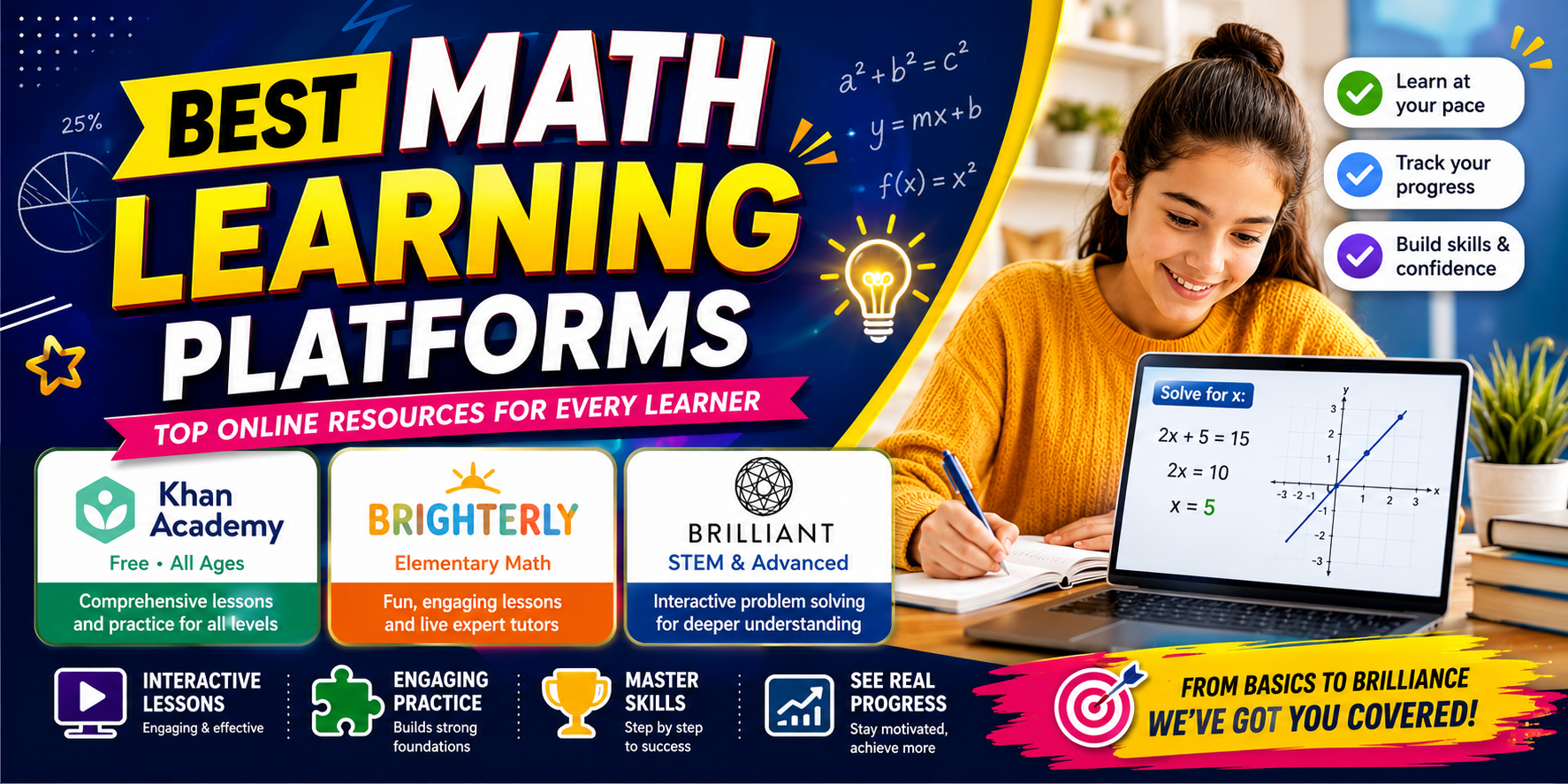
Best Math Learning Platforms: Top Online Resources for Every Learner

Finding the best math learning platforms can completely transform how you or your children understand mathematics. Traditional classrooms often move too quickly or too slowly, leaving students either frustrated or completely bored. Fortunately, high-quality digital options offer custom pathways to bridge these gaps. According to educational insights from Khan Academy, personalized practice helps students build true mastery of core skills. Whether you are preparing for standard tests, helping a child in elementary school, or tackling advanced calculus, the right online space makes a massive difference.
Digital tools bring flexibility to modern households. Instead of scheduling rigid weekly appointments with expensive local tutors, families can access world-class educational ecosystems at any hour of the day. Many modern systems integrate diagnostic placement tests to find your precise performance baseline. This approach eliminates unnecessary busywork and targets structural gaps directly.
In this comprehensive guide, we will break down the top tools available today. We closely analyze core software features, target age groups, and distinct teaching methodologies. This detailed breakdown ensures you find a system that successfully turns math anxiety into genuine mathematical confidence.
Why Choosing the Right Math Website Matters
Not all digital tools use the same teaching methods. Some rely heavily on gamification to keep younger kids engaged. Others focus on video lectures and step-by-step breakdowns for older students. Using the wrong platform can actually cause more stress. For instance, a student who needs deep conceptual visual tools will quickly get bored with standard repetitive drills. Consequently, matching the platform’s style to the student’s personal learning preference is the most critical step for long-term success.
Furthermore, a poorly matched system can damage a child’s educational self-esteem. When software pushes a student into complex exercises before they grasp the underlying foundational principles, frustration mounts rapidly. Excellent math sites focus on scaffolding, which is a process where new lessons slowly build upon previously mastered concepts. This methodical approach ensures that learners experience frequent small victories, which builds the psychological resilience required to tackle advanced mathematical problems down the road.
Best Math Learning Platforms for K-12 and Beyond
Here is our curated analysis of the top systems available today, built on user trust, educational quality, and verified results.
Khan Academy: Best Overall Free Platform
Khan Academy remains the gold standard for free, high-quality math education globally. It covers everything from early childhood counting to advanced college-level linear algebra. The interface uses clear dashboards that guide students systematically through complete grade-level curricula.
-
Key Feature: Completely free with no hidden ads or subscription fees.
-
Learning Style: Video-based instruction followed by adaptive practice problems.
-
Best For: Self-paced learners who need a structured, comprehensive curriculum.
The system tracks your progress automatically. If you miss a specific problem type, it suggests targeted review lessons to fix your foundational gaps. Millions of students worldwide use it to supplement their regular homework or prepare for major standardized exams.
Brighterly: Best for Elementary Students
For younger children, interactive engagement is critical. Brighterly focuses on early childhood math education through gamified lessons and live, expert tutoring. They emphasize building an intuitive relationship with numbers rather than memorizing dry rules.
-
Key Feature: Bright, animated visuals that turn abstract math into concrete puzzles.
-
Learning Style: Play-based learning backed by live instructor feedback.
-
Best For: Elementary school children who experience math anxiety.
By making math feel like an adventure game, children develop problem-solving skills without feeling overwhelmed by dry numbers. The combination of self-paced software and professional guidance keeps young kids highly motivated over long periods.
Brilliant.org: Best for Conceptual and Advanced Learning
If you want to understand the “why” behind complex formulas, Brilliant is an outstanding choice. It moves away from standard memorization. Instead of watching an instructor write formulas on a virtual chalkboard, you actively manipulate variables on your screen.
-
Key Feature: Interactive, hands-on visual simulations.
-
Learning Style: Active problem-solving without long, boring video lectures.
-
Best For: Teens and adults pursuing STEM fields or data science.
This practical methodology builds deep spatial and logical awareness. It is highly popular among college students, coding professionals, and adult learners who want to brush up on their analytical and mathematical reasoning skills.
Key Features to Look For in Digital Math Tools
When evaluating options, keep these three pillars in mind to ensure you get real value from your time and money:
-
Adaptive Learning Technology: The software should automatically adjust problem difficulty based on real-time performance.
-
Progress Tracking: Comprehensive dashboards help parents and teachers pinpoint exact problem areas.
-
Clear Explanations: Good software does not just tell you that your answer is wrong; it shows you exactly how to solve it correctly.
Comparison of Top Math Websites
| Platform | Best For | Price | Format |
| Khan Academy | All Ages / School Prep | Free | Videos & Practice |
| Brighterly | Elementary Kids | Varies (Paid) | Games & Live Tutors |
| Brilliant.org | Critical Thinking & STEM | Subscription | Interactive Puzzles |
FAQ Section
What are the best math learning platforms for elementary students?
The best math learning platforms for younger children focus heavily on gamification, interactive storytelling, and rich visual aids. Leading choices in this specific market segment include Brighterly, Prodigy Math, and ABCmouse. These services convert standard, dry arithmetic drills into engaging fantasy games or colorful puzzle adventures. This immersive approach keeps young minds focused while teaching essential foundational concepts like addition, subtraction, and basic fractions. By embedding math challenges directly into a rewarding gameplay loop, children develop core mathematical fluency naturally. They absorb tough concepts without experiencing the fatigue or anxiety often associated with traditional worksheet drills. Furthermore, these elementary platforms allow kids to customize their own digital avatars and earn virtual rewards, transforming math homework from an agonizing chore into a deeply exciting daily ritual.
Are there any high-quality free math websites available?
Yes, Khan Academy is widely recognized as the premier free math learning platform globally. It provides a massive, entirely ad-free educational ecosystem that spans from preschool basics up through advanced college-level calculus and statistics. The platform utilizes highly digestible video explanations alongside adaptive practice sets that instantly adjust difficulty based on student performance. Because it tracks learning progress across multiple grades, it helps users locate and mend old knowledge gaps. Its non-profit mission ensures that top-tier, aligned math education remains accessible to any student with an internet connection, completely removing financial barriers to learning. Additionally, teachers worldwide rely on its backend analytics to assign targeted homework modules and review specific class performance without charging cash-strapped school districts a single dollar.
How do I choose between video-based learning and interactive learning?
Your choice depends entirely on how the student naturally processes new information. Video-based learning platforms work beautifully for independent students who prefer traditional step-by-step explanations, clear lecture formats, and structured note-taking. Conversely, interactive learning software is ideal for tactile and visual learners. These students understand concepts far better by manipulating digital shapes, adjusting variables on sliders, and solving puzzles through active experimentation. If a student loses focus during long lectures, an interactive, hands-on environment will generally yield much higher engagement levels and better long-term concept retention. Many leading modern services are beginning to combine both methods, but identifying whether a learner thrives on passive audio-visual absorption or active tactical gameplay remains the key to choosing the ideal foundational digital architecture.
Can online math tools replace traditional classroom teaching?
Online math tools generally serve as powerful educational supplements rather than complete replacements for traditional classrooms. For example, digital platforms offer excellent remedial help, unlimited practice, and accelerated pathways for advanced students. However, most learners still require the emotional support, real-time guidance, and accountability provided by a live school teacher or private tutor. Therefore, a balanced approach usually delivers the best results. By combining classroom instruction with customized digital practice, students can enjoy personal mentorship while also using software to master difficult skills at their own pace. Furthermore, software cannot pat a frustrated student on the back or instantly read subtle facial expressions to recognize when a child is silently struggling. As a result, the irreplaceable value of human educators in mathematical development becomes clear.
Is Brilliant.org worth it for high school students?
Brilliant is highly worth the investment for high schoolers who intend to pursue competitive fields like engineering, computer science, or advanced data analysis. The platform avoids mechanical, recipe-style memorization entirely. Instead, it challenges students to solve deep logic puzzles and interact with visual mathematical models. This approach builds true conceptual understanding and teaches students how to think like scientists and mathematicians. It prepares teenagers exceptionally well for college-level coursework and standardized entrance exams by training their minds to break down unfamiliar, highly complex problems systematically. Rather than training kids to simply pass a test, it actively rewires their critical thinking habits, providing a massive intellectual advantage that pays substantial dividends far beyond their graduation dates.
Conclusion
Selecting from the best math learning platforms requires looking closely at a student’s age, long-term educational goals, and unique learning style. For example, free resources offer complete, structured learning paths for school support without any financial burden. Meanwhile, specialized interactive systems build strong logic skills for advanced learners. Therefore, by choosing a platform that matches your natural learning style, you can replace stress with genuine confidence. Finally, explore these options, try their sample lessons, and watch your math skills grow over time.
Moreover, investing time in finding the right digital environment ensures that mathematical education becomes an empowering asset rather than an ongoing academic obstacle. In addition, the modern educational landscape offers a wide range of learning methods, meaning that no student is left behind because of a rigid curriculum. Whether you are a parent hoping to strengthen your elementary schooler’s foundation with play-based applications or an adult aiming to master abstract logic puzzles, technology has made high-quality education more accessible than ever.
For more practical strategies to reinforce learning beyond digital tools, explore our guide on how to support learning at home. Ultimately, take advantage of free trials, review progress dashboards, and choose the platform that inspires lasting curiosity and continuous improvement.