
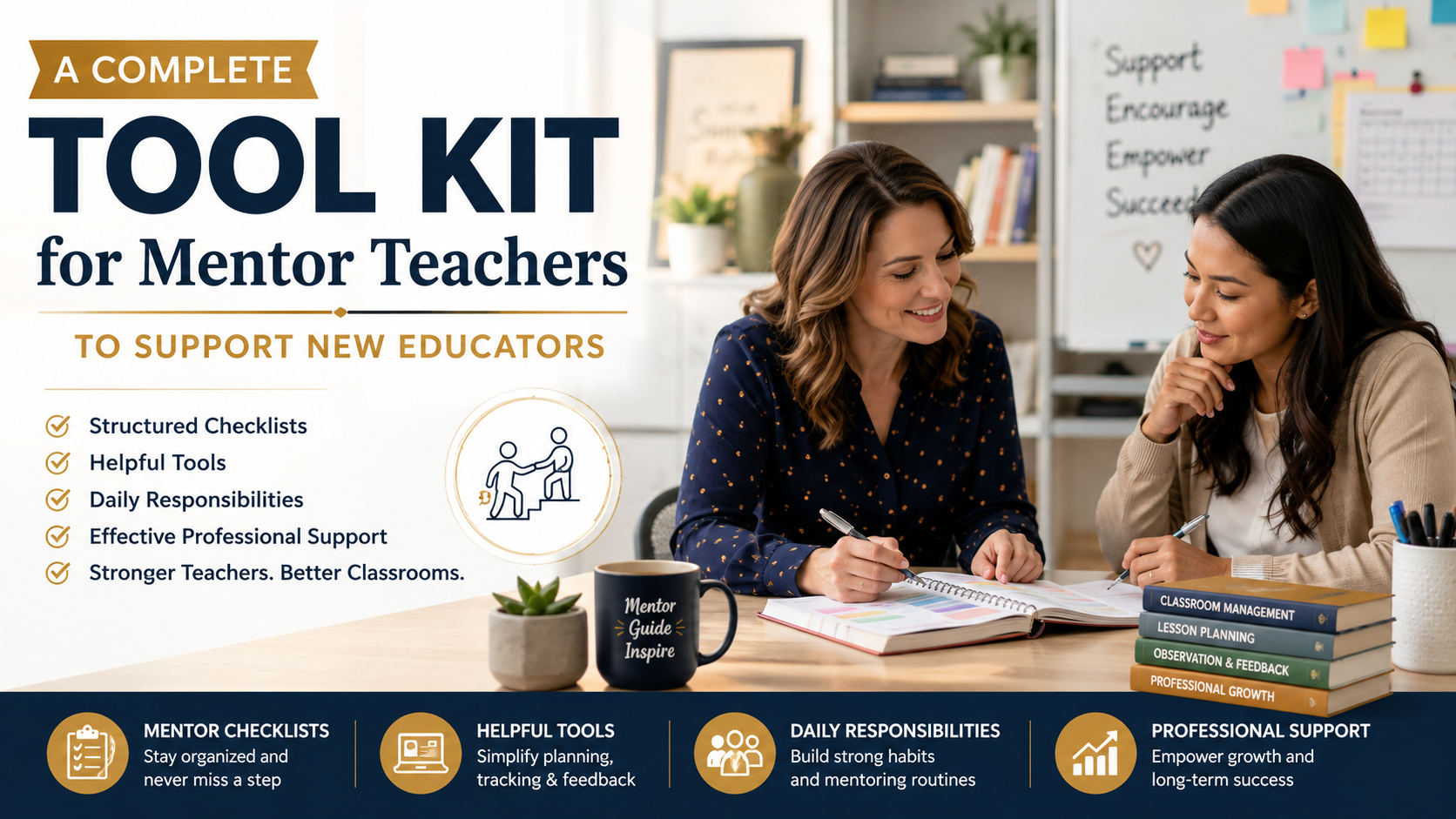
A Complete Tool Kit for Mentor Teachers to Support New Educators
Stepping into a leadership role as an experienced educator is both a privilege and a profound responsibility. When you guide a newly hired or student teacher, your influence shapes their entire career trajectory and impacts student success across the classroom. Having a reliable tool kit for mentor teachers ensures you never miss a critical step during orientation, observation, or constructive feedback sessions. Navigating this transition smoothly requires structured resources, clear expectations, and intentional professional support. According to the National Education Association, comprehensive teacher induction programs significantly improve staff retention and instructional quality. This guide breaks down the essential components every seasoned educator needs, including what a mentor checklist involves, helpful daily resources, core daily responsibilities, specialized mentoring tools, and the foundational pillars of effective professional support.
What Is a Mentor Checklist?
A mentor checklist is an organized, step-by-step document that guides experienced educators through the key milestones of supporting a new teacher. It outlines administrative tasks, classroom management check-ins, professional goals, and emotional support needs throughout the school year. A clear checklist helps mentors avoid missing important onboarding steps during busy academic terms.
It also creates transparency between the mentor and mentee. Both educators can see what has been completed and what still needs attention. This structure supports accountability while keeping professional development focused and manageable.
A useful mentor checklist may include:
- First-week orientation and school walkthroughs
- Classroom management discussions
- Lesson planning reviews
- Classroom observations
- Professional development goals
- Mid-year progress evaluations
- End-of-year reflections
Mentors can also strengthen these practices by focusing on building positive student relationships, an important part of effective classroom support.
Tracking Progress and Milestones
Tracking progress and milestones helps new teachers meet professional benchmarks throughout the academic year. A well-designed mentoring tracker divides goals into weekly, monthly, and term-based milestones. This approach makes professional development easier to manage and keeps both educators focused on practical priorities.
Instead of waiting for formal evaluations, mentors can review progress regularly. Short check-ins can identify challenges before they become larger problems. They also create opportunities to recognize improvements and adjust goals when needed.
A useful progress tracker can monitor areas such as:
- Classroom management
- Lesson planning
- Student engagement
- Assessment practices
- Communication with parents
- Professional development
- Personal teaching goals
Regular milestone reviews also reduce the pressure of last-minute preparation. New teachers receive feedback while there is still time to apply it. Mentors can then document progress and provide targeted guidance.
This consistent process supports steady teacher development and builds confidence throughout the school year.
What Are Some Helpful Tools for Teachers?
Helpful tools for teachers include digital organization platforms, collaborative lesson planning templates, observation forms, and professional development trackers. These resources can simplify daily workflows and reduce unnecessary administrative pressure. They also make communication between mentors and new teachers more consistent. Teachers should also develop digital literacy skills every student needs for success so they can model responsible and effective technology use in the classroom.
Shared cloud folders can provide one central location for lesson plans, observation notes, resources, and mentoring documents. Digital calendars can help mentors schedule classroom observations, feedback sessions, and important milestones. Grade books and planning systems can also support better organization when used appropriately.
Standardized rubrics are useful for creating objective feedback. They give mentors a consistent framework for reviewing areas such as classroom management, lesson pacing, instructional clarity, and student engagement.
Useful teacher mentoring tools may include:
- Shared calendars
- Cloud-based documents
- Lesson planning templates
- Classroom observation forms
- Digital grade books
- Feedback rubrics
- Professional growth trackers
The right tools should support the relationship rather than replace it. Technology works best when it makes mentoring conversations easier and more focused. As classrooms continue to evolve, understanding AI vs. human teachers can also help educators think critically about where technology should complement rather than replace human instruction.
Leveraging Digital Planning Platforms
Digital planning platforms can improve how mentors and mentees organize lessons, share resources, and exchange feedback. Shared calendars allow both educators to track observations, planning meetings, professional goals, and important school deadlines in one place.
Cloud-based documents also make collaboration easier. A mentor can review a lesson outline before class and provide suggestions without requiring another meeting. The new teacher can then revise the plan and document questions for later discussion.
These platforms can support several mentoring activities:
- Sharing lesson plans
- Scheduling classroom observations
- Recording feedback
- Tracking professional goals
- Organizing teaching resources
- Documenting progress
Digital planning also reduces preparation friction. New educators can access useful examples and resources without searching through scattered files. Mentors can model organized workflows that teachers may continue using throughout their careers.
However, technology should remain simple. Too many platforms can create additional work. The best digital mentoring tools are easy to access, clearly organized, and directly connected to the teacher’s daily responsibilities.
What to Do as a Mentor Teacher?
As a mentor teacher, your primary responsibility is to model effective instructional practices, provide constructive feedback, and offer consistent professional support. Mentoring involves more than explaining school procedures. It requires helping a new educator develop practical skills and confidence over time.
A mentor should observe lessons objectively and discuss specific areas for improvement. Collaborative debriefs can help the mentee understand what worked, what did not, and what could change during the next lesson. Mentors can also help new teachers navigate school policies, parent communication, classroom challenges, and professional expectations.
Effective mentoring includes:
- Setting clear goals
- Observing classroom instruction
- Providing specific feedback
- Encouraging self-reflection
- Sharing practical teaching strategies
- Supporting professional decision-making
- Maintaining appropriate confidentiality
Creating a safe and respectful environment is equally important. New teachers need to feel comfortable discussing mistakes and asking difficult questions. This supportive approach also connects with why teacher well-being matters for student success, since educators need sustainable support to perform effectively over time.
By combining constructive feedback with empathy, mentors can help educators develop authentic classroom confidence, stronger decision-making skills, and long-term professional resilience.
Conducting Constructive Classroom Observations
Constructive classroom observations should begin with clear goals. Before observing a lesson, the mentor and mentee can agree on one or two specific instructional areas to examine. This keeps the observation focused and prevents feedback from becoming overwhelming.
During the lesson, mentors should collect objective evidence rather than relying on general impressions. They might note student participation, questioning techniques, transitions, lesson pacing, or classroom management strategies.
A useful observation process includes:
- Discussing goals during a pre-conference
- Observing specific classroom behaviors
- Recording objective evidence
- Reviewing the lesson afterward
- Identifying practical next steps
The post-observation conversation should encourage reflection rather than feel like an evaluation. Mentors can ask the teacher what they noticed first and what they would change.
Specific feedback is more useful than broad comments. For example, discussing how students responded to a particular activity gives the teacher something concrete to consider.
This approach builds trust, self-assessment, and continuous improvement while turning classroom observations into meaningful professional learning experiences.
What Are Mentoring Tools?
Mentoring tools are practical instruments, reflection protocols, and conversation frameworks that support professional dialogue between experienced and new teachers. They help mentors move beyond informal advice and create more consistent coaching experiences.
Common mentoring tools include coaching scripts, cognitive coaching questions, self-assessment forms, observation templates, goal-setting worksheets, and reflection logs. Each tool serves a different purpose. Some encourage teachers to analyze challenges, while others help mentors structure feedback and track progress.
These resources can help mentoring conversations focus on evidence and solutions. Instead of immediately providing an answer, mentors can use reflective questions to help new teachers examine their own decisions.
Useful mentoring tools include:
- Coaching question prompts
- Classroom observation forms
- Self-assessment logs
- Goal-setting templates
- Reflection journals
- Feedback frameworks
- Professional growth trackers
The purpose is not to make mentoring mechanical. Tools should provide structure while leaving room for honest conversation and individual needs.
When used effectively, mentoring resources create a common language for professional growth. They can also strengthen collaboration and help transform a basic mentor relationship into a meaningful coaching partnership.
Utilizing Coaching Question Protocols
Coaching question protocols encourage new teachers to analyze challenges and develop their own solutions. Instead of immediately giving advice, mentors can ask open-ended questions that promote reflection and professional judgment.
For example, a mentor might ask what the teacher noticed about student engagement during a lesson. Another question could explore why a particular classroom strategy produced a certain result. These questions encourage the mentee to examine evidence before deciding what to change.
Effective coaching questions can explore:
- Student engagement
- Lesson design
- Classroom management
- Assessment strategies
- Teacher decision-making
- Possible alternative approaches
This inquiry-based process helps new teachers become more independent. They learn how to evaluate teaching challenges instead of relying on their mentor for every decision. Developing this kind of autonomy also reflects the value of independent learning habits, where learners gradually take greater responsibility for their own progress.
Mentors should still provide direct guidance when necessary. Coaching questions work best when combined with practical examples, relevant experience, and specific feedback.
Over time, this approach can strengthen independent problem-solving and professional autonomy. It also encourages teachers to view challenges as opportunities for reflection and improvement rather than simply as mistakes.
What Are the 5 Pillars of Mentoring?
The five pillars of mentoring provide a practical framework for building a productive professional relationship in education. These pillars are trust, active listening, goal setting, constructive feedback, and continuous reflection. Each one supports a different part of the mentoring process.
Trust creates the safety needed for honest conversations. Active listening helps mentors understand the challenges behind a problem rather than making quick assumptions. Goal setting gives the relationship clear direction and measurable priorities.
Constructive feedback helps new teachers identify strengths and improve specific areas of practice. Feedback should be specific, respectful, and focused on behaviors or outcomes. Finally, continuous reflection helps both educators review progress and adjust their approach over time.
Together, these five pillars create a balanced mentoring relationship. They prevent mentoring from becoming one-sided or overly focused on evaluation.
A strong mentoring process should help novice teachers become more confident, capable, and independent. When these pillars work together, mentors can provide meaningful support while encouraging long-term professional growth and effective teaching practice.
Establishing Unwavering Trust and Safety
Establishing trust and psychological safety is one of the most important responsibilities of a mentor teacher. New educators may hesitate to discuss classroom struggles if they fear criticism or negative consequences. A supportive mentoring relationship gives them space to be honest about their experiences.
Confidentiality is an important part of that relationship. Mentors should clarify what information remains private and what situations may require appropriate professional reporting. Clear expectations prevent misunderstandings and help establish boundaries from the beginning.
Mentors can build trust by:
- Listening without immediately judging
- Respecting professional boundaries
- Keeping commitments
- Focusing feedback on improvement
- Acknowledging challenges honestly
- Encouraging questions and self-reflection
Trust does not develop through one conversation. It grows through consistent actions over time. A mentor who responds calmly to mistakes creates a safer environment for learning.
When new teachers feel respected, they are more likely to discuss weaknesses and experiment with better approaches. This makes mentoring more productive and turns difficult experiences into practical opportunities for professional growth.
Frequently Asked Questions
How Often Should Mentor Teachers Meet With Their Mentees?
Mentor teachers should ideally meet with their mentees at least once a week for dedicated, uninterrupted collaboration. A Tool Kit for Mentor Teachers can include meeting schedules, discussion prompts, and progress trackers to make these sessions more productive. Brief daily check-ins can also address urgent classroom concerns. Meeting frequency should reflect the mentee’s experience, confidence, and current challenges. Consistent communication helps prevent small problems from becoming larger obstacles.
What Should Be Avoided When Mentoring a New Teacher?
Mentors should avoid taking over the classroom, micromanaging lessons, or providing excessive unsolicited criticism. These behaviors can reduce confidence and make new teachers dependent on constant direction. A Tool Kit for Mentor Teachers should encourage collaborative problem-solving rather than simply providing solutions. Mentors should offer specific feedback while respecting the mentee’s individual teaching style. They should also avoid overwhelming new educators with too much information at once. Patience, active listening, and clear guidance help build genuine independence.
How Can Mentors Handle Resistance or Defensiveness From a Mentee?
When a mentee becomes resistant or defensive, mentors should respond with empathy and curiosity rather than criticism. A Tool Kit for Mentor Teachers can provide coaching questions and reflection exercises that help structure these difficult conversations. Instead of arguing, ask questions about the reason behind the teacher’s concerns. Acknowledge their perspective before discussing classroom evidence and shared professional goals. This approach creates a collaborative environment where defensiveness can become an opportunity for reflection, communication, and professional growth.
How Long Does a Typical Formal Teacher Mentoring Relationship Last?
A typical formal teacher mentoring relationship lasts throughout the new educator’s first school year. Some programs extend support into a second year, especially when teachers need additional guidance with instructional strategies, differentiation, or leadership responsibilities. A Tool Kit for Mentor Teachers can help organize goals and resources across both years. Even after formal mentoring ends, informal professional support may continue. These ongoing relationships can strengthen collaboration, encourage knowledge sharing, and provide valuable guidance throughout a teacher’s career.
Conclusion
Supporting new educators requires intentional planning, consistent communication, and practical resources. A Tool Kit for Mentor Teachers can bring these elements together through checklists, planning templates, observation forms, coaching questions, and progress trackers. These resources help mentors provide structured support without making the relationship feel overly formal.
An effective Tool Kit for Mentor Teachers should also support the five pillars of mentoring: trust, active listening, goal setting, constructive feedback, and continuous reflection. These principles help create a safe environment where new educators can discuss challenges and develop independent solutions.
The purpose of a Tool Kit for Mentor Teachers is not to control every teaching decision. Instead, it should help mentors guide new educators toward greater confidence, stronger classroom practices, and professional independence. With consistent meetings, thoughtful feedback, and practical resources, mentoring can become a meaningful part of long-term teacher development.