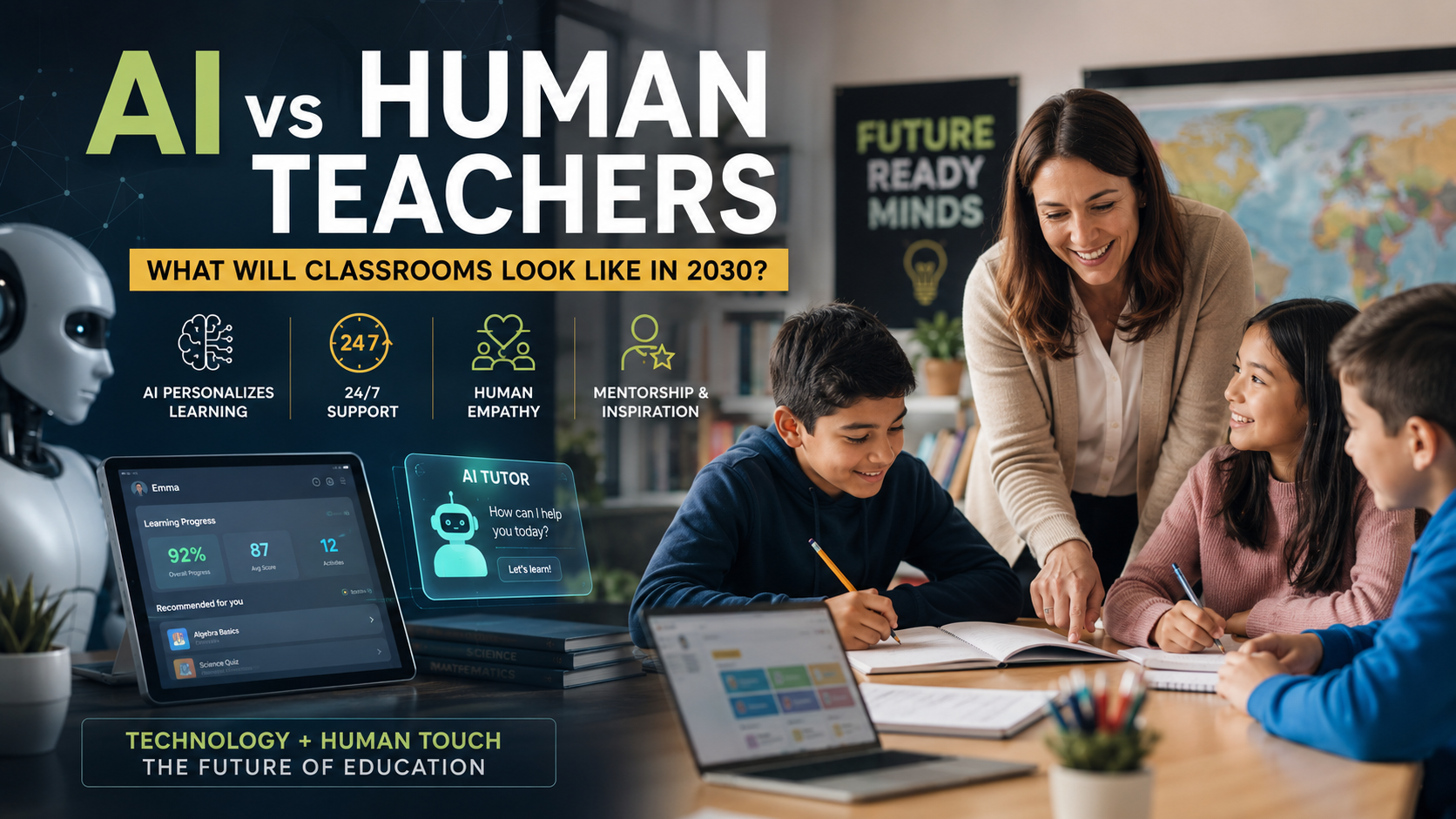
AI vs Human Teachers: What Will Classrooms Look Like in 2030?
The debate surrounding AI vs Human Teachers has shifted from science fiction speculation into an urgent topic for educators worldwide. As schools integrate tools built on platforms like OpenAI, artificial intelligence is rapidly entering modern classrooms. However, does this rapid technological shift signal the end of traditional educators? Or are we witnessing the birth of a powerful partnership between teachers and technology?
Understanding this evolution matters immensely for the future of schooling. Today’s students will graduate into an economy driven by automated tools, big data, and smart software. Consequently, school districts and parents must anticipate how teaching methods will change over the next decade.
In this article, we examine how artificial intelligence and traditional educators compare across core tasks. We will explore the strengths of automated software and highlight the irreplaceable qualities of human instructors. Finally, we will project what a typical school day will look like by 2030.
AI vs Human Teachers: Comparing Core Strengths in Education
To understand the future of learning, we must evaluate what automated software and human professionals do best. Neither side holds a complete monopoly on effective instruction. Instead, each offers distinct benefits that solve different educational challenges. Teachers have long struggled with large class sizes and heavy paperwork. Smart software addresses these scaling issues by processing complex data instantly.
However, true learning requires far more than basic information transfer. Education is fundamentally a social and emotional process built on trust, encouragement, and understanding. While an algorithm can track student scores, it cannot celebrate a student’s personal breakthrough. By evaluating AI vs Human Teachers, we can see how technology and personal mentorship complement one another.
Where Artificial Intelligence Excels in the Classroom
Smart software processes data at a scale no single person can match. Modern algorithms can parse thousands of student answers instantly. Instead of relying only on final exams, intelligent software continually tracks student performance across daily activities. This continuous tracking spots misunderstandings immediately, preventing students from falling behind unnoticed.
Furthermore, digital tools eliminate time boundaries for basic instruction. Automated systems provide round-the-clock homework help, allowing students to review difficult lessons at night. Routine paperwork, lesson planning, and test grading can also be automated. This gives teachers dozens of extra hours each month to focus directly on their students.
-
Personalized Learning Paths: Smart platforms analyze student progress. They automatically adjust lesson difficulty to match an individual’s exact pace.
-
Instant Diagnostic Feedback: Automated systems grade quizzes, check computer code, and offer step-by-step math solutions without delay.
-
24/7 Universal Accessibility: Digital tutors answer student questions at any hour, offering continuous help outside normal school hours.
-
Administrative Automation: Intelligent software generates lesson plan drafts, tracks attendance, and manages routine paperwork effortlessly.
Where Human Educators Remain Irreplaceable in Schools
While algorithms excel at data processing, they lack emotional intelligence, cultural awareness, and true empathy. Human connection remains the single most critical factor in student motivation and growth. A machine can deliver facts, but it cannot inspire curiosity or comfort a frustrated child. Teachers serve as role models who teach emotional resilience and teamwork through daily interactions.
In addition, human instructors adapt spontaneously to unpredictable classroom moments. When a planned lesson fails to engage the room, an experienced teacher pivots quickly. They use humor, personal stories, or real-world examples to recapture attention. Teachers also handle complex social issues and recognize subtle signs of personal struggle that sensors miss.
-
Empathy and Mental Health Support: A human teacher notices subtle signs of anxiety, sadness, or personal trouble that software cannot see.
-
Mentorship and Character Building: Teachers model ethical behavior, resilience, teamwork, and critical thinking through daily real-world interactions.
-
Creative and Spontaneous Adaptation: When a lesson falls flat, human instructors adjust their tone, pivot to storytelling, or use humor.
-
Nuanced Classroom Management: Managing group behavior and resolving social conflicts require deep intuition and lived human experience.
Key Differences: Digital Tutors vs Human Instructors
Comparing automated software with human educators highlights why a blended approach is essential for modern classrooms. The breakdown below outlines how each performs across fundamental instructional duties.
| Feature / Capability | Digital AI Assistant | Human Educator |
| Data Analysis | Exceptional speed and pattern recognition | Limited to manual grading and observation |
| Emotional Connection | Simulated text responses only | Authentic empathy, care, and rapport |
| Availability | Round-the-clock digital access | Limited to working hours and school days |
| Adaptability | Dependent on programmed logic | Instant pivot based on classroom mood |
| Cost Efficiency | High upfront cost, low scaling cost | Recurring salary and ongoing development |
Understanding these differences helps school leaders design better learning spaces. When technology handles data-heavy tasks, teachers gain the freedom to focus entirely on deep mentoring and character development.
AI vs Human Teachers: What Classrooms Look Like in 2030
By the year 2030, the traditional classroom setup will be largely transformed. Classrooms will evolve into dynamic, tech-enabled learning hubs where human teachers lead alongside smart digital co-pilots. Physical spaces will be redesigned to support small-group collaboration and hands-on projects rather than passive listening.
Technology will integrate smoothly into daily school routines. Smart displays, voice assistants, and learning dashboards will offer guidance without disrupting human interaction. Students will take greater ownership of their education, moving through custom lessons at their own pace while participating in group activities.
The Rise of the Automated Co-Teacher Model
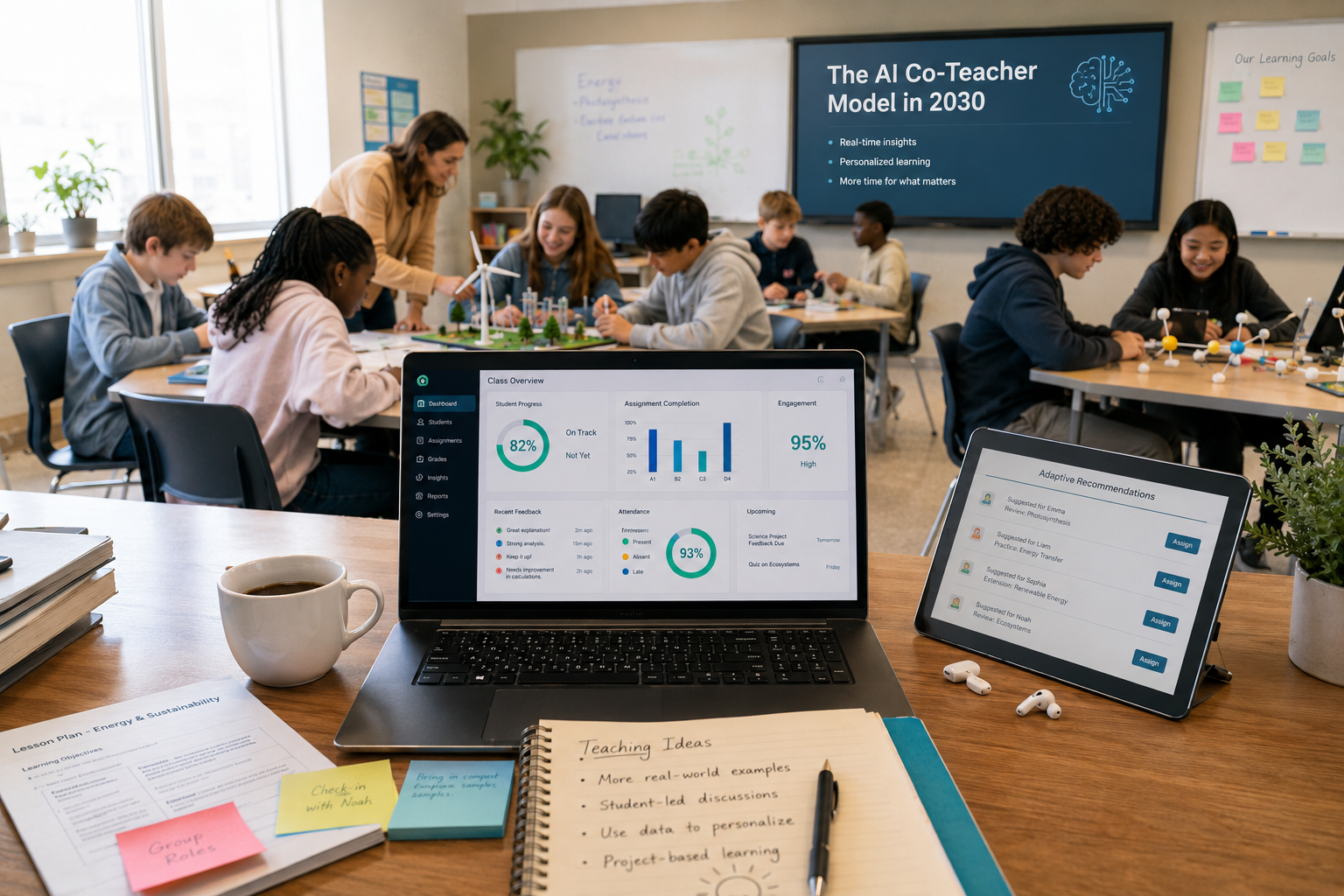
By 2030, every instructor will operate with an advanced software assistant acting as a permanent co-teacher. While the digital tool manages real-time grading, attendance, and drill work, the human educator leads group discussions and creative experiments. This partnership transforms the teacher’s role from a simple lecturer into an architect of learning experiences.
Rather than spending late evenings grading papers, teachers will review clear data dashboards. These dashboards highlight exactly which students struggled with specific concepts during the day. This data-driven approach allows for targeted one-on-one help during morning sessions. By removing repetitive work, the co-teaching model prevents teacher burnout and improves overall instruction.
Hyper-Personalized Curriculum and Smart Classrooms
Static textbooks will no longer dictate learning sequences in 2030. Smart software will generate custom reading lists, practice sets, and interactive modules tailored to each student’s personal interests and learning speed. A single classroom will easily accommodate students working at various skill levels simultaneously.
For instance, a student struggling with physics who loves sports will receive custom math problems based on basketball trajectories. Meanwhile, a peer interested in art will explore the exact same physics principles through light spectrums and color mixing. This deep personalization keeps student engagement high while ensuring everyone meets core educational standards.
FAQ SECTION
Will AI replace human teachers completely by 2030?
No, artificial intelligence will not replace human teachers completely by 2030. While technology will handle routine grading, administrative tasks, and personalized drill work, human educators remain essential for emotional support, mentorship, moral guidance, and complex classroom management. Learning is fundamentally a social experience that requires real trust and personal connection. Schools will adopt a hybrid model where technology assists teachers rather than replacing them entirely. This collaborative framework ensures students receive data-driven instruction while maintaining the essential human touch that fosters personal growth, ethical development, and lifelong curiosity.
What are the main benefits of AI in education?
The main benefits of integrating artificial intelligence into education include personalized learning, instant diagnostic feedback, reduced paperwork for teachers, and 24/7 learning assistance for students. Automated tools can quickly analyze student performance metrics to pinpoint specific learning gaps, allowing educators to intervene with precise instructional strategies. Additionally, smart software frees teachers from hours of repetitive grading and lesson preparation. This enables them to spend more direct, quality time mentoring students, facilitating group discussions, and building supportive classroom communities where every child feels valued.
What are the biggest risks of using AI in schools?
The biggest risks of using artificial intelligence in schools include data privacy concerns, loss of crucial human interaction, algorithmic bias, and digital inequality between wealthy and underfunded school districts. Over-reliance on automated tools can also hinder the development of critical thinking and social skills if screen time is not carefully balanced with human-led collaborative activities. Furthermore, if AI tools are trained on flawed or biased datasets, they may perpetuate unfair grading practices or deliver inaccurate information, requiring continuous oversight by qualified human educators at all times.
How will the role of a teacher change in the future?
The debate on AI vs Human Teachers shows that the teacher’s role will shift from a primary lecturer to a learning coach and mentor. Instead of standing at the front of the room delivering static lectures to large groups, instructors will focus on guided project work, social-emotional development, and individualized coaching based on data provided by intelligent software. Teachers will guide students on how to analyze information critically, evaluate AI-generated content, and apply knowledge ethically, ensuring that education remains focused on practical human wisdom rather than passive memorization.
How can current educators prepare for tech-integrated classrooms?
Current educators can prepare for tech-integrated classrooms by building fundamental digital literacy, experimenting with generative software for lesson planning, and learning how to interpret student data analytics. School leadership should provide ongoing professional development focused on ethical technology integration and human-centered pedagogy. Rather than fearing automation, teachers should learn to delegate administrative tasks to digital tools while sharpening their uniquely human skills—such as empathetic coaching, creative lesson design, inquiry-based learning, and building inclusive classroom cultures that inspire lifelong success.
CONCLUSION
Analyzing AI vs Human Teachers reveals that the future of education lies not in competition, but in synergy. Automated technology brings unprecedented precision, scale, and administrative relief to the learning environment. Meanwhile, human educators supply the empathy, inspiration, and moral guidance that turn raw information into meaningful wisdom. By joining these two forces together, we can build educational systems that are both highly efficient and deeply compassionate.
By 2030, classrooms will look strikingly different from those of past decades. Tech-enabled tools will curate personalized learning paths, grade routine assignments, and flag learning gaps in real time. Simultaneously, teachers will step into enhanced roles as mentors and facilitators. This evolution promises to make high-quality learning more engaging and accessible for students across diverse backgrounds worldwide.
To build effective learning environments for the decade ahead, educational leaders must invest equally in advanced technologies and comprehensive teacher training. Educators must also teach students how to use AI responsibly for homework to ensure technology enhances learning rather than replacing genuine effort. Embracing this collaborative partnership will ensure that future classrooms remain deeply human while harnessing the full power of modern innovation. Combining the best of human connection and technological speed will unlock true student potential.