
How Do Underwater Internet Cables Avoid Breaking All the Time?
These underwater internet cables form the hidden backbone of global digital communication. These fiber-optic lines stretch across ocean floors and connect continents, carrying internet traffic, international calls, financial transactions, and cloud data. Despite facing extreme pressure, fishing activity, ship anchors, and natural hazards, engineers design them to operate reliably for decades. The same underwater environment is also being explored for technologies such as tidal energy turbines.
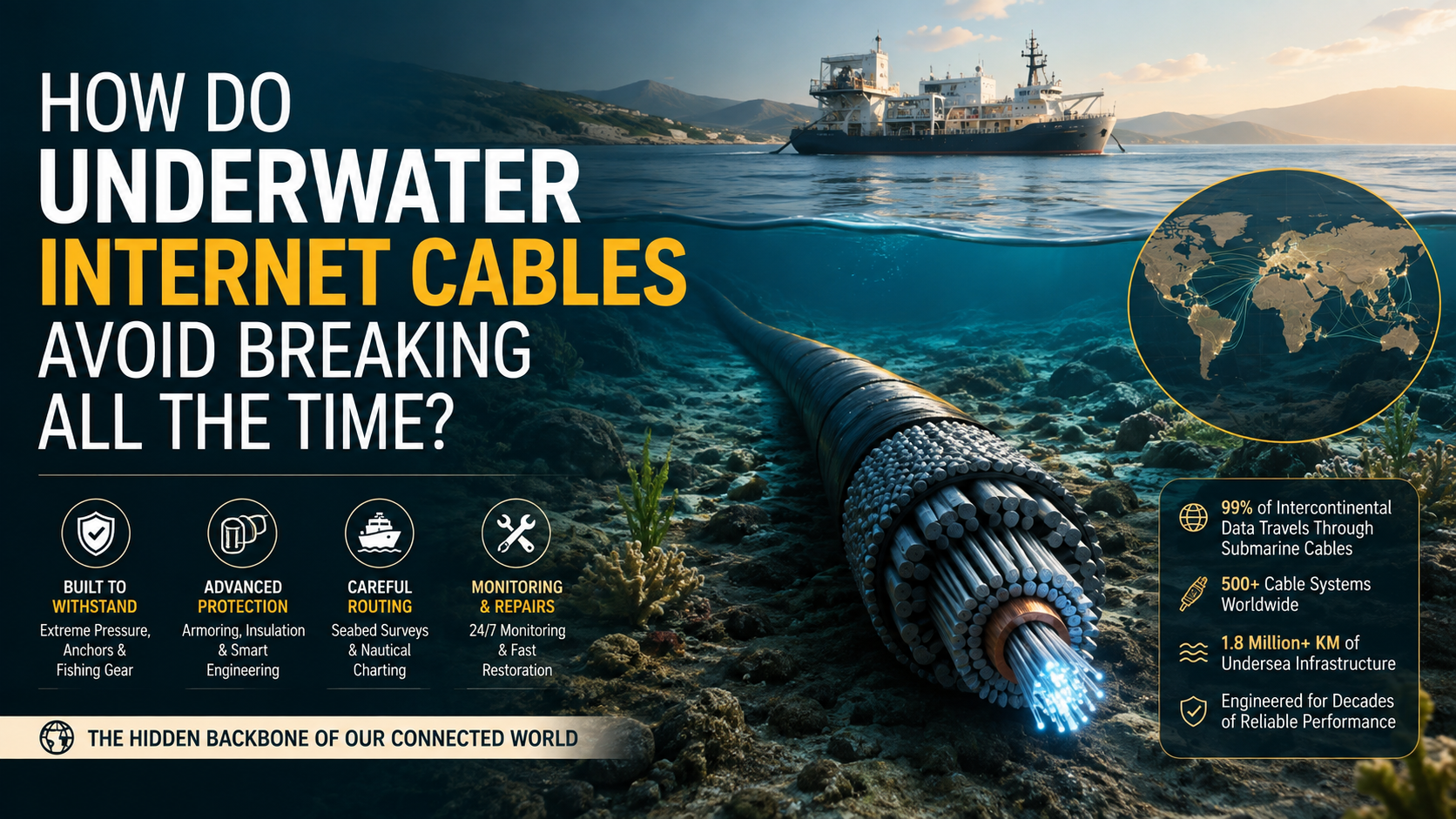
The International Cable Protection Committee (ICPC) says submarine cables carry more than 99% of the world’s intercontinental data connectivity. They support internet access, international calls, cloud services, financial transactions, and business communications.
Protecting these cables is a major engineering challenge. They must withstand pressure, movement, fishing activity, anchors, and natural hazards. Their design also changes depending on the seabed and water depth.
This guide explains how underwater internet cables are protected. It also covers their lifespan, repairs, ownership, and the risks they face.
How Can Undersea Cables Be Protected?
Protecting undersea cables begins before they reach the ocean floor. Engineers carefully survey the seabed and select routes that reduce exposure to hazards. Near busy coastlines, cables face greater risks from fishing equipment and ship anchors. Operators therefore use burial, armoring, route planning, and charting to improve protection.
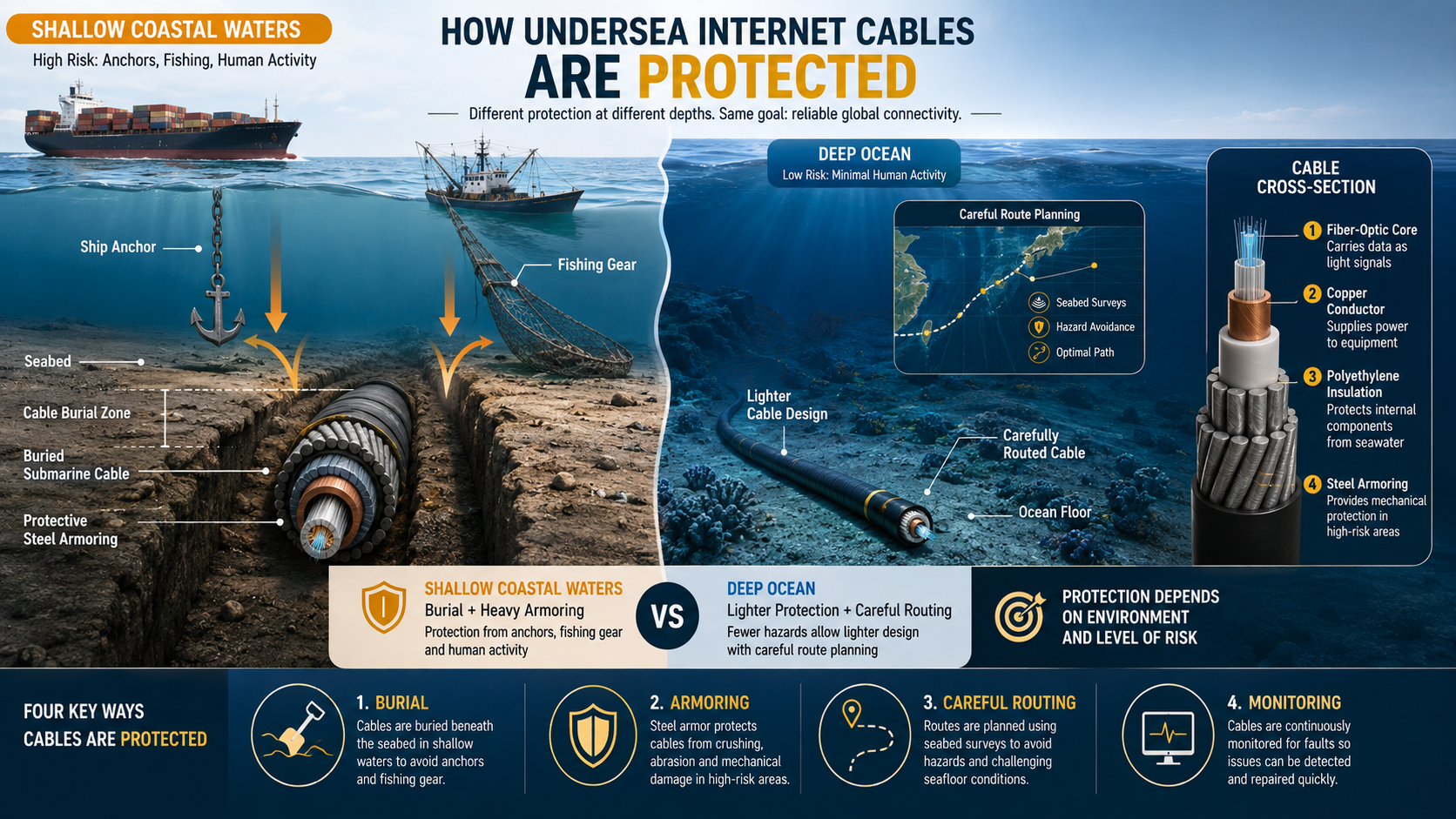
Cable burial is especially important in shallow waters. Specialized equipment can place cables beneath the seabed, reducing the chance of contact with anchors or fishing gear. The required burial depth varies with local conditions and seabed characteristics.
In deeper water, cables often rest directly on the seabed. There, heavy armoring is usually less necessary because large anchors and fishing gear rarely reach the cable.
Modern submarine cables also use several protective layers. These can include polyethylene insulation, steel wires, and a waterproof copper conductor surrounding the fiber core.
Together, burial, armoring, careful routing, and monitoring help submarine cables survive for decades.

Armoring Against Deep-Sea Anchors and Fishing Gear
Human activity is the leading cause of submarine cable faults. The greatest risks occur in shallow coastal waters, where fishing and shipping are common. According to the ICPC, around 70–80% of submarine cable faults result from accidental human activity, especially fishing and ship anchors.
Engineers reduce these risks by burying cables beneath the seabed. Specialized cable plows can create trenches and place the cable below the surface. Burial depth depends on the route, seabed, and expected hazards, rather than one universal standard.
Armoring provides another layer of protection. Steel wires surround the cable and help resist crushing, abrasion, and mechanical damage. Heavily armored designs are particularly useful near shore.
Cable routes are also identified on nautical charts. This gives mariners information about important subsea infrastructure and helps reduce accidental damage.
The cable does not need the same protection everywhere. In deep ocean areas, fewer human activities reach the seabed. Engineers can therefore use lighter cable designs while relying on careful route selection and natural separation from most surface hazards.
Are There Really Internet Cables Under the Ocean?
Yes. Underwater internet cables are real, and they carry most international digital communications. Despite the popularity of satellites, global internet traffic primarily travels through fiber-optic cables beneath the oceans.
These cables connect continents, countries, islands, data centers, and major cities. Inside each cable are extremely thin glass fibers. Lasers send pulses of light through those fibers, representing digital information as it travels across long distances.
Submarine cables can look surprisingly small compared with the enormous amount of data they carry. Deep-sea telecommunications cables may be only a few centimeters wide. Heavier armored versions become thicker near shore, where physical hazards are greater.
Satellites still play an important role. They provide connectivity in remote regions and support services where cables are impractical. However, submarine fiber systems offer enormous capacity and low latency for international networks.
This hidden infrastructure forms the physical foundation of modern global connectivity. Without it, international internet traffic would face severe capacity and latency limitations.
The Scale of the Global Submarine Network
The global submarine cable network is enormous. The ICPC currently describes roughly 500 submarine cable systems and about 1.8 million kilometers of cable infrastructure worldwide.
These systems cross the Atlantic, Pacific, Indian, and other major ocean regions. They connect countries to international internet exchanges, cloud platforms, financial networks, and data centers.
The network also contains considerable redundancy. Several cables may connect the same broad regions through different routes. This design helps networks continue operating when one cable experiences a fault.
Major technology companies, telecommunications operators, and cable consortia continue investing in new systems. Growing cloud usage, video traffic, artificial intelligence, and international data demand are increasing the need for capacity, including emerging approaches such as floating, wave-powered data centers.
The scale of this infrastructure also explains why cable protection matters. A single cable fault does not normally disconnect an entire country. However, multiple faults in a busy region can create congestion and longer routes.
Route diversity and redundancy therefore form an important part of global internet resilience.
How Long Do Undersea Cables Last?
Submarine cables are built for long-term operation, but there is no universal lifespan for every system. A common industry benchmark is a 25-year design life for many wet-plant components. That does not mean every cable operates for exactly 25 years.
Actual service life depends on several factors. These include the cable’s design, capacity, fault history, maintenance needs, technology changes, and economic value. Some cables remain useful after their original design period, while others are retired earlier for commercial reasons.
During operation, cables must withstand cold water, hydrostatic pressure, seabed movement, and occasional natural hazards. Their construction protects the fiber core and electrical components from the surrounding seawater.
Modern systems are also designed with maintenance in mind. Operators can monitor optical performance from landing stations and investigate signs of degradation.
A cable’s physical survival and commercial lifespan are therefore different things. A technically sound system may become economically outdated before its components fail.
This distinction explains why 25 years is better understood as a design benchmark, not a guaranteed retirement date.
Maintenance and Lifespan Extension Strategies
Submarine cable operators continuously monitor network performance. Equipment at cable landing stations can detect changes in optical signals and help engineers identify possible faults. These measurements can provide valuable information before and after a cable problem occurs.
When a fault is suspected, engineers estimate its location using measurements from the cable’s shore-end equipment. The operator can then coordinate with a specialized maintenance provider or repair vessel.
Regular maintenance also supports long-term reliability. Operators maintain repair agreements, spare cable, and specialized equipment in strategic locations. This preparation reduces the time needed to respond when damage occurs.
However, maintenance does not mean physically inspecting every kilometer of cable. Much of the system operates quietly on the seabed without human intervention.
The ICPC says the industry has an established global maintenance framework. It includes repair vessels, marine engineering expertise, and cooperative maintenance arrangements.
These measures help extend useful service and restore connectivity after faults. Preparedness is as important as cable strength because even well-protected systems can eventually suffer damage.
What Happens If an Undersea Cable Breaks?
A broken submarine cable does not usually mean an entire country loses internet access. Modern networks are designed with multiple routes and alternative capacity. When a cable fails, network operators can redirect traffic through other available systems.
The effect depends on how important the damaged cable is and how much spare capacity exists nearby. A major fault can still cause congestion, slower connections, or increased latency.
Once operators identify a fault, they estimate its position using electrical and optical measurements. A specialized repair vessel then travels to the affected area. The crew locates the cable, brings the damaged section to the vessel, and prepares it for repair.
Repair teams remove the damaged portion and join the healthy cable ends. The repaired section is then tested before the cable is returned to the seabed.
The process can take time because vessels must travel to the site. Weather, permits, seabed conditions, and regional restrictions can also delay repairs.
The industry handles many faults every year. The ICPC reports roughly 150–200 submarine telecommunications cable faults annually worldwide.
Specialized Repair Ships and Splicing Techniques
Repairing a damaged submarine cable requires specialized ships and highly trained crews. Once a repair vessel reaches the fault area, technicians must first locate and recover the cable safely.
Depending on the site, crews can use grapnels or remotely operated vehicles to work around the cable. The damaged section is then lifted aboard the vessel. Engineers cut away the faulty portion and prepare the remaining fiber ends.
The glass fibers inside the cable are extremely small. Technicians use fusion splicing equipment to join matching fibers with precise alignment. The repaired fibers are protected inside a new joint designed to withstand seawater and mechanical stress.
After splicing, engineers test the connection. They check optical performance and confirm that the repaired section meets system requirements.
The vessel then lowers the cable back toward the seabed. In shallow or hazardous areas, additional burial or protection may be required.
This process demonstrates why submarine cable repair is so specialized. It combines optical engineering, marine operations, navigation, and careful project coordination.
The result is a repaired link that can return to service without replacing the entire cable route.
Who Owns Underwater Internet Cables in India?
India’s international connectivity depends heavily on submarine cable systems. Ownership is not concentrated in one company. Instead, systems can involve telecommunications operators, technology companies, infrastructure providers, and international cable consortia.
Companies such as Tata Communications, Bharti Airtel, and Reliance Jio participate in India’s international connectivity ecosystem. Their involvement can include ownership, consortium participation, capacity investment, or network services.
Tata Communications, for example, continues to invest in submarine connectivity serving India and international markets. Its recent investments include routes linking Mumbai and Chennai with Singapore.
This shared model provides important advantages. Multiple operators and routes can improve redundancy and give networks more options when a cable experiences a fault.
India’s position between Europe, the Middle East, Africa, and Asia also makes its submarine infrastructure strategically important. International cable routes connect Indian networks with major global data centers and cloud regions.
Therefore, asking who owns India’s underwater internet cables has no single answer. Ownership and capacity rights vary by cable system, while several operators contribute to India’s broader international connectivity.
Strategic Landing Stations and Coastal Hubs
Submarine cables do not remain underwater for their entire journey. They come ashore at cable landing stations, where subsea systems connect with terrestrial fiber networks.
India has several important landing locations. Mumbai and Chennai are major connectivity hubs, while other coastal locations also support international and regional systems.
Landing stations contain specialized equipment that manages the transition between submarine and terrestrial networks. These facilities are carefully secured because they form important points in the communications chain.
The coastal environment also creates additional risks. Cables become more vulnerable as they approach shore because fishing, anchoring, construction, and other human activities become more common. This is one reason operators use stronger protection and burial near landing areas, while other offshore technologies are also developing, including offshore wind farms.
The ICPC notes that submarine cable faults are particularly concentrated closer to shore. Its 2024 repair analysis found that most reported repairs occurred in territorial waters and exclusive economic zones.
Protecting landing stations and coastal cable routes is therefore essential. A resilient international network needs both strong subsea infrastructure and secure terrestrial connections.
FAQ SECTION
How deep do underwater internet cables actually go?
Most submarine lines rest on the continental shelf at shallow depths, but many descend into deep ocean trenches. Some routes plunge as deep as eight thousand meters below the surface, matching the depth of the deepest oceanic abyssal plains and trenches.
Do sharks really bite underwater internet cables?
Yes, early historical records and modern observations show that sharks occasionally bite deep-sea lines, likely because electromagnetic fields attract them. Modern lines now feature specialized steel armor that helps prevent shark bites and mechanical punctures.
How fast does data travel through an undersea cable?
Data travels through fiber-optic cables at roughly two-thirds the speed of light in a vacuum. Because light moves extremely fast through pure glass, messages can cross the Atlantic Ocean between continents in less than sixty milliseconds.
How much do these massive underwater cable projects cost?
Building a new transoceanic communication route requires a multi-million-dollar investment that often exceeds hundreds of millions of dollars. The final price tag depends heavily on the total distance, route complexity, landing station locations, and the system’s total fiber capacity.
Conclusion
Understanding how underwater internet cables survive harsh ocean conditions reveals the remarkable engineering behind the modern internet. These cables cross vast distances while facing pressure, seabed movement, fishing activity, anchors, and natural hazards.
Protection begins with careful route planning. In shallow waters, operators use burial and armoring to reduce exposure to human activity. In deeper waters, lighter cable designs can operate with fewer physical hazards.
The network also depends on redundancy and maintenance. When a cable fails, operators can often reroute traffic while specialized repair crews restore the damaged section. This resilience helps prevent individual faults from becoming widespread internet outages.
India also plays an important role in the global submarine network. Major landing hubs and investments from telecommunications and technology companies connect the country with international markets.
As global data demand continues to rise, submarine cables will remain essential. These cables may remain hidden beneath the ocean, but they form the physical backbone of our connected world.