
Panthalassa’s Floating, Wave-Powered Data Centre Technology: The Future of Clean AI Infrastructure?
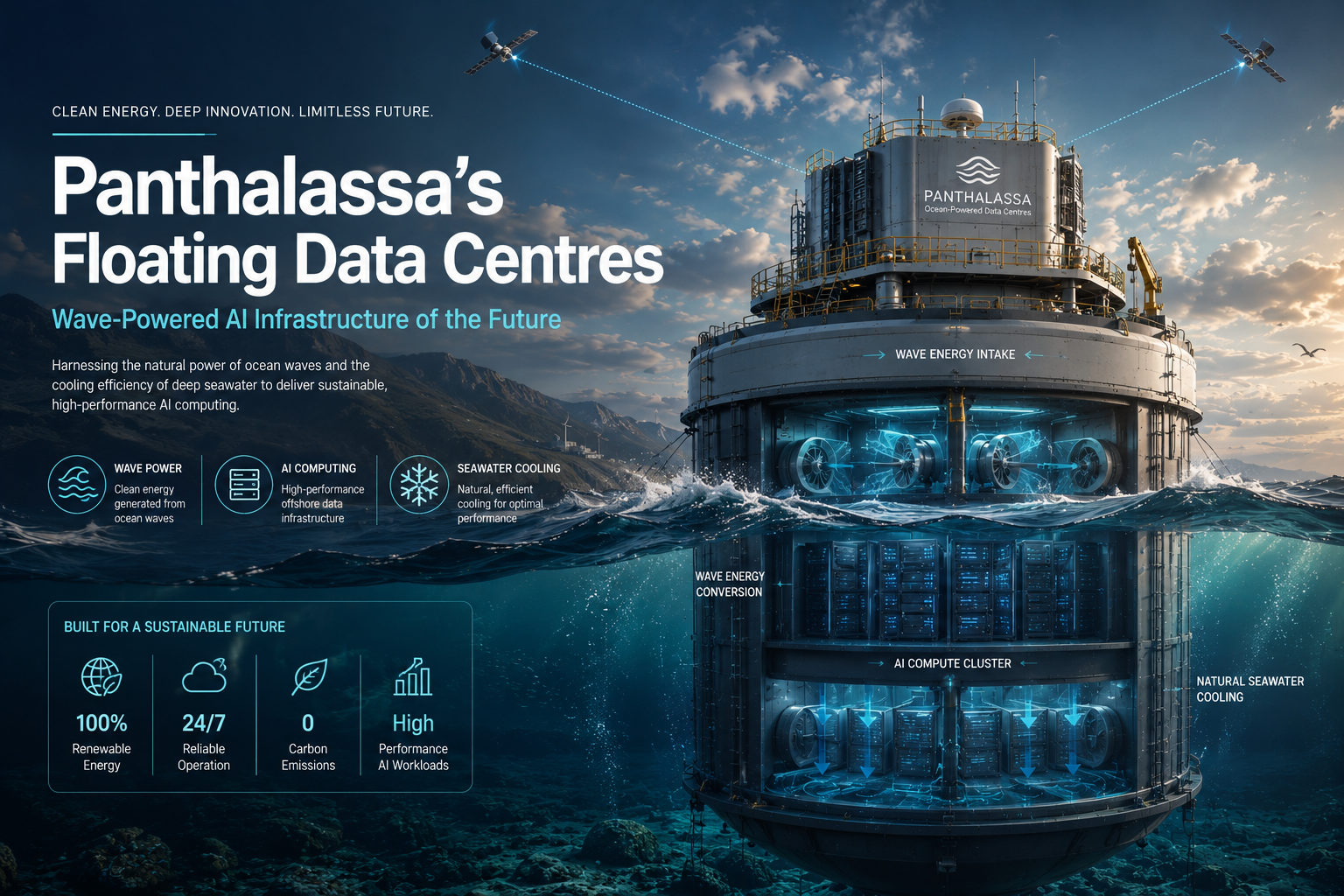
Panthalassa’s floating, wave-powered data centre technology is designed to address the growing demand for AI computing power. The artificial intelligence boom has created massive pressure on traditional data centres, and many energy systems struggle to support this rapid expansion. Panthalassa, an Oregon-based startup, proposes a new solution by moving advanced computing infrastructure into the open ocean.
The company designs floating data centres that capture energy from ocean waves and convert it into electricity for AI workloads. This approach removes the need for traditional land-based power connections and reduces pressure on existing electrical grids.
Panthalassa’s technology focuses on two major challenges: sustainable energy production and efficient cooling. The offshore systems generate their own power and use the surrounding seawater to manage heat from advanced computer hardware.
This article explores how these floating systems work, why the company attracted major investment, and how ocean-based computing could influence the future of clean AI infrastructure.
How Panthalassa’s Floating, Wave-Powered Data Centre Technology Works

Panthalassa follows a simple principle: place computing systems close to renewable energy sources. Instead of producing electricity offshore and sending it back to land, the company places servers directly inside floating ocean structures.
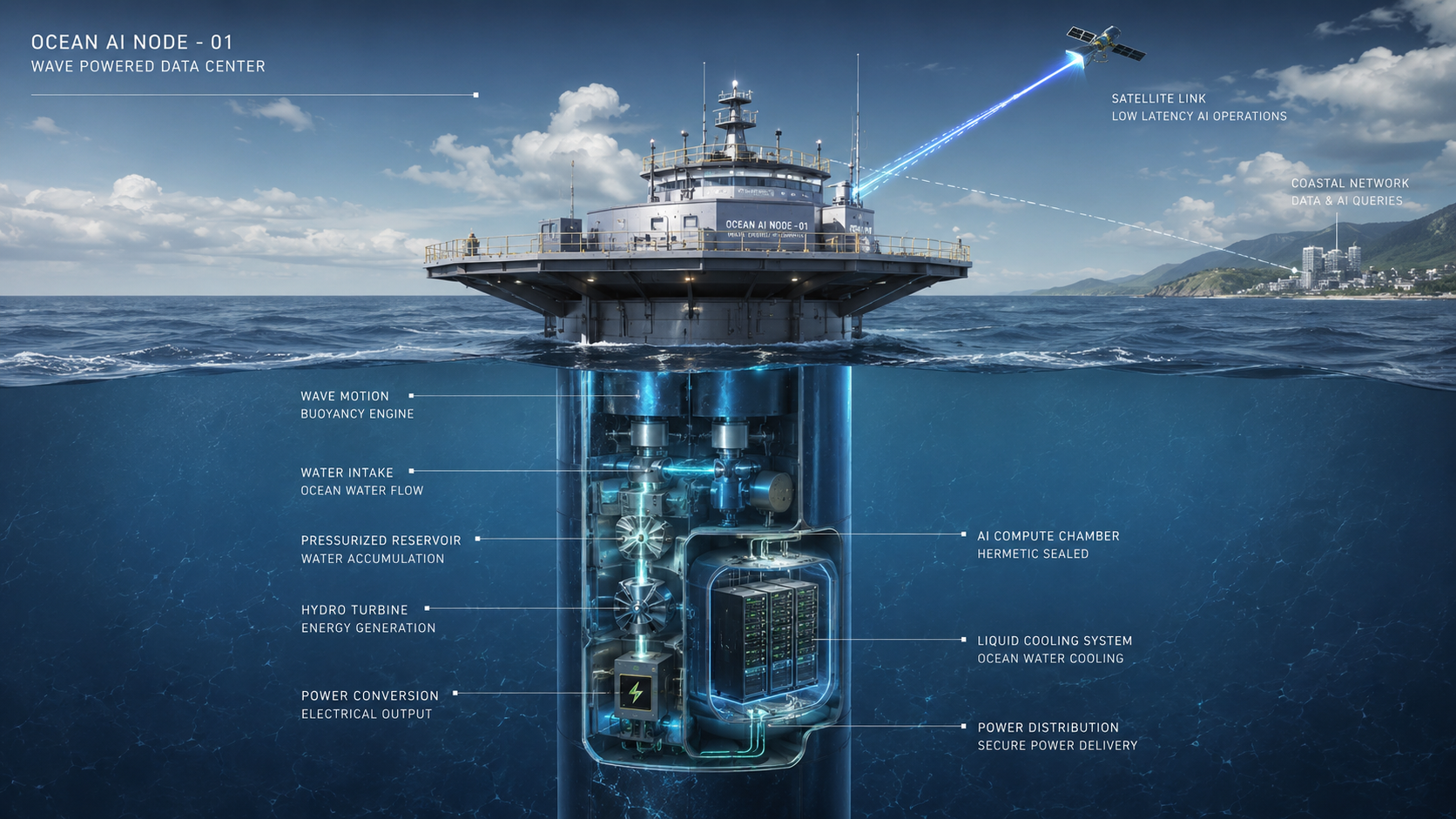
These offshore nodes use wave movement to generate electricity. Panthalassa’s floating systems combine renewable energy generation with autonomous AI infrastructure. Ocean swells move the structure up and down, forcing water through an internal system. The moving water powers turbines that create energy for onboard AI processors.
The design removes several problems linked to traditional data centres. Land facilities often compete for electricity, space, and cooling resources. Panthalassa’s ocean-based approach avoids these limits by operating independently at sea.
The company also connects these platforms through satellite networks instead of underwater cables. This allows remote operation while reducing the need for expensive marine infrastructure. Together, wave power, ocean cooling, and autonomous operation create a new model for future AI computing.
The Anatomy of Panthalassa’s Floating Compute Node
Panthalassa builds its offshore systems around large floating structures called nodes. These nodes use hollow steel cylinders that extend deep into the ocean. The main body reaches 50 to 80 meters below the surface, while the upper section spreads 15 to 30 meters across the water.
The design resembles a large vertical buoy. However, the structure does much more than float. It captures wave energy and transforms ocean movement into usable electricity.
The system works through three main stages. First, waves move the node and push seawater into an internal pressure chamber. Next, the pressurized water flows through a hydro turbine that generates power. Finally, the system sends electricity directly to onboard AI hardware.
The closed-loop design reduces mechanical complexity. Instead of using many external moving parts, the structure recirculates internal water. This reduces maintenance needs and improves long-term reliability in challenging ocean environments.
The mechanical architecture functions similarly to a self-filling hydroelectric dam, relying entirely on heavy-duty, earth-abundant materials like steel:
-
Kinetic Capture: As ocean waves cause the node to bob up and down, water is forced into an internal, pressurized reservoir.
-
Power Generation: This pressurized water drives an internal hydro turbine, which generates electricity continuously.
-
Closed-Loop System: The design eliminates high-maintenance mechanical failure points like external hinges, flaps, or gearboxes. It relies on a closed system that recirculates internal fluid to turn the generator.
-
Data Transmission: Because there are no physical wires linking the node to the mainland, all data routing and AI queries are processed via low-Earth-orbit satellite networks, specifically SpaceX’s Starlink.
Panthalassa’s Floating Data Centre Cooling Advantage
AI hardware produces enormous amounts of heat during operation. Traditional data centres spend large amounts of energy on cooling systems to protect processors. Panthalassa’s ocean-based approach uses the natural temperature of deep seawater to solve this challenge.
The company places computing equipment inside sealed underwater containers. The surrounding ocean absorbs heat from the hardware and works as a natural cooling system.
This method removes the need for energy-heavy cooling equipment. It also reduces dependence on freshwater resources, which many land-based facilities require for temperature control.
Deep-sea cooling creates an efficient environment for high-performance computing. As AI models become larger and demand more processing power, cooling efficiency becomes increasingly important.
By combining wave-generated electricity with passive seawater cooling, Panthalassa creates a system that could reduce the environmental impact of future AI infrastructure.
Panthalassa’s Floating Ocean Fleet Logistics
Operating computing infrastructure in the open ocean creates unique engineering challenges. Panthalassa designs its nodes to survive harsh marine conditions while working without constant human support.
Ships tow each node horizontally to its operating location. Once the structure reaches deep water, internal ballast systems rotate it into a vertical position. The node then begins its independent operation.
The platform uses autonomous systems to maintain its position. Sensors monitor ocean conditions and adjust the structure when currents or waves push it away from its target area.
The company designs the hull shape to improve stability and movement control. The nodes can operate in regions with strong and consistent ocean swells, especially areas in the Southern Hemisphere.
Autonomous operation reduces the need for frequent maintenance trips. This allows offshore data centres to function in remote locations while producing clean energy and supporting AI workloads.
Panthalassa’s Floating Node Navigation System
Floating data centres must remain stable despite changing weather and ocean conditions. Panthalassa solves this challenge through automated navigation and control systems.
Each node uses onboard technology to track its location and adjust its position. The system prevents the structure from drifting into shipping routes or restricted areas.
The vertical design improves stability because much of the structure remains below the surface. The deep underwater section acts like a heavy anchor, reducing movement caused by waves and currents.
The node’s hydrodynamic shape also helps it respond naturally to ocean forces. Instead of fighting every movement, the design uses the surrounding water to maintain balance.
This approach allows the platforms to operate independently for long periods. By combining renewable energy generation, satellite communication, and autonomous controls, Panthalassa aims to create a new generation of offshore computing facilities.
Frequently Asked Questions
Is Panthalassa a publicly traded company?
No, Panthalassa is not a publicly traded company at this time. The company operates as a privately held startup, which means everyday investors cannot purchase its shares through public stock exchanges such as NASDAQ or the New York Stock Exchange.
As a private company, Panthalassa receives funding from venture capital firms and private technology investors rather than public market shareholders. This allows the company to develop its offshore computing technology while raising capital through private investment rounds.
The company reportedly raised significant funding through a private Series A round, increasing investor confidence in its wave-powered data centre concept. This investment helped strengthen its position as a growing player in the clean AI infrastructure sector.
If Panthalassa chooses to become publicly traded in the future, it would need to complete an Initial Public Offering (IPO). An IPO would allow the public to buy shares and give the company access to broader financial markets.
Until that happens, ownership remains limited to founders, employees, and private investors.
Who is the CEO of Panthalassa?
The co-founder and CEO of Panthalassa is Garth Sheldon-Coulson. He leads the company’s mission to develop offshore computing systems powered by renewable ocean energy. His work combines experience from technology, energy, and investment fields.
Before founding Panthalassa, Sheldon-Coulson built a background across artificial intelligence, clean energy, and financial strategy. He previously worked as a senior investment associate at Bridgewater Associates, where he gained experience analyzing global economic trends and large-scale investments.
His academic background covers several disciplines. He earned a Doctor of Law (J.D.) from Harvard Law School, a Master of Science degree from the Massachusetts Institute of Technology (MIT), and a Bachelor of Arts degree from Swarthmore College.
Under his leadership, Panthalassa focused on developing and testing its wave-energy technology before entering the data centre industry. The company spent years refining its offshore systems, aiming to create a new approach for sustainable AI infrastructure.
Sheldon-Coulson’s vision centers on combining renewable energy, autonomous ocean platforms, and advanced computing to address the growing demand for cleaner AI operations.
What are the main benefits of moving data centers to the ocean?
Moving data centres offshore can solve several major challenges facing modern computing infrastructure. As artificial intelligence systems become more powerful, traditional land-based facilities require increasing amounts of electricity and cooling capacity. Many existing power grids struggle to support these large energy demands, which can delay the construction and expansion of new data centres.
Ocean-based facilities provide an alternative by generating energy closer to where computing takes place. Instead of depending on crowded terrestrial power networks, floating systems can use renewable ocean energy sources such as wave power. This allows the infrastructure to operate more independently from local electricity supplies.
Another major advantage comes from natural ocean cooling. AI processors create significant heat, and land-based facilities often rely on expensive mechanical cooling systems. Offshore data centres can use surrounding seawater as a natural heat sink, reducing energy consumption and freshwater usage.
By combining renewable energy production with efficient cooling, ocean data centres could lower operating costs and reduce the environmental impact of large-scale AI computing.
How do these floating nodes communicate with the mainland?
Panthalassa’s floating data centres operate far from traditional communication networks, so they avoid using physical connections such as undersea fibre-optic cables. Instead, the platforms rely on satellite-based communication systems to exchange data with users and operators on land.
Each ocean node connects through low-Earth-orbit (LEO) satellite networks, which provide high-speed communication over remote areas. When a user sends an AI request from the mainland, the data travels from the ground station to a satellite network. The satellite then transfers the information to the floating compute node in the ocean.
Once the request reaches the node, onboard AI processors complete the required calculations. The system processes the workload locally rather than sending large amounts of data back to land for every operation. After completing the task, the node sends the results back through the satellite network.
This wireless approach removes the need for expensive underwater cables and allows the platforms to operate in international waters. By combining renewable energy, autonomous operation, and satellite communication, Panthalassa creates a flexible model for future offshore computing.
What happens to the ocean nodes during severe storms?
Panthalassa designs its ocean nodes to handle extreme marine environments, including powerful storms and large ocean swells. The structures use a deep vertical design that keeps most of their mass below the surface, where water movement remains more stable. Instead of allowing waves to push against a large surface area, the node presents a smaller profile to incoming storms.
The hollow steel cylinder extends 50 to 80 meters underwater, creating a strong foundation that helps maintain balance. This deep structure works like a heavy pendulum. When waves move the upper section, the underwater mass naturally resists sudden changes and helps the node return to its original position.
The top section contains the critical computing equipment and remains sealed against water exposure. Its design allows large waves to move around and over the structure without causing major instability. Engineers also protect internal electronics from moisture, pressure changes, and harsh ocean conditions.
During severe weather, the autonomous control systems continue monitoring the node’s position and performance. The combination of deep-water stability, durable materials, and automated systems allows these offshore data centres to keep operating even in challenging storm conditions.
Conclusion
Panthalassa’s floating, wave-powered data centre technology offers an innovative path forward for an industry facing severe power constraints. By decoupling high-density AI computing from vulnerable terrestrial grids and placing it directly into high-energy ocean swells, the company provides a creative solution to the tech sector’s carbon footprint. The engineering design leverages passive seawater cooling and simplified internal hydro turbines to build a clean computing platform. While deploying unmoored fleets across international waters presents distinct regulatory and maintenance challenges, the influx of capital from major Silicon Valley investors indicates strong institutional confidence in the viability of offshore compute infrastructure.
As artificial intelligence infrastructure continues to evolve, technologies that improve computing efficiency and sustainability will become increasingly important. Understanding advanced AI concepts such as Generative Adversarial Networks (GANs) also highlights the broader innovations shaping the future of artificial intelligence.