
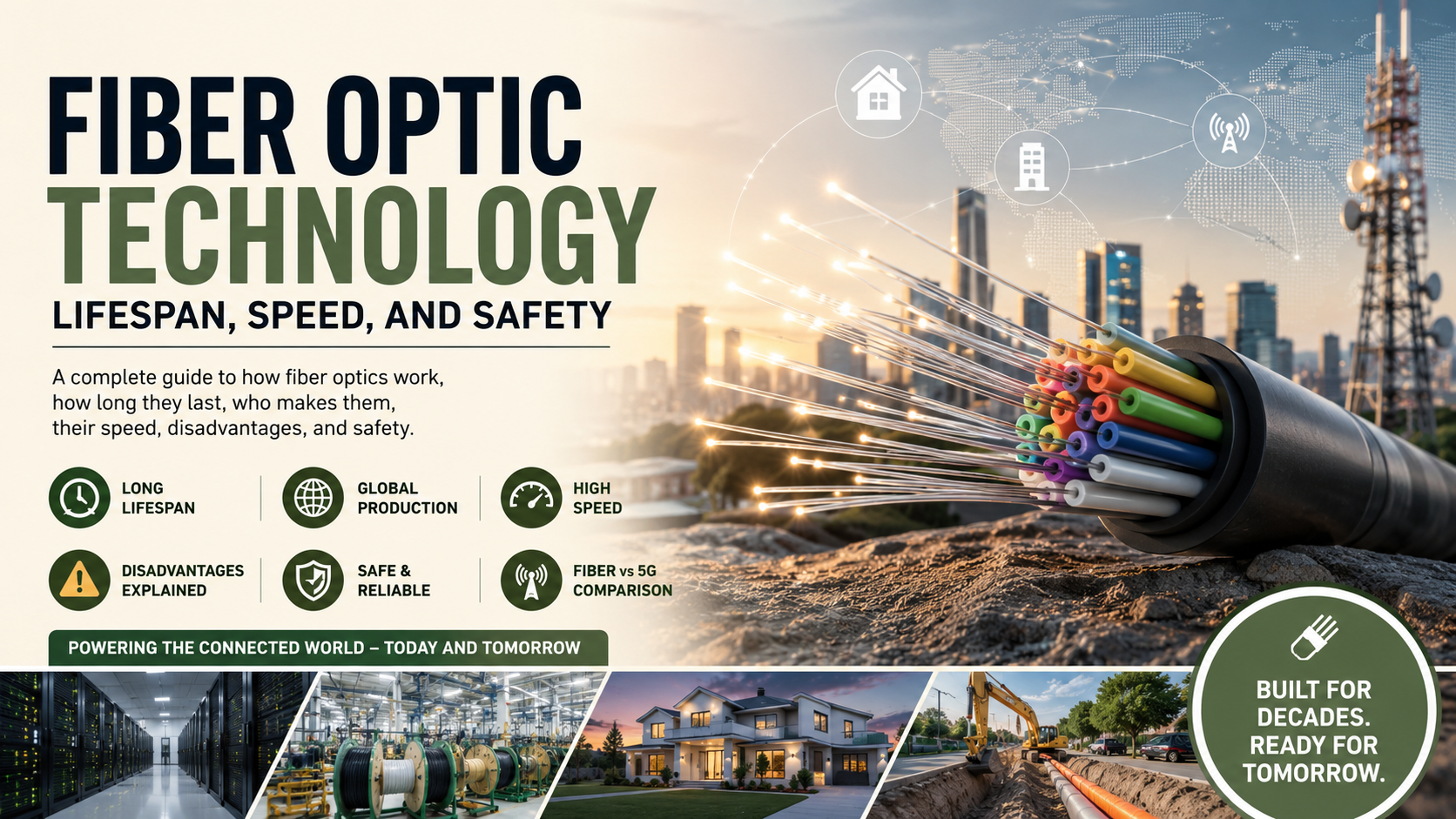
Fiber Optic Technology: Lifespan, Speed, and Safety
Fiber optic technology has transformed modern communication by enabling fast, reliable data transmission across cities, countries, and oceans. It sends information through pulses of light inside thin glass or plastic fibers. This method supports high bandwidth while keeping signal loss remarkably low over long distances. The Fiber Broadband Association describes fiber as a reliable broadband technology and highlights its long-term scalability.
Unlike copper networks, fiber uses light instead of electrical signals. This design helps reduce interference and supports increasingly demanding digital applications. Fiber networks now connect homes, businesses, data centers, mobile infrastructure, and other critical systems.
Understanding how fiber optic technology works can help consumers and businesses make better connectivity decisions. This guide answers key questions about fiber lifespan, global production, speed, disadvantages, and safety. It also explains how fiber compares with 5G and why it remains important for future internet infrastructure.

What Is the Lifespan of Fiber Optics?
Fiber optic cables can remain useful for several decades when they are correctly installed and maintained. The glass fiber itself does not have a simple expiration date. The Fiber Broadband Association notes that deployed fiber has no known fixed expiration date and can continue supporting networks for decades.
Unlike copper, glass does not corrode in the same way. Properly protected fiber can also withstand moisture, temperature changes, and many environmental conditions. The cable jacket and other protective layers help shield the delicate glass from physical damage.
Network operators often upgrade the equipment connected to fiber rather than replacing the fiber itself. New transmitters, receivers, and networking equipment can increase capacity without requiring new cable routes.
This makes fiber optic infrastructure a long-term investment. Its ability to support future upgrades is one reason fiber remains central to modern broadband networks.
Environmental Factors Affecting Cable Longevity
The glass core is durable, but the complete cable still requires careful protection. Excessive pulling force can damage fibers during installation. Sharp bends can also create stress and increase signal loss.
Outdoor cables may face additional risks from construction activity, severe weather, moisture, or rodents. Proper cable design can reduce these risks. Armored cables and suitable protective jackets provide additional physical protection where needed.
Installation quality is especially important. Technicians must follow the cable’s specified bend radius and pulling limits. They must also avoid crushing or sharply bending the cable during routing.
Regular inspection can help identify damaged sections before they cause service problems. When these precautions are followed, fiber can remain operational for many decades. This durability helps explain why operators continue using existing fiber while upgrading network equipment around it.
Who Is the Largest Producer of Fiber Optics?
China is currently the largest manufacturing base in the global optical fiber and cable supply chain. Recent industry data reported that China accounted for about 57% of global optical fiber production in 2025. It also represented a major share of optical preform and cable output.
This position reflects China’s large telecommunications market and extensive investment in broadband and communications infrastructure. Major manufacturers produce optical fiber, preforms, cables, and related components for domestic and international markets.
However, China is not the only important producer. The global industry includes major manufacturers in the United States, Japan, Europe, and other regions. These companies compete through manufacturing scale, specialized fiber designs, research, and advanced cable technologies.
The market also depends on international supply chains. Optical fiber manufactured in one country may become part of a cable assembled elsewhere. This interconnected system supports broadband expansion, data centers, mobile networks, and long-distance communications worldwide.
Key Manufacturing Players in the Global Market
Several major companies play important roles in the global fiber optics industry. Corning Incorporated is a leading U.S. manufacturer with a long history of developing optical fiber and related technologies. Other major suppliers operate across China, Japan, Europe, and additional telecommunications markets.
Manufacturers compete on more than production volume. They also develop specialized fibers for demanding applications. These include data centers, long-distance networks, telecommunications infrastructure, and high-capacity connections.
The industry continues to improve fiber performance as data requirements grow. Modern networks can use multiple wavelengths through a single fiber. This approach increases the amount of information that existing infrastructure can carry.
Manufacturing quality also affects reliability. Precise glass production, protective coatings, and cable construction help maintain performance over long distances. As cloud computing, artificial intelligence, streaming, and connected devices expand, demand for high-capacity optical infrastructure continues to rise.
Which Is Faster, 5G or Fiber?
For fixed broadband, fiber optic technology generally provides faster and more consistent performance than 5G. Fiber can deliver multi-gigabit connections with high upload and download capacity. The Fiber Broadband Association identifies fiber as a leading broadband technology for speed, reliability, and bandwidth.
5G can also provide very high speeds. Its biggest advantage is mobility. Users can access fast internet without a physical cable connecting their devices to the network. However, wireless performance can change based on signal strength, network congestion, spectrum, distance, and physical obstacles.
Fiber provides a dedicated physical transmission path. This makes performance more predictable for bandwidth-heavy applications. It also supports symmetrical speeds on many modern broadband plans.
Therefore, the better choice depends on the application. 5G is ideal for mobile connectivity, while fiber is usually better for fixed locations requiring maximum consistency, capacity, and reliability.
Latency and Bandwidth Comparison Metrics
Latency measures how long data takes to travel between two points. Fiber can achieve very low latency because signals travel through a controlled physical medium. Its performance is also less affected by local wireless interference.
5G can provide low latency as well, especially in favorable network conditions. However, wireless connections may experience changing performance because radio signals travel through the air. Buildings, distance, congestion, and network configuration can affect results.
Fiber also offers substantial bandwidth. Modern optical systems can carry multiple information streams using different wavelengths of light. This allows networks to increase capacity without replacing every physical cable.
These characteristics make fiber especially useful for applications that demand consistent performance. Examples include cloud services, video conferencing, online gaming, data centers, and large enterprise transfers.
For mobile users, 5G remains highly valuable. For fixed broadband, however, fiber generally provides the stronger combination of speed, capacity, latency, and stability.
What Are the Disadvantages of Fiber Optic Cable?
Despite its many advantages, fiber optic technology has several disadvantages. The biggest challenge is often the initial installation cost. Building new fiber networks can require construction work, specialized equipment, permits, and skilled technicians.
Fiber installation can also be more technically demanding than working with traditional copper. The glass strands are thin and require careful handling. Technicians must follow precise procedures when connecting and testing cables.
Repairs can take longer because damaged fibers usually require specialized tools. Fusion splicing equipment aligns and joins individual glass fibers with high precision. Technicians then protect the repaired connection inside an appropriate enclosure.
Fiber can also be difficult to deploy in areas with challenging geography or low population density. Digging trenches and installing supporting infrastructure can make rural projects expensive.
These limitations do not eliminate fiber’s long-term benefits. Instead, they explain why some regions continue using older infrastructure while gradually expanding fiber networks. Once deployed, fiber can support decades of network upgrades.
Installation Costs and Fragile Handling Requirements
Fiber installation requires specialized knowledge and equipment. Technicians must understand bend limits, pulling tension, connector standards, testing procedures, and splicing techniques.
The physical fiber is strong when properly protected, but the glass can be damaged by excessive bending or mechanical stress. A damaged fiber may continue working while experiencing higher signal loss. Careful installation therefore plays an important role in long-term reliability.
Fusion splicing also requires precision. A technician must align the fiber ends correctly before joining them. Testing equipment can then confirm whether the connection meets acceptable performance levels.
These requirements can increase labor and equipment costs. They also make professional installation important for large networks.
However, the higher upfront cost should be considered alongside fiber’s long service life and upgrade potential. Existing fiber can often support new networking equipment as technology improves. This scalability reduces the need for repeated cable replacement and can make fiber more economical over the long term.
Is Fiber Optic Safe for Health?
Fiber optic technology does not expose users to radio-frequency radiation through the cable itself. Fiber transmits information using light inside a glass core rather than electrical signals traveling through the cable. This makes fiber different from wireless communication systems that use radio waves.
The optical signal remains contained within the fiber during normal operation. People can therefore live and work around properly installed fiber infrastructure without concerns about routine exposure to the communication signal.
However, saying fiber is completely risk-free would be too broad. Technicians should never look directly into an active fiber connector or cable end. Optical equipment can contain concentrated light that may harm the eyes, even when the light is invisible.
For everyday users, properly installed fiber networks present no known health concern from radio-frequency exposure. The primary safety consideration during installation is handling active optical equipment correctly.
This distinction provides a more accurate view of fiber optic safety. The technology is generally safe for normal use, while trained workers should follow appropriate optical safety procedures.
Absence of Electromagnetic Interference Risks
Fiber has an important technical advantage because the fiber itself does not carry electrical signals. This means it is resistant to electromagnetic interference from nearby electrical equipment.
Copper cables can experience interference from motors, power systems, and other electrical sources. Fiber does not face the same problem because information travels as light.
This property makes fiber useful in environments where signal integrity is important. Hospitals, industrial facilities, laboratories, data centers, and telecommunications networks can benefit from its resistance to electromagnetic interference.
Fiber can also avoid creating electrical interference along the transmission path. However, the network equipment connected to the fiber may still use electricity and can generate electromagnetic fields. The fiber cable itself is not an electrical conductor.
For consumers, this distinction matters. Fiber should not be promoted as a technology with zero electromagnetic fields throughout an entire network. A more accurate statement is that the optical fiber itself does not transmit data through electromagnetic electrical currents.
Fiber Optic Technology FAQ
How does light travel through a fiber optic cable?
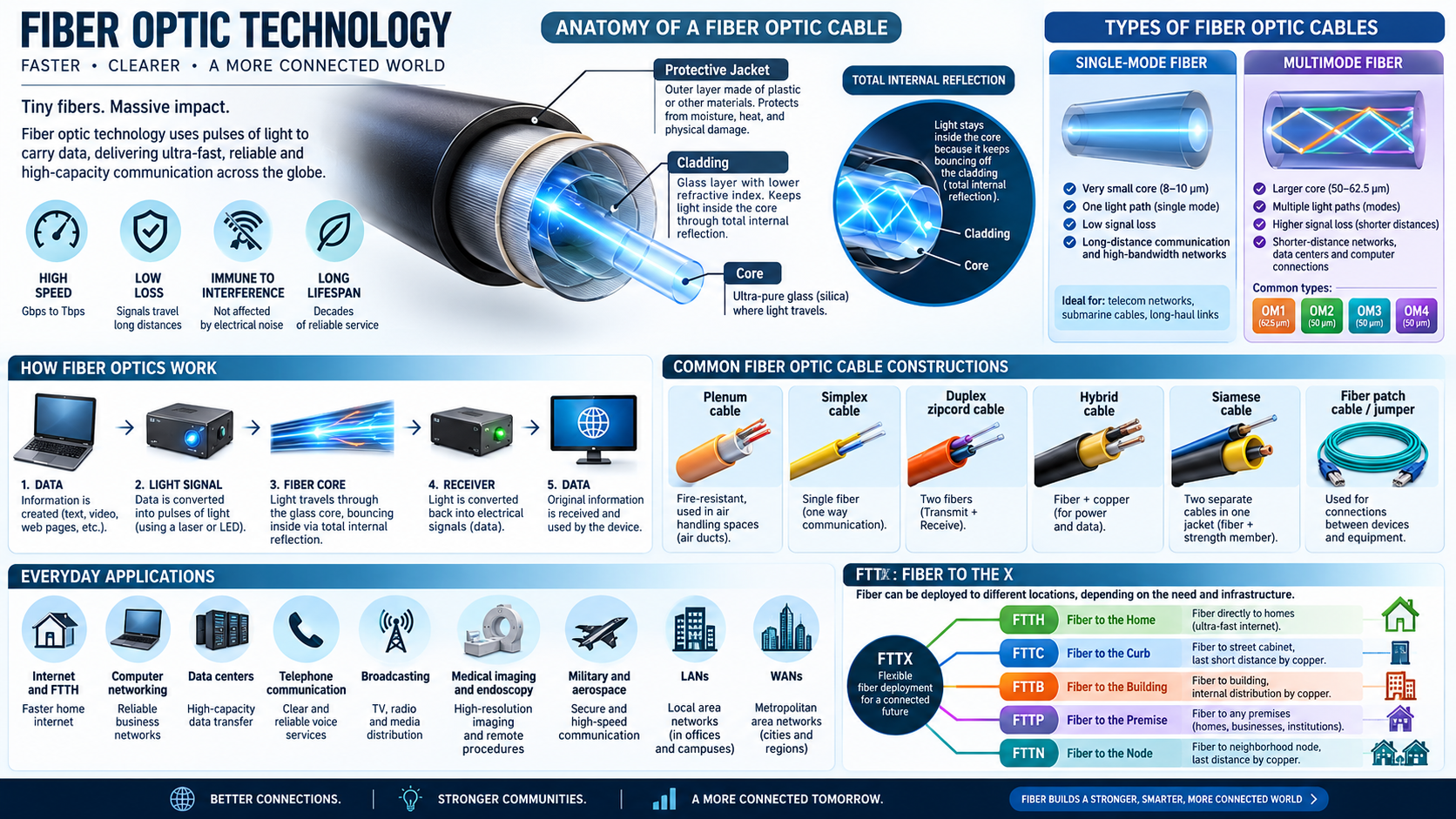
Light travels through a fiber optic cable using the physical principle of total internal reflection. The cable consists of a central core surrounded by a cladding layer with a lower refractive index. When light enters the core at a specific angle, it bounces continuously off the boundary between the core and cladding, allowing the signal to travel long distances around bends without escaping.
Can fiber optic cables be repaired if they break?
Yes, broken fiber optic cables can be successfully repaired, but the process requires specialized skills and tools. Technicians use a fusion splicer to precisely align the microscopic glass strands and melt them together with an electric arc. This method ensures minimal signal loss at the junction point, followed by protective housing installation to secure the repair.
Why do some areas still use copper instead of fiber?
Many regions continue using existing copper telephone infrastructure because replacing entire networks requires massive financial investments and extensive civil engineering work. Telecommunications providers often find it more cost-effective to upgrade legacy copper lines using digital subscriber line technologies until funding allows for complete fiber deployment in rural or low-density neighborhoods.
Does weather affect fiber optic internet performance?
Weather has virtually no impact on fiber optic internet performance because the light signals are safely enclosed within underground or aerial glass cables. Unlike satellite or fixed wireless systems that suffer slowdowns during heavy rain, snow, or windstorms, fiber networks deliver consistent, weather-resistant speeds 365 days a year.
Conclusion
Fiber optic technology remains one of the most important foundations of modern connectivity. It combines high bandwidth, low latency, reliability, and long-term scalability in a single transmission medium.
Fiber can remain useful for decades, while upgraded network equipment can increase capacity without replacing the physical cable. China currently leads global optical fiber production, while manufacturers across several regions continue developing new fiber technologies.
For fixed broadband, fiber generally offers more consistent performance than 5G. Its resistance to electromagnetic interference also makes it valuable in demanding environments. However, installation can cost more, and repairs require specialized skills.
Fiber is generally safe for everyday use because the cable carries data as light rather than radio signals. Proper optical safety procedures are still necessary for technicians working with active fiber equipment.
As data demands continue to grow, fiber optic infrastructure will remain essential. Its combination of performance and upgrade potential makes it a strong foundation for future digital networks.
For readers interested in how light-based sensing is also used in modern devices, optical heart sensor technology provides another practical example of how light can be used to measure and interpret physical signals.