
Types of Education: Understanding Frameworks, Styles, and Methods
Learning shapes how we navigate, understand, and contribute to the world. We learn in classrooms, at home, online, and through workplace experience. Exploring the different types of education helps students, parents, and educators choose suitable learning environments. According to UNESCO, flexible learning systems remain important for human development and social equality worldwide.
Structured classrooms provide foundational knowledge, but learning also happens outside academic settings. People develop practical skills through work, hobbies, conversations, reading, and everyday experiences. Understanding alternative types of education can help educators and learners explore options beyond traditional classroom settings.
This guide explains the main forms of formal, informal, and nonformal education. It also explores teaching methods, modern educational formats, and community-based learning. You will learn about seven commonly discussed learning preferences and the terms used for different educational institutions.
By understanding these concepts, learners can make more informed decisions. Educators can also create learning experiences that are practical, flexible, and easier to understand.
What is formal, informal, and nonformal education?
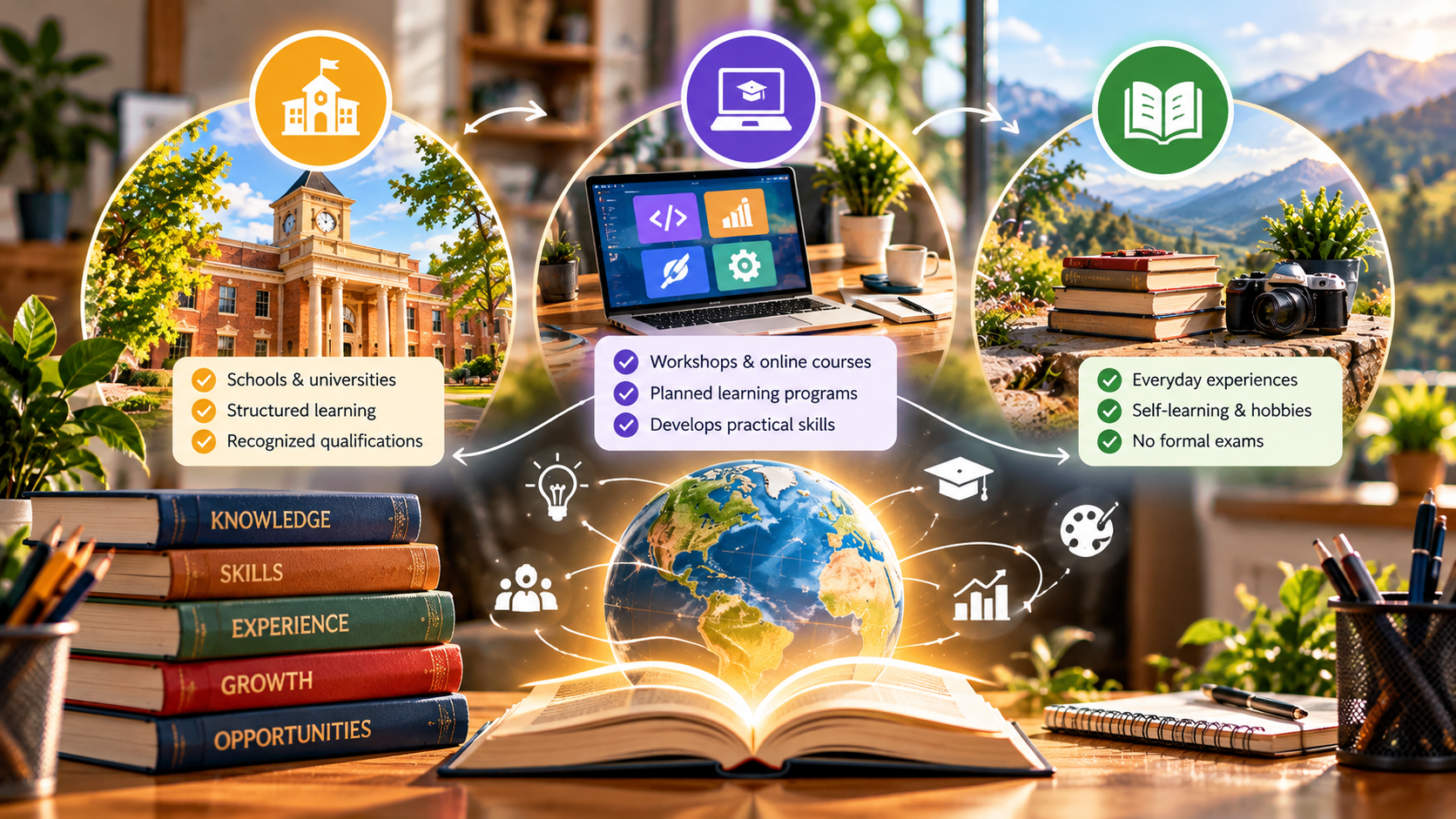
Formal education occurs within structured institutions such as primary schools, high schools, colleges, and universities. It follows an organized curriculum and usually involves qualified teachers, scheduled instruction, assessments, and recognized credentials. Students progress through defined levels and meet established academic requirements.
Informal education develops outside planned institutional settings. People learn through daily experiences, conversations, hobbies, reading, observation, travel, and personal interests. This type of learning is usually flexible and does not involve formal examinations or academic credentials.
Nonformal education sits between these approaches. It provides planned and organized learning without following the full structure of a traditional academic system. Examples include community literacy programs, coding bootcamps, vocational workshops, language classes, and professional training.
Each model serves a different purpose. Formal education builds systematic knowledge, informal education supports lifelong learning, and nonformal education develops practical skills. Together, these types of education create flexible ways to learn throughout life.
The Role of Structured Credentials
Formal pathways often use recognized qualifications to document a learner’s academic preparation. Schools, colleges, and universities may award certificates, diplomas, or degrees after required coursework and assessments. These credentials help employers understand a candidate’s educational background.
Some professions place greater emphasis on formal qualifications than others. Fields such as medicine, law, and engineering often require specific degrees, licenses, or professional credentials. In these careers, education provides theoretical foundations and preparation for regulated responsibilities.
Nonformal programs can also provide useful certificates. These credentials may demonstrate focused training in software, project management, digital marketing, or workplace safety. However, a short certificate does not always carry the same weight as a formal degree.
The value of a credential depends on the career, employer, institution, and skill being assessed. Learners should consider the requirements of their target field. Practical experience, portfolios, professional licenses, and demonstrated skills can also matter alongside formal education.
What are the 7 methods of teaching?
Educators use different teaching methods to help students understand, practice, and apply information. The best method depends on the subject, learner needs, classroom setting, and learning objective. Common approaches include direct instruction, inquiry-based learning, experiential learning, cooperative learning, differentiated instruction, flipped learning, and gamification.
Direct instruction uses clear explanations, demonstrations, and guided practice. Inquiry-based learning asks students to investigate questions and develop solutions. Experiential learning focuses on practical activities, experiments, projects, and real-world experiences.
Cooperative learning places students in small groups with shared tasks. Differentiated instruction adjusts content, activities, or support for different learner needs. In a flipped classroom, students review materials before class and use class time for practice and discussion.
Gamification adds game elements, such as challenges, points, or progress systems. These methods can be combined rather than used separately. Effective teaching focuses on whether students understand and can apply the material, not simply on the method used.
What type of education do we have?
Modern society uses a broad educational framework that includes several levels and settings. Primary and secondary schools develop skills such as literacy, numeracy, communication, and social understanding. After secondary education, learners can pursue universities, colleges, technical institutions, vocational programs, or specialized training.
Education also extends beyond traditional classrooms. Apprenticeships combine workplace experience with structured instruction. Online courses provide flexible access to academic and professional subjects. Employers may offer continuing education to help workers update skills and technology.
Special education services provide additional support for learners with specific needs. Adult education programs also help people return to learning, develop basic skills, or prepare for career changes. Personalized learning can further adapt educational experiences to individual learner needs and goals.
This variety gives learners multiple routes toward development. Some people need a traditional academic pathway, while others benefit from practical training or online study. Understanding the available types of education can help learners choose an approach that matches their goals, schedule, and abilities.
Blended and Digital Learning Environments
Today’s education increasingly combines physical instruction with digital tools. Blended learning brings together classroom teaching and online activities, while hybrid programs may allow learners to attend some sessions remotely. The exact format varies by institution and course.
Digital learning can provide recorded lectures, exercises, discussions, digital textbooks, and remote assessments. Students can review materials at their own pace and return to difficult topics when needed. This flexibility can benefit working adults and remote learners considering online or distance learning.
In-person learning still offers important advantages. Teachers can provide immediate guidance, students can collaborate directly, and practical subjects may require physical equipment or supervision. A blended model can therefore combine convenience with hands-on experience.
The quality of blended learning depends on course design and access to reliable technology. Simply moving classroom materials online does not guarantee better learning. Effective programs use digital tools for a clear purpose while preserving interaction, practice, feedback, and support.
What are the types of non-formal education?
Non-formal education includes organized learning programs outside traditional degree and school systems. These programs can serve people seeking specific practical skills. They are usually more flexible than formal academic pathways.
Adult education programs may focus on literacy, numeracy, language skills, or basic digital abilities. Vocational workshops can teach skills in areas such as welding, plumbing, electrical work, or computer repair. Professional development programs help employees update knowledge and maintain workplace skills.
Community education can address financial literacy, public health, parenting, civic participation, or digital safety. Youth organizations, scouting programs, clubs, and structured extracurricular activities can also provide organized learning experiences.
Online short courses are another form of non-formal education. They may teach software, communication, business, or creative skills. Unlike formal degree programs, these courses often have shorter timeframes and fewer entry requirements. Their value depends on instruction quality, relevance, and practical application.
What are the 7 types of learning?
People learn in different ways, and educational models describe several common learning preferences. One widely referenced seven-style model includes visual, auditory, verbal, kinesthetic, logical, social, and solitary preferences. These categories describe common learning preferences.
Visual learners may respond well to diagrams, charts, maps, and demonstrations. Auditory learners may prefer explanations, discussions, and spoken examples. Verbal learners often enjoy reading, writing, and explaining ideas through language. Kinesthetic learners may benefit from practical activities and hands-on tasks.
Logical learners may prefer patterns, systems, numbers, and structured reasoning. Social learners may enjoy discussion, teamwork, and collaborative problem-solving. Solitary learners may prefer quiet study and independent reflection.
These categories can help educators vary methods. However, they should not be treated as fixed labels or strict categories. Research has not established that matching instruction to a preferred learning style consistently improves outcomes. A flexible approach combining explanation, practice, discussion, visuals, and application is often more useful.
What is another name for school?
The institution commonly called a school has several alternative names, depending on its level, purpose, location, and educational tradition. General terms include academy, educational institution, and learning center. Early childhood settings may be called nursery schools, preschools, kindergartens, or preparatory schools.
Specialized institutions may use terms that describe their subject or purpose. A conservatory usually focuses on music or the performing arts. A seminary generally provides religious education and training. A polytechnic typically emphasizes technical, scientific, or applied education.
At higher levels, institutions may be called colleges, universities, institutes, faculties, or professional schools. Regional terminology varies. Terms such as lyceum and gymnasium can refer to particular types of secondary schools in different education systems.
These names do not have the same meaning worldwide. An institution’s title should therefore be considered alongside its curriculum, qualifications, accreditation, and level of study. Understanding these terms helps students compare options and identify suitable institutions.
Specialized Terminology in Academia
Specialized institutional titles often describe a school’s main educational purpose, although meanings vary between countries. A conservatory commonly focuses on music, dance, theater, or other performing arts. A polytechnic generally emphasizes applied science, engineering, technology, and professional education.
Other terms also have distinct meanings. A seminary usually provides religious or theological education. An institute may specialize in a particular discipline, research area, or professional field. A university normally offers broader higher education with multiple faculties or departments.
These labels can help students understand an institution’s focus. However, the name alone should not determine where someone studies. Institutions with similar titles can differ in curriculum, accreditation, teaching quality, admission requirements, and career outcomes.
Before applying, students should review details carefully. Check the subjects taught, qualification awarded, entry requirements, costs, practical opportunities, and recognition of the credential. This provides a clearer picture and helps learners choose an educational setting that supports their goals.
Frequently Asked Questions
What is the main difference between formal and nonformal education?
Formal education is a structured, hierarchical ladder managed by state-accredited schools and universities that awards recognized degrees based on established curricula. Nonformal education is organized and deliberate, but operates outside this rigid framework. It focuses on specific practical skills, personal interests, or targeted professional certifications without requiring multi-year degree commitments or standard academic grading scales.
Why is informal education important for child development?
Informal education builds emotional intelligence, problem-solving skills, and social etiquette through organic everyday experiences. Children learn by observing parents, playing with peers, and exploring natural environments. These unscripted moments teach resilience, practical survival skills, and ethical behavior, providing an essential social foundation that classroom curricula cannot fully replicate.
Can a person combine different learning styles?
Yes, most people use a multimodal combination of learning styles rather than relying solely on one preference. For instance, a learner might prefer visual diagrams to understand theoretical models, but require kinesthetic practice to master hands-on techniques. Combining sensory inputs through reading, listening, and physical practice usually reinforces memory and deepens overall comprehension.
Conclusion: Finding the Right Learning Journey
Ultimately, understanding how different learning models operate empowers you to make informed decisions about your intellectual growth. For instance, formal degrees offer structured benchmarks and recognized credentials. In contrast, informal daily habits build resilience and emotional depth. Meanwhile, flexible community programs ensure your practical skills stay sharp throughout life.
Furthermore, balancing structured classroom study with real-world practice creates an adaptable, curious mindset. As a result, instructors who tailor their teaching styles can support visual, auditory, and hands-on students with equal care. In addition, professionals can leverage self-paced digital workshops to pivot into exciting new career paths quickly.
Above all, learning is not a rigid milestone confined to youth or traditional lecture halls. Consequently, by exploring diverse types of education, you can build a customized personal development path that fits your distinct goals. Therefore, choose the methods and environments that serve you best, and embrace learning as an ongoing, lifelong journey.