

States of Matter Explained: Solids, Liquids, Gases, and Beyond
Everything around you, from the morning coffee in your mug to the screen you are reading, consists of matter. Understanding the states of matter explained in this guide helps you explore how materials behave under different conditions. Matter can change its physical state when temperature or pressure alters the movement and interactions of its particles.
These changes are essential to physics, chemistry, and planetary science. Most people encounter solids, liquids, and gases every day. Plasma is another familiar scientific state found in stars and lightning. However, researchers have also discovered unusual quantum phases under extreme temperatures, pressures, and magnetic fields. You can explore related scientific concepts through NASA Science and learn more about how energy travels through space.
This guide explores seven important states of matter, provides 20 examples of liquids, examines 22 examples of physical phases, and compares the four classical states. It also explains why some exotic phases are extremely difficult to create and study.
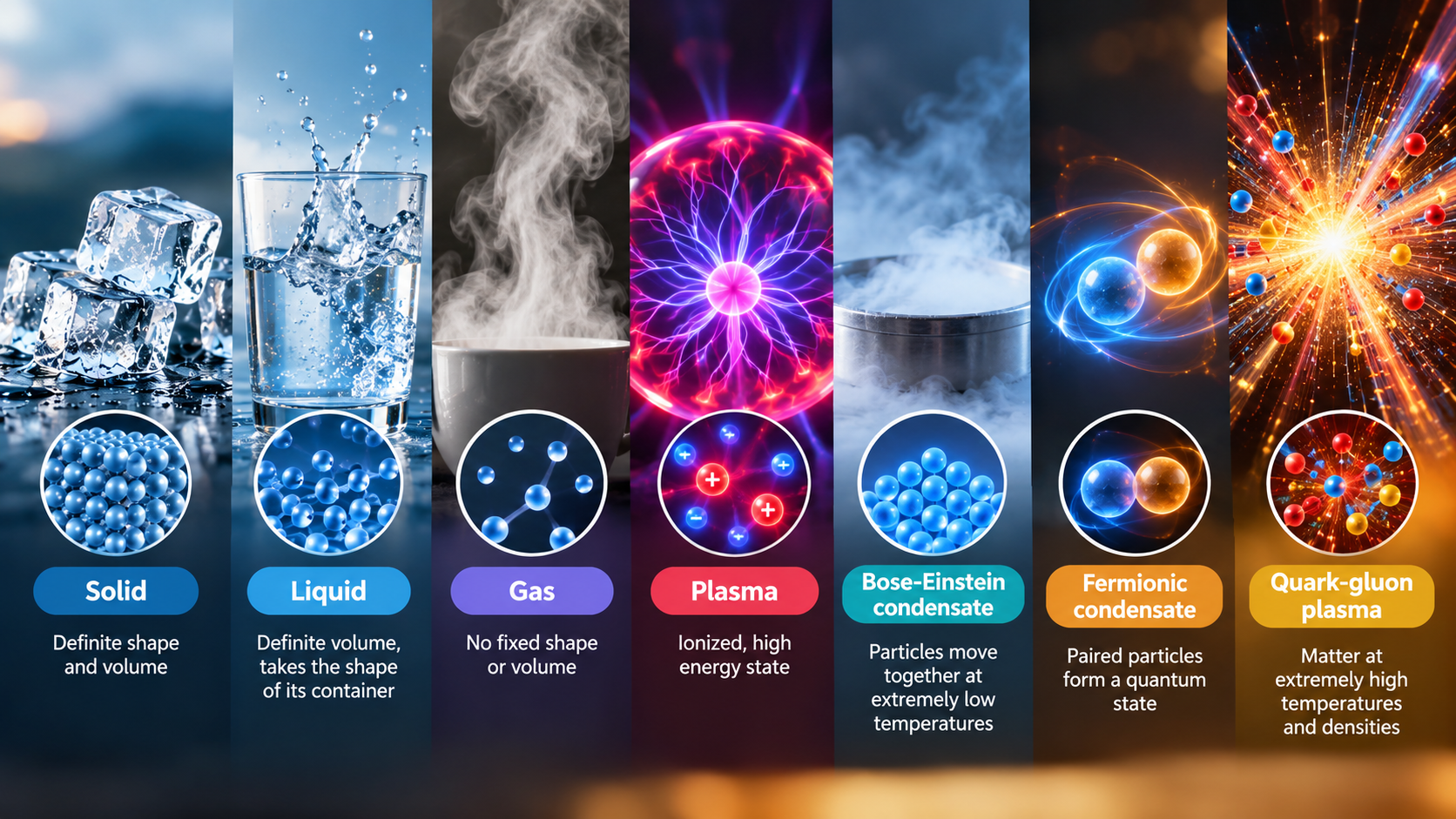
What are the 7 states of matter and describe each?
There is no universally accepted list of exactly seven states of matter. The number depends on how scientists classify different physical phases. However, seven commonly discussed examples illustrate how matter behaves under ordinary and extreme conditions.
- Solid: Solids have a definite shape and volume. Their particles remain closely packed and vibrate around relatively fixed positions. Ice, wood, and metal are common examples.
- Liquid: Liquids maintain a definite volume but take the shape of their containers. Their particles can move past one another. Water, milk, and cooking oil are familiar examples.
- Gas: Gases have neither a fixed shape nor a fixed volume. Their particles move freely and spread throughout the available space. Oxygen and carbon dioxide are examples.
- Plasma: Plasma contains electrically charged particles, including free electrons and ions. It occurs in stars, lightning, and certain laboratory experiments.
- Bose-Einstein condensate: This quantum state forms when certain particles are cooled extremely close to absolute zero. Many particles then occupy the same quantum state.
- Fermionic condensate: Under suitable conditions, fermions can pair and form a collective quantum state. This phenomenon occurs in specialized ultracold systems.
- Quark-gluon plasma: At extremely high temperatures or densities, quarks and gluons can move beyond the confines of individual protons and neutrons. Scientists study this state using high-energy particle collisions.
These examples demonstrate that matter behaves differently depending on its temperature, pressure, particle interactions, and quantum properties. Other phases, including superfluids and supersolids, reveal even more complex behavior.
What are 20 names of liquids?
Liquids are substances that generally maintain a definite volume while adapting to the shape of their containers. Their particles remain close together but can move past one another. This gives liquids their characteristic ability to flow.
Here are 20 examples of liquids:
- Water
- Milk
- Olive oil
- Gasoline
- Ethanol
- Blood
- Vinegar
- Honey
- Mercury
- Acetone
- Vegetable oil
- Liquid nitrogen
- Liquid household bleach
- Glycerol
- Sulfuric acid
- Maple syrup
- Kerosene
- Seawater
- Coffee
- Liquid oxygen
These substances have different chemical compositions and physical properties. For example, honey and glycerol are relatively viscous, meaning they flow more slowly than water. Mercury is a liquid metal at room temperature, while liquid nitrogen and liquid oxygen require extremely low temperatures.
Some examples need special handling. Gasoline, ethanol, and kerosene are flammable, while sulfuric acid is highly corrosive. Liquid nitrogen and liquid oxygen can cause severe cold injuries, and liquid oxygen intensifies combustion.
The physical state of a substance also depends on temperature and pressure. Water freezes into ice and boils into steam under familiar atmospheric conditions. Other substances undergo their own phase changes at different temperatures and pressures.
What are the 22 states of matter?
Scientists do not recognize one official list containing exactly 22 states of matter. The number varies because researchers classify phases according to their structure, particle behavior, and physical properties. Some names describe distinct phases, while others refer to broader categories or specialized quantum phenomena.
The following 22 examples illustrate the diversity of physical states and phases discussed in science:
- Crystalline solid
- Amorphous solid
- Liquid
- Gas
- Plasma
- Liquid crystal
- Supercritical fluid
- Superfluid
- Supersolid
- Bose-Einstein condensate
- Fermionic condensate
- Electron-degenerate matter
- Neutron-degenerate matter
- Quark-gluon plasma
- Color-superconducting matter
- Rydberg matter
- Rydberg polarons
- Photonic matter
- Quantum spin liquid
- Strange metal
- Time-crystalline phase
- Jahn-Teller-related phases
These examples do not represent 22 equivalent or universally accepted states. Some are established phases, while others describe specialized systems or particular forms of collective behavior. Photonic matter, for example, depends on the physical system and interactions involved.
Researchers continue to investigate new phases using advanced experiments and theoretical models. Their findings help explain superconductivity, quantum computing materials, neutron stars, and the early universe. The important distinction is that states of matter are classified by physical behavior, not by a fixed numerical total.
Which State of Matter Is Solid, Liquid, Gas, or Plasma?
Solid, liquid, gas, and plasma are four important states of matter. Generally, they differ in particle arrangement, movement, electrical properties, and responses to temperature and pressure. Therefore, understanding these differences provides a foundation for studying physical science.
Solid: First, a solid has a definite shape and volume. Its particles remain closely arranged and usually vibrate around fixed positions. For example, ice, glass, and iron are common examples of solids.
Liquid: Next, a liquid has a definite volume but no fixed shape. Unlike solids, its particles can move past each other, allowing it to flow. As a result, liquids take the shape of their containers. Water, milk, and cooking oil are common examples.
Gas: Similarly, a gas has neither a definite shape nor a definite volume. Its particles move freely and spread throughout the available space. Consequently, gases expand to fill their containers. Oxygen, nitrogen, and water vapor are examples of gases.
Plasma: Finally, plasma contains free electrons and positively charged ions. Unlike ordinary gases, it can conduct electricity and respond strongly to magnetic fields. For instance, the Sun, other stars, and lightning contain plasma.
Furthermore, temperature and pressure influence how matter transitions between these states. For example, heating ice produces liquid water, and further heating can produce water vapor. Under suitable conditions, additional energy can ionize a gas and create plasma. Thus, changes in energy and environmental conditions can transform matter from one state to another.
Although these four states provide a useful starting point, they do not describe every form of matter. In fact, quantum physics and high-energy research reveal many additional phases with unusual properties.
What Is the Rarest State of Matter?
Generally speaking, there is no single state of matter that scientists universally identify as the rarest. Instead, rarity depends on whether we consider natural occurrence, duration, location, or the difficulty of producing a particular phase. For this reason, some exotic states are considered rare because they exist only briefly under extreme experimental conditions.
For instance, quark-gluon plasma is one especially unusual state of matter. At sufficiently high temperatures or densities, quarks and gluons are no longer confined inside individual protons and neutrons. Instead, they form a hot, strongly interacting medium that scientists can investigate through high-energy nuclear collisions.
Historically, this state existed in the early universe shortly after the Big Bang. However, as the universe expanded and cooled, quarks and gluons became confined within hadrons, including protons and neutrons. Today, researchers recreate quark-gluon plasma for extremely short periods using specialized particle accelerators.
More specifically, experiments at facilities such as the Relativistic Heavy Ion Collider and the Large Hadron Collider help scientists investigate its properties. As a result, these studies provide valuable insights into the strong nuclear force and the evolution of the early universe.
In addition to quark-gluon plasma, other rare or difficult-to-produce phases include Bose-Einstein condensates and certain superconducting states. Nevertheless, each requires specific physical conditions and experimental techniques.
Ultimately, rather than declaring one phase the rarest, it is more accurate to say that quark-gluon plasma is among the most extreme and short-lived states of matter studied in laboratories. Because of its unusual properties, it remains an important subject in modern physics.
Frequently Asked Questions
How does temperature create a phase change?
Temperature changes directly adjust the kinetic energy inside atomic structures. Adding heat increases molecular vibrations, overcoming attractive forces that hold atoms in place. When kinetic energy exceeds structural bond strength, solids melt into liquids and liquids boil into gases. Removing heat reverses this motion, allowing intermolecular bonds to re-establish order.
Can matter exist in two different states simultaneously?
Yes, substances can coexist across multiple phases under specific thermodynamic conditions. At a material’s thermodynamic triple point, precise temperature and pressure allow solid, liquid, and gas phases to persist in thermodynamic equilibrium. Water reaches this balance at 0.01 degrees Celsius and 0.006 atmospheres of pressure.
What is the most abundant state of matter in the universe?
Plasma represents the most abundant observable state of matter across the cosmos, comprising over 99 percent of visible matter. Stars, interstellar nebulae, auroras, and galactic filaments consist primarily of ionized plasma. Classical solids, liquids, and neutral gases remain comparatively scarce, concentrated mainly on planetary bodies and small asteroids.
Why do supercritical fluids exhibit dual physical properties?
Supercritical fluids develop when a substance exceeds its specific critical temperature and critical pressure. Under these intense physical parameters, distinct liquid and gas boundaries vanish completely. The resulting single phase diffuses through solid barriers like an ordinary gas while dissolving dense solutes effectively like a heavy liquid solvent.
Conclusion
Having the fundamental states of matter explained transforms how you perceive the physical world. While early school curricula emphasize solids, liquids, and gases, physical reality spans far wider into high-energy plasmas and fragile quantum phases. Every state represents a delicate balance between thermodynamic energy, pressure, and intermolecular attraction. From common liquids sustaining biological life to quark-gluon plasma mirroring the infant universe, matter constantly adapts to its environment. Exploring these transformations bridges everyday chemistry with cutting-edge astrophysical research. As laboratory equipment advances, physicists will likely continue discovering even more nuanced physical phases, deepening our collective understanding of natural universal laws.