

Rhythms in Universe Music: Exploring Cosmic Cadence and Harmony
Everything in existence follows patterns of movement and vibration, from microscopic particles to celestial bodies orbiting through space. When we explore the connection between physical existence and sound, rhythms in universe music reveal how reality often resembles an ongoing composition. Ancient thinkers like Pythagoras explored this connection through mathematical relationships between musical intervals and planetary motion. This idea later became known as the music of the spheres. Modern astrophysics also investigates natural oscillations, including vibrations within stars and waves traveling through space. Organizations like NASA use scientific instruments to study these phenomena and transform certain cosmic data into sound.
Understanding these rhythmic patterns connects music theory with natural cycles. It also helps us appreciate how timing and repetition influence everyday life.
In this guide, we explore the seven foundational elements of rhythm, eight primary rhythm types, and the science behind cosmic patterns. We also examine spiritual interpretations, the historical concept of celestial music, and five everyday examples of rhythm.
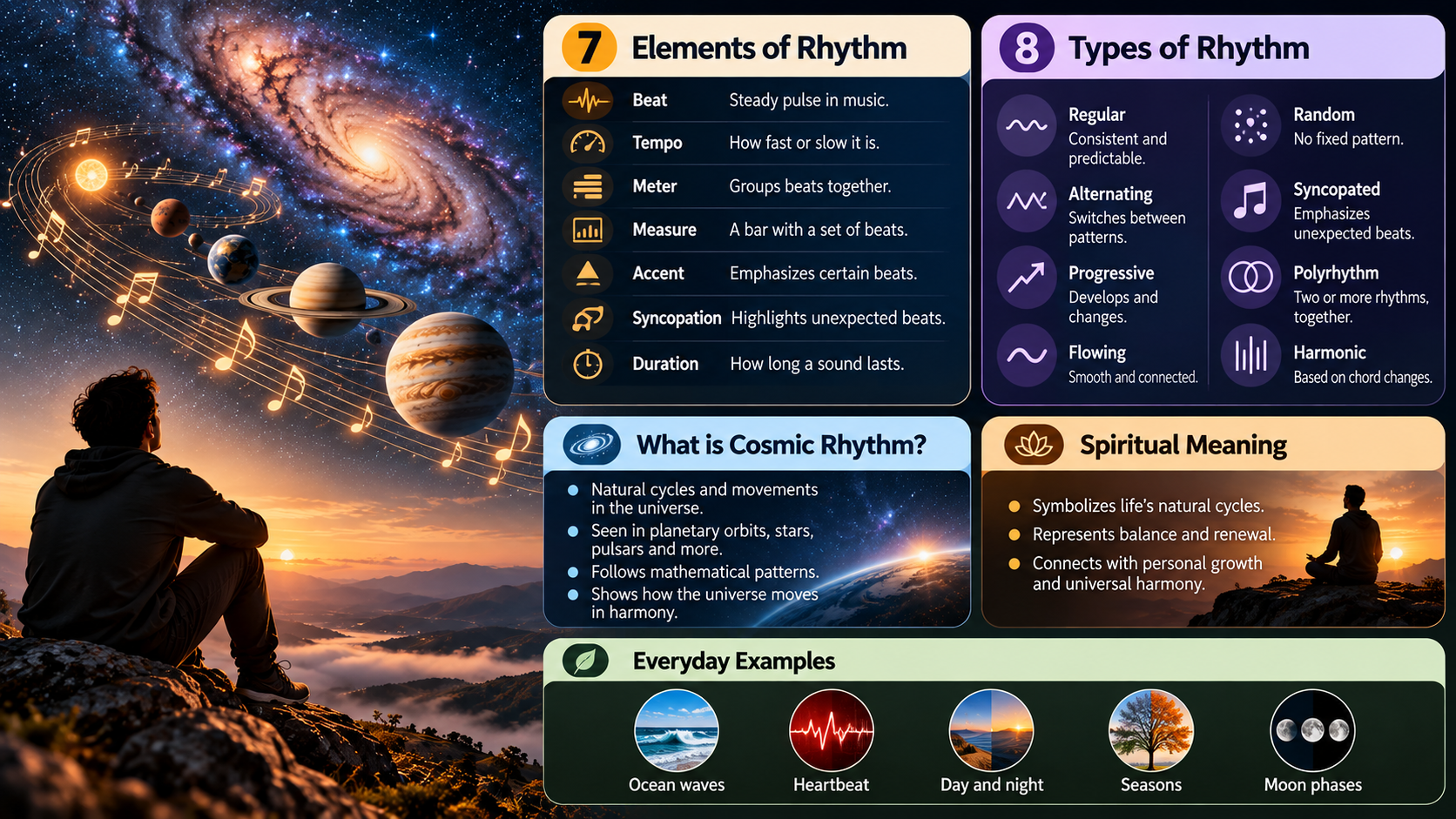
What are the 7 elements of rhythm?
The seven elements of rhythm provide the foundation for musical timing and structured movement. Each element contributes to how sounds are organized and experienced. Together, they create patterns that make music recognizable, expressive, and enjoyable.
- Beat: The beat is the steady pulse that listeners naturally follow. It provides the basic timing framework for a musical composition.
- Tempo: Tempo describes how quickly or slowly beats occur. Musicians usually measure it in beats per minute (BPM).
- Meter: Meter organizes beats into recurring groups, such as three or four beats.
- Measure: A measure, also called a bar, contains a specific grouping of beats.
- Accent: An accent gives particular beats or notes additional emphasis. It creates variation and highlights important moments.
- Syncopation: Syncopation places emphasis on unexpected beats or weaker subdivisions. This creates rhythmic surprise and movement.
- Duration: Duration describes how long a sound or silence lasts. It determines the spacing and length of musical events.
These elements work together to create structured rhythms in universe music. They also help musicians understand timing, coordination, and expressive musical patterns.
What are the 8 types of rhythm?
Rhythm appears in different forms depending on timing, repetition, and musical arrangement. These eight classifications help explain how rhythmic patterns create different musical experiences. Some describe how patterns develop, while others explain how musicians organize beats and accents.
- Regular Rhythm: Regular rhythm follows consistent, predictable timing. Marching music often uses this straightforward structure.
- Alternating Rhythm: This rhythm switches between two recurring patterns. It creates contrast while maintaining an organized structure.
- Progressive Rhythm: Progressive rhythm develops through changing patterns or motifs. It creates a sense of movement and gradual transformation.
- Flowing Rhythm: Flowing rhythm uses smooth, connected movements. Classical melodies and gentle instrumental compositions often feature this quality.
- Random Rhythm: Random rhythm avoids predictable repetition. It frequently appears in experimental and free-form musical compositions.
- Syncopated Rhythm: Syncopation emphasizes unexpected beats. Jazz, funk, and many contemporary genres use this technique.
- Polyrhythm: Polyrhythm combines two or more different rhythmic patterns. A common example is three beats played against two.
- Harmonic Rhythm: Harmonic rhythm describes how frequently chords change within a musical composition.
Understanding these patterns makes it easier to recognize musical variation. It also reveals how different rhythmic structures contribute to the wider idea of rhythms in universe music.
What is cosmic rhythm?
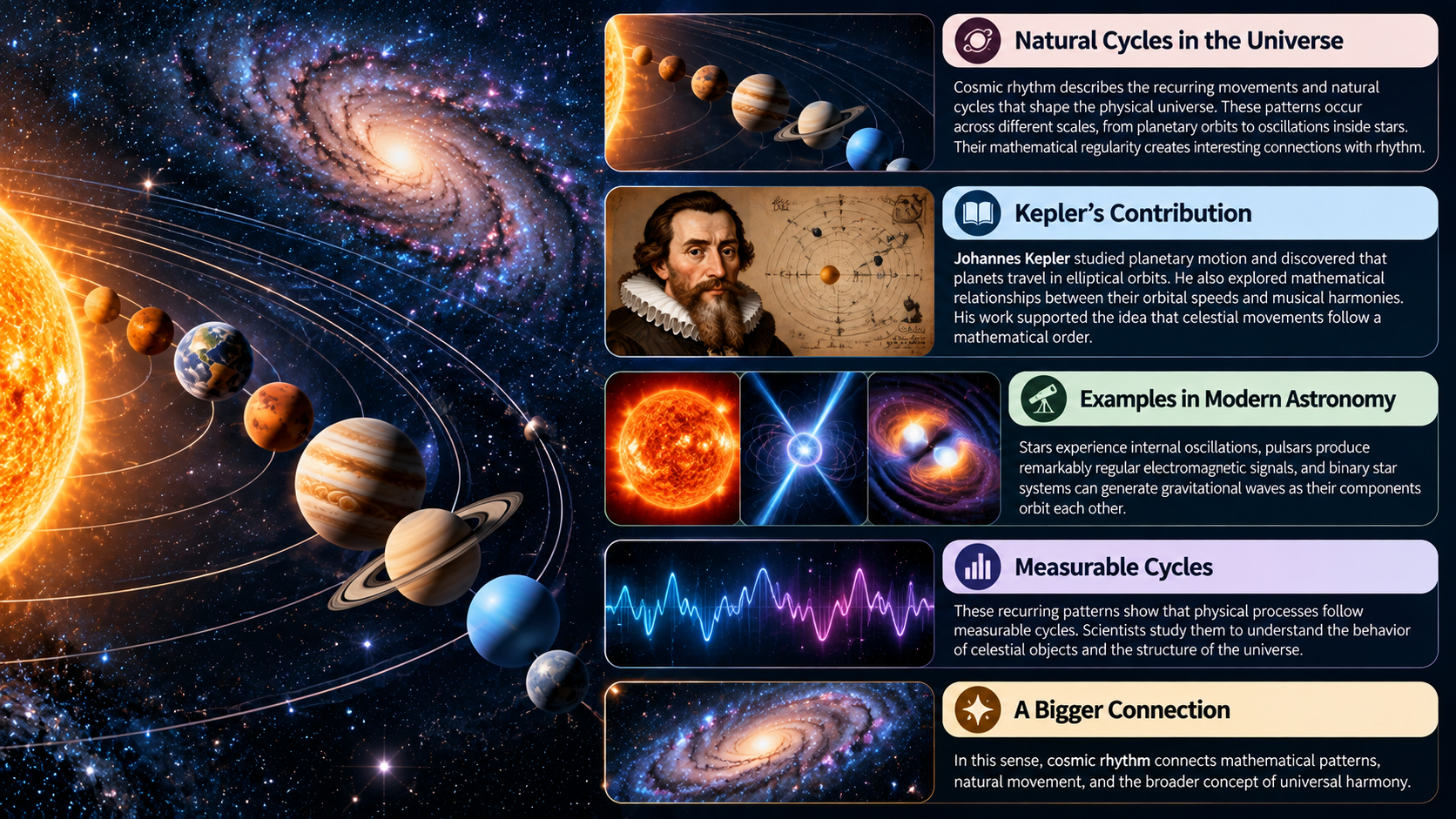
Cosmic rhythm describes the recurring movements and natural cycles that shape the physical universe. These patterns occur across different scales, from planetary orbits to oscillations inside stars. Although these movements are not necessarily musical sounds, their mathematical regularity creates interesting connections with rhythm.
Johannes Kepler studied planetary motion and discovered that planets travel in elliptical orbits. He also explored mathematical relationships between their orbital speeds and musical harmonies. His work contributed to the historical idea that celestial movements follow an underlying mathematical order.
Modern astronomy provides additional examples of cosmic rhythms. Stars experience internal oscillations, while pulsars produce remarkably regular electromagnetic signals. Binary star systems can also generate gravitational waves as their components orbit each other.
These recurring patterns demonstrate how physical processes follow measurable cycles. Scientists study them to understand the behavior of celestial objects and the structure of the universe.
In this sense, cosmic rhythm connects mathematical patterns, natural movement, and the broader concept of universal harmony.
What does rhythm mean spiritually?
Spiritually, rhythm represents the recurring cycles of existence, personal transformation, and universal balance. Many spiritual traditions associate rhythmic movement with creation, change, and renewal. These interpretations connect natural patterns with human consciousness and personal experiences. The concept of rhythms in universe music also reflects this spiritual connection between natural cycles and universal harmony.
In some esoteric traditions, the Principle of Rhythm describes how everything experiences movement, change, and recurring cycles. This concept suggests that life involves continuous transitions rather than permanent conditions. Eastern philosophical traditions also explore similar ideas through cycles of creation and dissolution.
People often connect these spiritual interpretations with everyday experiences. Breathing, sleeping, waking, and seasonal changes demonstrate how natural cycles influence human life. Recognizing these patterns can encourage greater awareness of personal habits and emotional responses.
Rather than resisting every change, individuals may find value in accepting different stages of life. Meditation, mindful breathing, and reflective practices can help develop this awareness.
Although spiritual interpretations are philosophical rather than established scientific explanations, they offer meaningful ways to explore rhythm, balance, and personal well-being. They also provide another perspective on how rhythms in universe music connect human experiences with the wider patterns of existence.
Aligning Personal Presence with Sacred Temporal Flow
Many spiritual traditions use repetitive chanting, sacred drumming, and rhythmic breathing to encourage meditation and concentration. These practices create predictable patterns that help participants focus their attention. Repetition can also make it easier to maintain a steady breathing rhythm during meditation.
Slow, controlled breathing may support relaxation by influencing the body’s stress response. Similarly, repetitive sounds can provide a focal point when someone wants to quiet distracting thoughts. Research into how rhythm influences the brain, memory, and focus further explores the relationship between auditory patterns and cognitive processes. However, the experience varies between individuals and depends on the practice.
Aligning personal awareness with natural rhythms does not require complicated rituals. Simple activities can help develop a stronger connection with the present moment. For example, observing your breathing, listening to rainfall, or walking at a comfortable pace can encourage mindfulness.
These experiences illustrate how rhythm influences human perception and daily routines. Through consistent practice, people can develop greater awareness of their surroundings and personal well-being.
What is the music of the universe?
The music of the universe, historically known as Musica Universalis or the music of the spheres, is an ancient philosophical concept. It suggests that celestial bodies follow mathematical relationships similar to musical harmonies. The idea is closely associated with Pythagoras and later philosophers who explored connections between mathematics, music, and planetary motion.
According to this historical perspective, the movements of planets and other celestial objects reflect an underlying mathematical order. These relationships were sometimes interpreted as a form of cosmic music, even though humans could not directly hear it.
Modern science approaches this concept differently. Space is largely a vacuum, so ordinary sound waves cannot travel through it like they travel through air. However, scientists can study electromagnetic waves, plasma oscillations, and other signals collected by spacecraft and observatories. These concepts also connect with how 8D audio creates spatial sound experiences through sound positioning and auditory perception.
Through sonification, researchers convert selected scientific measurements into audible frequencies. These audio representations help people explore otherwise invisible astronomical phenomena.
Although modern sonification does not prove that planets produce musical melodies, it creates an interesting connection between astronomy, mathematics, and sound.
How NASA Translates Cosmic Frequencies into Audible Wonder
NASA uses a process called sonification to transform scientific measurements into sounds that humans can hear. Spacecraft and observatories collect different types of astronomical data, including electromagnetic signals, plasma measurements, and information about celestial objects.
Scientists then assign selected data values to musical properties such as pitch, volume, and timing. This process allows researchers and the public to experience complex scientific information through sound.
For example, NASA has released sonifications based on observations of the Sun, planetary environments, and distant astronomical objects. These audio experiences help communicate scientific discoveries in an accessible format.
However, it is important to understand that these recordings are not always actual sounds captured traveling through space. They are often carefully created audio representations of scientific measurements.
By translating invisible data into audible patterns, sonification provides a fascinating way to explore the universe. It also demonstrates how technology connects modern astronomy with the timeless human interest in music and rhythm.
What are 5 examples of rhythm?
Rhythm exists throughout everyday life, nature, and human activities. Many examples do not involve musical instruments or deliberate compositions. Instead, they demonstrate how recurring patterns organize movement and create predictable cycles.
Here are five familiar examples:
- Human Heartbeat: The heartbeat creates a recurring physical pulse that circulates blood throughout the body. Its rate changes depending on activity, emotions, and overall physical condition. Understanding how optical heart sensors measure heart rate also helps explain how technology tracks these natural rhythms.
- Day-and-Night Cycle: Earth’s rotation creates the repeating pattern of daytime and nighttime. This cycle influences sleep patterns and many biological processes.
- Ocean Tides: Ocean tides rise and fall primarily because of gravitational interactions involving the Moon and Sun. Their recurring movement demonstrates natural rhythmic patterns.
- Seasonal Changes: Earth’s yearly revolution around the Sun, combined with its axial tilt, produces recurring seasonal changes. These transitions influence weather, agriculture, and ecosystems.
- Four-on-the-Floor Beat: This popular musical rhythm places a strong kick-drum beat on every quarter note. It appears frequently in electronic dance music, disco, and house music.
Each example demonstrates how repetition creates recognizable patterns. Whether found in biological processes, planetary movements, or musical compositions, rhythm remains an essential feature of the world around us.
FAQ SECTION
How do sound waves travel through outer space if it is a vacuum?
Direct acoustic sound waves require a physical medium like air, water, or dense gas to transmit pressure vibrations. Because interstellar space is largely an empty vacuum, sound cannot travel as conventional acoustic waves. However, astronomical bodies emit electromagnetic emissions, plasma vibrations, and radio waves. Ground-based instruments capture these wave frequencies and translate them into audible acoustic sounds through mathematical sonification, allowing humans to hear space activity clearly.
What is the primary difference between meter and rhythm in music?
Meter serves as the fixed, recurring framework that organizes musical time into predictable units, such as 3/4 or 4/4 time signatures. In contrast, rhythm consists of the actual notes, rests, and durations played within that structural container. While meter remains constant and uniform like a grid, rhythm moves freely across the beats with varying lengths, syncopations, and emotional expressions.
Why do humans respond physically to musical rhythms?
Humans respond physically to rhythm because of a neurological phenomenon known as rhythmic entrainment. The auditory cortex connects directly to motor processing areas within the brain, causing motor neurons to automatically synchronize with external acoustic pulses. This biological coupling influences heart rate, breathing, and motor responses, naturally prompting listeners to tap their feet, nod, or dance along to structured beats.
Can planetary motion actually produce real musical harmonies?
Planetary movements produce musical harmonies in a proportional, mathematical sense rather than literal airborne tones. Johannes Kepler proved that the minimum and maximum angular speeds of planets correspond precisely to musical intervals like octaves, fifths, and thirds. When modern researchers map these planetary velocity proportions directly onto audio synthesizers, the resulting intervals produce recognizable harmonic chords that validate historic mathematical intuition.
Conclusion
Exploring the multifaceted dimensions of cosmic timing reveals that existence is governed by systematic, musical principles. From the foundational 7 elements of rhythm that structure sound compositions to the complex orbital mechanics that guide planetary orbits, life thrives upon predictable periodicity. Recognizing spiritual and physical cadences allows us to navigate our personal growth, biological health, and creative pursuits with intentional harmony.
When we honor the profound beauty of rhythms in universe music, we realize our own thoughts, heartbeats, and seasons are vital notes within a grand cosmic symphony. Embrace these natural cycles in your daily routine. Prioritize restorative rest alongside your active work hours, listen deeply to the ambient patterns around you, and align your life to the steady, unifying song of the universe.