
Revenue vs Profit: Understanding the Financial Differences That Drive Success
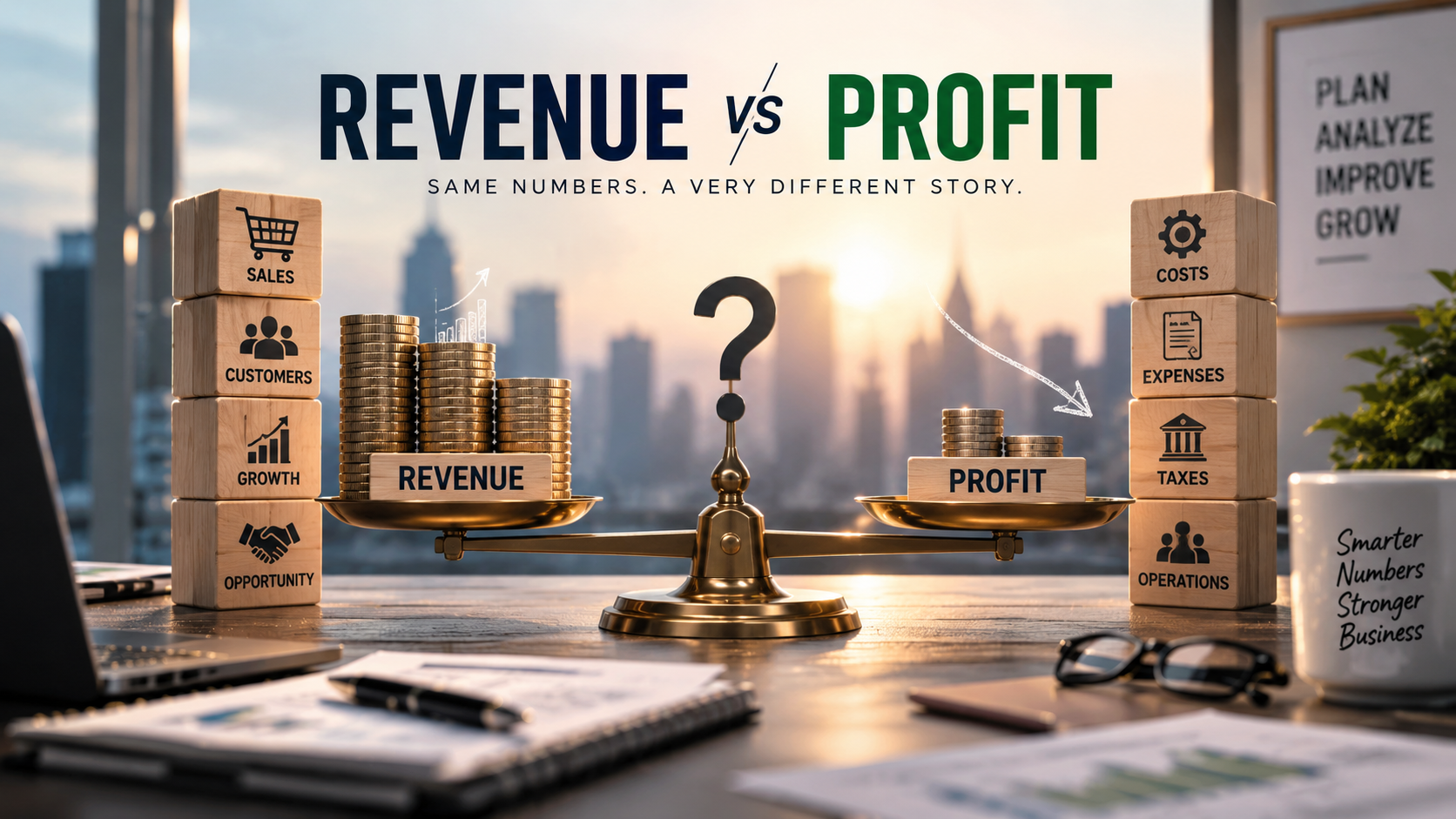
Running a successful business requires a clear understanding of key financial metrics. The distinction between revenue vs profit is especially important. Although people often use these terms interchangeably, they describe very different parts of business performance. Revenue measures the income generated from normal business activities before expenses are deducted. Profit shows what remains after the business covers its costs.
The U.S. Small Business Administration highlights the importance of accurate financial management for sustainable business growth. Understanding revenue and profit helps owners manage expenses, evaluate performance, and make better financial decisions.
Confusing these figures can create a false sense of success. A company may generate strong sales while still losing money because its expenses remain too high.
This guide answers several common questions about revenue and profit:
- Is revenue identical to profit?
- Can revenue ever be entirely profit?
- How do you calculate both figures?
- Does revenue simply mean total sales?
- Which metric appears first on financial statements?
- How do you calculate revenue correctly?
Understanding these differences can help you assess financial health and plan for long-term growth.

Is revenue the same as profit?
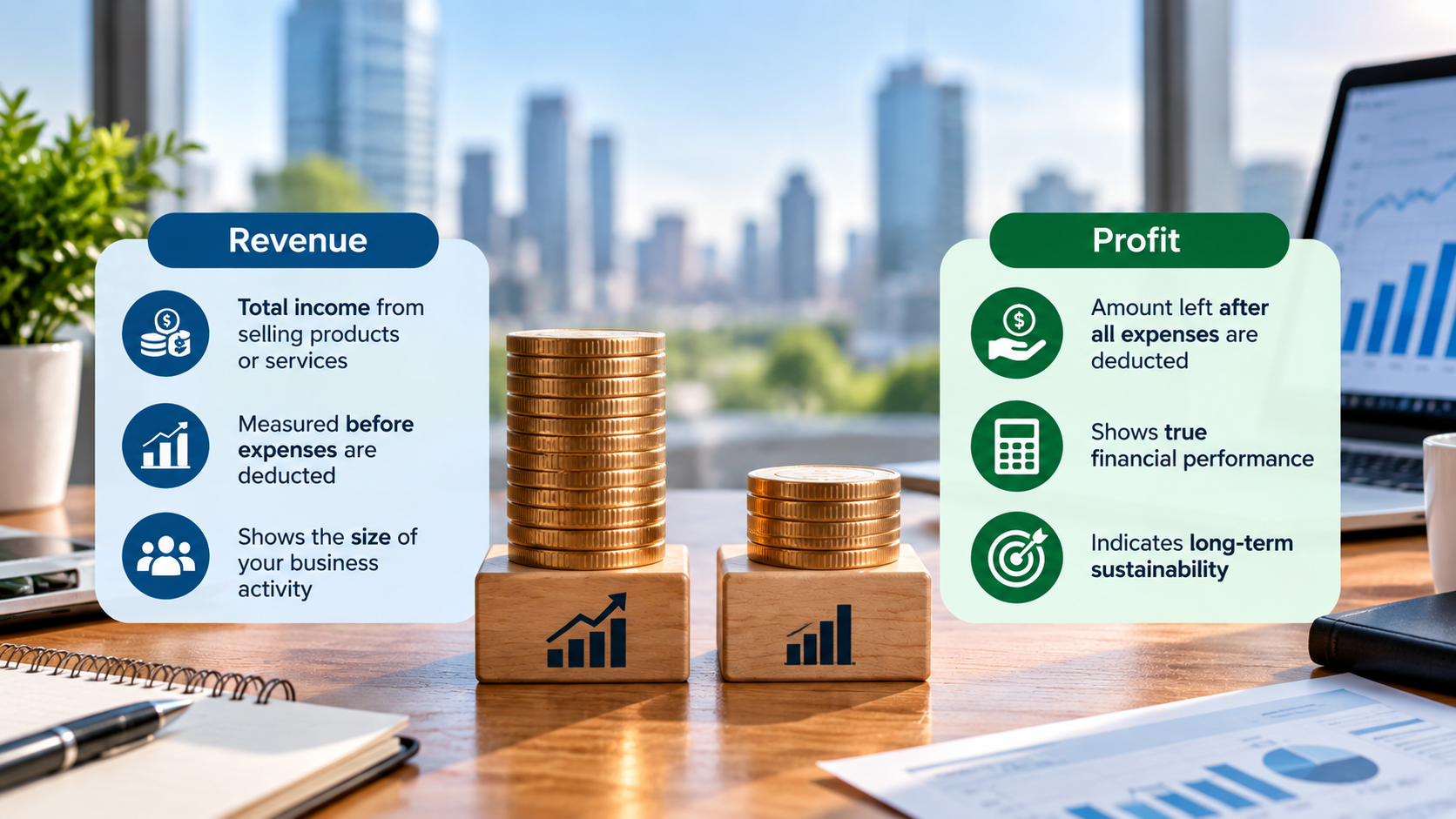
No, revenue is not the same as profit. Confusing the two can create serious financial problems for a business. Revenue refers to the income generated from selling products or providing services. It is generally measured before business expenses are deducted. Profit represents the amount left after the company pays its applicable costs.
When comparing revenue vs profit, think of revenue as the starting point. Profit is the financial result after expenses have been considered. A company can generate substantial revenue but still report a loss if its costs exceed its income.
For example, imagine a business generates $1 million in revenue during one year. If it spends $1.1 million on production, salaries, rent, marketing, taxes, and other costs, it does not earn a profit. Instead, it records a $100,000 loss.
Revenue therefore shows the scale of business activity. Profit shows whether that activity is financially sustainable. Both metrics matter, but they answer different questions about business performance.
The Danger of Prioritizing Top-Line Figures
Focusing only on revenue can create an inaccurate picture of business health. A growing top line may look impressive, but it does not automatically indicate stronger financial performance. Businesses must also examine their expenses, margins, and operating efficiency.
For example, a company could increase sales by offering heavy discounts or spending heavily on advertising. Revenue may rise, while profit margins fall. If this pattern continues, higher sales could actually increase financial pressure.
Profit provides a clearer indication of whether the business model works after costs are considered. Gross profit shows how much remains after direct production costs. Net profit goes further by accounting for operating expenses, interest, taxes, and other applicable costs.
Business owners should therefore monitor revenue alongside profit rather than choosing one metric. Comparing both figures over time can reveal whether growth is creating genuine financial value.
The key lesson is simple: high revenue does not guarantee profitability. Sustainable growth requires the business to generate enough profit from its revenue to support operations, investment, and future expansion.
Is revenue 100% profit?
No, revenue is not normally 100% profit. Revenue represents income generated by business activities, while profit reflects what remains after applicable expenses are deducted. Even businesses with relatively low operating costs usually face expenses related to payment processing, software, professional services, taxes, infrastructure, or administration.
For example, a consultant may receive $10,000 from clients during a month. That $10,000 represents revenue, not necessarily personal or business profit. The consultant may still pay for software, advertising, accounting services, banking fees, office expenses, and taxes.
Some digital businesses can achieve very high profit margins because they have relatively low variable costs. However, a high margin does not mean the business has no expenses.
Treating every dollar of revenue as profit can also lead to poor budgeting. Business owners may spend money that must later cover taxes, operating costs, or outstanding obligations.
The distinction between revenue and profit is therefore essential. Revenue measures what the business earns. Profit measures what it keeps after costs.
Factoring in Hidden Transaction Expenses
Businesses often overlook smaller expenses because individual charges appear insignificant. However, these costs can become substantial when they occur across thousands of transactions, making it important to understand how to evaluate new technology before you buy when software and digital tools add recurring costs.
Payment processing fees are one common example. Credit and debit card transactions can involve processing charges that reduce the amount a business ultimately receives. Businesses may also pay banking fees, software subscriptions, licensing costs, hosting charges, accounting fees, and other administrative expenses.
Taxes also require careful consideration. Revenue collected by a business does not automatically represent money available for unrestricted spending. Depending on the business structure and jurisdiction, some income may create tax obligations, making tax planning an important part of financial management.
A business with minimal physical overhead can therefore achieve a very high profit margin without reaching a 100% margin. The difference matters when creating budgets and forecasting cash requirements.
Instead of assuming revenue equals take-home earnings, business owners should calculate gross profit and net profit separately. This approach provides a more realistic picture of financial performance and helps prevent unexpected cash shortages.
How to calculate profit vs revenue?
Calculating revenue vs profit requires separating business income from the costs associated with generating that income. Revenue generally starts with the amount earned from selling products or providing services. For product-based businesses, a basic calculation is units sold multiplied by the selling price. Businesses with multiple products or services add the relevant amounts together.
Profit requires another step. Gross profit is calculated by subtracting the cost of goods sold from revenue. The cost of goods sold can include direct costs associated with producing or purchasing the products sold.
To calculate net profit, the business then subtracts applicable operating expenses and other costs. These can include salaries, rent, utilities, marketing, depreciation, interest, and taxes.
A simplified calculation looks like this:
Revenue − Cost of Goods Sold = Gross Profit
Gross Profit − Operating Expenses − Other Applicable Costs = Net Profit
Tracking these figures regularly helps businesses identify rising costs and declining margins before they become larger financial problems, while data analytics can help businesses monitor financial trends and make more informed decisions.
Breaking Down the Net Income Formula
Net profit, often called net income, shows how much remains after a business accounts for its relevant expenses. A simplified formula is:
Total Revenue − Cost of Goods Sold − Operating Expenses − Interest and Taxes = Net Profit
The exact calculation can vary depending on the accounting method and business structure. Some companies may also account for depreciation, amortization, gains, losses, or other items.
Consider a company with $200,000 in revenue. If its cost of goods sold is $80,000, its gross profit is $120,000. If operating expenses, interest, and taxes total $90,000, the company records $30,000 in net profit.
This calculation highlights why revenue alone cannot determine financial success. A company may increase revenue while losing profitability if expenses rise faster than sales.
Reviewing profit regularly also helps identify problems early. Rising supplier prices can reduce gross margins. Higher salaries or marketing costs can reduce operating profit.
By comparing revenue, gross profit, and net profit, owners can understand where money enters the business and where it leaves.
Does revenue mean sales?
Revenue and sales are closely related, but they are not always identical terms. Sales revenue generally refers to income generated from a company’s primary activities. For example, a retailer records revenue when it sells merchandise to customers. A consulting firm generates revenue by providing professional services to clients.
However, financial reporting can include other forms of income that do not come directly from ordinary sales. The exact presentation depends on the accounting framework and the nature of the transaction. Interest income, rental income, royalties, or gains from certain activities may be presented separately from core sales.
This distinction matters when analyzing business performance. Sales provide insight into demand for a company’s primary products or services. Other income may not reflect the same underlying customer demand.
Therefore, saying that revenue always means total sales can oversimplify financial reporting. Sales are often a major component of revenue, but revenue classification depends on the business and accounting rules.
Understanding the difference helps owners interpret financial statements more accurately and avoid misleading conclusions about operating performance.
Recognizing Non-Operating Cash Inflows
Not every amount received by a business represents revenue from its primary operations. Some transactions create cash inflows without reflecting normal sales activity. Examples can include proceeds from selling equipment, borrowing money, receiving investment funds, or collecting certain financial returns.
These amounts should not automatically be treated as operating revenue. For example, a manufacturing company that sells an old machine receives cash, but the transaction does not represent a new product sale. Depending on the accounting treatment, the resulting gain or loss may appear separately on the income statement, reinforcing the need to distinguish good debt vs bad debt when evaluating other financial obligations.
Similarly, receiving a business loan increases cash but does not create revenue. The company has also created a liability that must be repaid, which highlights the importance of understanding assets and liabilities when evaluating a company’s financial position.
Separating operating revenue from other financial activity gives owners a clearer view of core business performance. It helps answer an important question: Is the business generating income from its normal operations?
This distinction is particularly useful when reviewing financial statements, forecasting growth, and evaluating whether sales performance is improving independently of unusual transactions.
What comes first, profit or revenue?
Revenue comes before profit in the standard calculation of business performance. A business first records income generated from its activities. It then subtracts applicable costs and expenses to determine its profit or loss.
This relationship also appears on the income statement. Revenue generally appears near the top because it provides the starting point for calculating profitability. Businesses then account for costs such as cost of goods sold, operating expenses, interest, taxes, and other applicable items.
Profit appears later because it represents the amount remaining after those deductions. For this reason, profit is commonly associated with the bottom line.
The sequence can be summarized simply:
Revenue → Costs and Expenses → Profit
This does not mean revenue is more important than profit. The two metrics answer different questions. Revenue indicates how much income the business generated. Profit shows how effectively the business converted that income into financial surplus.
Looking at both figures together provides stronger insight than reviewing either one alone. A company with rising revenue and falling profit may have a cost problem. A company with stable revenue and improving profit may be becoming more efficient.
Navigating the Financial Income Statement
An income statement organizes a company’s financial performance over a specific period. While presentation varies by business and accounting framework, revenue generally appears near the beginning of the statement.
The statement then shows expenses and other applicable items before arriving at profit or loss. Common categories can include cost of goods sold, operating expenses, depreciation, interest, and taxes.
This structure makes it easier to follow how revenue becomes profit. It also helps managers identify where financial performance changes between reporting periods.
For example, revenue might increase by 10%, while operating expenses rise by 20%. The company could therefore experience weaker profitability despite stronger sales. Looking only at revenue would hide this issue.
The income statement can also help investors, lenders, and business owners evaluate margins. Gross margin shows the relationship between revenue and direct costs. Net profit margin shows how much profit remains from each dollar of revenue after applicable expenses.
Understanding this sequence makes financial statements easier to interpret. It also reinforces the central difference between revenue and profit: revenue starts the calculation, while profit reflects the final result.
How is revenue calculated?
Revenue is generally calculated from the amount a business earns by selling goods or providing services. For a simple product business, the basic formula is:
Revenue = Units Sold × Selling Price
For example, if a company sells 500 subscriptions for $100 each, its sales revenue equals $50,000 before applicable adjustments.
Service businesses can use a similar approach. A consultant billing 100 hours at $150 per hour would generate $15,000 in billable revenue, assuming all hours are recognized as revenue under the applicable accounting rules.
Businesses with multiple products or services calculate the revenue associated with each offering and combine the relevant amounts. However, revenue recognition is not always as simple as recording every customer payment. Accounting standards can determine when revenue should be recognized.
Businesses must also account for returns, discounts, and allowances where applicable. These adjustments help produce a more accurate net revenue figure.
Accurate revenue calculations support budgeting, financial reporting, tax planning, and performance analysis. They also provide the foundation for evaluating profit margins and understanding overall business growth.
Accounting for Commercial Deductions
Gross sales do not always equal the final revenue reported by a business. Companies may provide discounts, accept product returns, or issue allowances to customers. These adjustments can reduce the amount of revenue ultimately recognized.
For example, suppose a retailer records $100,000 in gross sales during a reporting period. If customers return $5,000 of merchandise and receive $3,000 in applicable allowances, the business may report $92,000 in net sales before considering other accounting requirements.
The exact treatment depends on the transaction and the applicable accounting standards. However, the basic principle remains important: reported revenue should reflect the amount the business expects to retain from qualifying sales.
Ignoring these deductions can make sales performance appear stronger than it actually is. It can also distort financial forecasts and profitability calculations.
Businesses should therefore maintain accurate records of refunds, discounts, allowances, and returns. Reviewing these adjustments regularly helps management understand realized sales rather than relying only on headline sales figures.
This approach creates a more reliable foundation for comparing revenue with expenses and calculating meaningful profit margins.
FREQUENTLY ASKED QUESTIONS
What is the difference between gross profit and net profit?
Gross profit shows what remains after subtracting the cost of goods sold from revenue. Net profit goes further by subtracting operating expenses, interest, taxes, and other applicable costs. In revenue vs profit analysis, gross profit measures production efficiency, while net profit shows the company’s overall financial performance.
Why can a company have high revenue but no profit?
A company can generate high revenue but report little or no profit when its expenses grow faster than its income. High marketing costs, expensive inventory, payroll, discounts, debt payments, and administrative expenses can consume revenue quickly. This is a key lesson when comparing revenue vs profit.
Which metric matters more to outside investors?
Investors usually examine both revenue and profit because each reveals different aspects of business performance. In revenue vs profit comparisons, revenue growth can indicate customer demand and market expansion. Profitability, margins, and cash flow show whether that growth creates sustainable financial returns for investors.
Can a business survive with low profit margins?
Yes, a business can survive with low profit margins when it maintains strong sales volume, efficient operations, and consistent cash flow. Supermarkets and discount retailers often operate on relatively thin margins. In revenue vs profit analysis, high revenue volume can support sustainability when costs remain tightly controlled.
Conclusion
Understanding revenue vs profit is essential for evaluating a company’s true financial health. Revenue shows how much income a business generates, while profit reveals what remains after applicable expenses. A company can increase revenue without improving profitability, especially when operating costs rise quickly. Business owners should therefore monitor sales, gross profit, net profit, and margins together. Reviewing these figures regularly can expose inefficient spending, pricing problems, and declining profitability before they become serious. The goal is not simply to generate more revenue. It is to convert revenue into sustainable profit while maintaining healthy operations, strong cash flow, and long-term financial stability.