
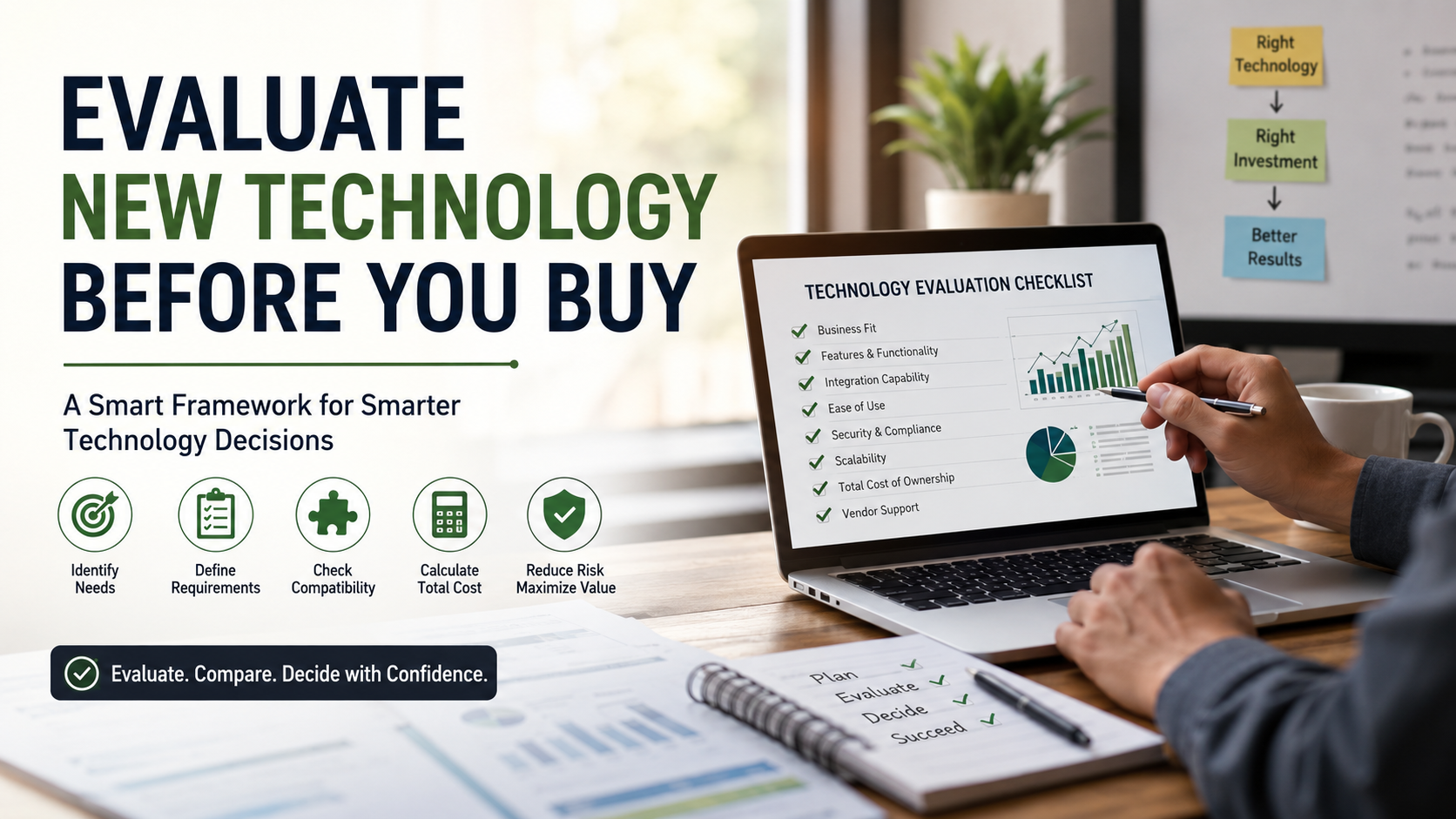
Evaluate New Technology Before You Buy
Investing in the wrong software or hardware can completely derail your team’s daily productivity. It can also drain your corporate budget quickly. When you look for ways to evaluate new technology before you buy, you actively protect your business. You avoid exceptionally costly implementation mistakes and severe operational friction by implementing a structured framework. A thorough software review allows you to analyze enterprise software options via platforms like Gartner to see what fits. Shiny object syndrome frequently drives companies to adopt trendy tools. However, they do not actually need these tools to execute their core operations.
The Importance of Software Assessment
A highly structured assessment framework ensures your modern IT investments align perfectly with long-term business goals. It also delivers a clear, measurable return on investment over time. Without a rigorous baseline evaluation protocol, organizations run the high risk of accumulating expensive technical debt. This debt slows down your overall growth. Taking the time to properly audit platforms prevents administrative headaches. These headaches typically arrive when you are forced to roll back a flawed deployment across multiple departments.
What This Procurement Guide Covers
This comprehensive guide will walk you through a practical, step-by-step framework. This framework is designed to assess digital tools thoroughly before making any long-term financial purchase. We will cover how to define your core business requirements. We will also analyze integration capabilities and accurately calculate the comprehensive total cost of ownership. By the end of this educational article, you will possess the exact strategic framework needed. This will allow you to make confident, data-driven technology acquisitions for your growing organization.
Embracing this disciplined approach allows leadership teams to remain agile. It helps you avoid marketing traps that often obscure a software application’s true operational limitations. Let us dive into the foundational steps required to make smart, efficient, and highly strategic technology selections. These choices will properly support your workforce.
How to Evaluate New Technology Before You Buy
Every single year, organizations waste thousands of dollars on complex software platforms. Employees ultimately abandon these tools due to poor usability or bad alignment. To prevent this widespread issue within your own business, you must look directly past polished marketing hype. You need to analyze how a tool actually functions under real-world conditions. Far too many applications look spectacular during a curated corporate presentation. Yet, they completely crumble when subjected to the chaotic data demands of a live department.
Evaluating a product requires a healthy dose of professional skepticism. You must be willing to investigate the underlying mechanics of the platform. By establishing strict baseline criteria before signing an agreement, you gain absolute clarity. You learn exactly what the software can achieve. This proactive analysis shifts the power back into your hands. It allows you to dictate terms based on practical requirements rather than vendor promises. If you want to evaluate new technology before you buy, you must build a repeatable screening process. This process should test every claim a software salesman makes during their pitch.
Identify Your Core Business Problems First
Before browsing vendor feature lists or booking sales calls, you must pinpoint the exact operational problems you need to solve. Technology is ultimately a tool designed to enable a broader business strategy. This means it can never serve as a functional strategy all by itself. Introducing an advanced platform into a broken, disorganized process will only accelerate your existing operational inefficiencies. It will not fix them. Leaders must sit down and diagnose the core breakdowns occurring within their daily production lines first. You must do this before looking outward for external software answers.
This internal diagnostic phase ensures you purchase tools to fix real gaps. It keeps you from investing in features that sound impressive but offer zero daily utility. By anchoring your search in concrete corporate issues, you create an objective filter. This filter quickly eliminates irrelevant software options from your consideration pool. This initial step is the most critical phase when you evaluate new technology before you buy. It sets the baseline for your entire procurement project.
Define Your Technical Software Requirements
Gather direct, unvarnished input from the specific team members who will actually use the software application on a daily basis. Write down their specific pain points and software friction points. Document the regular manual bottlenecks that slow down their core deliverables. Create a highly detailed list of “must-have” architectural features versus optional “nice-to-have” capabilities to guide your future vendor conversations. This clear, predefined distinction prevents costly scope creep from inflating your project parameters during the intense vendor selection process.
When you explicitly outline your technical boundaries ahead of time, you can quickly filter out software packages. You easily drop options that lack fundamental, non-negotiable features. Furthermore, involving your staff early in the requirement gathering phase builds immediate internal buy-in. It ensures they feel valued and respected throughout the procurement journey. Defining these core elements helps you evaluate new technology before you buy by matching software specs to human needs.


Map Out the End-User Digital Workflow
Document exactly how corporate data currently flows through your specific department. You can do this by creating an accurate visual map of your daily procedures. Visualize precisely how the proposed new application will alter this daily sequence once it is introduced to the active production environment. If a new platform requires your team to complete five additional manual steps to perform a simple task, user adoption rates will inevitably plummet.
A truly great software upgrade should simplify human actions. It should remove administrative redundancies and create an intuitive path toward task completion. Take the time to analyze user experience design, menu navigation, and the overall cognitive load required to operate the system effectively. Designing an optimized workflow prior to purchase helps ensure the chosen system adapts to your people. It prevents the system from forcing your people to adapt to a broken layout. A smooth workflow is vital when you evaluate new technology before you buy.
Analyze Tool Integration and Compatibility
A brilliant piece of software becomes entirely useless if it cannot communicate smoothly with your existing, highly critical corporate tech stack. Siloed data creates massive operational friction and encourages manual double-entry. It also exponentially increases the risk of catastrophic human error across your entire infrastructure. When tools operate in isolation, your employees waste valuable time exporting spreadsheets. They spend hours manually moving information between disconnected dashboards.
Modern businesses rely on fluid data ecosystems where information updates automatically across all operational nodes. It should do this without requiring manual intervention. Therefore, your technological evaluation must heavily prioritize architectural compatibility. You must ensure any incoming platform slots neatly into your current software environment. Failing to verify these digital connections beforehand will inevitably lead to expensive custom development projects later down the line. You will pay just to keep your business operational. To evaluate new technology before you buy, you must run an extensive compatibility check.
A text-based explanation of the integration framework illustrates how an existing tech stack connects to new technology through a dedicated API or native integration channel, enabling bidirectional data flow between both systems.
Check Available Vendor API Documentation
Carefully review the vendor’s public developer documentation to confirm how cleanly their system connects with your current tools. Look specifically for pre-built, native integrations that require absolutely minimal IT oversight or custom engineering work to set up successfully. You can verify these technical standards by reviewing official documentation on platforms like GitHub. A robust, well-documented Application Programming Interface (API) indicates that the software vendor prioritizes long-term system interoperability. It shows they value modern engineering standards.
If the API documentation is hidden behind a paywall or appears poorly maintained, consider that a major red flag for future development stability. Ask your internal engineering team to review the technical endpoints. They must ensure the data transfer speeds match your real-time business demands. Choosing a well-connected platform drastically reduces long-term maintenance overhead. It keeps your business data unified. Checking these details helps you evaluate new technology before you buy with high precision.
Evaluate Security Protocols and Corporate Compliance
Ensure the technology vendor strictly meets your specific industry compliance standards. They must hold mandatory regulations such as GDPR, HIPAA, or SOC 2 Type II certifications. Ask the vendor directly for their latest independent security audit reports. Review their formal data encryption standards for both rest and transit. A cheaper software tool could easily cost your company millions of dollars in legal fees if it triggers a severe corporate data breach.
You must verify where the vendor hosts their servers, how they handle data backups, and what their disaster recovery timeline looks like. Never compromise on cyber security protocols just to save a small percentage on your annual software subscription costs. Partnering with a security-conscious vendor protects your brand reputation. It ensures your proprietary business information remains safe from malicious actors. Security assessment is non-negotiable when you evaluate new technology before you buy.
Calculate the Total Cost of Ownership (TCO)
The upfront sticker price of a software subscription rarely represents the true, long-term financial impact on your business operations. To properly evaluate new technology before you buy, you must dig much deeper to uncover hidden implementation expenses. Software vendors often obscure these fees during early talks. A comprehensive financial assessment requires tracking direct and indirect costs over a prolonged operational window. This allows you to view the true expenditure curve.
-
Implementation Fees: The direct costs of data migration, custom software configuration, and initial IT architectural setup.
-
Training Costs: The value of lost productivity hours while employees step away from their jobs to learn the new system.
-
Maintenance and Support: Premium tier customer service fees, mandatory hardware upgrade costs, and annual renewal increases.
Build a detailed financial spreadsheet that explicitly calculates all of these distinct variables over a realistic three-to-five-year period. A tool with a deceptively low monthly fee might actually end up costing significantly more than an enterprise option. This happens if it requires extensive custom coding or heavy consulting fees. Knowing the true total cost of ownership allows you to negotiate better contract terms. It prevents painful budget surprises mid-deployment.
Conduct a Strict Proof of Concept (PoC) Before You Buy
Never commit your hard-earned capital to a long-term enterprise software contract without thoroughly testing the platform using your own real-world data. Relying solely on a polished, highly curated vendor demonstration is a dangerous recipe for operational disappointment. It leads directly to wasted financial resources. Sales presentations are deliberately designed to showcase a product under perfect, flawless conditions. These settings rarely match the chaotic reality of your daily business.
A formal Proof of Concept allows your organization to stress-test the software application. You can learn more about managing complex software assets by reviewing structural guides on IEEE Xplore. This practical trial phase strips away the marketing glitz. It exposes any underlying software bugs, slow loading times, or user experience flaws. Investing time into a rigorous pilot program provides concrete empirical evidence. Your executive leadership needs this data to approve the purchase with absolute confidence. It is the ultimate way to evaluate new technology before you buy.
Run a Limited System Sandbox Trial
Request a dedicated, fully functional trial environment from the sales representative. Do not accept a limited, feature-stripped demo account. Have a small, trusted group of power users test the system intensely for a minimum of two consecutive weeks. Challenge these specific employees to replicate their toughest, most complex daily tasks within the sandbox environment. This allows them to see how the system handles pressure.
Instruct them to actively look for interface latency, save errors, or confusing navigation menus that hinder speed. Collect their honest feedback through structured daily check-ins. This tracks how the platform performs under regular operational strain. If your power users struggle to complete basic tasks during the trial, the wider staff will likely reject the application entirely upon full launch. Running a sandbox trial is the safest path when you evaluate new technology before you buy.
Assess Customer Support Response Times
Make a deliberate effort to test the vendor’s customer help desk responsiveness during your active sandbox trial period. Submit a technical support ticket regarding a minor configuration issue. You can also ask a complex question about their API architecture. Note exactly how quickly the support team responds to your inquiry. Track whether their guidance actually resolves your technical issue efficiently.
A company that ignores prospective buyers during a sales trial will undoubtedly offer terrible service once they secure your long-term contract. Pay close attention to whether you interact with helpful human experts or unhelpful, automated AI bots. Avoid vendors that just repeat generic documentation. Reliable, fast, and knowledgeable technical support is essential for minimizing downtime when an unexpected system outage occurs in production. Assessing support response helps you evaluate new technology before you buy.
Frequently Asked Questions
How long should the technology evaluation process take before you buy?
The overall duration of your technology evaluation process depends heavily on the architectural complexity of the software. It also depends on your specific organizational size. For small, standalone SaaS applications with minimal integrations, a complete evaluation might only take two weeks of focused analysis. However, for massive enterprise resource planning systems or core database migrations, the process can easily span three to six months.
This requires cross-departmental review. Do not rush this critical timeline under any circumstances. Rushing frequently leads to overlooked integration bugs and missed compliance flaws. Rushing the process to save a few days often results in spending months fixing deployment errors later. You will pay for these mistakes after the contract is signed. Allow your evaluation committee the necessary time to investigate every single technical risk before releasing corporate funds. A patient approach helps you evaluate new technology before you buy.
Who should be included in the technology buying committee?
Your formal technology evaluation committee must include three distinct structural viewpoints. This ensures a completely balanced, risk-averse purchasing decision for the company. First, you need to include the specific department head or executive stakeholder who controls the budget. This person understands overall corporate strategy. Second, you must include an experienced IT professional or cybersecurity analyst.
This expert will rigorously review backend security protocols, data compliance, and API integrations. Finally, you must include the actual front-line employees who will be forced to utilize the software tool for their daily tasks. Leaving these crucial daily end-users out of the buying decision almost always leads to terrible software adoption rates. It also creates intense staff resentment. Gathering these diverse viewpoints protects your business from blind spots. It ensures the platform satisfies both technical and financial goals. This team structure is vital when you evaluate new technology before you buy.
What are the warning signs of a bad software vendor?
You should watch out for vague answers regarding data security, missing API documentation, hidden implementation fees, or uncooperative sales representatives. If a vendor pushes aggressively for a long-term contract before allowing your team to test the actual product, proceed with extreme caution. High-quality, trustworthy software vendors will openly share detailed technical specifications.
They will provide compliance certificates and real-world customer case studies without hesitation. Another major warning sign is a sales team that makes grand promises about features that are not yet built. Never purchase a software product based on what it might become in a future update. Evaluate only what functions today. If a vendor lacks transparency during the initial sales process, their behavior will likely worsen after onboarding. Spotting these signs is essential when you evaluate new technology before you buy.
How do I measure the return on investment for new software?
To accurately calculate the return on investment, you must systematically track specific key performance indicators both before and after you implement the tool. Common quantitative metrics include the total hours saved per week, significantly reduced operational error rates, or increased sales conversions within the department. Compare these clear financial gains directly against your calculated total cost of ownership.
This determines the absolute financial value generated by the tool. Additionally, consider qualitative factors like employee satisfaction and reduced burnout. These elements contribute heavily to long-term staff retention. If the financial and operational benefits do not clearly outweigh the all-inclusive costs within eighteen months, the investment may not be worthwhile. Continuous measurement ensures that your technology stack remains lean, efficient, and highly profitable over time. Tracking these metrics helps you evaluate new technology before you buy.
What should I do if a tool fails our software trial?
If a software platform completely fails your strict proof of concept or sandbox trial, you must walk away from the deal immediately. Do not fall into the psychological trap of the sunk cost fallacy. Do not believe smooth sales promises that upcoming updates will fix current bugs. It is infinitely cheaper to restart your software search from scratch than to spend months trying to repair a fundamentally broken framework.
Document exactly why the tool failed to meet your standards. This allows you to refine your requirements checklist for the next vendor. Use the failed pilot test as a valuable learning experience to steer your buying committee toward a more compatible solution. Standing firm on your operational requirements protects your company’s bottom line. It maintains high workflow standards across your teams. Knowing when to quit is crucial when you evaluate new technology before you buy.
Conclusion
Learning how to evaluate new technology before you buy systematically protects your business from expensive operational disruptions and broken budgets. By identifying your core problems first, analyzing system compatibility, and calculating the true total cost of ownership, you remove dangerous guesswork from software procurement. Do not let aggressive vendor sales pitches or flashy marketing videos pressure your team into making hasty, unresearched commitments. Approach every single software purchase with a highly systematic, analytical mindset to ensure your investments drive real operational growth and long-term efficiency.
A successful technology rollout requires patience, cross-departmental communication, and a stubborn adherence to your defined technical requirements. When you prioritize thorough testing via sandboxes and demand full transparency from vendors, you safeguard your company’s digital infrastructure. Technology should always serve as an accelerator for human talent, freeing your staff from tedious manual bottlenecks. If you want to dive deeper into financial validation metrics, you can learn how to measure ROI before investing in new software to ensure your budget yields positive strategic returns. By maintaining strict procurement standards, you ensure that every platform added to your stack actively strengthens your market position.
Take charge of your business transformation by implementing these rigorous evaluation steps today. This ensures your organization remains highly competitive, agile, and secure for years to come. Every step you take to evaluate new technology before you buy brings you closer to operational excellence. It protects your hard-earned corporate revenue from software waste.