
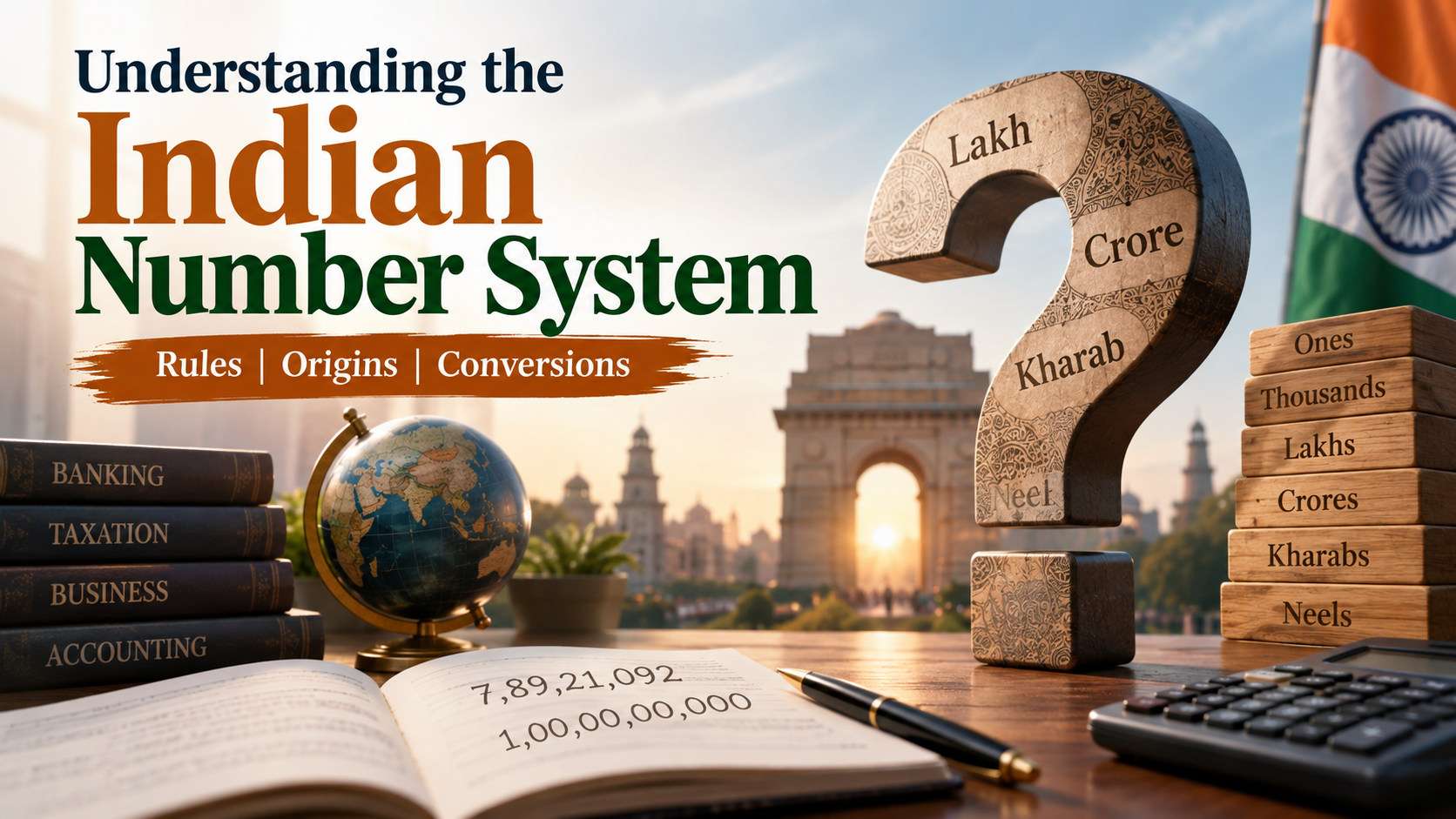
Understanding the Indian Number System: Rules, Origins, and Conversions
Reading large sums of money or financial statements in South Asia requires familiarity with a distinct counting method. The Indian number system groups large figures using a unique comma pattern and terms such as lakh and crore. Indian institutions, including the Reserve Bank of India, commonly use these units when presenting financial and economic figures.
Understanding this system helps prevent mistakes in banking, taxation, business, accounting, and everyday transactions. It also makes financial documents easier to read and interpret.
Many people find it difficult to convert between Western terms, such as millions and billions, and Indian terms. Others struggle to place commas correctly in large numbers. For example, an eight-digit number uses a different comma pattern in the Indian and international numbering systems.
Learning these differences makes salaries, invoices, contracts, accounting records, and financial reports easier to understand. It also supports clearer communication in regional trade and business.
This guide explains the main rules of the Indian number system. It covers large number denominations, comma placement, international conversions, historical origins, geographic usage, and Indian telephone numbering.

What is 10,000 crore called?
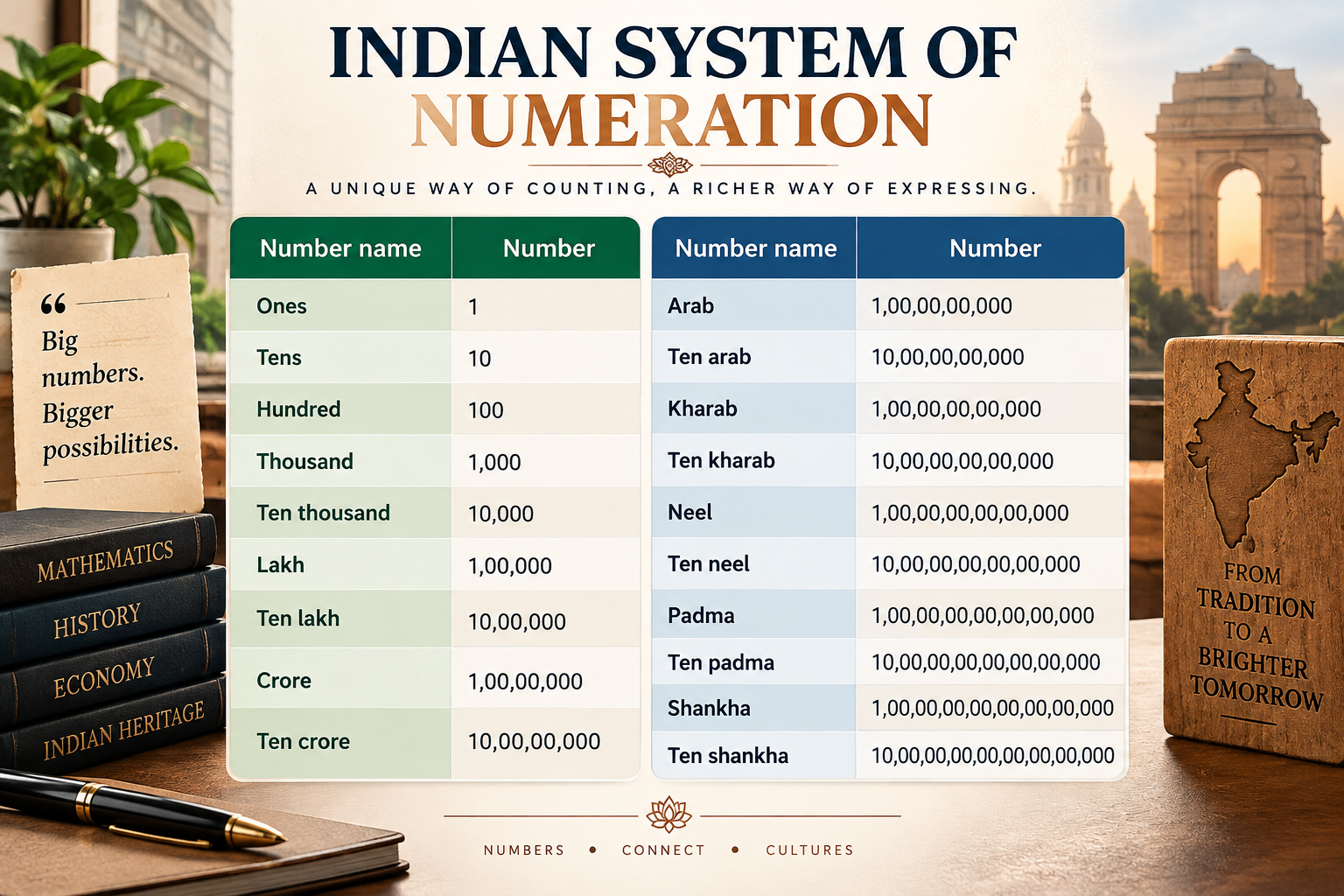
In the Indian number system, 10,000 crore is called one kharab. One crore equals ten million, or 10710^7. Therefore, multiplying one crore by 10,000 produces 101110^{11}. The number is written as 1,00,00,00,00,000 in the Indian format.
In the international system, the same value is called one hundred billion. This difference in terminology can create confusion when financial reports cross national or regional boundaries. Understanding the equivalent values makes large economic figures easier to interpret.
The term kharab is uncommon in everyday business. Most financial documents use crore, lakh crore, or billion instead. However, larger traditional denominations can still appear in historical, mathematical, or cultural contexts.
The basic relationship is:
- 1 crore = 10 million
- 100 crore = 1 billion
- 10,000 crore = 1 kharab
- 1 kharab = 100 billion
Knowing these relationships helps readers convert large figures accurately.
Practical Context and Higher Denominations
The denomination above kharab is neel, which equals 100 kharabs, or 101310^{13}. These terms belong to the traditional Indian large-number naming system. They are rarely needed in ordinary commerce because most modern financial reports use crore, lakh crore, billion, or trillion.
Still, these denominations are useful when studying traditional Indian mathematics or historical texts. They also demonstrate how the Indian number system provides names for extremely large quantities.
For practical calculations, understanding the relationship between crore and international units is usually more important. For example, 100 crore equals 1 billion, while 10,000 crore equals 100 billion.
The larger traditional sequence can be remembered as:
- 1 crore = 10 million
- 100 crore = 1 billion
- 10,000 crore = 1 kharab
- 100 kharab = 1 neel
These terms should not be confused with modern financial abbreviations. Their primary value today is helping readers understand historical numbering conventions and very large quantities.
How do you write 78921092 in Indian system?
To write 78921092 using the Indian number system, place the commas as 7,89,21,092. The Indian format groups the final three digits together. It then groups the remaining digits in sets of two.
The number can be written in words as seven crore, eighty-nine lakh, twenty-one thousand, ninety-two. This format immediately shows the relationship between crores, lakhs, thousands, and smaller units.
The international format would write the same number as 78,921,092. Both formats represent exactly the same quantity. Only the grouping and terminology change.
To place the commas correctly, start from the right side. Separate the last three digits first. Then place another comma after every two digits moving toward the left.
For this number:
78921092 → 7,89,21,092
This method is useful when preparing bank documents, invoices, salary records, tax documents, and accounting statements in India.
Step-by-Step Comma Placement Technique
Comma placement becomes simple when you follow a consistent rule. Start at the far right of the number and separate the final three digits. After that, move left and insert commas after every two digits.
For 78921092, the process looks like this:
- Start with 78921092.
- Separate the final three digits: 092.
- Move left two digits and separate 21.
- Move left another two digits and separate 89.
- The remaining digit is 7.
- The completed format is 7,89,21,092.
The first group can contain one, two, or three digits. Every group after it contains two digits.
This rule differs from the international system, where every group contains three digits. Learning the pattern makes large Indian figures much easier to read. It also reduces errors when entering numbers into financial records or interpreting documents that use lakhs and crores.
What is the US counting system?
The US counting system uses the short scale, which groups large numbers into sets of three digits. Commas separate thousands, millions, billions, and trillions in a consistent pattern.
For example, 1,000 is one thousand, 1,000,000 is one million, and 1,000,000,000 is one billion. Each major denomination increases by a factor of 1,000.
The Indian number system follows a different comma pattern after the first three digits. It uses lakh and crore instead of million and billion in common regional usage.
For comparison:
- 1 million = 10 lakh
- 10 million = 1 crore
- 100 million = 10 crore
- 1 billion = 100 crore
- 10 billion = 1,000 crore
The US format is widely used in international business, technology, science, and global financial reporting. Understanding both systems is important when comparing Indian and American financial figures.
Key Conversion Points for Global Finance
Converting between Indian and US number formats becomes easier when you remember a few key benchmarks. The most useful starting point is the relationship between lakh, crore, million, and billion.
One lakh equals 100,000. Ten lakh equals one million. One crore equals ten million. One hundred crore equals one billion.
This means:
- 1 lakh = 0.1 million
- 10 lakh = 1 million
- 1 crore = 10 million
- 100 crore = 1 billion
- 1,000 crore = 10 billion
These conversions are especially useful when reading international company valuations, investment reports, government spending figures, or economic statistics.
For example, a company valued at ₹500 crore has a value of ₹5 billion. Conversely, a business worth ₹2 billion has a value of ₹200 crore.
Using these benchmarks can prevent mistakes when comparing figures presented in different numbering systems. It also makes financial news easier to understand when Indian and international sources use different terminology.
How many countries use the Indian number system?
The Indian number system is mainly used across South Asia, although its adoption varies by country and context. India is its primary modern user, particularly for official documents, banking, accounting, business, and everyday transactions. The system uses terms such as lakh and crore and follows a distinctive comma-grouping pattern.
Countries where Indian-style numbering is commonly encountered include:
- India
- Pakistan
- Bangladesh
- Nepal
- Sri Lanka
The level of usage differs across these countries. Local languages may use their own terms for large numbers, while English-language publications may use million and billion, especially when addressing international readers.
The Indian-style grouping pattern remains particularly familiar in financial documents and everyday communication across parts of South Asia. Historical, cultural, and regional connections helped similar numbering conventions spread throughout the area.
Myanmar also has historical connections with related South Asian numbering terminology. However, it should not be described as using the Indian number system in exactly the same way as India or the countries listed above.
Therefore, there is no single universally accepted number of countries that exclusively use the Indian number system. Usage depends on the country, language, institution, and situation. It is more accurate to describe the system as a regional numbering convention with India as its primary user.
Who invented the Indian number system?
The Indian number system developed through centuries of mathematical work rather than being invented by one individual. Ancient Indian mathematicians made major contributions to the decimal place-value system and the mathematical treatment of zero.
Aryabhata, who lived around the 5th century CE, made important contributions to Indian mathematics and astronomy. Brahmagupta, writing in the 7th century, provided influential rules for working with zero and negative numbers in his mathematical treatise, the Brahmasphutasiddhanta. Learn more about influential historical figures who shaped human history and knowledge.
These developments helped establish a powerful positional method for representing numbers. Later, Indian mathematical ideas traveled through the Islamic world and eventually influenced European mathematics. The resulting tradition became known as the Hindu-Arabic numeral system, reflecting the historical development of mathematical ideas across regions.
It is therefore more accurate to describe the system as the product of several generations of Indian mathematicians. Its development transformed calculation and helped establish the numerical methods used around the world today.
Do Indian phone numbers have 10 digits?
Yes. Standard Indian mobile numbers contain 10 digits when written for domestic use, without the country code. Indian mobile numbers commonly begin with digits such as 6, 7, 8, or 9.
When calling India from another country, the country code +91 is added before the 10-digit number. For example, an Indian mobile number written domestically as 9876543210 can appear internationally as +91 9876543210.
Telephone numbering is separate from the Indian number system used for writing quantities. The two systems should not be confused simply because both involve numerical digits.
Indian telephone numbering follows national telecommunications rules and numbering plans. Landline numbers work differently because they use area or STD codes along with subscriber numbers.
The number of digits therefore depends on the type of telephone service and how the number is written. The familiar 10-digit format mainly refers to standard Indian mobile numbers used for domestic dialing.
Understanding Prefix Rules and Area Codes
Indian telephone prefixes help identify the type of service and numbering range. Mobile numbers commonly begin with 6, 7, 8, or 9, although the exact allocation depends on the national numbering plan and telecom requirements.
Older telephone practices sometimes required callers to use a leading zero with certain area or trunk codes. Mobile dialing within India generally uses the 10-digit mobile number directly.
Landline numbers follow a different structure. They combine an area or STD code with the subscriber number. When dialing from another region, callers may need to include the appropriate trunk prefix.
It is important not to confuse these telephone rules with numerical formatting. The commas used in figures such as 7,89,21,092 have no relationship to Indian mobile numbering.
In short, telephone numbers support telecommunications routing, while the Indian number system represents quantities. Both use decimal digits, but they follow different conventions and serve different purposes.
Frequently Asked Questions
What comes immediately after one crore?
In the regional hierarchy, ten crore comes immediately after one crore, followed by one arab, ten arab, one kharab, and ten kharab. Each successive major unit represents a multiple of one hundred times the preceding tier. For day-to-day corporate communication, speakers generally describe values between one and ninety-nine crore before adopting larger historical designations.
How much is 1 million in Indian rupees?
One million equals exactly ten lakh rupees (written numerically as ₹10,00,000). To convert any standard Western million value into Indian figures, simply multiply the original number by ten. For instance, a venture funding round of five million dollars translates directly into fifty lakh dollars before applying active foreign currency exchange rates.
Why does the Indian counting structure use two-digit clusters?
This structure stems from ancient Vedic linguistic categories that group numbers above one thousand into dual units, known as pairs. Historically, Sanskrit mathematicians assigned unique titles to every second power of ten. This distinct nomenclature directly shaped contemporary legal and commercial conventions, establishing the familiar three-then-two comma placement that defines regional bookkeeping.
Is one billion equal to one hundred crore?
Yes, one billion ($1,000,000,000$) corresponds exactly to one hundred crore ($1,00,00,00,000$). Both values contain nine zeros behind the initial digit. Remembering this straightforward equivalency provides the easiest mental shortcut for converting modern international tech investments, government budget deficits, and multinational corporate balance sheets into familiar domestic counting terms.
Conclusion
Mastering the Indian number system is an essential skill for anyone navigating trade, real estate, accounting, or media across South Asia. Its unique organizational rhythm—placing the initial comma at three digits and subsequently grouping by pairs—sets it apart from standard international conventions. From tracing ancient origins under brilliant scholars like Brahmagupta to converting millions into lakhs and billions into crores, understanding these rules eliminates confusion in everyday arithmetic.
Whether you need to transcribe 7,89,21,092 accurately on a bank draft or decipher substantial economic data measured in kharabs, this structural knowledge delivers clarity. Knowing that mobile numbering operates independently from mathematical place values further reinforces your practical understanding of modern systems.
As international trade continues to connect South Asian businesses with global markets, moving effortlessly between Western short scales and regional terms becomes an indispensable asset. Apply these simple comma placement rules and conversion formulas to your future balance sheets, contracts, and financial evaluations to ensure complete accuracy.