
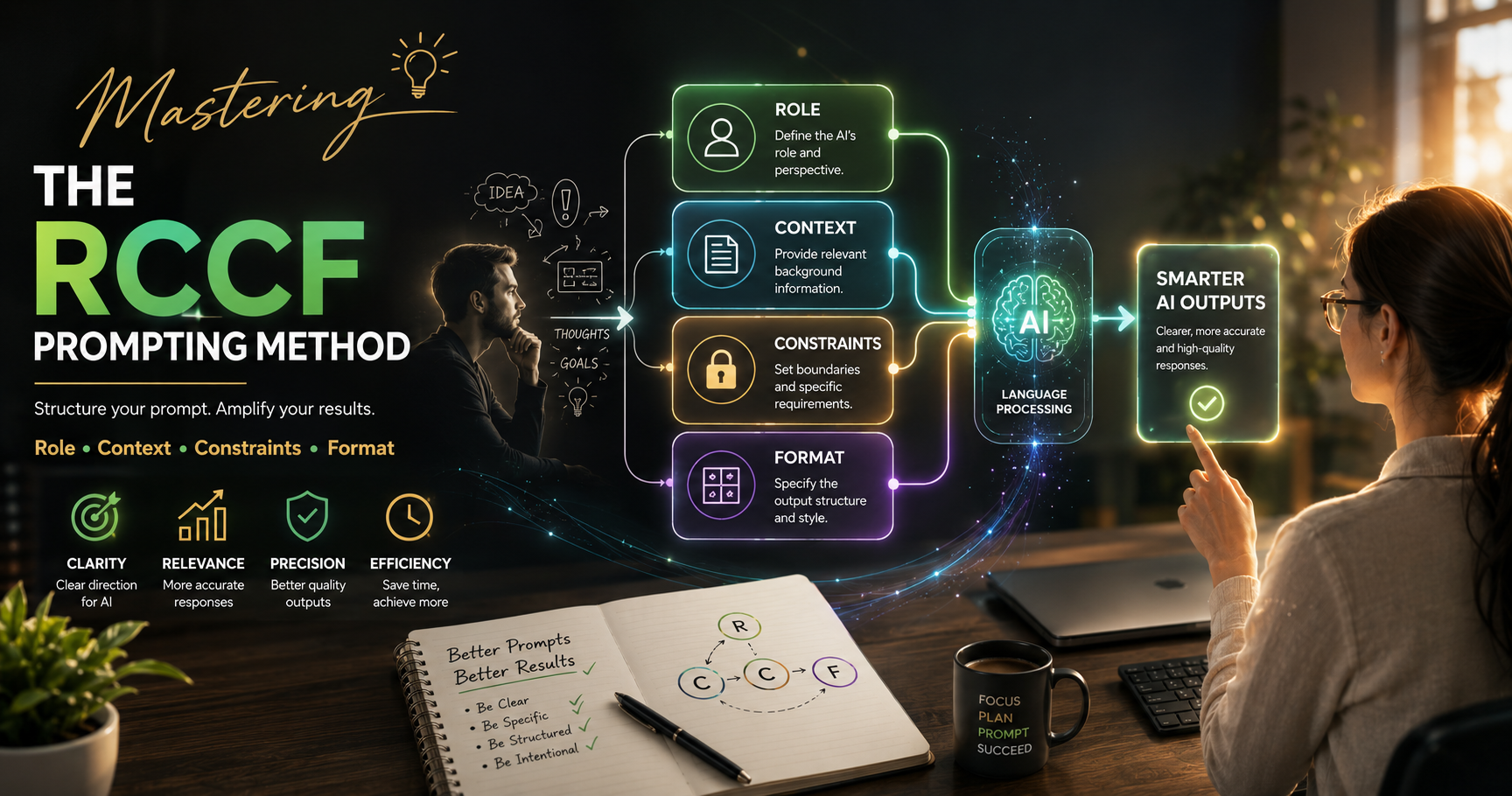
Mastering the RCCF Prompting Method for Smarter AI Outputs
Getting the exact output you want from artificial intelligence often feels like a guessing game. If you are tired of receiving vague, generic responses, mastering the RCCF Prompting Method will completely transform your workflow. By structuring your inputs according to this proven framework, you provide generative models with the precise guardrails they need to deliver high-quality, actionable results. Organizations like OpenAI continually emphasize that clear context and structural constraints are essential for maximizing the capabilities of large language models.
Understanding how to communicate with AI is no longer a niche skill; it is a core productivity driver. The RCCF Prompting Method solves the common issue of “hallucination” and irrelevant content by forcing the user to define the exact boundaries of the task. Whether you are generating marketing copy, analyzing complex code, or drafting business strategies, this methodology ensures consistency and reliability. In this comprehensive guide, we will break down the mechanics of the framework, explore its core components, and look at real-world examples to help you achieve prompt engineering mastery.
What is the RCCF Prompting Method?
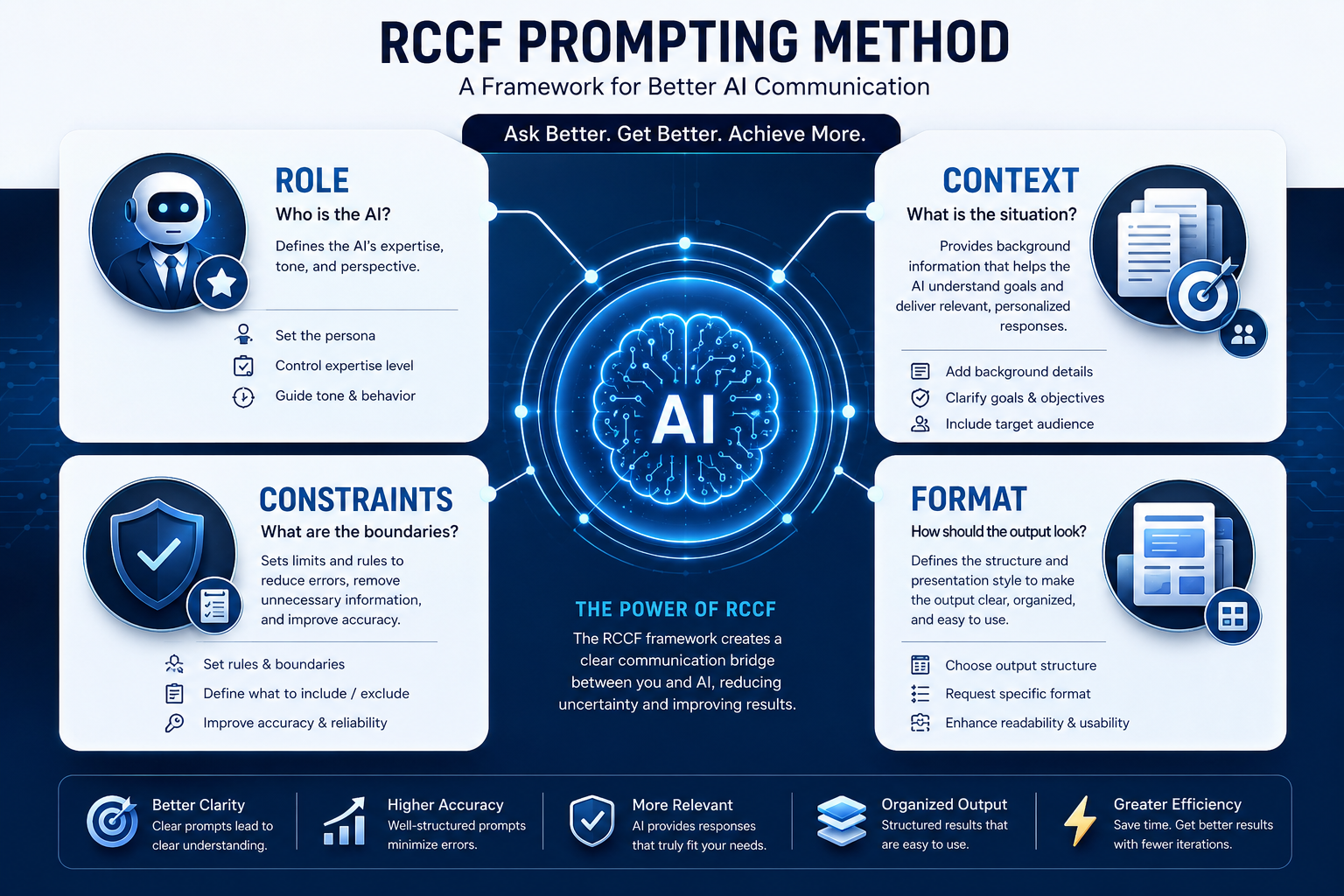
The RCCF Prompting Method is a structured approach designed to improve the way humans communicate with AI systems. Instead of providing a short and unclear instruction, this method organizes a prompt into four essential layers: Role, Context, Constraints, and Format. By using this framework, users can create clearer and more effective instructions that guide AI toward producing better results.
First, the Role defines the identity or expertise the AI should adopt, such as a teacher, researcher, or marketing specialist. Next, the Context provides background information so the AI understands the purpose and situation behind the request. In addition, Constraints establish specific limits, requirements, or rules that the AI must follow. Finally, the Format explains how the response should be structured, whether as a list, report, table, or another style.
Furthermore, this method reduces confusion because AI models do not understand requests exactly like humans do; instead, they predict responses based on patterns. Therefore, RCCF helps narrow possibilities and encourages more accurate, relevant, and personalized outputs. As a result, users can communicate with AI more efficiently and achieve higher-quality responses.
Breaking Down the 4 Pillars of the RCCF Prompting Method
To understand why the RCCF Prompting Method works so effectively, it is important to examine each component individually. Each pillar acts as a guiding point that helps the AI understand the user’s intention, reduce uncertainty, and generate more accurate responses. Instead of allowing the model to rely on general patterns, RCCF creates a clear framework that directs the AI toward a specific goal.
1. Role (Who is the AI?)
The first pillar, Role, focuses on assigning a specific identity or expertise level to the AI. By defining a persona, users can influence the tone, knowledge depth, and perspective of the response. For example, asking the AI to act as a “junior copywriter” will create a different response compared to instructing it to behave like a “senior behavioral economist.” Furthermore, the Role helps the AI understand the type of reasoning, language style, and professional approach required for the task.
2. Context (What is the Situation?)
The second pillar, Context, provides the essential background information needed for the AI to understand the situation. It includes details about the audience, purpose, goals, challenges, and environment surrounding the request. Without proper context, the AI may generate a generic answer because it lacks the information needed to personalize its response. Therefore, adding context allows the model to match its vocabulary, examples, and level of explanation with the user’s actual objective.
3. Constraints (What are the Boundaries?)
The third pillar, Constraints, establishes the rules and limitations that guide the AI’s response. This step is especially important because it prevents unnecessary information, incorrect assumptions, or irrelevant explanations. Users can define word limits, preferred writing styles, banned phrases, formatting rules, or specific points that must be included. As a result, constraints improve precision and keep the AI focused on the desired outcome.
4. Format (How Should the Output Look?)
The final pillar, Format, determines how the completed response should be structured. Whether the user wants a professional email, a comparison table, a step-by-step guide, a report, or a simple bullet list, specifying the format makes the output easier to use. Additionally, a clear format reduces editing time and ensures that the final result matches the user’s expectations.
Overall, the RCCF Prompting Method creates a powerful communication system between humans and AI. By combining Role, Context, Constraints, and Format, users can provide clearer instructions and consistently achieve more relevant, organized, and high-quality AI-generated responses.
RCCF Prompting Method vs Other Prompt Engineering Frameworks
The field of prompt engineering includes several frameworks designed to improve communication between users and AI systems. Although these methods share a common goal of creating clearer instructions, each framework approaches prompt structure in a different way. Therefore, understanding their differences helps users select the right method based on their specific needs.
| Framework | Core Focus | Best Used For |
|---|---|---|
| RCCF | Role, Context, Constraints, Format | Daily productivity, professional writing, research assistance, and data extraction |
| 5 P’s | Purpose, Person, Process, Practice, Performance | Long-term project planning, workflow design, and strategic AI alignment |
| 4 C’s | Clear, Concise, Correct, Comprehensive | Quick editing, communication improvement, and content refinement |
The RCCF Prompting Method stands out because it creates a strong balance between simplicity and structure. Unlike more detailed frameworks that may require extensive planning, RCCF provides a practical approach that can be applied quickly in everyday AI interactions. Furthermore, it ensures that users define the AI’s role, provide necessary background information, establish boundaries, and specify the expected output format.
In comparison, the 5 P’s framework focuses more on managing larger projects and building consistent processes over time. Meanwhile, the 4 C’s approach is mainly useful for improving existing content rather than designing complex AI instructions from the beginning.
As a result, RCCF is especially effective for users who want reliable AI responses without creating overly complicated prompts. By combining clarity, flexibility, and control, it helps transform general requests into precise instructions that produce more relevant and useful outcomes.
RCCF Prompting Method Example: A Real-World Use Case
To understand the practical value of the RCCF Prompting Method, let us examine a real-world example. Imagine that you need to create a product description for a new stainless steel water bottle. A simple request may seem clear at first; however, without proper instructions, the AI has to make many assumptions about the audience, tone, structure, and purpose of the content.
The Weak, Unstructured Prompt
“Write a description for a stainless steel eco-friendly water bottle.”
Although this prompt provides basic information, it lacks important details. As a result, the AI may generate a generic description filled with common marketing phrases and broad claims. Furthermore, it does not specify the target customers, writing style, important features, or the desired structure of the final output.
The Optimized RCCF Prompt
Role: Act as an expert e-commerce conversion copywriter.
Context: We are launching a premium, double-walled stainless steel water bottle designed for urban professionals who value sustainability but also want a stylish, office-ready product.
Constraints: Keep the description under 150 words. Avoid using words such as “revolutionary,” “game-changer,” or “eco-friendly.” Focus on practical advantages, especially the leak-proof lid, durability, and everyday convenience.
Format: Begin with an attention-grabbing headline, followed by a short persuasive paragraph, and finish with three clear bullet-point benefits.
By applying the RCCF framework, the AI receives clear direction about the audience, tone, limitations, and expected structure. Therefore, the final output becomes more focused, professional, and relevant. Additionally, it reduces the need for repeated edits because the AI understands exactly what type of response is required from the beginning.
FAQs About the RCCF Prompting Method and AI Prompt Engineering
What are the 4 C’s of prompting?
The 4 C’s of prompting are Clear, Concise, Correct, and Comprehensive. This framework focuses on improving the quality of communication between the user and the AI by ensuring that prompts are easy to understand, accurate, and complete. Unlike frameworks that emphasize roles or complex structures, the 4 C’s mainly improve the language and information included in a prompt.
First, Clear means the prompt should avoid confusing wording, vague instructions, or ambiguous meanings. A clear prompt helps the AI understand exactly what the user wants. Next, Concise focuses on removing unnecessary words and keeping the instruction direct while maintaining important details.
Additionally, Correct ensures that the information provided in the prompt is accurate and reliable. Incorrect details can lead to misleading or poor-quality responses. Finally, Comprehensive means including enough background, requirements, and expectations so the AI can complete the task effectively.
Overall, the 4 C’s framework is especially useful for editing, improving communication, and quick AI interactions. By making prompts clear, focused, accurate, and complete, users can achieve more relevant and consistent results.
What are the 5 P’s of prompting?
The 5 P’s of prompting are Purpose, Person, Process, Practice, and Performance. This framework offers a structured method for creating effective AI interactions, particularly for complex projects that require planning, consistency, and clear direction. Unlike basic prompting techniques, the 5 P’s provide a complete strategy for organizing AI tasks and improving overall results.
First, Purpose identifies the main objective of the prompt and explains what the AI should accomplish. Next, Person defines the AI’s role, expertise, or communication style, which helps shape the response. Additionally, Process describes the steps the AI should follow to complete the task successfully.
Practice includes examples, demonstrations, or reference information that guide the AI toward the desired outcome. Finally, Performance establishes evaluation standards to measure the quality and effectiveness of the response. Overall, the 5 P’s framework helps users create reliable AI workflows by improving clarity, accuracy, and alignment. As a result, it supports better decision-making and more consistent AI-generated outputs.
What are the three types of prompting?
The three primary types of prompting are Zero-Shot, Few-Shot, and Chain-of-Thought prompting. These methods help users communicate with AI models more effectively by adjusting the level of guidance provided.
First, Zero-Shot Prompting involves giving the AI a direct instruction without including any examples. In this approach, the model depends on its existing training and knowledge to complete the task. Therefore, it works well for simple requests where the expected result is already clear.
Next, Few-Shot Prompting improves responses by adding a few examples of desired inputs and outputs within the prompt. These examples guide the AI by showing the expected pattern, tone, or structure. As a result, the model can generate more accurate and relevant content.
Finally, Chain-of-Thought Prompting helps AI handle complex tasks by encouraging structured problem-solving before producing a final answer. It is useful for advanced reasoning, calculations, coding, and detailed analysis. Overall, selecting the right prompting method improves accuracy, consistency, and the quality of AI-generated responses.
What are the 5 pillars of prompt?
The 5 pillars of a strong prompt are generally considered to be Context, Instruction, Input Data, Output Indicator, and Persona. Together, these elements create a structured approach for communicating effectively with AI models. By including each pillar, users can provide clearer guidance and improve the accuracy, relevance, and consistency of AI-generated responses.
First, Context establishes the background information and explains the situation behind the request. It helps the AI understand the purpose, audience, and environment of the task. Next, Instruction defines the specific action the AI needs to perform, such as writing, analyzing, summarizing, or generating ideas.
Additionally, Input Data provides the information the AI must work with, including text, code, documents, examples, or other relevant materials. The Output Indicator explains how the final response should be structured, whether as a table, list, report, or another format. Finally, Persona determines the identity, expertise, or communication style the AI should adopt.
Why do constraints matter so much in prompt engineering?
Constraints play a crucial role in prompt engineering because they help guide AI models toward more accurate, focused, and useful responses. Without clear limitations, large language models may generate broad, repetitive, or overly generic content because they rely on common patterns learned from large amounts of data. As a result, the output may include predictable phrases, unnecessary explanations, or information that does not match the user’s exact goal.
By adding specific constraints, users can control important aspects of the response, including length, tone, vocabulary, structure, and content requirements. For example, setting a word limit, avoiding certain phrases, or requesting a specific writing style helps the AI understand exactly what is expected. Furthermore, constraints reduce the chances of irrelevant details and improve consistency across different outputs.
In addition, constraints can make AI-generated content feel more natural and human-like. Instead of producing standard responses filled with common clichés, the model is encouraged to create more targeted and creative language. Therefore, constraints act as a quality-control mechanism that transforms a general AI response into a polished, professional, and purpose-driven result.
Conclusion: Improve AI Results With the RCCF Prompting Method
Adopting the RCCF Prompting Method is one of the fastest ways to improve your daily digital productivity. Instead of wasting valuable time fighting with inconsistent AI generations, this framework allows you to establish control before the model writes a single word. By systematically defining the Role, Context, Constraints, and Format, you bridge the communication gap between human intent and machine execution.
As generative technology continues to evolve, the professionals who succeed will not be those who treat AI like a magic wand, but those who treat it like an elite assistant. Clear direction yields elite results. Start integrating these four structural pillars into your workflows today to experience cleaner data, sharper copy, and incredibly reliable responses.
If you are new to artificial intelligence and want to build a stronger foundation, explore our guide on AI terms every beginner should know to understand essential concepts, tools, and technologies shaping the future of AI.