

Mastering the 3 Word Rule in ChatGPT for Clean, High-Yield AI Outputs
If you have spent any time experimenting with Large Language Models, you know that getting the perfect response can feel like a guessing game. Many users fall into the trap of writing massive, over-complicated prompts that confuse the AI. However, a growing community of prompt engineers uses a constraint known as the 3 word rule in ChatGPT to force clarity and precision. According to official OpenAI documentation, keeping constraints sharp prevents the model from wandering off-topic. By mastering this minimalist framework, you can dramatically improve the accuracy, tone, and formatting of your AI-generated content.
Understanding how to control an AI with minimal input matters because it saves time and reduces editing friction. When you give ChatGPT fewer words to interpret within a specific constraint, it assigns higher statistical weight to those words. Consequently, the output aligns closely with your intended goal. This article covers exactly what this rule is, how to implement it in your workflows, and how it fits into broader AI frameworks.
What is the 3 Word Rule in ChatGPT?
The 3 word rule in ChatGPT is a prompting constraint where you limit a specific instruction, role, or style guide to exactly three words. Instead of telling the AI to “write a response that sounds very friendly, casual, and easy for a beginner to understand,” you compress that entire directive into three impactful words: “Tone: casual, friendly, simple.”
This technique leverages the core mechanics of transformer models. When a prompt is cluttered with filler text, the model distributes its attention tokens across unimportant words. By applying a strict three-word boundary to your stylistic or structural directives, you ensure that the AI focuses its computational power on the exact attributes you care about.
Similarly, this rule can apply to outputs. You can instruct ChatGPT to summarize a complex topic or define a concept using only three words. This forces the model to distill information down to its absolute essence, cutting out the fluff that frequently plagues AI content.
Why the 3 Word Rule in ChatGPT Changes Your AI Prompting Workflow
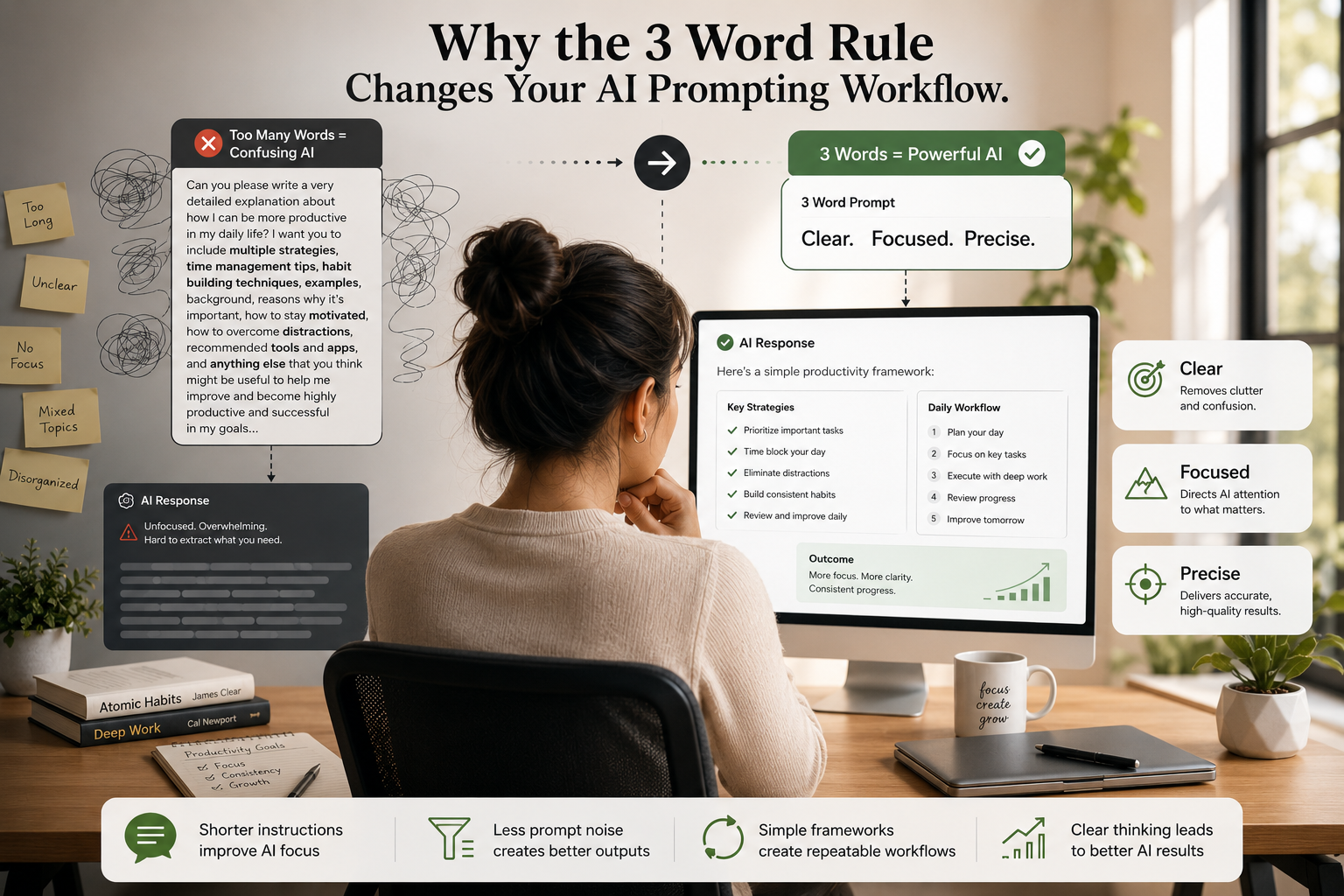
Many people assume that longer prompts yield better results. While detailed context is necessary for complex assignments, instructions regarding style, formatting, or constraints benefit from brevity. Using concise directives offers several distinct advantages for content creators and professionals:
-
Eliminates AI Hallucinations: When you limit instructions to core keywords, ChatGPT is less likely to misinterpret your goals or invent unnecessary details.
-
Saves Token Limits: Shorter prompts preserve the context window, allowing you to have longer, more productive conversations with the model.
-
Creates Repeatable Frameworks: Three-word style rules are easy to save, copy, and paste across multiple projects for consistent branding.
Moreover, forcing yourself to distill your goals into three words clarifies your own objective before you even hit enter. If you cannot describe your desired output style in three words, you likely need to refine your creative direction.
Real-World Examples of the 3 Word Rule in ChatGPT Style Constraints
To see the 3 word rule in ChatGPT in action, look at how modifying style constraints changes a basic request like “Explain email marketing.”
| Three-Word Constraint | Resulting AI Output Style |
Tone: bold, urgent, persuasive |
Direct, high-energy sales copy focused on immediate action. |
Format: bullet points only |
Clean, scannable data completely stripped of introductory paragraphs. |
Perspective: data analyst expert |
Analytical, metrics-driven explanations prioritizing ROI and statistics. |
How to Apply the Ultra-Short Prompting Framework
Implementing this strategy requires a shift in how you structure your daily prompts. Instead of writing conversational paragraphs to guide the AI’s behavior, you should treat your prompt structure like a clean configuration file.
First, provide the raw context or background data that the AI needs to work with. Second, state your core task clearly. Finally, append your three-word rule at the very end of the prompt to lock in the constraints. For instance, if you want a product description, paste the product features, state “Write a product description,” and finish with “Length: three short paragraphs” or “Style: minimalist, luxury, modern.”
Consequently, the final instructions act as an immediate filter for the generated text. The model processes the heavy context first, then molds that data through the tight lens of your final three-word directive.
Frequently Asked Questions About the 3 Word Rule in ChatGPT
What is the 3 word rule?
The 3-word rule is a prompt engineering technique used to make AI responses more focused, controlled, and efficient. It means expressing a specific instruction, style preference, or output requirement using exactly three words.
For example, a user can write: “Tone: professional, empathetic, concise” to guide the AI’s writing style. Another example is asking, “Summarize quantum physics in 3 words,” which sets a clear output limit.
This technique helps ChatGPT understand the main priorities of a request without unnecessary details. It can reduce extra information, improve consistency, and give users better control over tone, formatting, creativity, and response length. The 3-word rule is a simple but effective way to create clearer prompts and receive more precise AI-generated answers.
What are the rules for ChatGPT 3?
The rules for ChatGPT-3 were mainly based on how the older language model processed information and generated text. Since it is a legacy model, it relied heavily on recognizing patterns and following the instructions provided in a prompt.
Users needed to give clear context, specific instructions, and well-structured requests because older models had more limited reasoning and memory abilities compared with newer AI systems. Providing examples, defining a role, and explaining the desired format helped improve the quality of responses.
Another important rule was keeping prompts simple and direct. Clear wording and organized instructions reduced the chance of the model going off-topic or producing irrelevant information. Setting limits on length, style, and structure also helped guide the output and made results more consistent.
What is the 3 prompt rule?
The 3 prompt rule is a structured method for improving AI responses by dividing a task into three separate steps instead of asking for everything at once. It helps users guide the AI more effectively and achieve a better final result.
The first prompt focuses on providing context, explaining the goal, and sharing important details. The second prompt is used to create a draft, outline, or initial version based on that information. The third prompt is used to refine the response by adding improvements, adjusting the style, fixing errors, and applying specific formatting requirements.
This step-by-step approach makes it easier to review progress, make corrections, and control the final output. The 3 prompt rule is especially useful for writing tasks, planning, research, and creative projects where quality and accuracy matter.
What are the 3 rules of AI?
The 3 rules of AI are often linked to Isaac Asimov’s Three Laws of Robotics, a famous set of fictional principles about how intelligent machines should behave.
The first rule states that an AI or robot should not harm humans or allow humans to come to harm. The second rule says that AI should follow human instructions unless those instructions would violate the first rule. The third rule states that AI should protect its own existence as long as that does not conflict with the first two rules.
In modern AI development, these ideas are often connected to broader principles like safety, alignment, and usefulness. Developers aim to create AI systems that are helpful, reliable, and less likely to cause harm. These principles guide the design, training, and use of AI technologies in society.
Can I use the 3 word rule for summaries?
Yes, the 3-word rule can be used for summaries and is a useful way to capture the main idea of a topic quickly.
When you ask ChatGPT to summarize something in exactly three words, it has to identify the most important concepts and remove unnecessary details. This makes it a helpful technique for understanding the core message of a long article, book, or complex idea.
For example, a summary of the internet could be: “Global connected network.” A history topic might become “Events, causes, impact.”
This method is useful when you need a quick overview before studying a subject in more depth. However, because three words provide very limited detail, it works best as a starting point rather than a complete explanation.
Final Thoughts: Using the 3 Word Rule in ChatGPT Effectively
Mastering the 3 word rule in ChatGPT is a simple yet powerful way to elevate your prompt engineering skills. By replacing long, winding sentences with sharp, three-word constraints, you align your instructions perfectly with how transformer models process data. This approach strips away conversational noise, lowers token consumption, and yields highly accurate content tailored to your exact specifications.
Whether you are configuring a custom persona, adjusting your brand voice, or forcing the AI to summarize complex topics down to their absolute essence, constraints are your best friend. Start incorporating this minimalist framework into your daily workflows to see immediate improvements in your AI outputs. For the best results, remember to combine your concise style constraints with clear, accurate background context.
For beginners, learning essential AI concepts is the next step toward becoming a more confident AI user. Check out our guide on AI terms every beginner should know to build a stronger foundation and understand the technology behind these powerful tools.