

Why Did Google Pixels Stop Using Snapdragon Chips?
Tech enthusiasts often ask, why did Google Pixels stop using Snapdragon chips after years of relying on Qualcomm processors? Google used Snapdragon processors in its first five Pixel generations. However, everything changed in 2021 when Google introduced the Pixel 6 with its custom-designed Tensor processor.
This decision marked a major shift in Google’s smartphone strategy. Instead of depending entirely on Qualcomm, Google wanted greater control over its smartphone hardware. The company also wanted to improve artificial intelligence (AI), computational photography, and voice recognition.
Mobile processors influence several important aspects of smartphone performance. These include battery life, gaming capabilities, camera processing, and AI features. Google believed a custom processor could deliver a more integrated Pixel experience.
However, Tensor also introduced challenges involving heat management, battery efficiency, and processing performance. Understanding why did Google Pixels stop using Snapdragon chips requires looking beyond processor speed. Let’s explore Google’s decision, Tensor’s advantages, its hardware challenges, and the future of Pixel processors.
Why Doesn’t Pixel Use Snapdragon?
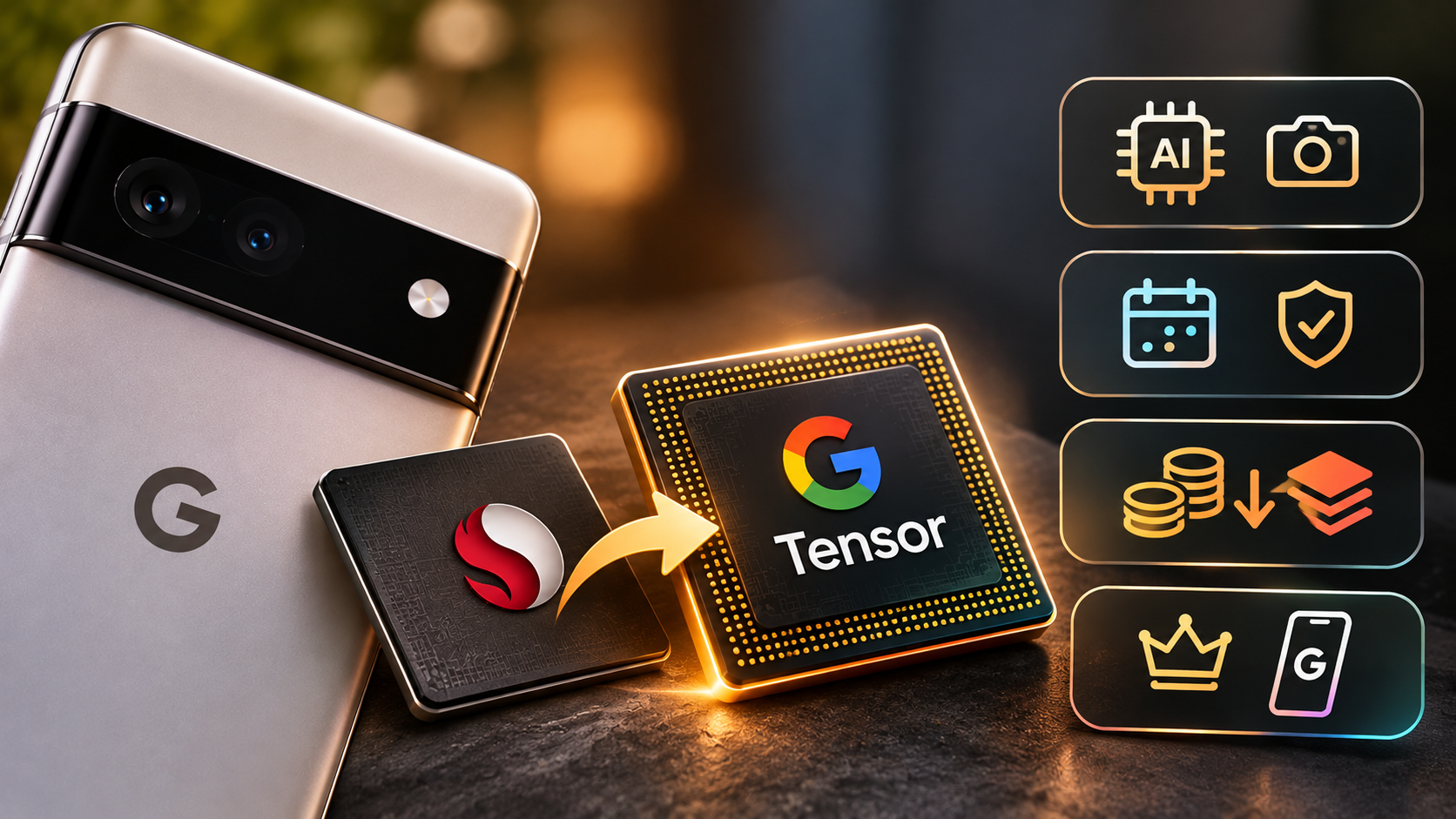
Google stopped using Snapdragon processors because it wanted greater control over smartphone hardware and artificial intelligence. Qualcomm already offered powerful mobile processors, but Google wanted a chip designed around its software and machine learning requirements. This became the foundation of the Google Tensor project.
Google wanted its hardware and software teams to work more closely. This approach allowed engineers to optimize specific smartphone features. It also reduced the company’s dependence on Qualcomm’s processor development roadmap.
The Advantage of Custom Tensor Architecture
Google introduced Tensor with the Pixel 6 in 2021. Its primary objective was to improve integration between hardware, software, and machine learning. Instead of relying entirely on general-purpose processing, Google developed specialized components for its workloads.
Tensor includes a Tensor Processing Unit (TPU) designed to accelerate machine learning tasks. It helps Pixel phones handle computational photography, speech recognition, and other AI-powered features. Google’s approach also allows its engineers to optimize software and hardware together. This image-processing technology also influences Google’s camera performance, particularly when comparing Google Pixel and Samsung Galaxy night photography.
Some important advantages include:
- Computational photography: Improves image processing and camera features.
- Voice recognition: Supports speech-to-text and voice-based functions.
- On-device AI: Runs supported machine learning models directly on smartphones.
- Hardware security: Integrates dedicated security components into the processor.
However, Snapdragon processors also support advanced AI features. Google’s decision focused on customization and control, not an inability to run AI on Qualcomm hardware.
Google explained its original vision in its Tensor processor announcement.
Why Is Exynos Worse Than Snapdragon?
Samsung’s Exynos processors have sometimes struggled against competing Snapdragon chips in performance, efficiency, and thermal management. However, calling every Exynos processor worse than Snapdragon would be inaccurate. Results depend on the specific generation, manufacturing process, modem, and smartphone design.
Google’s early Tensor processors shared important architectural and manufacturing connections with Samsung’s Exynos platform. Samsung Foundry manufactured the first Tensor generations. Their designs also incorporated several Samsung-related technologies.
Consequently, some early Pixel phones received criticism for overheating, battery efficiency, and sustained performance. Meanwhile, Qualcomm continued improving its Snapdragon platforms and manufacturing partnerships. Several flagship Snapdragon generations manufactured by TSMC delivered strong performance and efficiency.
These differences helped Snapdragon maintain advantages in certain demanding workloads. However, actual results depend on the complete smartphone rather than its processor alone.
Modem Efficiency and Thermal Throttling
A smartphone modem affects battery consumption, connectivity, and network performance. Google’s early Tensor generations used Samsung modem technology instead of Qualcomm’s modem solutions. Some users reported weaker connectivity and higher battery consumption in challenging network conditions. These factors also make real-world battery comparisons important when evaluating smartphones, as explained in this comparison of Google Pixel 10 and OnePlus 15 battery life.
Modem performance matters because smartphones constantly communicate with cellular networks. Poor signal conditions can increase power consumption. The device may also generate additional heat while maintaining its connection.
Thermal throttling occurs when a processor reduces its operating speed to control excessive temperatures. This can affect demanding activities such as gaming, video recording, and extended multitasking.
However, modem efficiency is not the only reason behind Pixel heating problems. Processor design, cooling systems, software optimization, and network conditions also influence temperatures. Therefore, comparing Snapdragon and Exynos requires considering overall device performance.
Why Is No One Buying Google Pixels?
Google Pixel phones are not completely unpopular, but their global smartphone market share remains relatively small. Apple and Samsung have stronger distribution networks, established retail partnerships, and larger customer bases. This makes global competition difficult for Google. However, Samsung users interested in Google’s smartphone experience can explore this complete guide to switching from Samsung Galaxy to Google Pixel before making a decision.
Several factors influence Pixel sales. First, Google sells Pixel devices in fewer countries than major smartphone manufacturers. This restricts availability and makes local repairs or customer support harder in some regions.
Second, early Tensor generations received criticism for overheating, modem performance, and battery efficiency. These issues affected the perception of Pixel hardware among some potential buyers.
Third, Samsung and Apple benefit from established carrier relationships and extensive advertising campaigns. Their smartphones are also available through more retail channels. However, Google’s smaller market share does not mean customers have stopped buying Pixel phones.
Limited Global Availability and Carrier Reach
Product availability plays an important role in smartphone sales. Many customers prefer purchasing phones through local retailers, mobile carriers, or installment plans. Manufacturers with stronger distribution networks can reach these customers more easily.
Google has expanded Pixel availability over the years. However, its international presence remains smaller than Samsung’s and Apple’s. This creates several disadvantages. Buyers should also consider the availability and cost of device protection before purchasing. Google’s protection options are worth understanding, including Pixel Care costs, coverage, and available plans.
- Fewer retail locations: Customers have fewer opportunities to experience Pixel devices before purchasing.
- Limited carrier partnerships: Some markets offer fewer carrier promotions and financing options.
- After-sales support: Repair services and replacement parts may be harder to access.
- Brand awareness: Samsung and Apple receive broader global marketing exposure.
However, limited availability is not the only reason behind Google’s smaller market share. Pricing, brand loyalty, product preferences, and competition also influence purchasing decisions.
Google’s strategy focuses heavily on software differentiation rather than competing only through hardware specifications. Its camera technology and AI features help distinguish Pixel devices from other Android smartphones.
Will Google Pixel Use Snapdragon?
Google has invested heavily in its custom Tensor processor, making a complete return to Snapdragon unlikely in the near future. Tensor remains central to Google’s strategy for integrating Android, artificial intelligence, and smartphone hardware.
So, why did Google Pixels stop using Snapdragon chips if Qualcomm already offered powerful processors? The answer comes down to Google’s long-term hardware strategy. The company wanted greater control over processor design, AI capabilities, and software integration.
However, saying Google will never use Snapdragon again would be too certain. Google has not guaranteed that every future Pixel generation will exclusively use Tensor. Business requirements and hardware partnerships can change over time.
For now, Google continues developing its own processors. The Pixel 10 series introduced Tensor G5 in 2025, manufactured using TSMC’s 3nm process. This allowed Google to retain its custom processor architecture while changing its manufacturing partner.
The Shift to TSMC Manufacturing
Google’s move to TSMC manufacturing represents an important development in the Tensor roadmap. Earlier Tensor generations relied on Samsung Foundry, which attracted criticism over performance and efficiency.
The Tensor G5 changed this manufacturing arrangement. Google designed the processor around its own requirements, while TSMC handled fabrication using its advanced 3nm process.
This approach offers several potential advantages:
- Manufacturing efficiency: Advanced fabrication technology can improve performance per watt.
- Thermal management: Better power efficiency can help reduce heat generation.
- AI performance: Google’s custom TPU continues supporting machine learning workloads.
- Hardware control: Google retains control over its processor design and software integration.
Google also reported improvements in Tensor G5’s CPU and TPU capabilities. However, manufacturing technology alone cannot guarantee better battery life or eliminate overheating.
Importantly, TSMC also manufactures several Qualcomm Snapdragon flagship processors. Google can therefore use the same manufacturing partner without purchasing Snapdragon chips.
Read Google’s Tensor G5 announcement for more information about this manufacturing transition.
Conclusion
Google stopped using Qualcomm processors because it wanted greater control over smartphone hardware, software, and artificial intelligence. The introduction of Tensor allowed Google to develop features specifically for Pixel phones. These include computational photography, voice recognition, and on-device AI.
However, early Tensor generations faced challenges involving overheating, battery efficiency, and modem performance. Google’s move to TSMC manufacturing with Tensor G5 represents an important step toward addressing these weaknesses.
The answer to why did Google Pixels stop using Snapdragon chips ultimately comes down to customization and long-term strategy. Google wanted a processor designed around its own vision rather than relying entirely on third-party hardware.
Instead of returning to Qualcomm, Google appears committed to improving Tensor. Its goal is to combine advanced AI capabilities with better performance and energy efficiency. Future improvements will determine whether this strategy delivers the experience Pixel users expect.