
Global Nuclear Energy Companies Shaping the Future of Clean Power
The global shift toward low-carbon electricity has brought nuclear energy companies back into focus. Countries need reliable power sources that can complement variable renewable energy. Nuclear power can provide steady electricity while producing very low lifecycle carbon emissions.
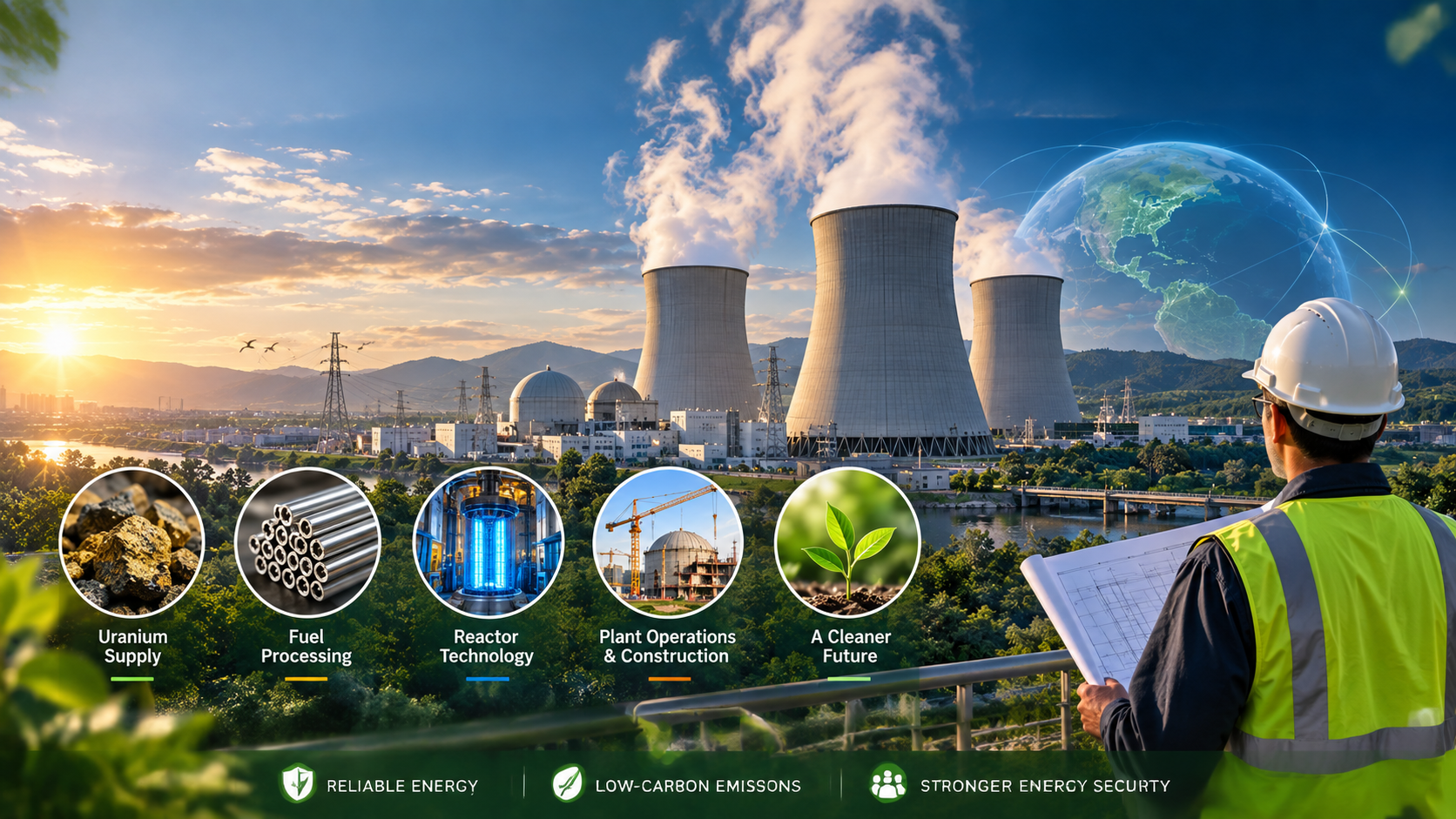
The sector covers much more than reactor construction. It includes uranium mining, fuel processing, reactor design, engineering, plant operations, maintenance, and regulation. This makes nuclear energy important for both energy security and long-term power planning. The International Atomic Energy Agency recognizes nuclear power as a low-carbon electricity source, alongside other clean energy technologies being developed to support the global energy transition.
Investors, policymakers, and energy researchers closely follow the companies shaping this industry. Their positions vary across reactor technology, uranium supply, engineering, and electricity generation.
This article answers key questions about nuclear energy companies, including global market leaders, investment options, Indian nuclear stocks, nuclear power rankings, uranium energy density, and the world’s major nuclear powers.

What is the leading company in nuclear energy?
There is no single measure for identifying the world’s leading nuclear energy company. Reactor exports, fuel-cycle services, operating assets, construction activity, and technology development can produce different rankings. Rosatom, Russia’s state-owned nuclear corporation, is one of the industry’s most influential companies, particularly in international reactor construction and nuclear fuel services. It has supplied VVER reactors to several countries and maintains a substantial overseas project pipeline.
Other major nuclear energy companies also hold important positions. Framatome, part of France’s EDF group, provides reactor technology, fuel, equipment, and services. Westinghouse Electric Company supplies reactor technology, fuel, and services across international markets. These companies also compete in advanced reactor development, including small modular reactors (SMRs).
The global market is therefore highly specialized. Leadership depends on whether the focus is reactor exports, fuel supply, engineering, plant operation, or advanced nuclear technology.
Global Market Share and Export Dominance
Rosatom’s international reach comes from its broad involvement across the nuclear supply chain. Its business includes reactor construction, fuel services, engineering, and other nuclear technologies. Its VVER reactor designs are being built or planned in several countries, giving the company a significant position in the global export market.
However, export dominance does not mean every nuclear market is controlled by one company. Western suppliers remain important in reactor servicing, fuel development, safety upgrades, and new reactor technologies.
Westinghouse, for example, supplies AP1000 reactor technology and nuclear fuel products. Framatome supports reactor fleets with fuel, components, maintenance, and engineering services. South Korea’s KHNP is also an important international reactor developer and operator.
The competitive landscape is becoming more complex. Countries increasingly consider supply-chain security alongside cost and technology. This creates opportunities for established nuclear energy companies and newer firms developing advanced reactors, SMRs, and innovative technologies born from limitations in conventional nuclear systems.
What is the best nuclear power company to invest in?
There is no universally best nuclear stock because companies provide different types of exposure to the industry. Investors must distinguish between uranium producers, nuclear utilities, equipment manufacturers, engineering companies, and reactor developers. Each category has different risks and growth drivers.
Cameco Corporation is a major uranium producer and provides direct exposure to the nuclear fuel market. Its performance can be influenced by uranium prices, production levels, long-term contracts, and mine development. Constellation Energy, meanwhile, provides exposure to operating nuclear power generation in the United States.
Investors should also examine debt, cash flow, regulatory conditions, project costs, and valuation. New reactor projects can require substantial capital and may face construction delays. Uranium producers can experience significant commodity-price swings.
Therefore, the best nuclear investment depends on the investor’s objective. Fuel suppliers offer commodity exposure, while utilities can provide exposure to electricity generation and long-term nuclear assets.
Evaluating Utility Giants vs. Fuel Suppliers
Uranium producers and nuclear utilities respond to different market conditions. This distinction matters when comparing nuclear energy companies as investments.
Uranium miners can benefit when uranium prices rise and reactor demand increases. Their revenue can therefore be more sensitive to commodity cycles. Production costs, mine expansion, permitting, and long-term contracts also influence their financial performance.
Nuclear utilities operate power plants and generally earn revenue from electricity sales. Their cash flows can be more predictable when plants have favorable market conditions or long-term contracts. However, utilities face substantial maintenance costs, regulatory requirements, and potential expenses related to plant extensions or new construction.
Investors should also consider technology suppliers and engineering companies. These businesses may benefit from new reactor construction without owning nuclear plants themselves, particularly as advanced industrial work is transformed by AI and new technologies.
The key question is not simply which company is “best.” It is which business model offers the right balance of growth, stability, commodity exposure, capital requirements, and regulatory risk.
What are the top 5 nuclear energy stocks in India?
India’s nuclear industry is dominated by government-owned organizations, while several listed companies participate through engineering, construction, equipment, and electricity-generation activities. Nuclear Power Corporation of India Limited (NPCIL) operates India’s commercial nuclear fleet but is not publicly listed.
Among listed companies, Bharat Heavy Electricals Limited (BHEL) supplies major power-generation equipment and has participated in nuclear-related projects. Larsen & Toubro (L&T) provides engineering, heavy fabrication, construction, and nuclear-sector capabilities. NTPC Limited is also expanding its interest in nuclear generation through planned partnerships and projects.
Other listed companies can gain indirect exposure through construction and infrastructure work. Hindustan Construction Company (HCC) has experience with major nuclear civil construction projects. Tata Power provides broader exposure to India’s electricity sector and clean-energy transition.
These companies should not be treated as pure-play nuclear stocks. Their financial results depend on many businesses beyond nuclear energy.
Engineering Giants Driving India’s Atomic Expansion
India’s nuclear expansion depends heavily on domestic engineering and manufacturing capabilities. Larsen & Toubro and BHEL are among the major industrial companies connected with this ecosystem. Their capabilities include heavy engineering, equipment manufacturing, fabrication, construction, and power-sector infrastructure.
This domestic supply chain is strategically important. India wants to increase nuclear generation while strengthening local manufacturing and reducing dependence on imported equipment. Nuclear projects require specialized components that must meet demanding quality and safety requirements, making supply chain disruptions an important consideration for major infrastructure projects.
Infrastructure companies also have opportunities through civil construction and project execution. HCC, for example, has worked on major infrastructure projects connected with India’s nuclear program.
However, investors should avoid treating every company involved in a nuclear project as a dedicated nuclear stock. Most Indian companies in this space have diversified operations.
For investors, the stronger approach is to examine nuclear order exposure, project pipelines, revenue contribution, margins, debt, and execution risk rather than relying only on a company’s association with the nuclear sector.
Who is no. 1 in nuclear power?
The answer depends on how nuclear leadership is measured. By total installed nuclear generating capacity, the United States remains the world’s largest nuclear power country. EIA data shows that the U.S. had about 96 operating commercial reactors across 57 nuclear power plants in March 2026. Its fleet had nearly 98 gigawatts of nuclear generating capacity.
The United States also produces more nuclear electricity than any other country. France remains particularly notable for its high dependence on nuclear power within its domestic electricity mix. China has become one of the fastest-growing nuclear markets and continues adding new reactors.
Russia has a different strength. It is a major international reactor exporter and nuclear fuel supplier. Therefore, the country leading in operating capacity is not necessarily the country leading in reactor exports or construction.
The global nuclear landscape is increasingly shaped by several major players. The United States, France, China, Russia, and South Korea all have significant nuclear capabilities, but their strengths differ across generation, construction, technology, and exports.
The Scale of the American Nuclear Fleet
The American nuclear fleet remains one of the world’s most important sources of steady low-carbon electricity. As of March 2026, the United States had 96 operating commercial reactors across 57 nuclear power plants, according to EIA data.
Many U.S. reactors have operated for decades. Operators have pursued license renewals, capacity upgrades, and efficiency improvements to extend the useful life of existing facilities. The average U.S. nuclear reactor age is now more than four decades.
The fleet also operates at high capacity factors. EIA reports that U.S. nuclear plants recorded an average capacity factor of about 91% in 2025.
This operating performance makes existing nuclear plants valuable grid assets. However, extending reactor lifetimes still requires significant investment and regulatory oversight.
The United States is also exploring small modular reactors and advanced reactors. These technologies could expand nuclear capacity, but high construction costs and lengthy licensing processes remain major challenges, similar to the broader push toward hardware-rooted AI and other emerging technologies that depend on specialized physical infrastructure.
What can 1 kg of uranium do?
Uranium has an exceptionally high energy density, but the exact answer depends on the isotope and how much of its potential energy is actually extracted. One kilogram of U-235 undergoing complete fission contains roughly 24 million kWh of thermal energy, not 24,000 kWh.
That figure represents theoretical energy from complete fission. A commercial reactor does not extract all of that energy from one kilogram of uranium. Reactor fuel also contains mostly uranium-238, while only a fraction of the fuel is fissile U-235.
Even with these limitations, nuclear fuel has an extraordinary energy density compared with fossil fuels. This allows nuclear plants to store large amounts of energy in relatively small quantities of fuel.
The comparison also explains why nuclear plants require far less fuel transportation than coal-fired facilities. Nuclear fuel is manufactured into compact fuel assemblies and replaced during planned refueling outages.
This high energy density is one reason nuclear energy companies remain important to long-term energy-security strategies.
Energy Density Versus Fossil Fuels
Nuclear fuel has a much higher energy density than conventional fossil fuels. Complete fission of 1 kg of U-235 releases roughly 24 million kWh of thermal energy.
However, this figure should not be confused with the electricity produced from 1 kg of ordinary reactor fuel. Commercial reactors use enriched uranium fuel, and the fuel cycle does not extract all available nuclear energy.
The practical advantage remains significant. Nuclear plants can operate for long periods using relatively compact fuel inventories. Refueling normally occurs during planned outages rather than through continuous fuel deliveries.
Coal plants, by comparison, require large and frequent fuel deliveries because coal has much lower energy density. This creates a substantial transportation and storage requirement.
Nuclear energy also benefits from high capacity factors. U.S. nuclear plants averaged about 91% in 2025, illustrating their ability to produce electricity consistently.
These characteristics make fuel efficiency and energy density important advantages when countries evaluate reliable low-carbon electricity systems.
Who are the big 5 nuclear powers?
The term “big 5 nuclear powers” usually refers to the five nuclear-weapon states recognized under the Nuclear Non-Proliferation Treaty: the United States, Russia, China, France, and the United Kingdom. These countries are also the five permanent members of the United Nations Security Council.
Their nuclear capabilities extend beyond military programs. Each has significant scientific, industrial, or research infrastructure related to nuclear technology. The United States, China, Russia, France, and the United Kingdom also have civilian nuclear power programs, although their fleet sizes and strategies differ.
China has rapidly expanded its commercial nuclear capacity and reactor construction program. Russia remains a major reactor exporter. France relies heavily on nuclear generation for electricity. The United States operates the world’s largest nuclear power fleet, while the United Kingdom continues developing new nuclear projects.
Together, these countries exert considerable influence over nuclear technology, safety standards, fuel supply, research, and international non-proliferation policy.
Geopolitical Influence and Advanced Technology
The five major nuclear powers have significant influence over the future direction of nuclear technology. Their governments support research into reactor safety, fuel cycles, advanced reactors, and other nuclear applications.
Their commercial industries also compete internationally. Russian companies have a strong reactor-export presence. U.S. and French companies provide reactor technology, fuel, engineering, and services. China is rapidly expanding its domestic reactor fleet and industrial capabilities.
Advanced technologies are becoming increasingly important. Small modular reactors, fast reactors, and other advanced designs could change how countries build and operate nuclear facilities. However, many technologies remain under development or require further commercial demonstration, highlighting the importance of hype versus value when evaluating emerging technologies.
Geopolitics also affects nuclear supply chains. Countries increasingly consider fuel security, technology independence, sanctions, financing, and domestic manufacturing when selecting nuclear suppliers, while broader global supply chain disruptions can also influence the availability and cost of critical materials and equipment.
As a result, the future of nuclear energy companies will depend on more than reactor performance. Technology, economics, supply-chain resilience, regulation, and international relationships will all shape the industry’s next phase.
Frequently Asked Questions
How long does it take to build a nuclear power plant?
Building a commercial nuclear power plant typically takes between five to ten years from the initial pouring of concrete to commercial operation. However, the pre-construction phase involving site selection, environmental impact assessments, and complex regulatory licensing can add several additional years to the timeline. Delays often stem from regulatory reviews, supply chain bottlenecks for specialized heavy components, and unexpected financing adjustments. Despite these long timelines, modern modular designs aim to streamline construction schedules significantly in the coming decades.
Are nuclear energy companies environmentally friendly?
Nuclear energy companies produce electricity with virtually zero direct greenhouse gas emissions during operation. The entire lifecycle emissions of nuclear power, including uranium mining and plant construction, are comparable to wind and solar power. Furthermore, nuclear plants require a very small physical land footprint relative to the massive amounts of energy they generate. The primary environmental challenge remains the safe long-term management and geological disposal of spent nuclear fuel, which is strictly regulated by government environmental protection agencies globally.
What is a Small Modular Reactor (SMR)?
Small Modular Reactors are advanced nuclear reactors designed to have a smaller physical footprint, with a power capacity typically under 300 megawatts per unit. Unlike traditional large-scale reactors built on-site, SMR components are factory-fabricated and transported via truck or rail to the installation site for assembly. This modular approach drastically reduces upfront capital costs, shortens construction timelines, and provides flexible power options for remote communities, industrial sites, or replacing retiring coal plants.
How safe is modern nuclear energy?
Modern nuclear energy is statistically one of the safest methods of generating electricity, resulting in fewer deaths per terawatt-hour than coal, oil, and natural gas. Strict international oversight by organizations like the World Association of Nuclear Operators ensures rigorous safety cultures across all member facilities. Advanced reactors feature passive safety systems that rely on natural physical laws, such as gravity and natural convection, to shut down safely without requiring operator intervention or external electrical power during emergencies.
Conclusion
Navigating the landscape of nuclear energy companies reveals an industry experiencing a profound global renaissance. From dominant global reactor builders and uranium producers to specialized engineering firms in India, the sector offers critical solutions for a carbon-constrained world. We explored how industry leaders operate, the massive energy density locked inside a single kilogram of uranium, and the strategic importance of the world’s leading nuclear nations. As technological innovations like Small Modular Reactors mature, nuclear power will continue playing a foundational role in electricity generation. Investors and energy stakeholders should monitor regulatory developments and supply chain dynamics closely. By leveraging clean, reliable baseload power, nations can successfully secure their energy futures while meeting ambitious climate targets.