
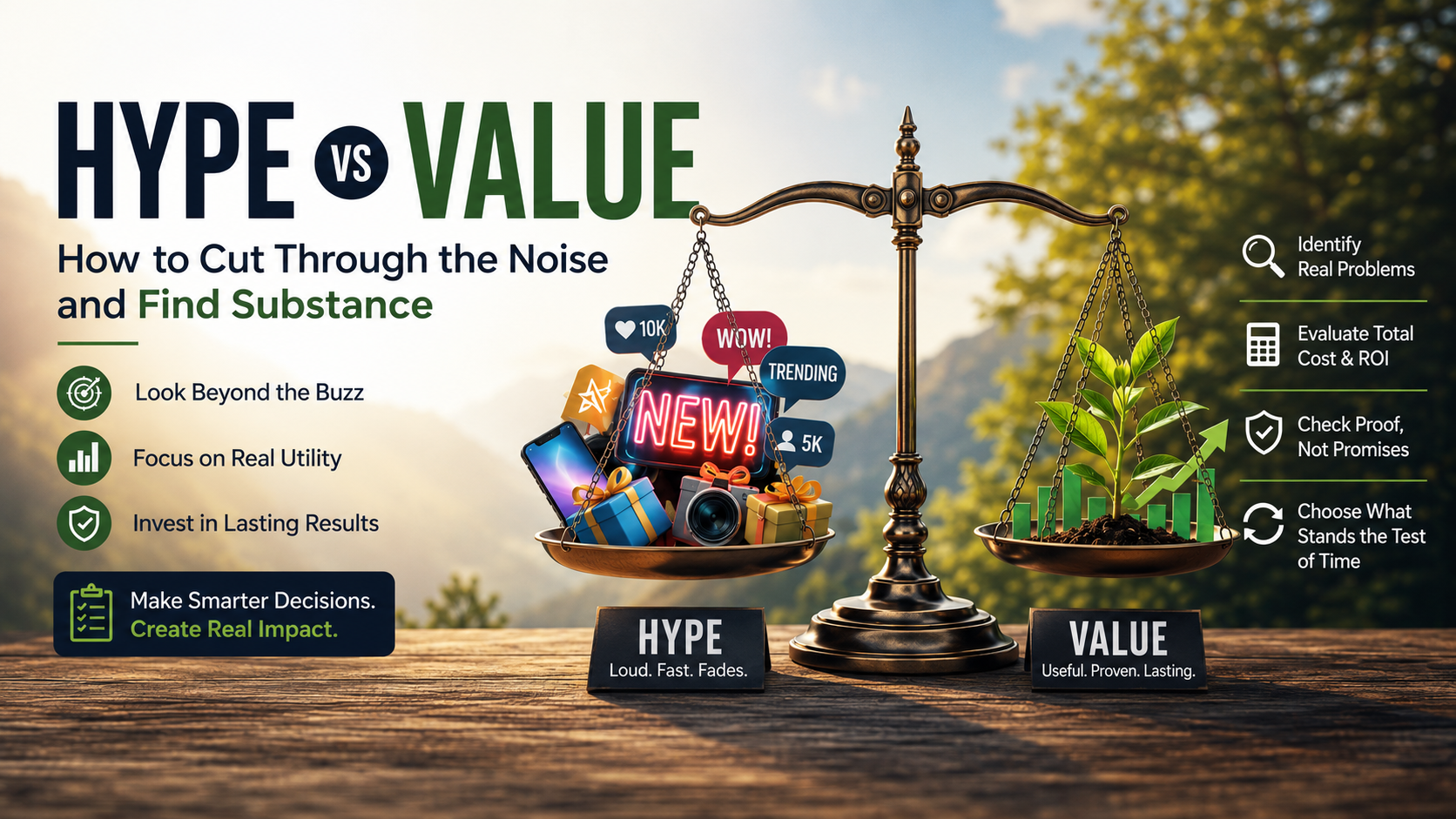
Hype vs Value: How to Cut Through the Noise and Find Substance
When exploring new markets, technologies, or products, we constantly face the dilemma of hype vs value. Every new launch claims to change the world, fueled by aggressive marketing and social media buzz. However, separating short-lived excitement from genuine, long-term utility is becoming increasingly difficult for consumers and businesses alike. According to research frameworks like the Gartner Hype Cycle, most innovations go through a visible peak of inflated expectations before their practical reality sets in. This cycle highlights how initial public perception can wildly deviate from actual, everyday utility.
Understanding this distinction matters because mistaking excitement for utility costs time and money. When we chase trends blindly, we risk investing in tools or ideas that offer no real return. Conversely, recognizing true worth allows you to make strategic, sustainable decisions. This article explores how to evaluate market trends, assess actual utility, and protect your investments from fleeting buzz. We will break down practical strategies to help you identify lasting worth in a crowded marketplace, allowing you to focus your energy and capital only on solutions that deliver real results over time.
Understanding the Dynamics of Hype vs Value


The balance between hype vs value shapes how we adopt new technology. Hype is an artificial amplification of expectation. It thrives on emotion, the fear of missing out (FOMO), and bold promises. Marketing campaigns excel at building this energy. They create a sense of urgency that demands immediate action. When a product is driven by this dynamic, its popularity spreads rapidly. This popularity often completely outpacing its actual readiness or functional capabilities. People buy into the vision of what the product might become tomorrow, rather than focusing on what it actually does today. This creates a speculative bubble where popularity is mistaken for utility.
Value, on the other hand, is quiet, stable, and measurable. It solves a specific problem, improves efficiency, or lowers costs. While excitement fades as soon as the next trend arrives, genuine utility remains relevant over time. It delivers tangible benefits consistently. It does not require continuous marketing noise to justify its existence. Its return on investment is perfectly clear to the user. True worth is built on reliable infrastructure and clear performance metrics. It relies on a track record of satisfying core consumer or business needs consistently under real-world conditions.
| Hype | Value |
|---|---|
| Driven by emotion and FOMO | Driven by utility and metrics |
| Focuses on future promises | Focuses on current results |
| Fades when the novelty wears off | Grows as adoption stabilizes |
The Cost of Chasing Marketing Buzz and Overblown Expectations
Investing heavily in unproven trends can damage an organization or personal budget. When a company adopts a tool simply because it is popular, they often face hidden challenges. Teams spend weeks learning systems that do not fit their workflow. This friction causes productivity to plummet. Furthermore, rapid obsolescence means the trend may vanish entirely within a year. This leaves you with unsupported software, dead-end data formats, and wasted capital. The emotional rush of being an early adopter rarely compensates for the massive operational friction caused by adopting half-baked solutions.
Resource diversion is another critical consequence of chasing the latest buzz. Capital, time, and engineering talent are pulled away from core projects. These core tasks actually drive growth and customer satisfaction. Instead of refining existing services, teams end up debugging unstable beta features of a trending platform. This structural distraction allows steadier competitors to capture market share. By the time the trend deflates, the business has lost valuable time. The company must then scramble to rebuild its core foundations from scratch.
How to Evaluate Lasting Product Utility and Real Worth
To accurately weigh hype vs value, you need a reliable framework for evaluation. You should look past the sleek presentations and ask hard questions about function and performance. True assessment requires stepping back from the social media conversations. You must analyze the product strictly through the lens of objective utility. If an innovation cannot stand on its own financial and functional merits without influencer campaigns, it is likely an overinflated market trend.
Look for Solved Problems Over Fleeting Trends
A valuable product always addresses a clear pain point. If a company cannot explain the exact problem their product solves without using buzzwords, it is likely driven by marketing noise. True utility means the offering makes a process faster, cheaper, or measurably better for the end user. You should look for concrete examples of how the product fixes a specific bottleneck in your daily routine or business pipeline. If the solution feels like it is actively searching for a problem to solve, the entire dynamic is artificial.
Furthermore, a genuine solution should offer a measurable improvement over existing alternatives. If a new tool promises to revolutionize your workflow but only offers a marginal difference, the transition cost is rarely justified. Authoritative evaluation requires looking at the raw output and comparing it directly to your established baselines. When the data shows a clear reduction in errors, time spent, or capital expenditures, you can confidently conclude that the product offers meaningful utility rather than temporary excitement.
Analyze Long-Term Costs and Financial Worth
An item or service may seem revolutionary, but you must calculate the total cost of ownership. High maintenance fees, steep learning curves, and mandatory upgrades can quickly erase any initial benefits. If the maintenance outweighs the utility, the product lacks real worth. Many trending tools attract users with low initial price points, only to lock them into expensive long-term contracts. These proprietary ecosystems become financial burdens over time. You must evaluate the full financial commitment before integrating any new solution into your environment.
Beyond the immediate financial costs, you must also consider the cognitive load and time required for implementation. A complex system that requires months of specialized training for your staff creates an ongoing operational drag. If the system undergoes frequent, disruptive updates to chase new features, your team will spend more time adapting to changes than actually producing work. A truly valuable tool integrates smoothly. It requires minimal administrative overhead and provides a stable environment that allows your primary operations to thrive without constant intervention.
Seek Independent Social Proof and Verified Utility
Marketing teams craft beautiful case studies, but independent reviews reveal the truth. Look for feedback on public forums, neutral third-party sites, and community discussions where real users share unfiltered experiences. Pay attention to recurring complaints about reliability, customer support, and actual daily usage. If the general consensus among real-world practitioners points to frequent bugs or missing core features, the product is not ready for mainstream deployment, regardless of how many industry awards it has won.
It is also vital to evaluate who is providing the praise. When the dominant voices celebrating a product are investors, marketers, or paid influencers, the sentiment is likely manufactured to drive financial speculation. Conversely, when quiet professionals within a specific niche quietly adopt a tool because it genuinely simplifies their workday, you have found authentic social proof. Look for detailed, technical feedback that explains exactly how a tool behaves under stress, as this data is incredibly reliable for spotting true utility.
Moving Past Marketing Buzz to Smart Decisions
Shifting your focus from popularity to utility requires a disciplined mindset. It means slowing down your decision-making process when everyone else is rushing. By establishing clear boundary lines and strict internal protocols, you can insulate your choices from external emotional pressure. This disciplined approach ensures that every investment you make is grounded in operational necessity rather than a reactionary desire to follow the crowd. Over time, this builds an incredibly resilient foundation that maximizes your resource efficiency.
-
Define your specific needs first: Never look at a new tool before writing down what you actually need to accomplish in your own workflow.
-
Demand a proof of concept: Test a tool or strategy on a small scale with a limited group before committing your full budget or changing systems.
-
Focus on integration: Ensure the new acquisition works seamlessly with your existing infrastructure and habits without requiring a total overhaul.
-
Establish clear exit criteria: Know exactly when to walk away from a trial if the tool fails to meet its promised performance benchmarks.
By prioritizing substance, you position yourself to benefit from innovations after the initial excitement settles. When you analyze hype vs value carefully, this approach saves resources and builds a resilient foundation for the future. You avoid the costly mistakes of the initial boom-and-bust cycle. This allows you to acquire refined, stable versions of technologies at a fraction of the cost paid by early, trend-chasing adopters.
FAQ SECTION
What is the main difference between hype vs value?
The main difference lies in sustainability, proof, and foundational intent. The debate of hype vs value shows that hype relies on emotional excitement, future promises, and intense marketing to attract attention. It creates an illusion of absolute necessity. It focuses heavily on what a product could eventually do, rather than what it accomplishes right now. Value relies on practical utility, measurable results, and consistent problem-solving in the present moment. While a trending topic can completely disappear in a few months when the novelty fades, a truly valuable asset continues to deliver concrete benefits long after the initial public excitement has ended. It proves its worth through return on investment, operational efficiency, and structural reliability under real-world conditions, making it a sustainable choice for long-term planning.
How can I tell if a new technology is just hype?
You can identify pure marketing noise by looking closely at its practical applications and language. If the technology requires complex, abstract explanations and relies heavily on buzzwords like “revolutionary” or “disruptive” without showing clear, repeatable use cases, it is likely hyped. Check if it solves a unique, existing problem or simply rebrands an old solution in a shiny new package. When early adopters struggle to show real efficiency gains, financial savings, or structural improvements, the technology lacks current substance. Furthermore, if the primary discussion around the technology focuses on its market valuation or investment potential rather than its practical day-to-day utility, you are dealing with a speculative trend rather than a mature, valuable tool.
Does a hyped product never have actual value?
A hyped product can certainly possess real utility, as the two concepts are not mutually exclusive. Often, a genuinely great product receives massive marketing support, causing a massive spike in public excitement that temporarily overshadows its actual function. The challenge is that the public expectation often far surpasses what the product can actually deliver in its current state, creating a gap between promise and reality. Over time, as the excitement normalizes and the speculative buyers leave, the true utility of the product becomes clear. The goal for smart decision-makers is to separate the exaggerated marketing claims from what the item actually accomplishes on a daily basis. Once you strip away the promotional noise, you can evaluate the remaining functional core objectively.
How do business leaders protect their companies from market hype?
Business leaders protect their organizations by establishing strict, data-driven evaluation processes that isolate decisions from external media noise. They avoid making sudden purchasing decisions based on trending news or competitor announcements. Instead, they require teams to perform comprehensive cost-benefit analyses and run small-scale pilot programs to test functionality in isolation. By focusing entirely on internal operational gaps rather than external market trends, leaders ensure they only invest in tools that actively improve their business outcomes. They also foster a company culture that rewards analytical skepticism and structural stability over the blind adoption of trendy tools, saving the enterprise from expensive integration failures and the constant disruption of shifting software ecosystems.
Why do consumers fall for hype so easily?
Consumers frequently fall for marketing buzz due to deep-seated psychological triggers like social proof, herd mentality, and the fear of missing out (FOMO). When media outlets, industry leaders, and popular influencers praise a new product, people naturally assume it must be excellent. This creates immense social pressure to join the trend to maintain status or relevance. This emotional desire often overrides logical thinking, causing individuals to buy items they do not actually need or understand. Marketing professionals know exactly how to exploit these vulnerabilities by creating artificial scarcity and urgency, making consumers feel that delaying a purchase will result in a permanent disadvantage, which successfully drives short-term sales volume despite a complete lack of long-term utility.
CONCLUSION
Navigating the constant tension between hype vs value requires patience, critical thinking, and a focus on utility. While marketing buzz can create exciting trends, it rarely sustains long-term success or satisfies real operational needs. True worth is found in products, services, and ideas that solve concrete problems, save time, and offer measurable returns on your investment. By implementing strict evaluation criteria, demanding clear evidence of utility, and ignoring emotional marketing tactics, you can protect your resources.
The goal is not to reject innovation entirely, but to approach it with a grounded perspective. Make your next decision based on verified substance rather than temporary popularity, and ensure your investments deliver lasting utility. This same principle applies beyond investing—whether you’re buying digital assets or improving physical ones, focusing on real value consistently delivers better long-term results. For example, investing in practical home upgrades can generate measurable returns, as explained in our guide on how to add value to your house. This shift in perspective transforms how you interact with the marketplace, turning you from a passive consumer of trends into a strategic accumulator of real assets. By consistently demanding proof over promises, you safeguard your financial future and build a sustainable path forward in an increasingly noisy world.