
Neurotechnology Explained: Tools, Leading Companies, and Future Horizons
Have you ever wondered what happens when advanced engineering connects directly with human cognition? Neurotechnology brings these fields together through tools that record, interpret, or influence activity in the brain and nervous system. These systems range from non-invasive brain-monitoring devices to implanted neural interfaces.
The field matters because it can support neurological treatment, rehabilitation, communication, and research. Brain-computer interfaces, for example, can help researchers translate neural activity into commands for computers or assistive devices. The National Institutes of Health (NIH) supports extensive research into neuroscience, neurological disorders, and emerging technologies that help scientists understand the brain.
However, neurotechnology is still developing. Some applications are established clinical treatments, while others remain experimental. This distinction is important when evaluating claims about future capabilities.
This guide explains what neurotechnology does, where it is being developed in India, and which companies are shaping the industry. It also examines its potential future applications, major risks, and relationship with artificial intelligence.
What does neurotechnology do?
Neurotechnology interacts with the brain, spinal cord, or peripheral nervous system. Depending on the system, it can record neural activity, stimulate nerves, or translate neural signals into digital commands. Understanding the brain’s structure provides useful context, as explained in Classification of Human Brain: Structure & Stages. These functions support medical diagnosis, rehabilitation, communication, and research.
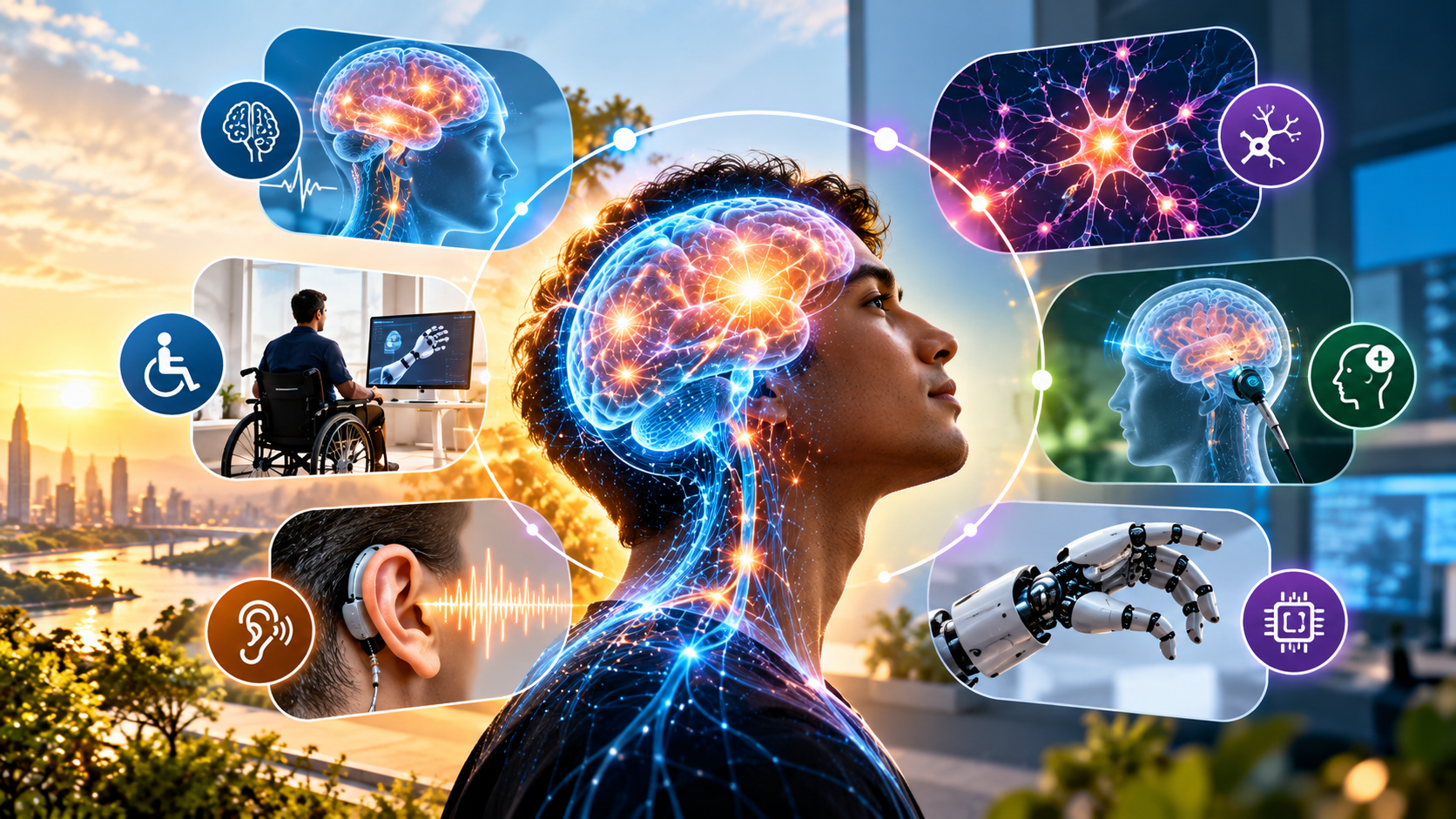
Brain-monitoring technologies can capture electrical signals from the scalp or directly from neural tissue. Software then processes these signals to identify useful patterns. In some brain-computer interfaces, those patterns can control a cursor, robotic device, or communication system.
Neurotechnology also includes therapeutic stimulation. Deep brain stimulation, for example, delivers controlled electrical impulses to specific brain regions. It is used clinically for conditions such as Parkinson’s disease and certain movement disorders.
Other technologies restore sensory functions. Cochlear implants convert sound into electrical signals that stimulate the auditory nerve. Research is also exploring visual and spinal interfaces.
Consumer devices represent another area of development. Some headsets measure brain activity for research, wellness, or human-computer interaction. However, their capabilities should not be confused with clinically validated medical devices.
Medical Rehabilitation and Sensory Restoration
Medical rehabilitation is one of the most established areas of neurotechnology. These systems can help compensate for damaged communication pathways between the brain, nerves, and muscles. Their applications range from sensory restoration to movement assistance and neurological treatment. Understanding the major systems of the body can also provide useful context, as discussed in The Human Body Parts: Names, Organs, and Main Systems.
Cochlear implants are a well-established example. They convert external sound into electrical signals that stimulate the auditory nerve. This process can provide useful hearing for eligible people with significant hearing loss.
Neural stimulation is also used in several medical settings. Deep brain stimulation can reduce symptoms associated with conditions such as Parkinson’s disease. Spinal cord stimulation can help manage certain forms of chronic pain.
Researchers are also developing brain-computer interfaces for people with severe paralysis. These systems can interpret neural signals and convert them into commands for computers or assistive devices. Some experimental systems have enabled participants to communicate or control external technology.
However, results vary between technologies and patients. Many advanced neural interfaces remain experimental and require extensive clinical testing before wider adoption.
Who is offering neurotechnology in India?
India’s neurotechnology ecosystem combines academic research, hospitals, engineering institutions, and emerging technology companies. Institutions such as IIT Madras and the Centre for Brain Research at the Indian Institute of Science contribute to research involving neuroscience, computational methods, and brain-related technologies.
Large hospital networks also provide established neurological treatments. Deep brain stimulation, neuro-rehabilitation, advanced imaging, and related neurological services are available at selected specialist centres. However, availability varies by hospital, location, and clinical indication.
India’s startup ecosystem is developing as well. Companies working in areas such as brain imaging, neurological assessment, biosensing, and artificial intelligence are exploring ways to make neurological tools more accessible.
BrainSightAI, for example, focuses on neuroimaging and computational approaches for understanding brain conditions. Other Indian companies and research groups are exploring biosensors, brain-computer interfaces, and digital neurological assessments.
The Indian market still faces challenges. Advanced equipment can be expensive, specialist expertise is concentrated in major cities, and many experimental technologies remain unavailable outside research settings. Therefore, India’s neurotechnology sector has significant potential, but adoption will depend on clinical validation, affordability, regulation, and infrastructure.
Translating Clinical Research Into Indigenous Solutions
Turning laboratory research into practical healthcare products is one of the biggest challenges for India’s neurotechnology sector. A promising prototype must demonstrate safety, reliability, clinical usefulness, and economic viability before hospitals can adopt it widely.
Indian universities, hospitals, research laboratories, and startups can help close this gap. Collaboration allows engineers to understand real clinical problems while doctors can evaluate whether a technology works in practical settings.
Cost is another important factor. Imported neurological equipment and specialized software can be expensive. Locally developed solutions could potentially reduce costs when they achieve comparable performance and receive appropriate clinical validation.
Artificial intelligence may also support this transition. Researchers can use machine learning to analyze medical images, identify patterns, and assist with neurological assessments. Yet these systems require representative datasets and careful validation.
Government research programs, biotechnology initiatives, and academic partnerships can support commercialization. Still, innovation alone is not enough. Successful indigenous neurotechnology will require strong clinical evidence, regulatory approval, cybersecurity, trained professionals, and sustainable healthcare delivery models.
What are the biggest neurotechnology companies?
The global neurotechnology industry includes established medical-device companies and newer brain-computer interface developers. Their technologies differ considerably, so comparing them only by company size can be misleading.
Medtronic is a major medical-device company with established neuromodulation products, including deep brain stimulation systems. Boston Scientific and Abbott also develop technologies used in neuromodulation and neurological care.
Several newer companies focus more directly on brain-computer interfaces. Neuralink is developing implanted brain-computer interface technology designed to record neural signals and potentially translate them into computer commands. Its approach involves implantable hardware and robotic surgical technology.
Synchron is pursuing a different approach. Its system is designed to access neural signals through blood vessels, potentially avoiding some aspects of open-brain surgery. The technology remains an area of clinical development.
Blackrock Neurotech has worked on implanted brain-computer interfaces and neural recording systems for research and assistive applications. Kernel has focused on non-invasive technologies for measuring brain activity.
These companies represent different approaches to neurotechnology. Their technologies vary in maturity, clinical evidence, regulatory status, and intended use.
Is neurotechnology the future?
Neurotechnology is likely to play an important role in the future of healthcare and human-computer interaction, but its impact should not be overstated. Some applications are already established, while others remain experimental. Evaluating such claims carefully is important, especially when separating established information from speculation, as explored in Myth vs Fact: Understanding the True Differences.
Future systems may improve neurological diagnosis, rehabilitation, communication, and assistive technology. Researchers are studying whether neural interfaces can help people with paralysis control computers, robotic limbs, or other devices. Improvements in sensors, signal processing, and machine learning could make these systems more practical.
Neurotechnology may also become less invasive. Smaller sensors and better algorithms could reduce the hardware required to capture useful neural information. This could support more comfortable monitoring and rehabilitation systems.
Consumer applications are possible, but they face greater uncertainty. Devices that claim to measure attention, stress, fatigue, or other mental states need careful validation. Neural signals are complex, and interpreting them reliably outside controlled environments is difficult.
The long-term future will therefore depend on evidence, safety, affordability, regulation, and public acceptance. Neurotechnology could become increasingly important, but widespread adoption is not guaranteed.
Convergence With Everyday Consumer Electronics
The combination of neurotechnology and consumer electronics could create new ways to interact with digital devices. Instead of relying only on keyboards, touchscreens, or voice commands, future systems may use neural or physiological signals as an additional input.
Researchers are investigating non-invasive brain-computer interfaces that can detect patterns associated with specific tasks or intentions. If these systems become sufficiently accurate and comfortable, they could support accessibility features and specialized human-computer interactions.
Wearable devices may also combine brain signals with other measurements. Sensors could potentially track factors such as movement, sleep, or physiological stress. However, detecting a specific mental state is much harder than measuring basic physical signals.
Entertainment and workplace applications are possible, but they raise important questions about privacy and reliability. A device that estimates fatigue, for example, should not automatically be treated as a definitive measure of cognitive performance.
The most realistic future may therefore involve gradual integration. Neurotechnology is more likely to complement existing interfaces than immediately replace keyboards, touchscreens, and voice controls.
What are the risks of neurotechnology?
The risks of neurotechnology depend heavily on the device and how it is used. Implantable systems can involve medical complications, while non-invasive systems raise different concerns involving accuracy, privacy, and data security. Maintaining overall brain health is also important when considering technologies that interact with the nervous system, as discussed in Keep Your Brain Healthy With These Tips.
Brain implants require medical procedures. Potential complications can include infection, bleeding, inflammation, tissue damage, or problems involving implanted hardware. Long-term performance can also change as the body responds to electrodes or other components.
Neural data creates another major concern. Brain activity can reveal sensitive information about a person’s neurological state or behavior. Strong cybersecurity and clear rules about data ownership are therefore essential.
Neural stimulation also requires careful control. Incorrect settings could produce unwanted effects, although clinical systems are designed with safeguards and professional oversight.
Ethical questions extend beyond physical safety. People may worry about mental privacy, informed consent, autonomy, and unequal access to advanced technologies. Enhancement applications could also create social pressure if certain cognitive capabilities become commercially available.
These risks do not make neurotechnology unacceptable. They show why responsible development must combine engineering progress with medical evidence, regulation, cybersecurity, and strong ethical protections.
Will AI take over neuroscience?
AI is unlikely to replace neuroscience as a field. Instead, artificial intelligence will probably become an increasingly important tool for researchers, clinicians, and engineers working with complex neural data.
The brain contains billions of neurons and produces enormous amounts of biological information. Machine learning can process large datasets faster than traditional manual analysis. Researchers can use these systems to identify patterns in brain imaging, neural recordings, and behavioral measurements.
AI can also support brain-computer interfaces. Algorithms can learn relationships between neural signals and intended actions. With sufficient training data, these models may help translate brain activity into commands for computers or assistive devices.
However, AI has important limitations. A model can identify statistical patterns without explaining the biological mechanism behind them. It also depends heavily on the quality and representativeness of its training data.
Human researchers remain essential for designing experiments, interpreting biological findings, validating results, and making ethical decisions. Neuroscience also involves questions about consciousness, behavior, and disease that cannot be solved through pattern recognition alone.
The likely outcome is collaboration. AI will accelerate analysis and prediction, while neuroscientists provide biological understanding, experimental judgment, and clinical context.
Frequently Asked Questions
How much do neurotechnology devices cost?
Consumer-grade neurotechnology devices like basic EEG wellness headbands cost between $250 and $1,000. In contrast, medical-grade neuromodulation implants like deep brain stimulation units cost between $20,000 and $100,000 including specialized neurosurgery, pre-operative imaging, and device programming. Insurance providers often cover FDA-approved medical implants for diagnosed conditions like Parkinson’s disease, whereas experimental chips and non-clinical consumer headbands require out-of-pocket payment.
What is the difference between invasive and non-invasive neurotechnology?
Invasive neurotechnology requires neurosurgical procedures to place microelectrodes directly on or inside brain tissue, producing crystal-clear signal fidelity. Non-invasive neurotechnology captures neural activity from outside the skull using surface sensors, headbands, or caps. Non-invasive devices eliminate surgical risks and infections entirely, but skull bone and scalp tissue scatter electrical signals, resulting in lower spatial resolution than surgically implanted chips.
Conclusion
The ongoing evolution of neurotechnology represents an unprecedented milestone in modern medicine and computational science. By establishing bidirectional communication between biological neurons and digital systems, this field transforms clinical treatments for paralysis, chronic pain, and severe psychiatric disorders. Understanding the brain itself remains fundamental to these developments, making The Human Body Parts: Names, Organs, and Main Systems a useful related resource. Key industry leaders like Medtronic and innovators like Neuralink continue pushing technological boundaries, while research institutions and startups across India develop localized, accessible clinical applications.
Nevertheless, realizing this tremendous potential requires solving significant challenges. Medical safety risks, mental privacy threats, and ethical questions surrounding cognitive liberty demand transparent legal frameworks and rigorous oversight. Furthermore, as artificial intelligence continues to refine how machines interpret neural codes, it remains an empowering investigative tool for human neuroscientists rather than a standalone replacement.
Moving forward, closing the gap between complex laboratory breakthroughs and accessible patient therapies will define the industry’s success. By keeping ethics, patient safety, and equity at the forefront of development, researchers can create a future where neurotechnological innovations restore lost functions, elevate cognitive well-being, and empower human lives responsibly.