

This Programming Language Is Quickly Becoming One Of The Most Popular In The World
Choosing the right technology path often starts with finding the most popular programming language. Coding powers everything from mobile apps and websites to artificial intelligence systems. It also supports automation, cloud services, games, and enterprise software.
For beginners, popularity can provide a useful starting point. Experienced developers can also use programming language trends to assess career opportunities and technology demand. However, the most popular language is not always the best choice for every project.
In this guide, we explore today’s leading programming languages and their common uses. We also compare Python and C++, explain the widely used language trio, and review the top programming languages in the current TIOBE Index. The August 2026 TIOBE Index ranks Python at No. 1, followed by C and C++.
Which Is the No. 1 Programming Language?
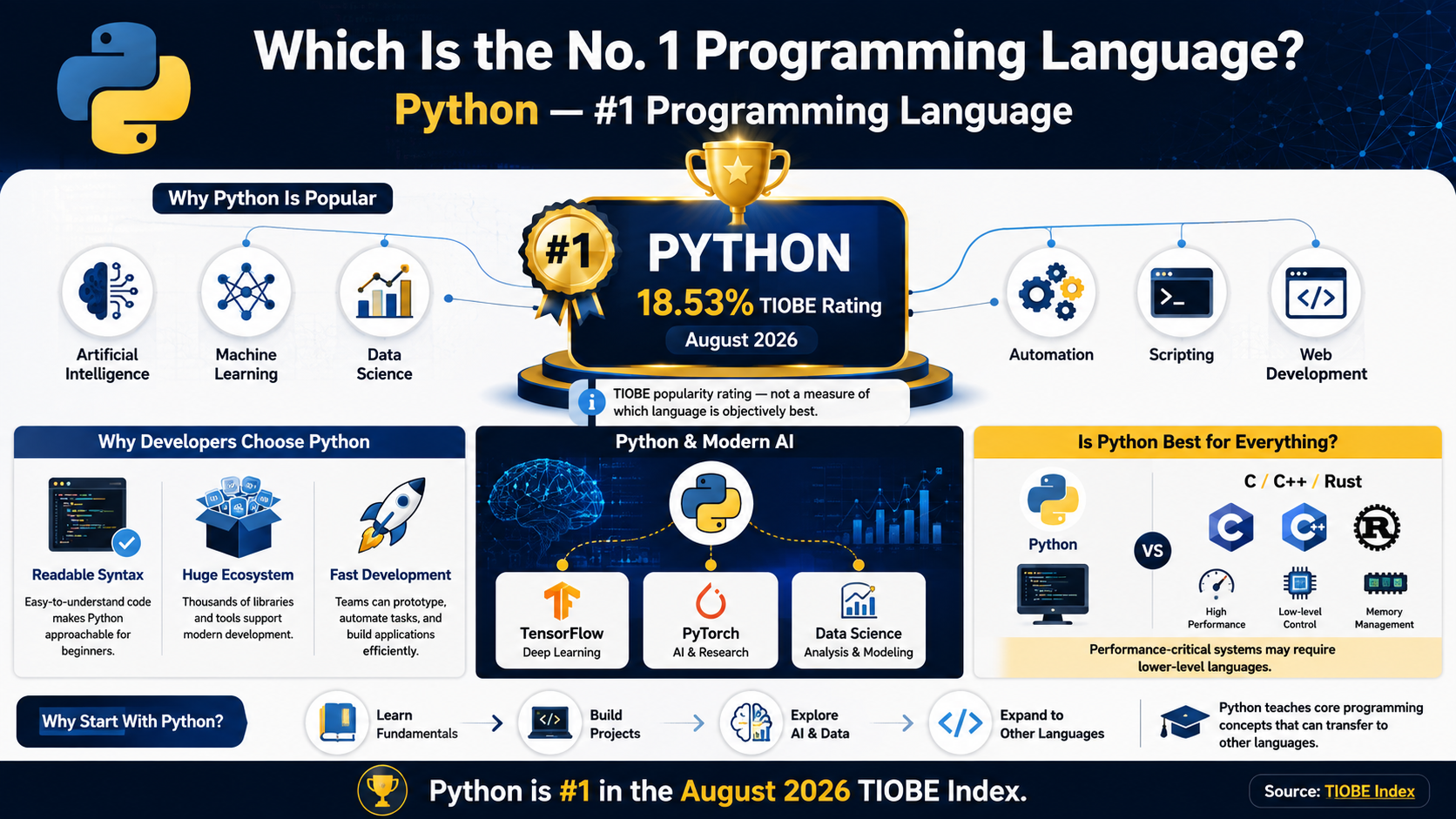
Python is currently the most popular programming language according to the August 2026 TIOBE Index. It holds the No. 1 position with an 18.53% rating. TIOBE measures programming language popularity using signals from skilled engineers, courses, third-party vendors, and major websites. It does not measure which language is objectively the best.
Python remains popular because it combines readable syntax with a broad ecosystem. Developers use it for artificial intelligence, machine learning, data science, automation, scripting, and web development. Its simple structure also makes it approachable for people learning programming for the first time.
Python’s flexibility gives it value across many industries. Businesses can use the same language for prototypes, data analysis, internal tools, and production applications. Its large collection of libraries also reduces development time for common tasks.

The Rise of Python in Modern Tech
Artificial intelligence has strengthened Python’s position in modern software development. Popular machine learning frameworks, including TensorFlow and PyTorch, provide extensive Python support. This makes Python a common choice for researchers, data scientists, and AI developers exploring what is generative AI and related technologies.
The language also benefits from its strong developer ecosystem. Teams can quickly test ideas, automate repetitive work, and build functional prototypes. This flexibility helps companies move from experimentation to production more efficiently.
Python is not ideal for every situation. Performance-critical systems may require languages such as C++, C, or Rust. Still, Python’s combination of simplicity and versatility keeps it highly relevant.
For anyone choosing a first language, Python offers a practical foundation. It teaches core programming concepts without introducing unnecessary complexity. Those skills can later transfer to other languages and development environments, especially when following the best coding websites for beginners.
Is C++ Harder Than Python?
C++ is generally considered harder to learn than Python. The two languages take very different approaches to programming. Python emphasizes readability and handles many low-level operations automatically. C++ gives developers much greater control over memory, performance, and system resources.
C++ can require developers to understand pointers, references, memory allocation, object lifetimes, and complex language features. These concepts create a steeper learning curve. They can also introduce difficult bugs when developers manage resources incorrectly.
Python uses automatic memory management, which removes much of that burden. This allows beginners to focus more directly on program logic and problem-solving. Its simpler syntax also makes Python code easier to read and write.
C++ offers important advantages. Developers use it for game engines, operating systems, embedded systems, and other performance-critical software. Its low-level control can produce highly optimized applications when used correctly, making it particularly relevant to gaming jobs for a secure future.
Memory Management and Performance Control
C++ gives programmers detailed control over how applications use memory. Developers can manage resources closely and optimize software for demanding workloads. This level of control is valuable when performance and efficiency are critical.
Game engines are a strong example. Complex games need fast processing, efficient memory use, and direct access to system resources. C++ can provide the performance control required for these demanding environments.
The trade-off is complexity. Developers must understand resource lifetimes and avoid problems such as memory leaks and invalid memory access. Modern C++ provides safer tools and practices, but the language still requires discipline.
Python takes the opposite approach. It sacrifices some low-level control for simplicity and faster development. Therefore, choosing between Python and C++ depends on the project’s requirements, performance needs, and the developer’s experience.
What Are the Big 3 Coding Languages?
The big three coding languages often discussed in mainstream software development are Python, JavaScript, and Java. Each language serves different technical needs. Together, they cover major areas of modern development, including web applications, enterprise systems, automation, data science, and backend services.
Python is particularly strong in artificial intelligence, machine learning, data analysis, automation, and scripting. JavaScript remains central to interactive web development. It runs directly in web browsers and also supports server-side development through environments such as Node.js.
Java has maintained a major role in enterprise software. Organizations use it for large backend systems, business applications, and Android development. Its long history and mature ecosystem have also created a large collection of tools and libraries.
These languages are popular for different reasons. Therefore, there is no single winner for every type of project. Your ideal choice should depend on the application, development environment, performance requirements, and long-term goals.
Powering the Global Digital Ecosystem
Each language in this trio has a distinct role. Python supports data-focused development, automation, and artificial intelligence. JavaScript powers interactive websites and many modern web applications. Java supports large-scale enterprise systems and backend platforms.
Modern development also involves many additional languages. C and C++ remain important for systems and performance-focused software. C# is widely used for enterprise applications and game development. SQL remains essential for working with relational databases.
This diversity shows why popularity rankings should not determine every technology decision. A language can rank highly while being unsuitable for a specific project.
Developers often combine several technologies in one application. A web platform might use JavaScript for its interface, Python for data services, and SQL for database operations. Understanding the strengths of each language helps developers choose tools more effectively, especially when building skills outlined in a data analytics career roadmap.
What Are the 10 Most Used Programming Languages?
The latest August 2026 TIOBE Index lists Python, C, C++, Java, C#, JavaScript, Visual Basic, SQL, R, and Rust as its top 10 programming languages. Python leads the ranking at 18.53%, while Rust has reached the top 10 at No. 10 with a 1.45% rating.
The current top 10 are:
- Python — AI, data science, automation, and web development
- C — systems programming and embedded software
- C++ — performance-focused applications and game development
- Java — enterprise software and backend systems
- C# — enterprise applications and game development
- JavaScript — web development and server-side applications
- Visual Basic — Windows and business applications
- SQL — relational database management
- R — statistics and data analysis
- Rust — systems programming and memory-safe software
These rankings show the diversity of modern software development. Popularity does not necessarily mean usage volume or job demand. TIOBE itself states that its index is an indicator of popularity, not a ranking of the best languages or total lines of code.
Ecosystem Diversity in Modern Development
Modern software rarely depends on one programming language alone. Developers combine languages, frameworks, databases, and cloud platforms to meet specific requirements.
For example, a web application may use JavaScript for its interface and Python for backend services. SQL can manage its relational data, while another language handles performance-critical components.
This approach gives development teams greater flexibility. They can select tools based on speed, security, maintainability, scalability, and available expertise.
The current TIOBE rankings also highlight this diversity. Rust has entered the top 10, while SQL and R have climbed into higher positions. Meanwhile, languages such as Go, PHP, TypeScript, and Swift remain relevant outside the current top 10.
Therefore, learning one popular language is useful, but understanding broader programming concepts is even more valuable. Developers who understand algorithms, data structures, APIs, databases, and software design can adapt more easily as technology changes.
How to Say “I Love You” in C++?
You can express “I love you” in C++ with a simple console program. C++ includes standard input and output functionality through the <iostream> header. The std::cout object then sends text to the console.
A basic example looks like this:
#include <iostream>

int main() {
    std::cout << "I love you\n";
    return 0;
}
The program first includes the <iostream> header. This provides access to standard output tools. The main() function contains the instructions that run when the program starts.
The std::cout statement prints the message. The \n moves the cursor to the next line. Finally, return 0; indicates that the program completed successfully.
This small example is also useful for beginners. It demonstrates several fundamental C++ concepts without requiring complicated logic. You can replace the message with any text you want.
Writing Your First Romantic Code Snippet
Writing a simple C++ message can be a fun way to practice basic programming syntax. Start by creating a new C++ source file. Then add the <iostream> header before the main() function.
Inside main(), use std::cout to display your message. The insertion operator, <<, sends the text to the console. Add \n if you want the cursor to move to a new line.
After saving the file, compile it with a C++ compiler. Run the resulting program to display your message.
This example teaches more than console output. It introduces headers, functions, statements, namespaces, operators, and return values. These concepts appear throughout larger C++ programs.
For beginners, small programs like this provide a simple way to build confidence. You can gradually expand the example by adding user input, variables, conditions, or functions.
FAQ: Most Popular Programming Language
Which Programming Language Should Beginners Learn First?
Beginners should typically start with Python because it has readable syntax and a gentle learning curve. As a result, new coders can focus on programming logic without dealing with complex memory rules.
Additionally, Python supports many areas of software development. For example, beginners can explore web development, automation, data analysis, and artificial intelligence. Therefore, learning Python can provide a strong foundation for future technical growth.
However, Python is not the only suitable choice. Beginners interested in websites may prefer JavaScript. Likewise, those interested in systems programming may eventually choose C or C++.
Ultimately, the best starting language depends on your goals. Nevertheless, Python remains a practical option for many new developers.
Is JavaScript Still Important for Web Development?
Yes, JavaScript remains essential for modern web development. In particular, it is supported natively by major web browsers. Therefore, developers can use it to create interactive features and dynamic web experiences.
Moreover, JavaScript is not limited to browser-based development. Through Node.js, developers can also use JavaScript for server-side applications. As a result, teams can build both frontend and backend systems with the same core language.
In addition, JavaScript has a large ecosystem of frameworks, libraries, and development tools. Consequently, it remains valuable for everything from simple websites to complex web applications, while beginners can also explore AI terms every beginner should know as they expand their technology knowledge.
For these reasons, JavaScript continues to be an important language for aspiring web developers.
How Long Does It Take to Learn a Programming Language?
Learning the basic syntax of a programming language usually takes a few weeks of consistent practice. During this stage, learners can understand variables, functions, loops, conditions, and other core concepts.
However, learning syntax is only the beginning. To become comfortable with programming, you need to build practical projects and solve real problems. Therefore, progress depends heavily on consistent hands-on practice.
For many learners, developing professional-level skills can take six months to a year or longer. The exact timeline varies based on study time, previous experience, learning resources, and the language itself.
Instead of focusing only on a deadline, set practical goals. For example, build small applications, fix bugs, and gradually work on more complex projects. As your experience grows, your programming skills will naturally improve.
What Language Is Best for Game Development?
C++ is widely used for high-performance game development. Its speed and low-level control make it suitable for demanding applications. In particular, developers can manage system resources and optimize performance closely.
Furthermore, major game engines such as Unreal Engine rely heavily on C++. This makes C++ an important skill for developers targeting high-end games, real-time graphics, and complex simulations.
However, C++ is not the only option for game development. For example, C# is widely used with Unity and can offer a more approachable development experience. Other game engines also support different programming languages.
Therefore, the best language depends on your chosen engine, platform, and project requirements. Beginners may prefer starting with a simpler language. Later, they can move to C++ when they need greater performance control.
Conclusion
Understanding the most popular programming language can help you make better technology and career decisions. According to the August 2026 TIOBE Index, Python currently holds the top position. Meanwhile, C, C++, Java, C#, and JavaScript remain among the leading languages. These skills can also connect to top IT jobs in demand as technology careers continue to evolve.
However, popularity should not be your only consideration. Each programming language solves different problems. For instance, Python excels in AI, data science, and automation. Similarly, JavaScript powers interactive web experiences, while C++ provides strong performance and low-level control.
Therefore, the best programming language depends on what you want to build. Consider your project requirements, learning goals, available tools, and the ecosystem surrounding each language.
Most importantly, start writing code and practice consistently. Build small projects first, then gradually tackle more challenging applications. As a result, you will develop practical skills through real-world problem-solving rather than memorization.
Finally, remember that software development continues to evolve. Programming languages may rise or fall in popularity over time. Nevertheless, strong fundamentals such as logic, algorithms, data structures, and problem-solving remain valuable across technologies and platforms.