

Top IT Jobs in Demand: High-Paying Tech Careers for 2026
Discovering the top IT jobs in demand remains essential for professionals seeking high-paying careers within today’s fast-paced digital economy. The technology landscape evolves at a breathtaking pace, transforming how businesses operate, innovate, and secure their digital assets. Therefore, staying ahead of these shifts requires professionals to align their skills with market needs, especially as emerging technologies redefine traditional roles. According to the U.S. Bureau of Labor Statistics, employment in computer and information technology occupations is projected to grow much faster than the average for all occupations over the next decade. Meanwhile, this incredible growth creates countless opportunities for skilled professionals willing to adapt and learn continuously. Whether you are launching a brand-new career or planning a strategic pivot, understanding which technical skills dominate the market is critical. This comprehensive guide explores the most sought-after technology positions, required qualifications, and strategies to secure your future in a competitive digital economy.
Which IT Roles Are in Demand in 2026?
The technology industry continues to evolve at a rapid pace, creating strong demand for professionals with specialized technical skills. Businesses across healthcare, finance, manufacturing, retail, and government are investing in digital transformation to improve efficiency and remain competitive. As a result, organizations need experts who can build secure systems, manage cloud infrastructure, analyze business data, and develop modern software solutions.
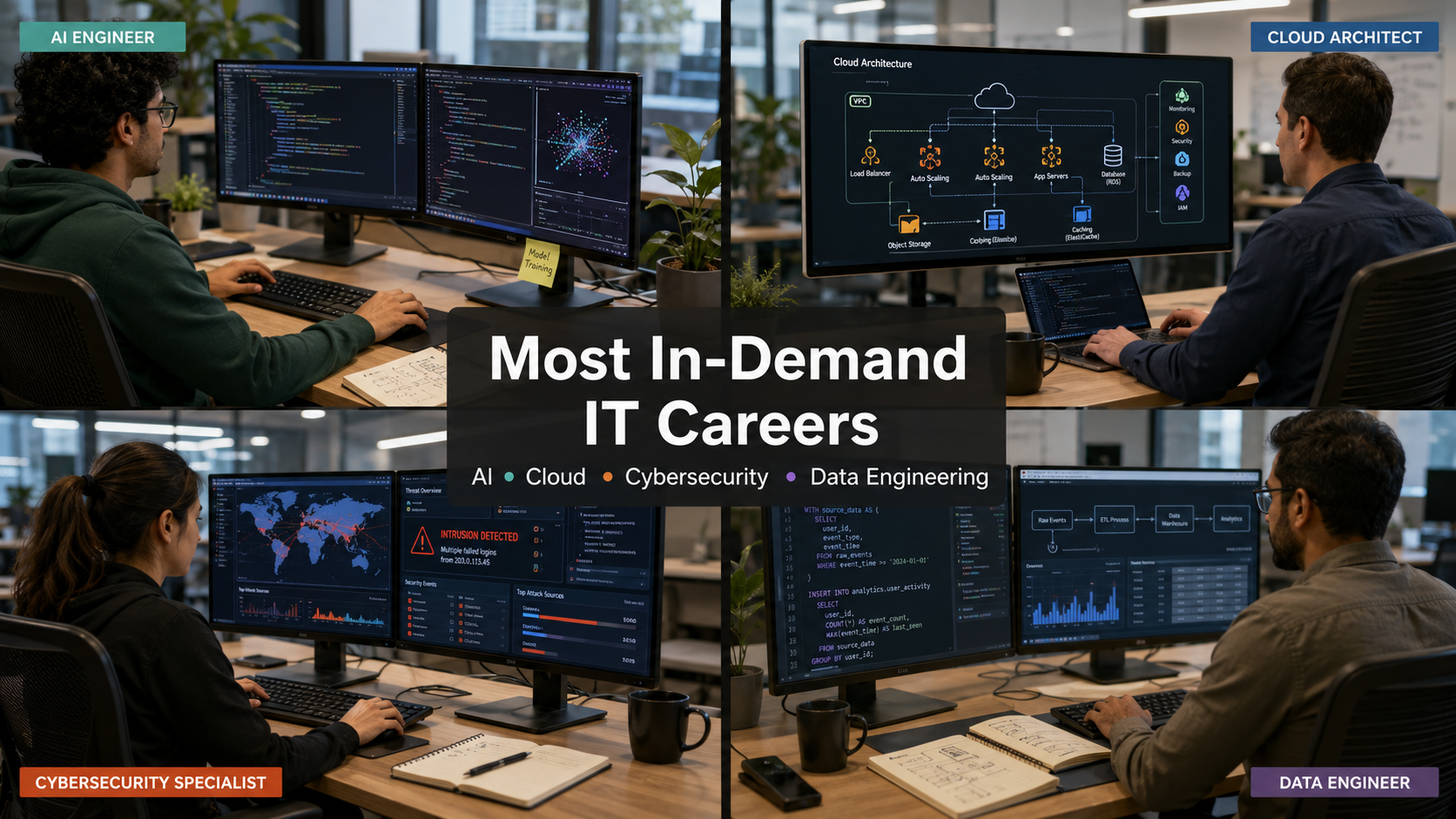
Among the most in-demand IT jobs in 2026 are cloud engineers, cybersecurity specialists, AI engineers, data analysts, DevOps engineers, and software developers. These professionals help organizations modernize legacy systems, improve security, automate workflows, and deliver reliable digital services. Employers value candidates who combine technical expertise with strong problem-solving abilities and adaptability. Professionals who continuously update their skills are well-positioned for excellent career growth, competitive salaries, and long-term job security in the rapidly changing technology landscape.
Cloud Engineers and Cybersecurity Specialists
Cloud engineers and cybersecurity specialists remain among the most sought-after IT professionals in 2026. Businesses increasingly rely on cloud platforms to host applications, store data, and support remote work. Cloud engineers design scalable infrastructure, optimize costs, improve performance, and ensure systems remain highly available under changing workloads.
At the same time, cybersecurity specialists protect organizations from ransomware, phishing attacks, data breaches, and other evolving cyber threats. They implement security policies, monitor networks, respond to incidents, and ensure compliance with industry regulations. Together, these professionals help organizations maintain secure, reliable digital environments while protecting customer trust and business continuity. As cyber risks continue to grow, demand for skilled cloud and security experts is expected to remain exceptionally strong.

Which 5 Jobs Will Survive AI?
Artificial intelligence is transforming nearly every industry, leading many professionals to question which careers will remain valuable. While AI can automate repetitive tasks and assist with decision-making, it cannot fully replace roles requiring human judgment, creativity, ethical reasoning, leadership, and interpersonal communication.
Five technology careers expected to remain highly resilient include AI ethicists, cybersecurity leaders, cloud solutions architects, data governance specialists, and IT project managers. These professionals use AI to improve productivity rather than compete against it. They make strategic decisions, manage complex projects, oversee compliance, and solve business challenges that require human expertise. As organizations adopt AI more widely, professionals who understand both technology and business strategy will become increasingly valuable. They will play a key role in leading successful digital transformation initiatives.
AI Ethics Officers and Strategic Leaders
AI ethics officers and strategic technology leaders play an essential role in ensuring artificial intelligence is developed and used responsibly. They evaluate automated systems for fairness, transparency, accountability, and regulatory compliance. While AI can process information quickly, it cannot independently establish ethical standards or organizational policies.
These professionals collaborate with legal, technical, and executive teams to reduce bias, protect user privacy, and ensure responsible AI adoption. Their work helps organizations build customer trust while minimizing legal and reputational risks. As AI regulations continue to evolve worldwide, demand for governance and ethics professionals is expected to grow steadily throughout the coming years.
Which IT Skill Is Highly Paid?
The highest-paying IT skills in 2026 are typically those that combine technical complexity with significant business impact. Organizations are increasingly willing to pay premium salaries for professionals who can improve security, automate infrastructure, build intelligent applications, or optimize cloud environments.
Today, machine learning engineering, cloud security architecture, DevOps engineering, and AI infrastructure management consistently rank among the most lucrative specialties. Furthermore, these skills directly contribute to business growth, operational efficiency, and risk reduction. Professionals with expertise in designing scalable systems, protecting sensitive data, and deploying enterprise applications often receive attractive compensation packages that include bonuses, stock options, and additional benefits. Consequently, continuous learning and practical project experience remain essential for reaching these high-paying positions.
Advanced Machine Learning Engineering
Machine learning engineering continues to rank among the highest-paid technology specialties. These professionals design, train, optimize, and deploy intelligent models that help businesses automate decisions, improve customer experiences, and extract valuable insights from large datasets.
The role requires expertise in mathematics, statistics, programming, data engineering, and model optimization. Machine learning engineers work closely with data scientists and software developers to build production-ready AI systems that deliver measurable business value. Because experienced professionals remain relatively scarce, organizations compete aggressively for top talent, making machine learning one of the most financially rewarding career paths in the technology industry.
Which job has the highest salary in 2026?
Artificial intelligence engineering and specialized cloud architecture secure the highest salaries in the technology sector for 2026. Companies invest heavily in technical experts who build scalable machine learning models and secure enterprise cloud infrastructures against emerging threats. Executive leadership roles, such as Chief Technology Officers and Principal AI Architects, regularly command six-figure base salaries alongside lucrative equity packages. These high-paying positions require deep mathematical foundations, advanced programming skills, and years of hands-on experience designing complex software systems. Organizations compete aggressively for elite engineering talent, driving compensation packages to historic heights across major global tech hubs and remote enterprises alike.
The Financial Impact of Artificial Intelligence Specialization
Artificial intelligence integration drives unprecedented corporate profitability, translating directly into premium compensation for expert model builders. Professionals who master natural language processing and neural network optimization earn exceptional salaries. Enterprises reward these rare technical skill sets because efficient algorithms reduce operational costs and unlock entirely new revenue streams globally.
What jobs are going to be in high demand in 2026?
Cybersecurity analysts, data engineers, and cloud migration specialists represent the roles experiencing the highest market demand in 2026. As organizations migrate sensitive data to digital environments, protecting infrastructure against sophisticated cyberattacks becomes a top corporate priority. Cybersecurity professionals face immense demand due to rising global threats and stricter regulatory compliance standards across industries. Simultaneously, companies require skilled data engineers to clean, organize, and process massive volumes of information generated daily. These in-demand careers offer exceptional job security, continuous professional development, and diverse opportunities for remote work and career advancement.
Addressing the Global Cybersecurity Skills Shortage
The persistent global shortage of qualified cybersecurity experts leaves millions of enterprise positions vacant worldwide. Organizations actively recruit professionals holding advanced security certifications and practical incident response experience. This severe talent gap guarantees robust employment stability and rapid promotions for dedicated security specialists entering the workforce.
Which IT Field Is Best for 2030?
Artificial intelligence engineering, quantum computing integration, and advanced cybersecurity stand out as the absolute best IT fields for 2030. Emerging technologies evolve at an astonishing pace, requiring forward-thinking specialists who can adapt to unprecedented computational paradigms. Artificial intelligence will deeply integrate into every facet of software development, healthcare diagnostics, and automated manufacturing systems. Meanwhile, early developments in quantum computing promise to revolutionize cryptography, financial modeling, and drug discovery entirely. Preparing for the next decade means mastering machine learning frameworks, data ethics, and advanced network defense strategies early on.
Preparing for the Quantum Computing Era
Quantum computing undoubtedly represents the next massive frontier that will transform enterprise data processing and cryptographic security protocols. In fact, forward-thinking engineers are already learning quantum programming languages in order to build future-proof algorithms. Moreover, gaining familiarity with quantum mechanics and specialized computing architecture actively positions you ahead of technological shifts anticipated by 2030.
Frequently Asked Questions
What qualifications are needed to enter the IT industry in 2026?
A successful IT career combines formal education with practical experience. A computer science degree remains valuable, but many employers also recognize coding bootcamps, professional certifications, and personal project portfolios. Certifications in cloud computing, cybersecurity, networking, and AI improve job prospects. Employers increasingly prioritize demonstrated skills, continuous learning, and the ability to solve real-world technical problems.
How does artificial intelligence impact entry-level technology jobs?
Artificial intelligence is changing entry-level responsibilities rather than eliminating them. AI tools now automate repetitive coding, testing, documentation, and debugging tasks. Because of this shift, employers expect junior professionals to focus more on critical thinking, software design, collaboration, and problem-solving. Learning to use AI development tools effectively has become an essential skill for professionals pursuing the top IT jobs in demand.
Are remote work opportunities still common for top IT professionals?
Yes. Remote and hybrid work remain common across the technology industry. Organizations continue to hire skilled professionals regardless of location, especially for cloud engineering, cybersecurity, software development, DevOps, and data-related roles. Success in remote environments depends on strong communication, time management, collaboration skills, and the ability to work independently with modern project management platforms.
Which programming languages should professionals learn for high-paying roles?
Python, TypeScript, Go, and Rust remain among the most valuable programming languages for high-paying IT careers. Python dominates artificial intelligence, automation, and data science. TypeScript powers modern web application development. Go supports cloud-native services and scalable backend systems, while Rust continues to gain popularity for secure, high-performance software. Combining these languages with cloud platforms and DevOps practices can significantly improve your chances of securing the top IT jobs in demand.
Conclusion
The demand for skilled technology professionals shows no signs of slowing down as digital innovation accelerates globally. Therefore, navigating this dynamic landscape successfully requires continuous upskilling, strategic career planning, and a commitment to lifelong learning. By focusing on top IT jobs in demand, such as artificial intelligence, cloud architecture, and cyber security, you position yourself at the forefront of modern industry. In addition, you can explore resources on most in-demand skills for jobs to learn more about emerging opportunities. Ultimately, your career growth depends on your ability to solve complex problems and deliver measurable business value. As a result, take the first step today by auditing your current skill set, identifying knowledge gaps, and pursuing targeted certifications that align with your professional goals. Finally, embracing these opportunities with enthusiasm and dedication will help you build a prosperous, resilient, and rewarding professional career.