
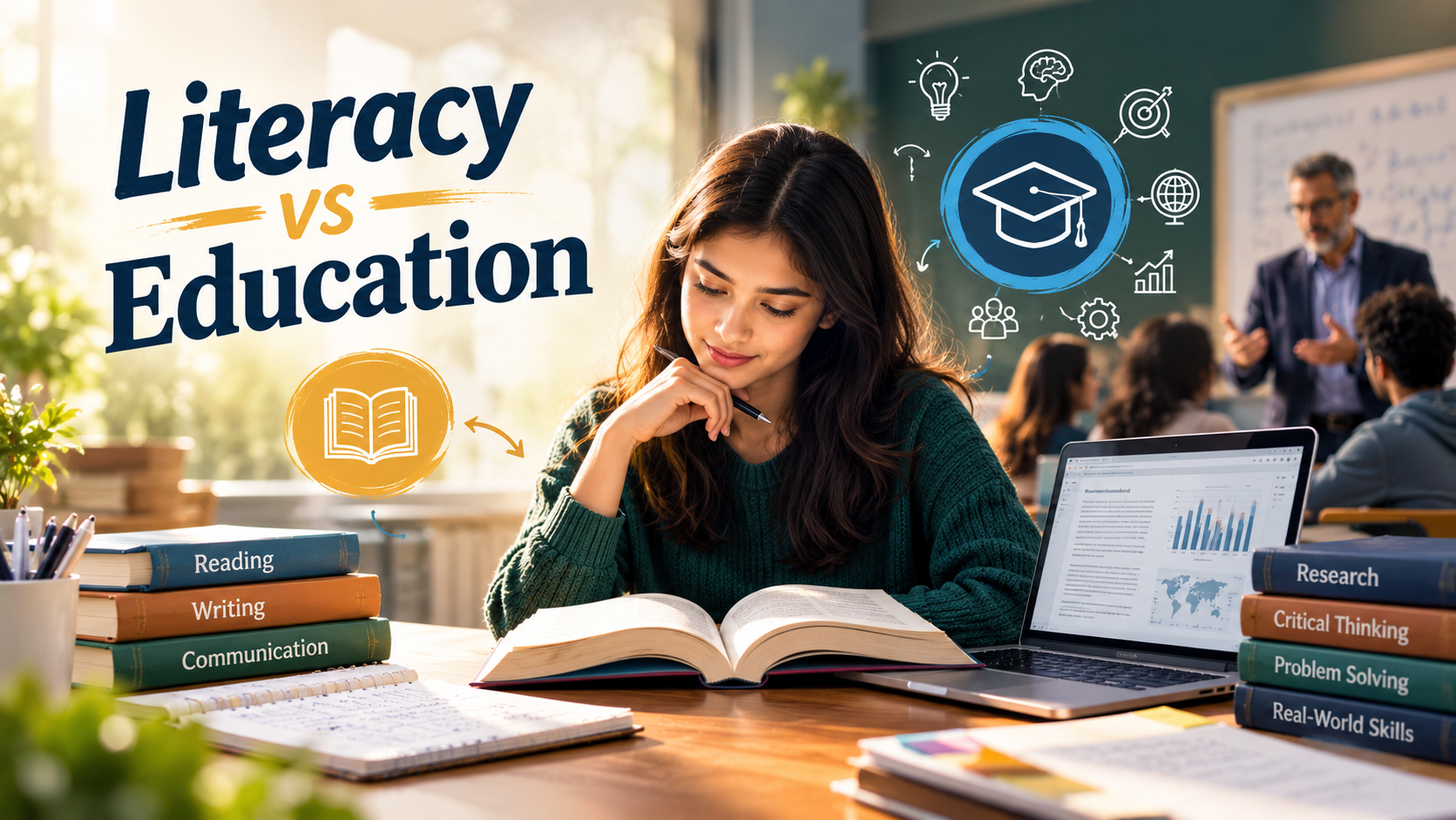
Literacy vs Education: Understanding the Essential Differences
Many people treat reading ability and formal schooling as the same thing. However, understanding literacy vs education reveals an important distinction. Literacy generally refers to the ability to read, write, understand, interpret, and communicate using written information. UNESCO’s literacy resources provide further context on the role of literacy in learning and society. Education is much broader. It develops knowledge, reasoning, values, practical abilities, and specialized expertise.
This distinction matters when designing effective learning systems. Basic literacy gives people the tools to access information and participate in society. However, personal and intellectual development requires learning that extends beyond reading and writing. Without foundational literacy, advanced education becomes much harder to access. At the same time, basic reading ability does not automatically create critical thinking or broad knowledge.
In this guide, we explore the key differences between literacy and education. You will also learn how countries approach universal literacy, how literacy differs from knowledge, and how different literacy frameworks work. Finally, we examine the seven commonly discussed pillars of literacy and the Big 5 reading components that support effective literacy instruction.

Which country is 100% literate?
Some countries report adult literacy rates that are effectively 100% in international education statistics. Examples have included Andorra, Finland, Norway, Liechtenstein, and Luxembourg. However, claims that a country is literally “100% literate” require caution. Literacy statistics depend on definitions, survey methods, age groups, and reporting practices. A reported 100% rate does not necessarily mean every person can handle complex written information independently.
Countries with very high literacy rates usually share several characteristics. They provide broad access to primary education and maintain strong public education systems. Compulsory schooling also helps ensure that children develop foundational reading and writing skills. Social programs can further reduce barriers caused by poverty, geography, or limited educational access.
Basic literacy also differs from advanced reading ability. Someone may read simple instructions successfully but struggle with complex reports. Therefore, literacy rates provide useful information, but they do not capture every aspect of reading comprehension or educational achievement.
The Role of Universal Primary Schooling
Universal primary schooling plays a major role in developing high literacy rates. When children receive consistent access to early education, they have more opportunities to develop reading, writing, vocabulary, and comprehension skills. Compulsory schooling laws can also reduce the number of children who leave education before gaining basic literacy.
Strong education systems usually support this process with trained teachers, suitable learning materials, and early intervention. Students who struggle with reading can receive additional support before difficulties become more severe. Public funding can also reduce financial barriers that prevent children from attending school.
Several factors commonly support high literacy levels:
- Accessible primary education for children across different communities
- Qualified teachers who understand effective reading instruction
- Learning resources that support classroom and independent study
- Early intervention for students experiencing literacy difficulties
- Social support programs that reduce economic barriers to education
These measures show why literacy cannot be separated completely from education. Literacy represents a foundational skill, while effective schooling creates the environment where that skill can develop and expand.
Are education and literacy the same thing?
No. Literacy and education overlap, but they describe different concepts. Literacy generally means having the skills needed to read, write, interpret, and communicate information. Education describes a much broader process of acquiring knowledge, developing reasoning, building practical abilities, and understanding social or ethical concepts.
Literacy can therefore be viewed as a foundation for education. A student needs sufficient reading and writing ability to access textbooks, research, instructions, and other learning materials. However, becoming literate does not automatically make someone highly educated. Education involves applying information, evaluating evidence, solving problems, and developing knowledge across different subjects.
The difference becomes clearer in practical situations. A literate person may successfully read a scientific article. An educated reader can go further by evaluating its evidence, understanding its limitations, comparing it with other research, and applying its conclusions appropriately.
This distinction is central to understanding literacy vs education. Literacy provides essential communication tools. Education develops the broader intellectual abilities needed to use those tools effectively.
Moving Beyond Basic Functional Ability
Education moves beyond basic reading and writing by developing analysis, judgment, knowledge, and practical competence. A person may read a set of instructions without understanding whether those instructions are accurate or appropriate. Education encourages people to question information and consider evidence before accepting a conclusion, skills that also support technical and soft skills development.
This difference becomes particularly important in professional and academic environments. Workers often need to interpret technical documents, compare alternatives, solve unfamiliar problems, and make decisions based on incomplete information. Basic literacy supports these activities, but deeper education strengthens the reasoning behind them and can contribute to career success.
Education can develop abilities such as:
- Critical thinking and evidence-based reasoning
- Problem-solving across unfamiliar situations
- Subject knowledge in academic or professional fields
- Communication skills for different audiences
- Ethical and social judgment when decisions affect others
Literacy remains essential throughout this process. Without it, accessing advanced information becomes significantly more difficult. However, education determines how effectively a person can interpret, evaluate, and apply that information.
What is the difference between literacy and knowledge?
The difference between literacy and knowledge is mainly the difference between ability and understanding. Literacy describes skills used to access, interpret, and communicate information. Knowledge refers to the facts, concepts, principles, experiences, and understanding a person has acquired.
Literacy can help someone obtain knowledge from written sources. For example, a person with strong reading skills can study a medical textbook, research paper, or technical manual. However, being able to read the material does not mean the reader understands the subject deeply. Understanding develops through learning, experience, practice, and critical evaluation.
Consider a medical example. Reading a research paper demonstrates the ability to process specialized written information. Understanding how diseases develop, interact, and respond to treatment requires subject-specific knowledge. The two abilities support each other, but they are not interchangeable.
This distinction also matters outside formal education. A person can have extensive practical knowledge gained through experience while having limited literacy. Conversely, someone can read complex material fluently but possess limited knowledge of the subject.
Therefore, literacy is a tool for accessing information, while knowledge represents what a person understands and can use.
How Reading Fluency Generates True Insight
Reading fluency makes it easier to acquire knowledge because readers can process written information with greater speed and accuracy. When decoding requires significant effort, less mental capacity remains available for understanding the broader meaning of a passage.
Strong reading skills allow learners to focus on ideas rather than individual words. This becomes especially important when studying complex subjects. Scientific explanations, historical arguments, technical instructions, and academic theories often require readers to connect information across several paragraphs.
Reading can contribute to knowledge development by helping people:
- Access reliable information independently
- Compare different explanations and viewpoints
- Identify important details within complex texts
- Connect new concepts with existing knowledge
- Apply information to practical situations
However, reading fluency alone does not guarantee genuine insight. Readers must also understand vocabulary, recognize relationships between ideas, evaluate evidence, and draw reasonable conclusions.
This is where literacy and education work together. Literacy provides access to written information. Education helps learners interpret that information, challenge assumptions, connect ideas, and turn information into meaningful knowledge.
What are the 7 types of literacy?
There is no single universally accepted list of exactly seven literacy types. Different educators and organizations use different frameworks. However, several commonly discussed forms extend literacy beyond traditional reading and writing. These include print literacy, digital literacy, media literacy, financial literacy, visual literacy, information literacy, and emotional literacy.
Print literacy covers conventional reading and writing skills. Digital literacy involves using digital devices, software, and online platforms effectively. Media literacy helps people evaluate messages, sources, and potential misinformation. Financial literacy supports responsible decisions involving money, budgeting, saving, credit, and investing.
Visual literacy involves interpreting images, diagrams, symbols, charts, and other visual information. Information literacy focuses on finding, evaluating, and using information responsibly. Emotional literacy involves recognizing and expressing emotions while understanding how feelings influence communication and relationships.
These forms of literacy reflect the demands of modern life. People increasingly need to interpret information across different formats rather than relying only on printed text.
Understanding these broader skills helps explain why literacy vs education is not simply a comparison between reading and schooling. Modern literacy involves applying communication and information skills across many areas of everyday life.
Adapting to Rapidly Evolving Modern Information
Modern environments require people to process information across multiple platforms. A person may read a news article, interpret a financial chart, evaluate a social media claim, use unfamiliar software, and compare online sources within the same day. These changing demands are also reshaping modern classroom teaching styles.
Traditional reading and writing skills remain important, but they no longer cover every information challenge. Digital literacy helps people navigate technology. Media literacy helps them question potentially misleading content. Financial literacy supports responsible economic decisions, while information literacy helps them judge the reliability of sources, especially as AI enters the classroom.
Developing broader literacy skills can help people:
- Identify unreliable information and misleading claims
- Navigate digital tools with greater confidence
- Interpret charts, images, and visual information
- Make informed financial decisions
- Communicate more effectively in different environments
- Manage information without becoming overwhelmed
These abilities complement formal education rather than replacing it. Schools can provide opportunities to develop them through practical activities, research tasks, discussions, and real-world problem-solving.
As technology and communication methods continue to change, literacy must also adapt. The core goal remains the same: helping people understand information and use it effectively.
What are the 7 pillars of literacy?
The phrase “seven pillars of literacy” can refer to different educational frameworks, so it does not have one universally standardized definition. A commonly used framework includes listening, speaking, reading, writing, spelling, vocabulary, and comprehension. Together, these areas describe important elements of language and literacy development.
Listening and speaking provide the foundation for oral language. Children first encounter words through communication before connecting those words with written symbols. Reading and writing then allow them to recognize, produce, and communicate ideas through text.
Spelling supports accurate written communication and reinforces relationships between sounds and letters. Vocabulary gives readers access to word meanings, while comprehension allows them to understand ideas beyond individual words. These skills interact rather than developing in complete isolation.
Effective literacy instruction can therefore address several areas at the same time. For example, classroom discussions can build vocabulary before students encounter the same words in a reading passage. Writing activities can then reinforce those concepts through practical use.
The exact terminology varies between literacy programs. However, the broader principle remains consistent: strong literacy development requires more than teaching students to decode words.
Integrating Oral and Written Communication
Oral language and written language strongly influence one another during literacy development. Students often understand new vocabulary more effectively when they hear, discuss, read, and use those words in different contexts.
Teachers can connect these skills through simple classroom activities. Students might discuss a topic before reading about it, explain a passage after reading, or use new vocabulary in their own writing. These activities give learners repeated opportunities to encounter and apply language.
Useful approaches include:
- Structured discussions before reading
- Vocabulary activities connected to real examples
- Reading aloud to model fluent expression
- Short writing tasks based on reading material
- Questions that require students to explain their reasoning
These activities help students connect spoken language with written symbols and meaning. They can also reveal misunderstandings that may remain hidden during silent reading.
Strong literacy instruction should therefore treat oral communication as part of the broader learning process. Reading and writing develop more effectively when students have a strong language foundation and opportunities to use new vocabulary in meaningful contexts.
What is the big 5 in literacy?
The Big 5 in literacy commonly refers to five key components of reading instruction identified by the National Reading Panel: phonemic awareness, phonics, fluency, vocabulary, and comprehension. These components describe important skills involved in learning to read successfully.
Phonemic awareness involves recognizing and manipulating individual sounds in spoken words. Phonics connects those sounds with letters and spelling patterns. Fluency allows readers to recognize words accurately and read with appropriate speed and expression.
Vocabulary gives readers knowledge of word meanings. Comprehension allows them to construct meaning from what they read. These components support one another, although they are distinct skills that may require different forms of instruction.
The Big 5 framework is particularly useful when discussing early reading development. A child who struggles with phonemic awareness may have difficulty learning phonics. A student who can decode words but lacks vocabulary may still struggle to understand a passage.
The framework does not mean that these five areas represent every aspect of literacy. Rather, they provide a research-based structure for addressing major components of reading instruction.
Applying Evidence-Based Science to Reading
Evidence-based literacy instruction combines explicit teaching with opportunities for students to practice reading and apply new skills. The Big 5 provides a useful framework because it addresses several important parts of the reading process, alongside approaches such as structured literacy instruction.
Teachers can develop phonemic awareness through activities that ask students to identify, separate, blend, or manipulate sounds. Phonics instruction then helps students connect those sounds with written letters and spelling patterns. Regular reading practice can build fluency while vocabulary activities expand word knowledge.
Comprehension instruction should remain central throughout the process. Students need opportunities to explain ideas, make connections, answer questions, summarize passages, and use evidence from texts.
Effective instruction can therefore include:
- Explicit phonemic awareness activities
- Systematic phonics instruction
- Guided practice to improve reading fluency
- Direct vocabulary development
- Comprehension strategies using meaningful texts
The Big 5 should not be treated as a guarantee of reading success on its own. Student needs, instructional quality, language development, and access to appropriate reading materials also matter.
When these factors work together, literacy instruction can provide a stronger foundation for independent reading, academic learning, and lifelong education.
Frequently Asked Questions
Can a person be literate without being formally educated?
Yes, a person can become literate without completing formal schooling. People may learn to read, write, and perform basic calculations through home study, community programs, family support, or workplace experience. In literacy vs education, literacy represents foundational skills, while formal education provides broader academic knowledge and structured learning.
What is health literacy and why does it matter?
Health literacy is the ability to find, understand, evaluate, and use health information when making decisions. It helps people follow medical instructions, understand treatment options, communicate with healthcare professionals, and recognize reliable information. In literacy vs education, health literacy shows how literacy skills can support practical decisions beyond traditional classroom learning.
Why is early childhood literacy so important?
Early childhood literacy provides an important foundation for later learning. Children develop skills such as phonemic awareness, vocabulary, reading, and comprehension during these early years. Strong literacy skills can make future learning easier and improve confidence. Understanding literacy vs education also shows why foundational reading skills support broader educational development.
How does digital literacy differ from traditional literacy?
Traditional literacy focuses mainly on reading, writing, and understanding written language. Digital literacy applies these abilities in online and technology-based environments. It includes using digital tools, searching for information, evaluating online sources, communicating safely, and protecting personal data. In literacy vs education, digital literacy represents one way literacy continues to evolve alongside modern education and technology.
Conclusion
Understanding the dynamic between literacy vs education highlights why both basic communication skills and comprehensive schooling are essential for modern society. Literacy equips individuals with the primary tools to decode language, read text, and navigate daily environments. Meanwhile, holistic education builds upon that base to develop critical reasoning, ethical judgment, and complex domain expertise.
By mastering the seven pillars of literacy and implementing the evidence-based “Big 5” reading model, educators can help every student achieve foundational fluency. At the same time, expanding learning opportunities ensures that basic reading ability matures into deep, analytical knowledge.
Whether you are an educator refining your teaching strategies or a lifelong learner broadening your perspective, focusing on both fundamental literacy and broader educational growth is vital. Use these insights to support early reading initiatives, build diverse modern competencies, and pursue lifelong learning and continuous development in your daily personal and professional life.