
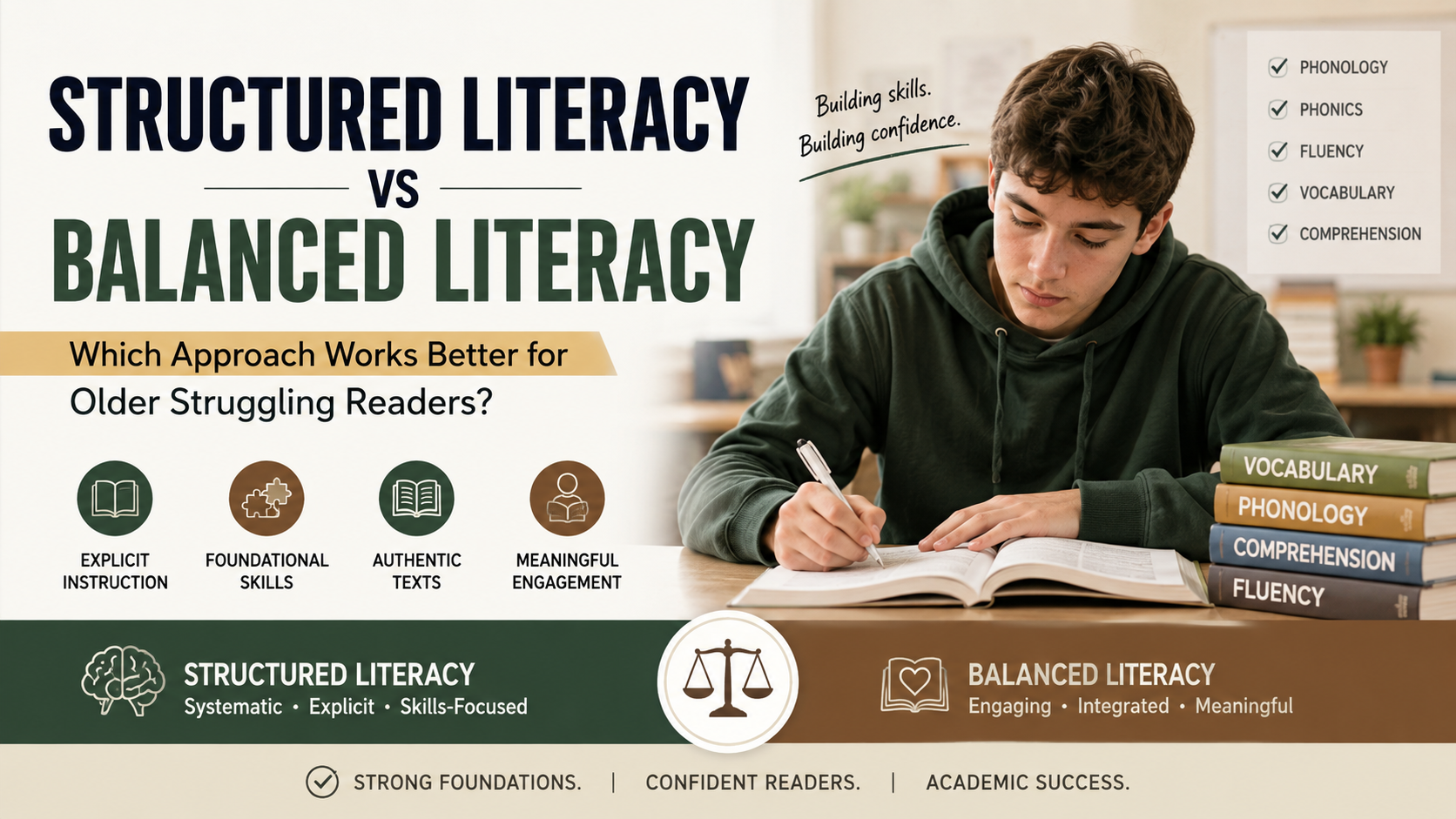
Structured Literacy vs Balanced Literacy: Which Approach Works Better for Older Struggling Readers?
Choosing between instructional models can feel overwhelming, especially when helping older students who continue to struggle with reading comprehension and decoding skills. The debate surrounding Structured vs Balanced Literacy remains central to modern education reform. According to the Reading Rockets research initiative, targeted interventions are vital for secondary students who fall behind early literacy benchmarks. This article examines foundational definitions, core components, and practical examples. We will explore what structured literacy means, what balanced literacy means, examples of structured literacy, what a balanced approach to literacy means, the 5 components of structured literacy, and the four principles of structured literacy.
What Is the Meaning of Structured Literacy?
Structured literacy refers to an explicit, systematic approach to teaching reading. It focuses on the foundational layers students need for successful literacy development. This approach teaches phonology, sound-symbol association, syllable types, morphology, syntax, and semantics directly.
Teachers do not expect students to discover language patterns on their own. Instead, they break complex skills into smaller, manageable steps. Instruction follows a logical sequence and provides repeated opportunities for practice and review.
This approach can be especially valuable for older struggling readers. Many secondary students have gaps in foundational decoding skills that were not fully addressed during their early school years. These gaps can make advanced vocabulary and complex texts difficult to understand. For a deeper look at this population, see our guide to structured literacy for older struggling readers.
By teaching the mechanics of language explicitly, structured literacy gives students reliable strategies for reading unfamiliar words. It also helps build the fluency, confidence, and cognitive stamina needed for increasingly challenging academic texts.
Why Explicit Instruction Matters for Older Students
Explicit instruction reduces guesswork for secondary students who experience persistent reading difficulties. Instead of asking learners to infer patterns, teachers clearly model how sounds, letters, syllables, and word parts work together.
Teachers can demonstrate a skill, guide students through practice, and then gradually reduce support. This process helps students develop strategies they can use independently across different subjects. Teachers looking to strengthen this process can also use mentor teacher tools and checklists to support effective instructional practice.
For older learners, this matters because academic texts contain increasingly complex vocabulary. Students may encounter unfamiliar multisyllabic words in science, history, mathematics, and other subjects. Without dependable decoding strategies, these words can interrupt fluency and comprehension.
Explicit instruction also makes learning more predictable. Students understand what they are learning, why it matters, and how to apply the skill. Regular practice reinforces accurate reading habits and reduces dependence on guessing.
Over time, this direct approach can strengthen foundational reading skills while supporting greater academic confidence. It also gives teachers a clearer way to identify remaining difficulties and provide targeted support.
What Does Balanced Literacy Mean?
Balanced literacy is a curricular framework that combines several approaches to reading instruction. It commonly includes guided reading, shared reading, independent reading, word work, and writing activities. The goal is to develop both foundational skills and a lasting interest in literature.
This approach often emphasizes meaningful reading experiences. Students encounter authentic texts while teachers provide instruction in vocabulary, comprehension, phonics, and other literacy skills. The exact balance can vary considerably between classrooms and programs.
Supporters value the opportunity to combine skill development with authentic reading. However, critics have raised concerns about approaches that encourage students to rely heavily on context or picture cues when identifying unfamiliar words.
That concern can become more significant for older struggling readers. Secondary texts often contain long, unfamiliar, and domain-specific words. Context may help students understand a word after they decode it, but it cannot always provide a reliable way to identify the word itself.
For students with significant foundational gaps, educators may therefore need to provide more explicit instruction alongside meaningful reading experiences.
The Role of Authentic Text in Instruction
Authentic, high-interest literature can play an important role in reading intervention for older students. Struggling readers may become disengaged when instruction focuses only on isolated drills or worksheets. Meaningful texts can give students a reason to practice newly learned skills.
Stories, biographies, articles, and other age-appropriate materials can connect reading instruction to students’ interests and experiences. This connection can help maintain attention during challenging lessons.
However, authentic text should not replace direct skills instruction when students have substantial decoding difficulties. A student may enjoy a story but still struggle to read its vocabulary independently.
A balanced lesson can address both needs. Teachers can provide targeted practice with phonics, syllables, morphology, or spelling before asking students to apply those skills within a meaningful passage.
This combination helps bridge the gap between skill development and authentic reading. Students receive explicit support while still experiencing the purpose and enjoyment of reading.
For older struggling readers, the key is choosing texts that respect their age and interests while matching their instructional needs. High-interest materials should support intervention rather than distract from it.
What Are Examples of Structured Literacy?
Several established instructional programs and multisensory frameworks demonstrate structured literacy principles in practice. Examples include the Orton-Gillingham approach, Wilson Reading System, Barton Reading and Spelling System, and Preventing Academic Failure.
These approaches typically provide structured instruction in areas such as phonology, sound-symbol relationships, syllables, spelling, and word structure. Many also incorporate multisensory activities that engage visual, auditory, and kinesthetic pathways.
For older struggling readers, structured programs can provide a clear instructional roadmap. Teachers introduce skills in a deliberate sequence and provide practice before moving toward more complex patterns.
This sequence is particularly useful when students have missed important foundational concepts. Rather than assuming that earlier skills are secure, educators can identify gaps and address them systematically.
Students can then apply foundational knowledge to increasingly complex words and academic vocabulary. Instruction may progress from basic sound relationships toward syllable patterns, morphology, spelling, and advanced word analysis.
The specific program matters less than whether instruction follows sound structured literacy principles. Effective teaching should remain explicit, systematic, cumulative, and responsive to assessment results.
Multisensory Techniques in Daily Practice
Multisensory techniques combine several learning pathways during reading and spelling instruction. Students may see a letter or word, say its sounds aloud, write it, and physically trace it during the same activity.
For example, a student might trace a letter pattern while pronouncing the corresponding sounds. The teacher can then connect that pattern to a word and guide the student through reading and spelling it.
These activities provide repeated reinforcement through visual, auditory, and kinesthetic experiences. This can make abstract language concepts more concrete for students who have struggled with traditional instruction.
Multisensory teaching does not simply mean making lessons more active. Each activity should have a clear instructional purpose. The sensory elements should reinforce the language concept being taught.
For older struggling readers, teachers can adapt these techniques to age-appropriate materials. Students can analyze academic vocabulary, word roots, syllable patterns, and spelling structures rather than relying only on elementary-style exercises.
When used purposefully, multisensory techniques can strengthen connections between sounds, letters, word parts, and meanings. They work best as part of a systematic instructional sequence rather than as isolated activities.
What Does a Balanced Approach to Literacy Mean?
A balanced approach to literacy combines different instructional strategies to address varied student needs. Teachers may blend explicit skill lessons with literature discussions, independent reading, writing, and collaborative activities.
The philosophy attempts to address both the mechanics and meaning of reading. Students learn how written language works while also developing comprehension, vocabulary, background knowledge, and engagement with texts. These goals also reflect the broader core benefits of education in our lives, including knowledge development and engagement with learning.
However, the appropriate balance depends on the learner. Students with strong foundational skills may benefit from spending more time reading and discussing increasingly complex texts. Older struggling readers with significant decoding gaps may require considerably more explicit intervention.
For these learners, a balanced classroom approach may not provide enough intensive instruction on its own. Teachers must assess individual reading profiles before deciding how much time to devote to each instructional component.
The goal should not be to choose one philosophy for every student. Instead, educators should identify the specific barriers affecting reading performance and select strategies accordingly.
A responsive literacy program can combine explicit structured literacy instruction with meaningful grade-level content. This allows students to strengthen foundational skills without being permanently separated from rich academic and literary experiences.
Adapting Instruction for Diverse Learner Needs
Adapting instruction helps students access grade-level content while they continue developing their reading skills. A learner may understand the ideas in a text but struggle to decode its vocabulary. Another student may decode accurately but have difficulty with comprehension. This kind of adaptation is part of understanding how education systems around the world address different learner needs.
Teachers can respond by providing targeted scaffolds that address the specific barrier. These may include graphic organizers, vocabulary previews, audio support, guided reading, and explicit word analysis.
Instruction can also vary in pacing. Some students may need additional practice with syllable patterns or morphology before they can work independently with complex vocabulary.
Differentiation does not mean lowering expectations. Instead, it provides appropriate support so students can engage with meaningful academic material.
For older struggling readers, age-appropriate materials remain important. Instruction should respect students’ maturity while addressing their actual skill levels.
Teachers can gradually reduce scaffolds as students become more independent. This approach helps learners transfer newly developed skills into classroom reading, writing, and content-area assignments.
When differentiation is based on assessment rather than assumptions, instructional time becomes more focused. Students receive support for their specific needs while continuing to participate in the broader literacy curriculum.
What Are the 5 Components of Structured Literacy?
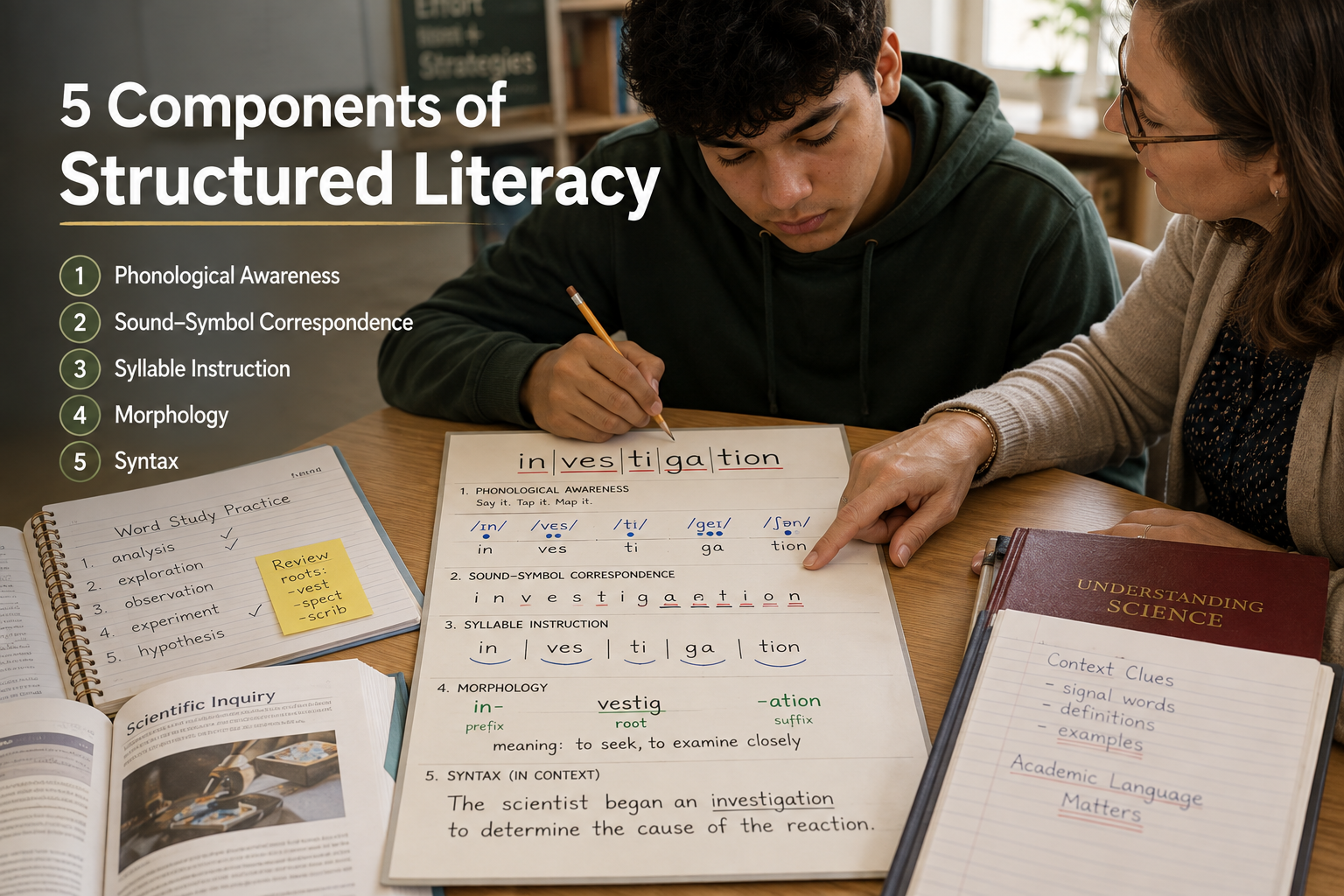
The five commonly emphasized components of structured literacy include phonological awareness, sound-symbol correspondence, syllable instruction, morphology, and syntax. Together, these areas address important parts of how written language works.
Phonological awareness involves recognizing and manipulating spoken language sounds. Students learn to identify, separate, blend, and manipulate sounds within words.
Sound-symbol correspondence connects speech sounds with written letters and letter combinations. Reliable knowledge in this area supports accurate decoding and spelling.
Syllable instruction helps students recognize common syllable patterns and divide longer words into manageable parts. This becomes increasingly important as students encounter multisyllabic academic vocabulary.
Morphology focuses on meaningful word parts, including roots, prefixes, and suffixes. Students can use these parts to analyze unfamiliar words and understand relationships between words.
Syntax addresses sentence structure, grammar, and the way words function within sentences. Strong syntactic knowledge supports both reading comprehension and written expression.
Together, these components provide a framework for systematic literacy instruction. For older struggling readers, they can address foundational weaknesses while building strategies for reading increasingly complex texts.

Mastering Morphology for Advanced Vocabulary
Morphology instruction helps students analyze unfamiliar words by examining their meaningful parts. This becomes especially useful as academic vocabulary becomes longer and more specialized.
Students can learn to recognize common prefixes, suffixes, roots, and base words. For example, understanding a familiar root can provide clues about the meaning of an unfamiliar scientific or historical term.
Greek and Latin roots are particularly useful in secondary education. Many terms in science, medicine, social studies, and other subjects contain recurring roots and affixes.
Morphological analysis also supports spelling. Students can understand why related words share particular letter patterns rather than memorizing every word separately.
For older struggling readers, this instruction should connect directly to authentic academic vocabulary. Teachers can select words from current classroom texts and guide students through their structure.
Morphology should also complement decoding instruction. Knowing a word’s meaning does not eliminate the need to read its individual sounds and syllables accurately.
When students combine decoding, morphology, and context, they have several tools for approaching unfamiliar vocabulary. This broader word-analysis ability can improve reading fluency and support stronger comprehension across content areas.
What Are the Four Principles of Structured Literacy?
Four core principles commonly guide structured literacy instruction: explicit, systematic, cumulative, and diagnostic teaching. These principles describe how instruction should be delivered rather than simply listing the skills students should learn.
Explicit instruction means teachers directly explain and model concepts. Students should not have to discover important language patterns through guesswork.
Systematic instruction follows a planned sequence. Teachers introduce skills in a logical progression, moving from simpler concepts toward more complex ones.
Cumulative instruction builds on previously taught knowledge. New learning connects with earlier skills, giving students repeated opportunities to review and apply what they already know.
Diagnostic instruction requires teachers to monitor student performance and adjust instruction accordingly. Assessment helps identify which skills are secure and which require additional practice.
These principles are particularly important for older struggling readers. Their difficulties may involve several overlapping skill gaps rather than one isolated problem.
A structured approach allows teachers to identify those gaps and provide targeted instruction. It also prevents students from repeatedly practicing material they have already mastered.
Using Diagnostic Data to Guide Instruction
Diagnostic assessment helps teachers identify specific reading and language skill gaps. Instead of relying only on overall reading scores, educators can examine performance across individual components.
A student may struggle with multisyllabic decoding while demonstrating strong phonological awareness. Another student may decode accurately but have weaknesses in morphology, vocabulary, or sentence comprehension.
Regular formative assessment provides useful information during instruction. Teachers can observe errors, review student work, and use brief skill checks to determine whether students are ready to progress.
This information should directly influence lesson planning. If students continue to confuse a particular syllable pattern, teachers can provide additional modeling and guided practice.
If students demonstrate consistent mastery, instruction can move forward without unnecessary repetition. This makes intervention more efficient and keeps learning appropriately challenging.
For older struggling readers, diagnostic teaching is especially valuable because reading difficulties can vary significantly between students. Assessment-driven instruction allows educators to address individual needs instead of applying the same intervention to everyone.
The result is a more responsive literacy program that targets the skills most likely to improve reading accuracy, fluency, vocabulary, and comprehension.
FAQ SECTION
How Do Educators Identify Older Students Who Need Structured Literacy?
Educators identify older students who may need structured literacy through diagnostic assessments, reading screeners, and classroom performance data. These assessments examine skills such as decoding accuracy, phonological processing, spelling, word recognition, and reading fluency. Students who consistently struggle with multisyllabic words or comprehension may have underlying foundational gaps. In the Structured vs Balanced Literacy discussion, assessment helps educators determine whether explicit, systematic intervention is appropriate for the student’s specific needs.
Can Balanced Literacy Ever Work for Severe Reading Struggles?
Balanced literacy can support comprehension, vocabulary, engagement, and exposure to authentic literature. However, students with severe decoding difficulties may need more explicit intervention than a balanced approach typically provides. In the Structured vs Balanced Literacy comparison, structured literacy emphasizes systematic instruction in phonological awareness, phonics, syllables, and word structure. Authentic texts can still be valuable, but they should complement direct skills instruction when students have significant foundational reading difficulties.
What Is the Primary Difference Between Phonics and Structured Literacy?
Phonics focuses mainly on teaching relationships between speech sounds and written symbols, making it one part of reading instruction. Structured literacy is a broader instructional framework that includes phonological awareness, phonics, syllables, morphology, syntax, and semantics. This distinction is important when considering Structured vs Balanced Literacy. Structured literacy also emphasizes explicit, systematic, cumulative, and diagnostic instruction. Therefore, phonics can be included within structured literacy, but the two terms are not interchangeable.
How Long Do Older Students Typically Need Structured Literacy Intervention?
The length of structured literacy intervention varies based on each student’s reading skills, learning rate, and severity of difficulty. Some students may need support for one academic year, while others require intervention for several years. In Structured vs Balanced Literacy, intervention length should not determine which approach educators choose. Instead, teachers should use regular progress monitoring to evaluate decoding, fluency, spelling, and comprehension. Students can gradually reduce support when they demonstrate greater independence.
Conclusion
The Structured vs Balanced Literacy debate is ultimately about how well an instructional approach meets individual student needs. Structured literacy provides explicit, systematic, cumulative, and diagnostic instruction for learners with foundational reading difficulties. Balanced literacy can support authentic reading, comprehension, and engagement. In Structured vs Balanced Literacy, neither label should replace careful assessment. Educators should identify specific skill gaps and combine appropriate interventions with meaningful, age-appropriate reading experiences to support lasting literacy growth.