
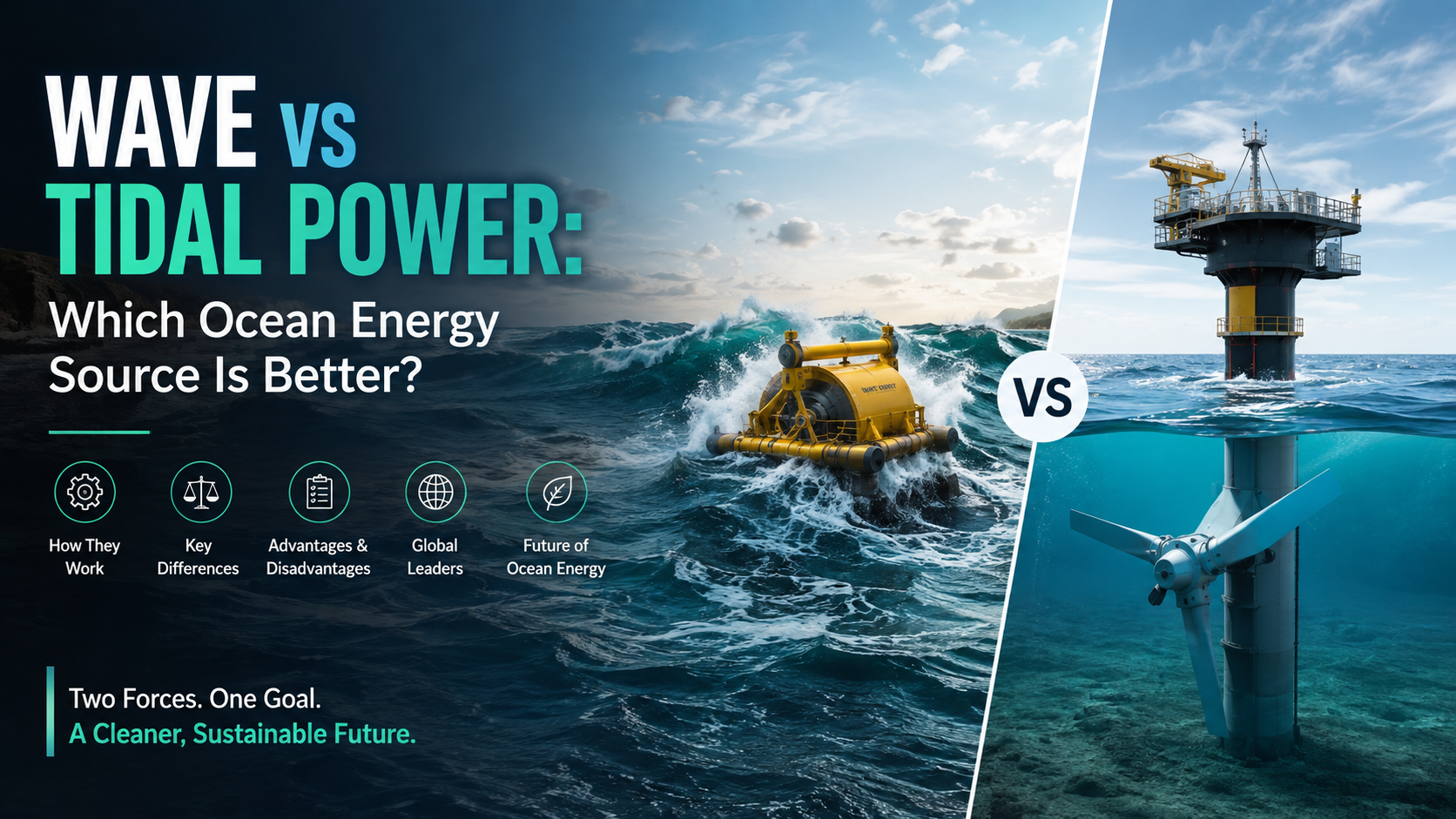
Wave vs Tidal Power: Which Ocean Energy Source Is Better?
The global shift toward clean energy requires us to explore every natural resource, especially the world’s vast oceans. When comparing wave vs tidal power, engineers examine two different methods for converting ocean movement into electricity. Marine energy could provide valuable low-carbon power in suitable coastal regions, according to research from the International Renewable Energy Agency.
Although both technologies use ocean water, they rely on different physical forces. They also differ in predictability, equipment design, environmental requirements, and suitable locations. These differences can strongly influence project costs and long-term performance.
Understanding wave and tidal energy helps clean energy advocates, investors, engineers, and policymakers evaluate the right technology for specific coastal conditions.
This guide explains the key differences between these two marine energy sources. You will learn what creates tides, why wave energy faces several engineering challenges, and how the technologies differ in operation. We also examine global tidal energy leaders and the specific challenges India faces when developing commercial-scale marine power projects.

What is the source of tidal energy in the ocean?
Tidal energy comes from the gravitational interaction between Earth, the Moon, and the Sun. These celestial bodies exert gravitational forces that affect the oceans. The Moon has the strongest influence because it is much closer to Earth than the Sun.
This gravitational interaction creates large ocean bulges on different sides of Earth. As Earth rotates, coastal regions move through these bulges. This produces regular changes in water levels called high and low tides.
Tidal power plants capture this predictable movement in several ways. Some systems use the potential energy created by differences in water levels. Others use the kinetic energy of fast-moving tidal currents.
Tidal turbines can operate underwater, where strong currents move their blades. These tidal energy turbines and underwater power systems can also face challenges related to installation, maintenance, and harsh marine conditions. Meanwhile, tidal barrages control water flow through coastal basins to generate electricity.
Unlike wave energy, tidal energy is driven primarily by astronomical forces. This makes tidal cycles highly predictable and useful for long-term energy planning.
The Influence of the Lunar Cycle
The Moon’s orbit plays a major role in changing tidal strength over time. During full and new moons, the Sun, Moon, and Earth align. Their combined gravitational effects produce stronger tides called spring tides.
Spring tides create higher high tides and lower low tides. This increases the difference between water levels and can improve energy production at suitable tidal power facilities.
During the first and third quarter phases of the Moon, the Sun and Moon form roughly a right angle relative to Earth. Their gravitational influences partially offset each other. This produces weaker tides known as neap tides.
These cycles affect how much energy tidal systems can generate. However, they do not make tidal power unpredictable. Scientists can calculate tidal timing and range years or even decades ahead.
This predictability is one of tidal energy’s biggest advantages over wave generation. Grid planners can anticipate production windows and combine tidal electricity with other renewable sources.
What are 5 disadvantages of wave energy?
Wave energy converters face several challenges that have slowed commercial deployment. The first is marine corrosion. Saltwater can damage metals and electrical components, increasing maintenance requirements, especially in floating wave-powered technology.
Second, offshore equipment must withstand powerful storms and repeated mechanical stress. Large waves can place extreme loads on floating devices, anchors, moorings, and structural components.
Third, wave projects can require substantial capital. Installation often needs specialized vessels, subsea equipment, and experienced marine crews. These requirements can make wave energy more expensive than mature renewable technologies, particularly when deploying floating wave-powered systems.
Fourth, offshore infrastructure can affect marine habitats, fisheries, navigation routes, and coastal ecosystems. Careful environmental assessment is therefore essential before construction.
Fifth, wave conditions vary with weather and seasons. This creates challenges for consistent electricity generation and grid planning.
The five major disadvantages are:
- Corrosion from constant saltwater exposure
- Storm damage and mechanical stress
- High construction and maintenance costs
- Potential environmental and marine-use conflicts
- Variable wave conditions that affect electricity output
These limitations continue to influence the commercial viability of wave energy.
Overcoming High Capital Expenditure
High capital expenditure remains one of the biggest barriers to large-scale wave energy development. Offshore projects require equipment that can survive demanding marine conditions while remaining economical over many years.
Developers may need specialized installation vessels, subsea technicians, heavy lifting equipment, anchors, mooring systems, and underwater internet cables and subsea infrastructure. Each additional component increases construction and maintenance costs.
Repairs can also become expensive when equipment operates far from shore. A damaged offshore converter may require a vessel and specialist crew before technicians can even begin the repair, much like the maintenance challenges involved with underwater internet cables.
These challenges can increase the levelized cost of energy, particularly when compared with mature solar and wind technologies. Wave energy therefore needs improvements in reliability, manufacturing, deployment, and maintenance.
Standardized device designs could help reduce costs. Better materials may also improve durability and limit corrosion. Developers can further lower expenses by designing equipment that allows faster retrieval and repair.
Until these improvements become widespread, financing remains a major challenge for commercial wave farms.
Is tidal energy the same as wave energy?
No. Tidal energy and wave energy are different forms of ocean energy with different physical causes. This distinction is central when comparing wave vs tidal power.
Waves mainly form when wind transfers energy to the surface of the ocean. Their size and direction depend on factors such as wind speed, duration, and the distance over which wind travels across open water.
Tides, by contrast, result primarily from the gravitational effects of the Moon and Sun. They involve large-scale movements and changes in ocean water levels.
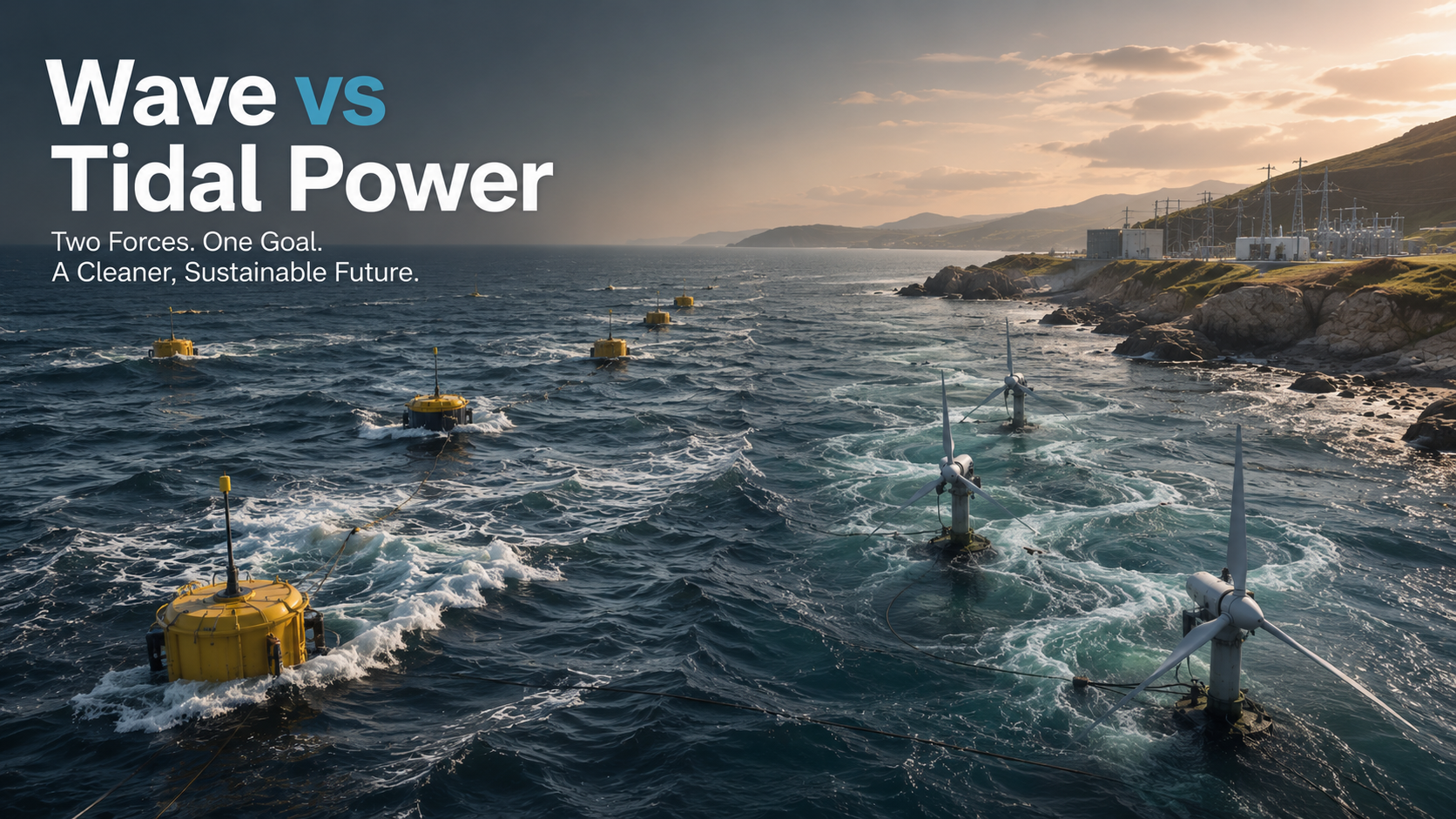
The technologies also differ. Wave energy converters generally operate on or near the ocean surface. Tidal systems can use underwater turbines placed in strong currents. Barrage systems can also capture energy from changing water levels in coastal basins.
The two resources differ in predictability as well. Tidal cycles are highly predictable, while wave conditions depend more heavily on changing weather patterns.
Understanding these differences helps developers choose the appropriate technology for specific coastal environments.
Predictability and Grid Integration
Predictability is one of the strongest advantages tidal power has over wave generation. Because tides are controlled mainly by astronomical cycles, scientists can forecast their timing and approximate strength far into the future.
This gives grid operators useful information about when tidal turbines or barrages are likely to produce electricity. However, predictable generation does not mean constant generation. Tidal output still rises and falls throughout each tidal cycle.
Wave energy is less predictable because waves depend heavily on changing wind and weather conditions. Short-term forecasting can estimate expected wave conditions, but uncertainty remains higher.
Both technologies may therefore benefit from energy storage and grid balancing. Batteries, pumped storage, flexible generation, and demand management can help manage variable marine output.
Tidal power has an advantage in forecasting, but that does not automatically make it cheaper or easier to deploy. Site conditions, environmental restrictions, construction costs, and available tidal resources still determine commercial feasibility.
Economic Barriers in Indian Coastal Waters
India faces significant economic challenges when developing tidal energy. Marine generation must compete with rapidly expanding solar and onshore wind projects, which have established supply chains and increasingly competitive costs.
Tidal projects can require expensive underwater turbines, foundations, cables, vessels, and coastal infrastructure. These costs become harder to justify when electricity from alternative renewable sources is cheaper.
Indian coastal conditions can add further complications. Silt accumulation in estuaries may increase maintenance requirements and affect equipment performance. Environmental restrictions can also limit construction in sensitive coastal ecosystems.
Earlier proposals demonstrated these difficulties. The planned 3.75-megawatt Durgaduani Creek project in West Bengal was canceled after economic and technical concerns made development impractical.
For India, future tidal projects would likely need strong site selection and improved technology. Developers would also need to demonstrate clear economic benefits.
Until costs fall and suitable sites become commercially attractive, tidal power is likely to remain a niche opportunity within India’s broader renewable energy strategy.
Which country is leading in tidal energy?
South Korea has been a global leader in commercial tidal power generation, largely because of the Sihwa Lake Tidal Power Station. The facility has an installed generating capacity of 254 megawatts, making it one of the largest tidal power plants ever built.
France also has a major place in tidal energy history. The 240-megawatt Rance Tidal Power Station became the world’s first major commercial tidal barrage and operated for decades.
Other countries have pursued tidal technologies as well. The United Kingdom, Canada, and China have developed tidal stream projects, experimental arrays, and other marine energy systems.
Leadership in tidal power depends on how it is measured. South Korea leads in large-scale operating tidal generation, while other countries have played important roles in research, technology development, and demonstration projects.
This distinction matters when comparing national marine energy programs. A country can lead in installed tidal capacity without leading in every area of tidal technology.
For now, South Korea remains a key reference point for commercial-scale tidal barrage development.
The Engineering Feat at Sihwa Lake
The Sihwa Lake Tidal Power Station demonstrates how existing coastal infrastructure can support renewable electricity generation. South Korea originally constructed the 12.5-kilometer seawall for flood control and agricultural purposes.
The project later incorporated tidal generation into the existing infrastructure. This approach reduced the need for entirely new coastal construction and helped make the development more practical.
The facility uses ten submerged bulb turbines and eight sluice gates. Water movement through the system drives the turbines and produces electricity.
Sihwa has a generating capacity of 254 megawatts. Its annual electricity production has been reported at roughly 550 gigawatt-hours, depending on operating conditions.
The project illustrates an important lesson for tidal energy development. New marine power plants do not always need completely new infrastructure. Existing dams, seawalls, ports, and coastal structures may provide opportunities for underwater tidal power generation.
However, this model is highly site-specific. Infrastructure must have suitable water movement, tidal range, structural capacity, and environmental conditions. Therefore, the Sihwa approach cannot automatically be replicated elsewhere.
Where is the highest tidal range in India?
The Gulf of Khambhat in Gujarat is widely recognized as one of India’s most important areas for tidal energy because of its exceptionally large tidal range. In suitable locations, the difference between high and low water levels can reach several meters.
The gulf’s funnel-shaped geography helps amplify tidal effects as water moves into narrower sections. This creates strong water-level changes and potentially powerful tidal flows.
These characteristics make the Gulf of Khambhat attractive for theoretical tidal barrage and other marine energy applications. However, a high tidal range alone does not guarantee commercial viability.
The Gulf of Kutch, also in Gujarat, also has substantial tidal energy potential. Both regions have historically featured prominently in estimates of India’s tidal resource.
Developers must consider more than tidal range when evaluating a site. Sedimentation, environmental sensitivity, construction costs, transmission access, navigation, fisheries, and local ecosystems can all affect feasibility.
India therefore has significant theoretical tidal resources, but turning that resource into affordable electricity remains a much more difficult engineering and economic challenge.
Geographic Funneling in Gujarat’s Gulfs
The geography of Gujarat’s gulfs helps explain their strong tidal characteristics. The Gulf of Khambhat narrows inland, creating a funnel-like shape that can amplify changes in water level as tidal water moves through the region.
As incoming tidal water enters the narrowing gulf, the available space becomes more restricted. Local bathymetry and coastal geometry can therefore contribute to large tidal ranges and strong currents in suitable locations.
This natural effect creates theoretical opportunities for tidal power. A larger difference between high and low water levels can provide more potential energy for certain barrage systems.
However, geographic advantages also create engineering complications. Estuaries and coastal inlets can experience significant sediment movement. High sediment loads may increase maintenance requirements and affect turbines or other infrastructure.
Environmental factors are equally important. Gujarat’s coastal areas support fisheries, wetlands, mangroves, and other ecosystems that can be sensitive to major infrastructure projects.
Therefore, high tidal range is only one part of site selection. Commercial development requires a balance between energy potential, engineering feasibility, environmental protection, and project economics.
Frequently Asked Questions
Which ocean energy technology is more predictable?
Tidal energy is far more predictable than wave power, which is one of the biggest advantages in the wave vs tidal power comparison. Tides are driven by gravitational forces and orbital mechanics, allowing electricity generation to be forecast years in advance. Wave power depends more heavily on wind speed, direction, duration, and changing weather conditions, making its output less consistent.
What equipment generates electricity from ocean waves?
Several technologies are used to convert ocean waves into electricity, making wave energy an important part of the wave vs tidal power discussion. Common devices include oscillating water columns, point absorbers, attenuators, and overtopping systems. Point absorbers, for example, use floating buoys that move with waves and drive mechanical or hydraulic systems connected to an electrical generator.
Can marine power turbines harm fish and sea life?
Marine energy systems can create environmental concerns, although their impacts vary significantly by technology and location. In the wave vs tidal power comparison, tidal barrages can have larger ecosystem effects because they may interfere with fish migration, sediment movement, and estuarine habitats. Modern tidal-stream turbines generally operate in open water, and careful site selection, monitoring, and turbine design can help reduce risks to fish and marine mammals.
Why is ocean energy development slower than solar or wind?
Ocean energy has developed more slowly because marine equipment must withstand harsh operating conditions while remaining economically competitive. In the wave vs tidal power debate, both technologies face challenges from saltwater corrosion, powerful storms, underwater maintenance, and biofouling. Meanwhile, solar and wind have benefited from major manufacturing improvements, falling costs, established supply chains, and large-scale commercial deployment, attracting more investment.
Conclusion
The comparison of wave vs tidal power highlights both the opportunities and limitations of ocean-based renewable energy. Tidal power offers exceptional predictability because it is driven by gravitational cycles, while wave power can access energy across many coastal regions but remains more dependent on weather and wave conditions. Both technologies still face significant engineering and economic challenges, particularly in harsh marine environments. As technology improves, combining wave, tidal, and offshore wind systems could provide more reliable renewable electricity for coastal communities while supporting long-term decarbonization. Understanding the differences between wave vs tidal power will remain important when selecting marine energy technologies for specific geographic and environmental conditions.