
How to Spot Fake News and Misinformation Online
In today’s digital era, learning how to spot fake news is an essential skill. False information can spread quickly across social media, websites, messaging apps, and online communities. Some misleading posts aim to create outrage, influence opinions, attract clicks, or generate advertising revenue.
According to research from the Pew Research Center, fabricated news is a recurring part of the online information environment. This makes media literacy and critical thinking increasingly important. False claims presented as legitimate journalism can distort public understanding and influence important decisions.
Learning to identify misinformation does not require advanced technical skills. It requires careful habits and a willingness to question what you see. This guide explains the main warning signs, common types of fake news, verification techniques, detection methods, and useful fact-checking resources. These practical steps can help you evaluate online information before believing or sharing it, including by learning how to avoid misinformation while studying online.

What are 5 ways to spot fake news?
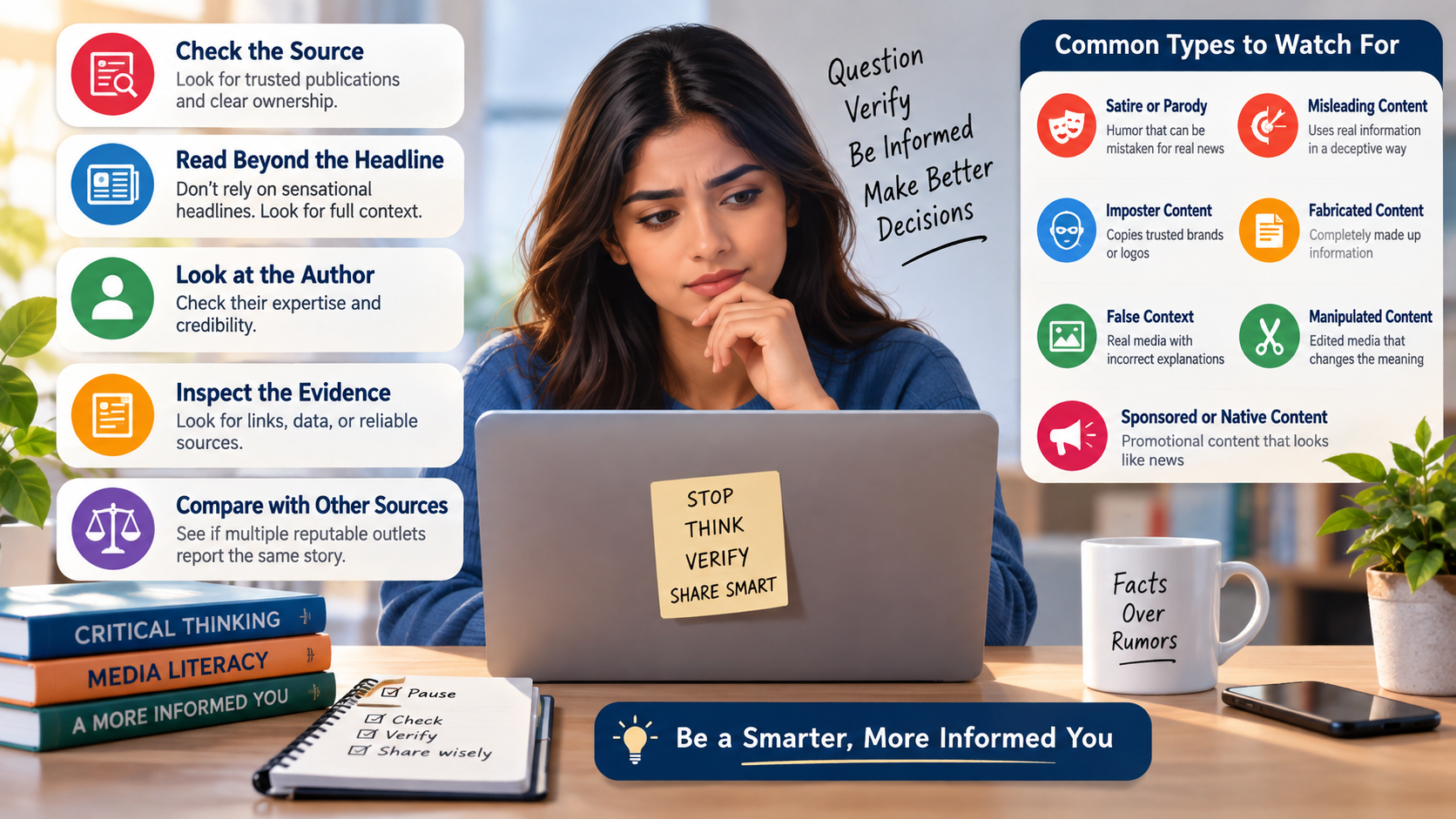
Learning how to spot fake news starts with slowing down before accepting a story as true. A structured approach can help you identify misleading claims more effectively.
First, check the source. Look for an established publication, transparent ownership, and clear editorial standards. Second, read beyond the headline. Sensational headlines can exaggerate claims or leave out important context. Third, examine the author. Check whether the writer has relevant expertise or a credible journalistic background.
Fourth, inspect the evidence. Reliable reporting usually includes links, documents, interviews, data, or clearly identified sources. Finally, compare the claim with independent reporting from several reputable outlets.
You should also consider whether the story relies heavily on emotion. Fear, anger, and surprise can make people react before they verify information. Building these habits into your daily browsing routine can significantly reduce your exposure to online misinformation and deceptive content.
Check the publishing date and context
Checking the publishing date is one of the simplest ways to spot fake news and misleading content. Old stories are often shared again during new events, creating the false impression that something recently happened.
Photographs and videos can create similar problems. An authentic image may show a real event but come from another country, year, or situation. Someone can then attach a misleading caption and make the content appear relevant to current events.
Always examine when the article, photograph, or video was originally published. Look for information about the location and circumstances surrounding the event. Compare the details with reliable reports from the same period.
Context matters just as much as the original material. A genuine quote can become misleading when important surrounding information is removed. Before sharing a surprising post, ask whether the content accurately represents the original event. This simple pause can prevent outdated or misrepresented information from spreading further.
What are the 7 types of fake news?
Understanding different forms of misinformation makes it easier to recognize deceptive content. Researchers and media-literacy experts commonly describe several categories of misleading information. Developing digital literacy skills can also help readers evaluate these different forms of online content more effectively.
Satire or parody uses humor and exaggeration. Readers can mistake it for genuine reporting when the context is unclear. Misleading content uses real information but presents it in a deceptive way. Imposter content copies the branding, logos, or style of trusted organizations to appear legitimate.
Fabricated content contains information created without a reliable factual basis. False context uses authentic images, videos, or statements alongside incorrect explanations. Manipulated content changes genuine media to create a misleading impression. Sponsored or native content can also confuse readers when promotional material looks similar to independent journalism.
These categories are not always completely separate. A single misleading post can combine several tactics. Recognizing the technique being used helps you assess the content more carefully and determine whether further verification is necessary before trusting or sharing it.
Recognizing fabricated and manipulated media
Fabricated and manipulated content can look convincing, especially when it uses realistic images, videos, screenshots, or professional-looking graphics. Deepfake technology can make some forms of manipulated media even more difficult to recognize. However, these forms of misinformation differ in important ways.
Fabricated content is created without a reliable factual foundation. The story, quotation, image, or claim may be completely invented. Its purpose is often to deceive readers or influence their understanding of an issue.
Manipulated media, however, usually begins with something genuine. A real photograph may be edited, a video may be shortened, or audio may be altered. These changes can remove important context or create an impression that differs from the original event.
When evaluating suspicious media, look for the original source. Search for earlier versions of the image or video and compare them with the version being shared. Pay attention to unusual edits, missing context, inconsistent dates, and unexplained changes.
Understanding this distinction makes it easier to spot fake news and recognize how digital content can be deliberately altered.
What are the warning signs of fake news?
Fake news often contains recognizable warning signs. Learning these signals can help you pause before accepting or sharing questionable information.
One common warning sign is extreme emotional language. Headlines filled with anger, fear, or outrage may be designed to trigger an immediate reaction. Excessive capital letters, dramatic punctuation, and exaggerated claims can serve a similar purpose.
Poor grammar, spelling mistakes, unusual formatting, and low-quality graphics may also indicate an unreliable source. These signs alone do not prove that information is false, but they deserve closer attention.
Check whether the article identifies its sources. Reliable reporting normally provides enough information for readers to understand where important claims came from. Be cautious when major allegations rely on anonymous or unnamed sources without supporting evidence.
The website itself also deserves scrutiny. Look for unusual domain names, copied branding, misleading URLs, or websites that imitate established publications.
These warning signs should not automatically determine whether a story is false. Instead, they should tell you that the claim requires additional verification before you trust it.
Spotting sensationalist headlines and clickbait
Sensationalist headlines are designed to capture attention quickly. They often use dramatic language, surprising claims, or unanswered questions to encourage readers to click before checking the underlying information.
A headline may promise an extraordinary discovery while providing little useful detail. It may also use phrases that create urgency or imply that readers are being deliberately kept from the truth. These techniques can encourage emotional reactions instead of careful evaluation.
When you encounter a shocking headline, open the article and read beyond the first paragraph. Check whether the article actually supports the claim made in the headline. Look for specific evidence, named sources, dates, and relevant context.
You should also compare the story with independent reporting. If a major event is supposedly happening but reputable outlets provide no confirmation, treat the claim cautiously.
Clickbait does not always contain completely false information. Sometimes it simply exaggerates a legitimate story. Learning to spot fake news therefore means evaluating both the headline and the evidence behind it.
How do you usually check if news is true?
Checking whether a news story is accurate requires more than reading the post itself. One effective approach is lateral reading, which means leaving the original page and researching the claim through independent sources.
Start by searching the headline or key statement. Add terms such as “fact check,” “hoax,” or “false” when appropriate. This can reveal whether professional fact-checkers or reputable publications have already investigated the claim.
Reverse image searching can also help when a story includes a suspicious photograph. It may reveal where the image first appeared and whether it has been used in another context.
For important claims, check primary vs secondary sources whenever possible. Government websites, official records, research institutions, court documents, and original statements can provide stronger evidence than social media posts.
Do not rely on a single website to confirm a controversial claim. Compare information from multiple independent sources and look for peer-reviewed research and consistent evidence.
These verification habits help you spot fake news before it influences your opinions or becomes something you unintentionally share with others.
Utilizing trusted fact-checking organizations
Fact-checking organizations can make it easier to investigate claims that are already circulating widely online. They examine evidence, review available sources, and explain whether a claim is accurate, misleading, or false.
Services such as Snopes, PolitiFact, and FactCheck.org are widely known resources for checking viral statements and disputed claims. Their articles often explain the evidence behind their conclusions instead of simply labeling information as true or false.
However, fact-checking websites should support your research rather than replace it. Read the full explanation and examine the sources used to reach the conclusion. Some claims are more complicated than a simple true-or-false label suggests.
It is also useful to check several reputable sources when the issue is important or controversial. Different organizations may focus on different parts of the same claim.
Using fact-checking resources alongside source evaluation, lateral reading, and primary evidence creates a stronger verification process. These habits can help you spot fake news without depending entirely on a single platform or automated tool.
How to detect fake news?
Detecting fake news requires a deliberate approach to online information. The first step is to pause before reacting. False information often targets emotions such as fear, anger, excitement, or confirmation of existing beliefs.
Next, examine the website carefully. Check the domain name and make sure it belongs to the organization it claims to represent. Look for unusual spellings, copied logos, misleading URLs, or missing information about the publisher.
Read the article itself and evaluate its evidence. Ask whether the writer identifies sources, provides relevant documentation, and separates facts from opinions. Comments can sometimes provide useful leads, but they should not be treated as reliable evidence by themselves.
You can also use reverse image searches, fact-checking databases, and reputable verification tools. These resources can help investigate suspicious photographs, videos, and websites.
Most importantly, avoid sharing information simply because it matches your existing beliefs. Critical thinking vs memorization highlights why active evaluation is important when assessing claims you agree with and claims you reject. This balanced approach makes it easier to identify misinformation before it spreads.
Evaluating author expertise and site credibility
Evaluating the author and publisher can provide important clues about the reliability of an online story. Start by checking who wrote the article and whether the author has relevant knowledge or professional experience.
A credible publication usually provides information about its editorial team, ownership, contact details, and publishing standards. Many established outlets also explain their correction policies and distinguish news reporting from opinion or advertising.
Be cautious when a website hides its ownership or provides little information about its writers. Anonymous publishing does not automatically mean that a story is false, but it makes independent verification more important.
You should also examine the publication’s track record. Search for the organization independently rather than relying only on information presented on its own website. Look for reporting from reputable sources about its history and credibility.
Remember that professional appearance does not prove accuracy. A misleading website can use polished graphics, convincing logos, and authoritative language.
Combining author research with source evaluation, evidence checking, and independent reporting gives you a stronger method for deciding whether information deserves your trust.
Is there any fake news detection app?
Several tools and browser extensions can help users investigate suspicious information online. These technologies can evaluate websites, identify questionable domains, or assist with checking digital images and videos.
NewsGuard, for example, provides credibility ratings for news and information websites. Other tools, including InVID, can help users investigate images and videos by examining digital content and locating related material.
Social platforms may also provide features that add context to disputed claims. X, for example, uses Community Notes to allow contributors to add explanatory information to posts. These systems can provide useful leads, but they should not be considered perfect sources of truth.
No fake news detection app can identify every false claim accurately. Automated systems can miss context, misunderstand satire, or struggle with rapidly developing stories. Human judgment remains important.
Use these tools as part of a broader verification process. Check the original source, compare independent reports, inspect the evidence, and consider the date and context. Combining technology with critical thinking provides a more reliable way to spot fake news and misinformation.
Leveraging browser extensions for real-time checks
Browser extensions can make information verification more convenient while you browse. Some tools provide credibility information about websites, while others help investigate images, videos, and suspicious digital content.
These extensions can save time by highlighting information that deserves closer examination. They may identify questionable domains, provide background about publishers, or help users trace visual content to earlier sources.
However, a browser extension should never be treated as a final authority. A warning does not automatically prove that an article is false, just as a positive rating does not guarantee that every individual claim is accurate.
Use extensions as an early screening tool. When something appears suspicious, investigate the source manually and compare the claim with independent evidence. Check the original publication date, author, supporting documentation, and reporting from reputable organizations.
This approach is particularly useful when browsing social media, where misleading content can appear beside legitimate reporting. Combining real-time tools with careful verification makes it easier to spot fake news without depending entirely on automated judgments.
Frequently Asked Questions
What is the most common motivation behind fake news?
The primary motivations driving the creation of fake news are financial gain through advertising revenue and political influence designed to sway public opinion. Creators often use sensational headlines and fabricated stories to maximize web traffic, generate clicks, and manipulate elections or cultural debates. Recognizing these underlying incentives helps readers understand why certain deceptive articles appear online.
How can I talk to family members who share fake news?
Approaching friends or family members who share misinformation requires empathy, patience, and a non-confrontational communication style. Instead of publicly embarrassing them on social media, send a private message providing polite context, reputable fact-checks, and gentle corrections. Frame the conversation around the deceptive nature of the source rather than attacking their personal intelligence or political beliefs.
Do social media algorithms promote fake news?
Social media algorithms frequently amplify sensational, emotionally charged, and polarizing content because these posts generate high levels of user engagement, comments, and shares. Platforms prioritize visibility based on user interaction metrics rather than factual accuracy, which inadvertently creates echo chambers where misinformation spreads rapidly before it can be moderated or debunked by independent fact-checkers.
Why do people fall for fake news so easily?
People frequently fall for fake news because of cognitive biases, confirmation bias, and the human tendency to accept information that aligns with pre-existing beliefs. When an article validates a person’s worldview or triggers strong emotions like fear and anger, their critical thinking skills often shut down. Overcoming this vulnerability requires active self-awareness and a commitment to verifying claims before sharing them.
Conclusion
Navigating the modern digital landscape requires constant vigilance, critical thinking, and a commitment to verifying information before accepting it as truth. Throughout this guide, you have learned how to spot fake news by examining sources, understanding the seven distinct types of misinformation, recognizing warning signs, and utilizing professional fact-checking tools. Misinformation thrives on emotional manipulation, lazy reading habits, and the rapid sharing capabilities of social media platforms. By applying structured verification techniques, checking publishing dates, and questioning sensational headlines, you protect yourself and your wider community from deception. Remember that media literacy is a continuous practice rather than a one-time lesson. Commit to slowing down, checking multiple credible sources, and sharing only verified facts so we can build a healthier, more truthful digital environment for everyone online.