
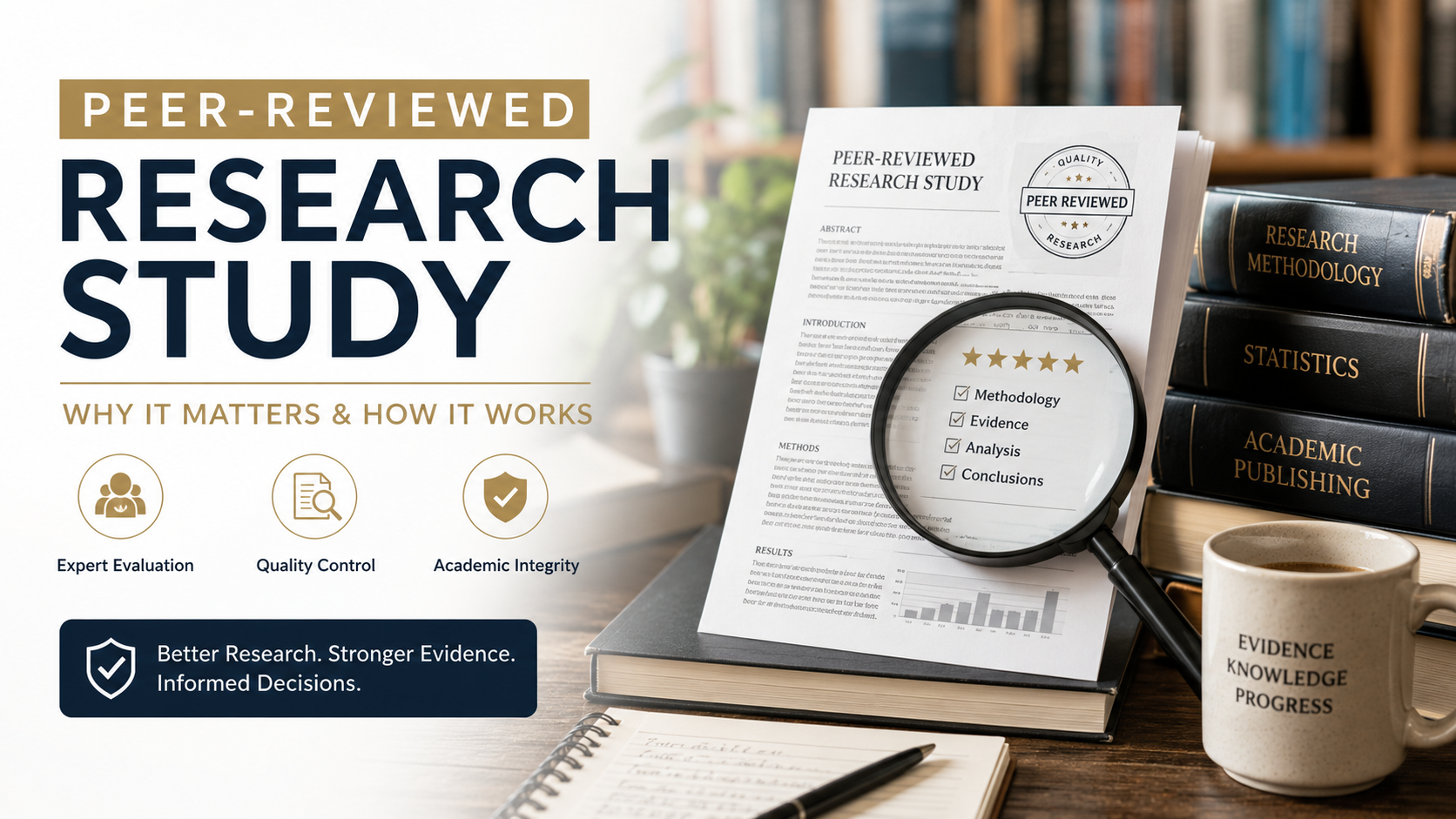
Peer-Reviewed Research Study: Why It Matters & How It Works
Navigating academic publishing can feel overwhelming for beginners. Understanding how a peer-reviewed research study works is essential when evaluating trustworthy information. Anyone can publish content online within seconds. That makes separating verified evidence from misinformation more difficult.
Peer review provides an important quality-control step in academic publishing. Experts evaluate research before a journal accepts it for publication. However, peer review does not guarantee that every published finding is correct. Instead, it helps identify weaknesses, methodological problems, unsupported claims, and other issues before publication.
According to the National Institutes of Health (NIH), peer review is an important part of scientific publishing and research communication. This guide explains how the process works and why it matters. You will learn what makes a research paper credible and how experts evaluate scholarly work.
We will also examine common peer-reviewed sources and explain how to identify them. By the end, you will better understand academic research and make more informed decisions when evaluating scholarly information.

What is a peer-reviewed research study?
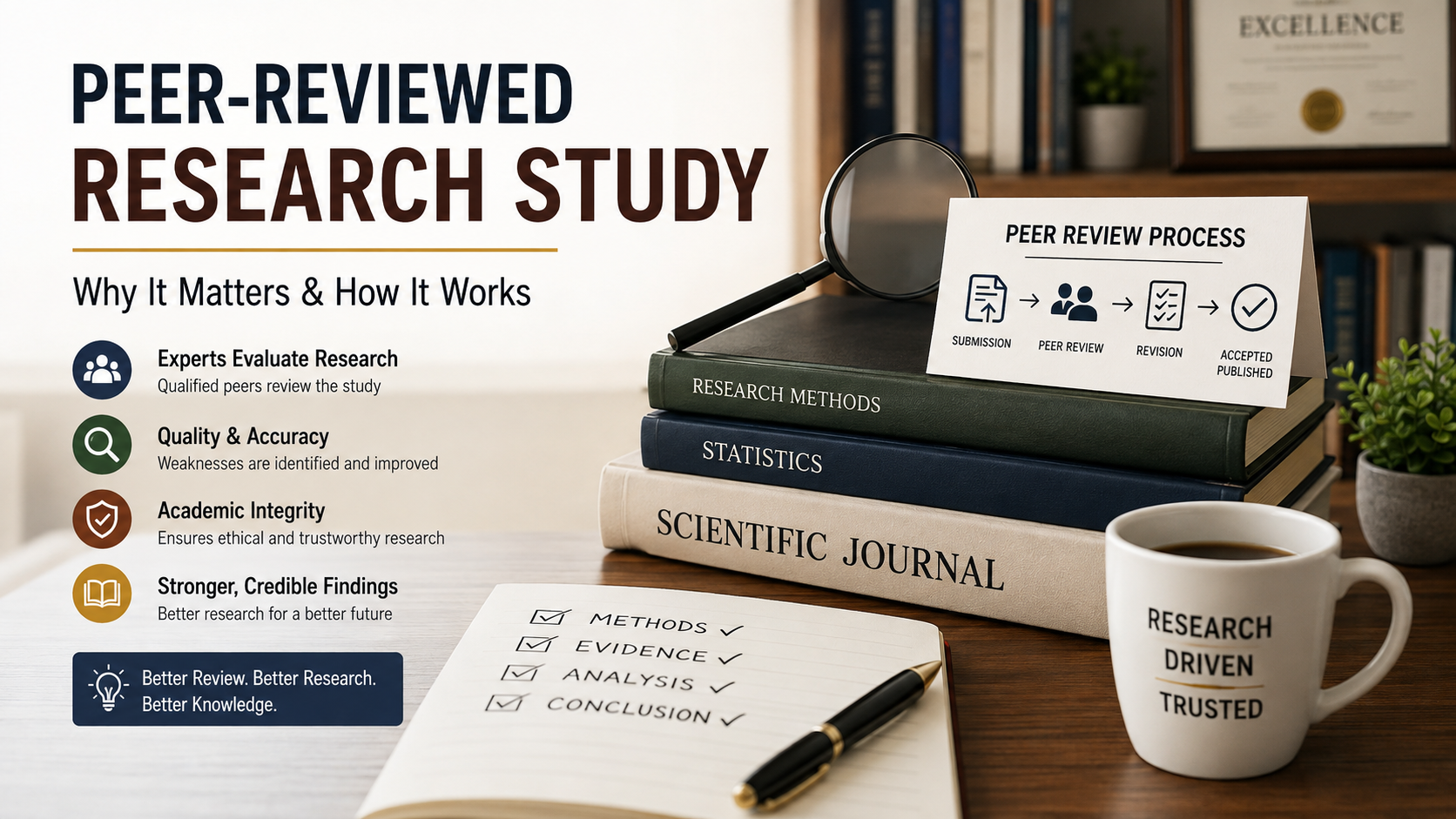
A peer-reviewed research study is an academic paper that experts in the same field evaluate before publication. Researchers typically submit their findings to a scholarly journal after completing their study. An editor then assesses the submission and may send it to independent reviewers with relevant expertise.
Reviewers examine the research methods, evidence, analysis, and conclusions. They may identify errors, missing information, unclear explanations, or unsupported claims. They can also recommend changes that improve the paper before publication. Based on the reviewers’ feedback, the editor may accept, request revisions, or reject the manuscript.
Peer review helps journals maintain academic and scientific standards. It does not guarantee that every published study is flawless. Research can still contain limitations or produce conclusions that later studies challenge.
The Role of Blind Reviews
Some journals use double-blind peer review, where authors and reviewers do not know each other’s identities. Other journals use single-blind or open review systems. Anonymity can reduce certain personal biases, but it cannot remove every source of bias.
The review system depends on qualified reviewers, appropriate editorial decisions, and transparent publication practices. Together, these elements help strengthen the reliability of scholarly research.
What is peer review and why is it important?
Peer review is a formal evaluation process used by academic journals to assess submitted research. Experts with relevant knowledge examine a manuscript before the journal makes a final publication decision. Their role is to identify weaknesses and determine whether the research meets the journal’s standards.
This process matters because researchers often work with complex methods, large datasets, and specialized evidence. A second expert perspective can reveal problems that the original researchers may overlook. Reviewers may question research methods, statistical analysis, interpretations, or unsupported conclusions. Understanding the difference between research-based and evidence-based information can also help readers interpret these findings more carefully.
Peer review also encourages authors to explain their work more clearly. Reviewers can request additional evidence, stronger reasoning, or better descriptions of the research process. These revisions can improve the final article.
However, peer review is not a guarantee of truth. Reviewers can miss errors, and published findings can later be challenged or corrected. Still, peer review provides an important layer of academic quality control.
Protecting Academic Integrity
The review process supports academic integrity by encouraging researchers to present evidence honestly and clearly. Reviewers may identify questionable methods, inconsistencies, missing disclosures, or potential ethical concerns.
Editors can request clarification or further documentation when serious issues arise. Journals may also investigate concerns after publication when new evidence appears. These safeguards help maintain confidence in the academic record.
Peer review therefore supports research integrity without making research infallible. Scientific knowledge remains open to correction as better evidence becomes available.
What is peer review in simple terms?
In simple terms, peer review is an expert check performed before research is published. Imagine writing a complex essay and asking several teachers to examine it before submission. They would look for factual errors, weak arguments, unclear explanations, and missing evidence.
Academic reviewers perform a similar role, but they have specialized knowledge within a particular field. They examine whether the research question is appropriate and whether the methods support the conclusions. They may also identify weaknesses that require revision.
Reviewers can recommend acceptance, changes, or rejection. The journal editor makes the final decision after considering the available feedback. This process helps improve research before other scientists and readers rely on it.
Peer review is not simply a test that separates good research from bad research. It is also a structured way to strengthen scholarly communication and encourage researchers to address important weaknesses.
The Expert Feedback Loop
The reviewer-author relationship creates an important feedback loop. Reviewers identify problems, while authors respond with explanations, corrections, or additional analysis.
This exchange can make research clearer and more transparent. It can also encourage authors to explain limitations rather than presenting conclusions too broadly.
The process varies between journals and disciplines. Some reviews are anonymous, while others identify reviewers or publish review reports. Regardless of the format, constructive expert feedback remains an important part of scholarly publishing.
What are the 7 importances of research?
Research plays an important role in expanding knowledge and addressing practical problems. Its value extends beyond universities and laboratories. A peer-reviewed research study can contribute to evidence that influences medicine, technology, business, education, and public policy. Evidence-based research is especially valuable when making informed decisions across these fields.
Seven common importance areas include:
- Gathering reliable information to answer specific questions.
- Supporting medical progress through new evidence and treatments.
- Building professional knowledge within specialized fields.
- Understanding social issues through systematic investigation.
- Encouraging critical thinking and evidence-based reasoning.
- Supporting informed decisions in organizations and businesses.
- Expanding knowledge by testing existing ideas and developing new explanations.
Research can also challenge theories that no longer fit available evidence. This process helps knowledge evolve rather than remain fixed.
Driving Daily Innovation
Research contributes to many technologies and services people use every day. Smartphones, medical treatments, communication systems, and modern materials all depend on years of investigation.
Innovation usually develops through multiple stages. Researchers identify problems, test ideas, analyze evidence, and refine their approaches. Other researchers then build on published findings.
Not every study produces a major breakthrough. Many studies provide smaller pieces of evidence that eventually contribute to larger advances. This cumulative process is one reason reliable research matters to society.
What are the 5 key elements of peer review?
The peer review process depends on several principles that help maintain research quality. Five key elements are impartiality, reviewer expertise, confidentiality, constructive criticism, and editorial oversight.
Impartiality means reviewers should evaluate research based on its quality rather than personal preferences. Reviewer expertise is equally important because complex studies require informed technical assessment. Confidentiality may protect unpublished research and allow reviewers to provide candid feedback.
Constructive criticism helps authors address weaknesses without turning the process into personal judgment. Useful reviews explain what needs improvement and why the issue matters.
Finally, editorial oversight keeps the process organized. Editors select reviewers, evaluate their recommendations, communicate decisions, and determine whether a manuscript is ready for publication.
These elements work together rather than independently. A journal can have skilled reviewers but still produce inconsistent decisions if editorial standards are weak.
The Role of Editorial Oversight
Editors have a central responsibility throughout peer review. They usually select reviewers with appropriate expertise and consider whether potential conflicts of interest could affect the evaluation.
When reviewers disagree, editors assess the reasoning behind their recommendations. They may request another review or ask authors for additional clarification.
Editors also decide whether revisions adequately address major concerns. This makes editorial judgment an important safeguard within academic publishing.
A well-managed review process should be fair, transparent, and appropriate for the journal’s subject area. Standards can differ between disciplines, so readers should consider the journal’s policies when evaluating published research.
What are examples of peer-reviewed sources?
Examples of peer-reviewed sources include research articles published in established scholarly journals. Well-known journals include Nature, The Lancet, and the Journal of the American Medical Association (JAMA). However, a journal’s reputation alone does not make every individual article correct.
Academic databases can help readers locate scholarly research. PubMed, JSTOR, Google Scholar, and Scopus provide access to large collections or indexes of academic literature. Their coverage and search features differ, so the best database depends on the subject.
When evaluating a source, check whether the specific article underwent peer review. Look for the journal’s publication policies and information about its editorial process. Some databases also provide filters that help users narrow results to scholarly or research-focused material.
Remember that conference papers, books, preprints, and reports may follow different review processes. They should not automatically be treated as peer-reviewed journal articles.
Identifying Credible Journals
You can assess a journal by reviewing its official website and publication policies. Look for clear information about peer review, editorial leadership, submission requirements, and ethical standards.
A credible journal should explain how manuscripts are evaluated. It should also provide information about conflicts of interest, corrections, and publication ethics when applicable.
Be cautious with journals that make unrealistic publication promises or provide little information about their editorial process. Predatory journals may prioritize publication fees over meaningful scholarly review.
Checking the journal, article, authors, methods, and evidence gives you a stronger basis for judging credibility. Evaluating research quality systematically can help you determine whether a study is reliable. Peer review is an important signal, but it should be only one part of your evaluation.
FREQUENTLY ASKED QUESTIONS
How can I tell if an article is peer-reviewed?
You can confirm an article’s status by checking the journal’s official website for an “Editorial Board” and “Review Policy” section. Additionally, search for the publication title in Ulrichsweb or academic databases like PubMed and JSTOR, which explicitly label evaluated periodicals. Standard popular magazines and general blogs never feature structured academic peer-review policies.
What is the difference between single-blind and double-blind review?
In a single-blind review, the expert reviewers know the identities of the authors, but the authors do not know who evaluated their manuscript. In a double-blind review, both the authors and the reviewers remain anonymous to each other. Double-blind evaluation minimizes unconscious geographic, institutional, and gender biases during assessment.
Can a peer-reviewed study contain errors?
Yes, peer review is not completely infallible. While the process catches major methodological flaws, mathematical errors, and unfounded claims, reviewers cannot always detect deliberate data falsification or subtle statistical anomalies. However, scientific publication encourages post-publication commentary, replication studies, and official retractions when subsequent investigators discover legitimate analytical mistakes.
How long does the peer review process usually take?
The entire process typically takes between three to twelve months, depending on the academic discipline and journal workflow. Finding qualified reviewers, conducting detailed manuscript critiques, performing requested laboratory revisions, and making final editorial decisions require substantial time. Certain urgent medical publications, however, use expedited fast-track reviews during public health emergencies.
CONCLUSION
Navigating modern information requires a clear understanding of empirical evidence and scientific validation. Peer-reviewed research remains the primary benchmark for distinguishing credible scientific facts from unverified opinions. By requiring independent subject specialists to scrutinize methodologies, evaluate statistical data, and challenge unsubstantiated conclusions, the academic publishing model ensures that published literature remains accurate, ethical, and dependable.
Throughout this guide, we explored how the review workflow functions, why systematic inquiry drives societal progress, and how to identify verified journals across academic databases. While the peer-review system is not entirely immune to human error, its multi-tiered evaluation structure provides the most reliable standard of truth available in modern science. Whether you are conducting academic research, designing corporate strategy, or evaluating everyday health advice, always prioritize vetted scientific literature. Applying these evaluation principles empowers you to reject sensational headlines and build your knowledge upon authentic, evidence-based discoveries.