
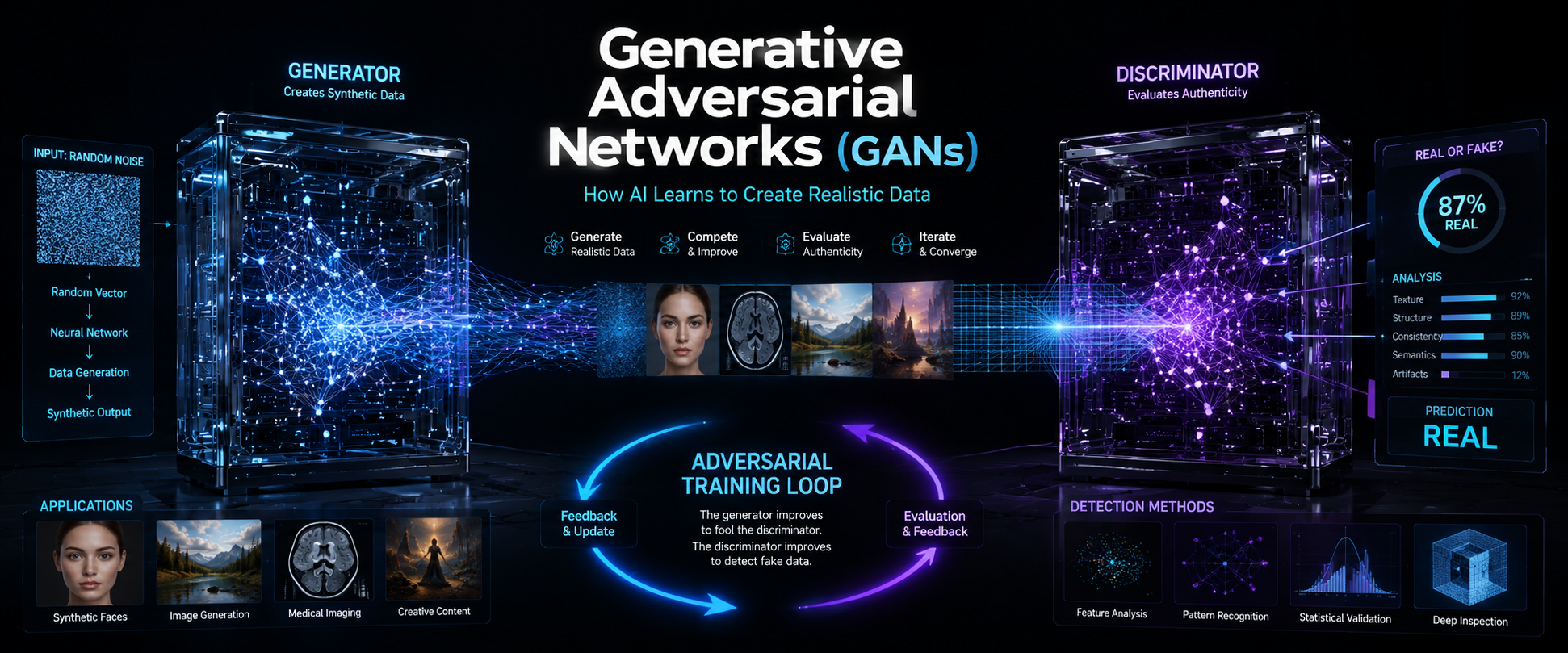
Understanding the Power of a Generative Adversarial Network (GAN)
Imagine two talented artists working in the same room, but instead of cooperating, they are locked in a fierce, ongoing competition. One artist acts as a master copyist, constantly trying to create a perfect forgery of a classical masterpiece. The other artist operates as a brilliant art detective, analyzing every brushstroke to catch the fake. This intense competitive dynamic is exactly how a generative adversarial network operates in the digital world. Originally introduced by artificial intelligence researcher Ian Goodfellow and his colleagues in 2014, this revolutionary architecture completely transformed the field of machine learning. Instead of just analyzing existing information, machines could suddenly generate brand-new, realistic data from scratch, a major leap forward that is thoroughly detailed in the machine learning archives of GeeksforGeeks.
Understanding this technology matters immensely because it powers many of the cutting-edge visual tools we see today, from deepfakes and special effects to advanced medical imaging systems. It allows computers to move far beyond standard data analysis and enter the complex realm of realistic creation. By setting up a digital battleground where two algorithms constantly challenge each other, engineers can train software to mimic real-world patterns with incredible accuracy. In this comprehensive guide, we will explore exactly how these networks function under the hood, break down their core architectural components, examine their real-world use cases across various industries, and look at the unique technical challenges they face during training.
How Does a Generative Adversarial Network Work?
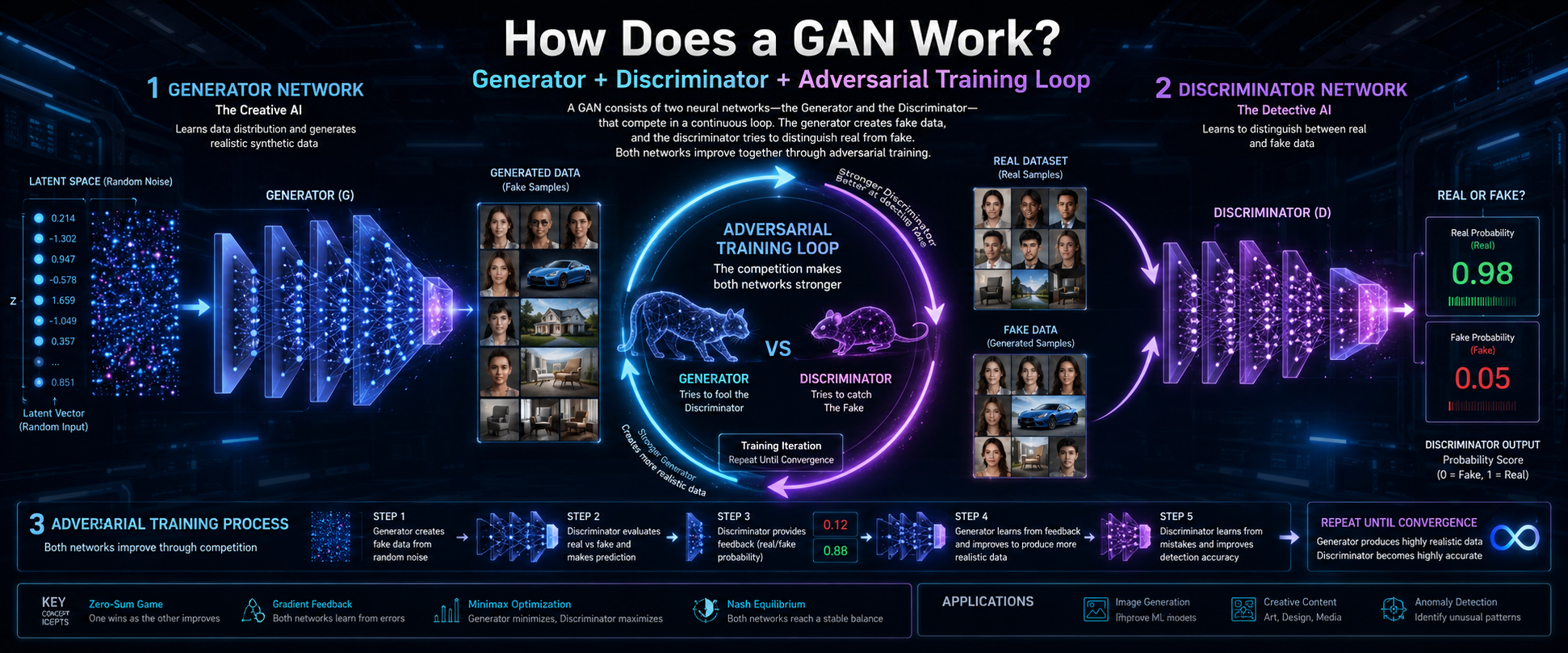

To understand a generative adversarial network, you must look closely at its two internal core components: the generator and the discriminator. These two separate neural networks engage in a continuous, algorithmic game of cat and mouse, which completely drives the learning process from start to finish. At the beginning of the process, the entire system is highly inefficient, but the adversarial tension forces rapid improvement.
The Generator in a Generative Adversarial Network
The generator in a generative adversarial network is responsible for creating artificial data that closely resembles real-world examples. Its main goal is to produce outputs that are realistic enough to fool the discriminator into believing they are genuine. At the beginning of training, the generator starts with random noise and creates outputs that often appear unrealistic or meaningless.
As training continues, the generator receives feedback from the discriminator about the quality of its results. It uses this information to adjust its internal parameters and learn important features. These features include patterns, textures, shapes, and other details found in the original dataset.
Over thousands of training cycles, the generator becomes better at creating realistic content. It can produce images, videos, audio samples, and other forms of synthetic data. This ability to improve through competition is one of the main reasons why generative adversarial networks can create highly convincing results.
The Discriminator in a Generative Adversarial Network
The discriminator works as the judge of the generative adversarial network. It receives two types of data: real examples from the training dataset and fake examples created by the generator. Its purpose is to decide whether each piece of data is genuine or artificial.
The discriminator can be compared to an expert who checks whether something is authentic or fake. It studies the details of the input and provides a probability score. A score close to 1 means the data is likely real, while a score close to 0 suggests it is fake.
As the discriminator improves, it becomes better at detecting generated content. This forces the generator to create more accurate outputs. The continuous competition between these two networks helps the entire system become stronger and more effective.
The Adversarial Training Loop
The true magic happens when these two components interact inside a continuous, cyclical training loop. The process follows a strict, repeating sequence of events that pushes both networks to their structural limits:
-
The generator takes a random string of numbers, known as a latent vector, and transforms it into a synthetic image.
-
The discriminator evaluates this new synthetic image alongside a selection of real images from the database.
-
The discriminator penalizes its own network if it accidentally misclassifies a fake image as real or a real image as fake.
-
The generator receives a heavy mathematical penalty if the discriminator successfully identifies its output as a fabrication.
Consequently, both neural networks get smarter simultaneously through this mutual punishment. The generator learns how to make better fakes, and the discriminator learns how to be a sharper detective. This adversarial process continues until the generated data is virtually indistinguishable from real data, creating a state of equilibrium where the detective can no longer tell the difference.
The Core Challenges of Training Competitive Neural Networks
Although generative adversarial networks have powerful creative abilities, training them is a complex process. These systems depend on two neural networks that compete with each other. The first network is the generator, which creates new data. The second network is the discriminator, which checks whether the generated data is real or fake. Both networks must improve together for the system to work properly.
The main challenge is maintaining a balance between these two networks. If the discriminator becomes too strong, the generator may not receive enough useful feedback. If the generator improves too quickly, the discriminator may struggle to identify fake outputs. This imbalance can reduce the quality of the results.
Training also requires large amounts of data and computing power. Engineers must carefully adjust many settings, such as learning rates and network structures. Small changes can have a major effect on performance. Because of these difficulties, GAN training is often unpredictable. Researchers continue developing improved methods to make these systems more stable, accurate, and efficient.
Mode Collapse
Mode collapse is one of the most common problems that occurs during GAN training. It happens when the generator finds a small number of outputs that successfully trick the discriminator. Instead of learning the full range of patterns in the training data, the generator starts producing similar results repeatedly.
This problem prevents the model from creating diverse outputs. For example, a GAN trained to generate images of different animals should create many types of animals. However, a model affected by mode collapse may create only one animal repeatedly. The images might appear realistic, but they do not represent the variety of the original dataset.
Mode collapse occurs because the generator chooses an easier path. It focuses on outputs that already receive positive feedback from the discriminator. As a result, it stops exploring new possibilities. This reduces the usefulness of the model, especially in creative applications.
Researchers use different techniques to reduce mode collapse. These include improving training methods, changing network designs, and adding better evaluation strategies. Solving this issue helps GANs create more realistic and diverse content.
Vanishing Gradients
Vanishing gradients are another important challenge in training competitive neural networks. This issue occurs when the discriminator becomes much better than the generator during the early stages of training. The discriminator may quickly identify fake outputs with very high accuracy.
When this happens, the generator receives weak feedback. The information it needs to improve becomes very limited. During training, neural networks depend on gradients to update their internal settings. If these gradients become extremely small, the generator cannot make meaningful changes.
As a result, the learning process slows down or stops completely. The generator may continue creating poor-quality outputs because it cannot understand how to improve. This creates an imbalance between the two networks.
Researchers have developed several methods to reduce the problem of vanishing gradients. Some approaches involve changing the loss functions or improving the architecture of the networks. These techniques help maintain better communication between the generator and discriminator. By solving this challenge, GANs can become more stable and capable of producing higher-quality results.
The Core Challenges of Training Competitive Neural Networks
Although these systems have impressive creative abilities, training them can be difficult. Two neural networks must learn at the same time. They must maintain a careful balance to work effectively. If one network becomes much stronger than the other, the entire training process can fail.
Mode Collapse
One common problem in GAN training is called mode collapse. It happens when the generator discovers a specific output that easily fools the discriminator. Instead of creating different and creative results, the generator keeps producing the same type of output.
This reduces the diversity of the generated data. For example, if a GAN is trained to create images of different dog breeds, a generator affected by mode collapse may produce only one type of dog repeatedly. It may create realistic images, but it fails to represent the full variety of the training dataset.
Vanishing Gradients
Another challenge is the problem of vanishing gradients. This occurs when the discriminator becomes too powerful during training. It may quickly identify all generated outputs as fake. As a result, the generator receives very little useful feedback.
Without proper feedback, the generator cannot improve its results. The learning process slows down or stops completely. Researchers continue to develop better training methods to overcome these issues and make generative models more stable and reliable.
FAQs
What is a generative adversarial network?
A Generative Adversarial Network (GAN) is a machine learning framework that uses two neural networks working against each other. These networks compete in a process based on game theory. The two main parts of a GAN are the generator and the discriminator.
The generator creates new data from random inputs. Its goal is to produce realistic results that look similar to real examples. The discriminator examines the generated data and compares it with real training data. It then decides whether the output is genuine or fake.
This competition helps both networks improve over time. The generator learns to create more realistic content, while the discriminator becomes better at identifying differences. Through this process, GANs can produce high-quality synthetic data.
GANs are widely used in generative artificial intelligence. They can create realistic images, improve video quality, generate audio, and support research in many fields. Their ability to produce new and convincing data has made them an important development in modern AI.
How are these networks used in healthcare?
In healthcare, these networks are used to create synthetic medical data, such as CT scans, mammograms, and MRI images. This helps researchers train medical AI systems with larger datasets. It also reduces the need to use real patient records, which can protect privacy and support compliance with healthcare data regulations.
These models are especially useful when real medical data is limited. Some rare diseases have very few available examples, making it difficult to train accurate diagnostic systems. Generative models can create realistic synthetic cases that help researchers study these conditions more effectively.
They are also used to improve medical imaging technologies. AI systems trained with synthetic data can assist doctors in detecting diseases, analyzing scans, and improving diagnosis. However, these generated images must be carefully tested to ensure accuracy and reliability.
Overall, these networks provide valuable support in healthcare research. They help overcome data limitations while creating new opportunities for faster and more advanced medical solutions.
What is mode collapse in AI training?
Mode collapse is a common failure that can happen when training Generative Adversarial Networks (GANs). It occurs when the generator network starts producing only a limited variety of outputs.
In this situation, the generator finds a few outputs that consistently fool the discriminator. Instead of exploring new possibilities, it keeps repeating those successful patterns. As a result, the model stops learning the full diversity of the training data.
This leads to repetitive and low-variation results. For example, an image generator might keep producing nearly identical faces or objects. Even though the outputs may look realistic, they lack variety.
Mode collapse reduces the usefulness of the model. The goal of generative AI is to capture the full range of real data distributions. When mode collapse happens, that goal is not achieved. Researchers continue to develop new training methods to reduce or prevent this issue.
Can these systems generate text?
Yes, these systems can generate text, but they are more commonly used for creating images and videos. Text generation is more challenging because language works differently from visual data. Images contain continuous values, such as pixel colors, which can be adjusted gradually. However, text is made of separate units called tokens, including words and punctuation.
Because of this difference, it is harder for a generator to improve text output through the feedback process. The discriminator must judge whether the generated text appears realistic and meaningful. Small changes in language can also completely change the meaning of a sentence.
Despite these challenges, researchers have created specialized versions of these models for natural language tasks. These systems can perform activities such as text summarization, translation, and dialogue generation. Although GANs are not the primary technology used for modern text generation, they have contributed to the development of creative AI systems. Their ideas continue to influence research in language and generative models.
Who invented this AI architecture?
Generative Adversarial Networks (GANs) were introduced by computer scientist Ian Goodfellow and his research colleagues in 2014. They presented this idea in their influential research paper, which proposed a new approach to machine learning. The paper introduced a system where two neural networks compete with each other.
One network, called the generator, creates new data. The other network, called the discriminator, checks whether the data is real or generated. This competition follows the principles of game theory. Over time, both networks improve their abilities through continuous training.
The creation of GANs became a major milestone in artificial intelligence. It changed how researchers approached data generation and creative machine learning tasks. The technology made it possible to create realistic images, videos, and other forms of synthetic content. Today, GANs continue to influence modern generative AI systems. Their development helped establish new possibilities for how humans and machines can create and interact with digital information.
Conclusion
The evolution of Generative Adversarial Networks (GANs) has changed the direction of modern artificial intelligence and machine learning. This technology introduced a new way for machines to create realistic content. GANs work by using two neural networks that compete with each other. One network generates new data, while the other evaluates its quality. Through this process, the system learns to produce more accurate and creative results.
GANs have moved AI beyond simple data analysis and classification. They have opened new possibilities in areas such as healthcare, entertainment, and scientific research. For example, they can support medical image creation, improve visual effects, and help generate useful training data. However, GANs still face challenges. Issues such as mode collapse, unstable training, and high computational requirements continue to affect their development.
Despite these limitations, GANs remain one of the most important innovations in AI. As technology improves, these systems will become more reliable and powerful. They will continue to influence the way humans and machines work together in creative and practical fields.
To understand more about the future of artificial intelligence and how machines create new content, explore our detailed guide on what is generative AI.