

What Is Full Stack AI? An Expert Guide to Systems and Careers
Software architecture is undergoing a significant transformation driven by artificial intelligence. Traditionally, the term “full stack” referred to building both frontend and backend applications. Today, Full Stack AI extends this concept across the entire artificial intelligence development lifecycle.
Building intelligent products requires more than connecting a React frontend to a Node.js backend. Engineers must understand computing hardware, data pipelines, AI models, orchestration frameworks, and user interfaces. Research from Stanford University’s Human-Centered AI Institute explores the broader AI ecosystem, including machine learning systems, foundational models, and the infrastructure supporting their development.
Engineers, technical founders, and career switchers often wonder how these technologies fit together. Does traditional web development still matter when AI models can generate code and process information? How do data science and machine learning connect with conventional software engineering?
This guide explains the Full Stack AI architecture, the responsibilities involved in building intelligent applications, and the career opportunities emerging across the industry. You will explore the five major layers of an AI stack, examine occupations facing automation risks, and compare AI engineering with traditional full stack development. You will also learn how these technologies work together to deliver reliable applications in production environments.
What Does Full Stack AI Actually Mean?
Full Stack AI refers to the complete ecosystem of technologies and processes needed to build, deploy, and maintain AI-powered applications. Rather than focusing only on AI models, it covers everything from computing infrastructure to the products people use daily.
To understand this concept, imagine an AI application as a system with several interconnected layers. Each layer performs a specific function. Together, they transform computing power, data, and AI research into practical solutions.
The Full Stack AI architecture can be divided into five major layers:
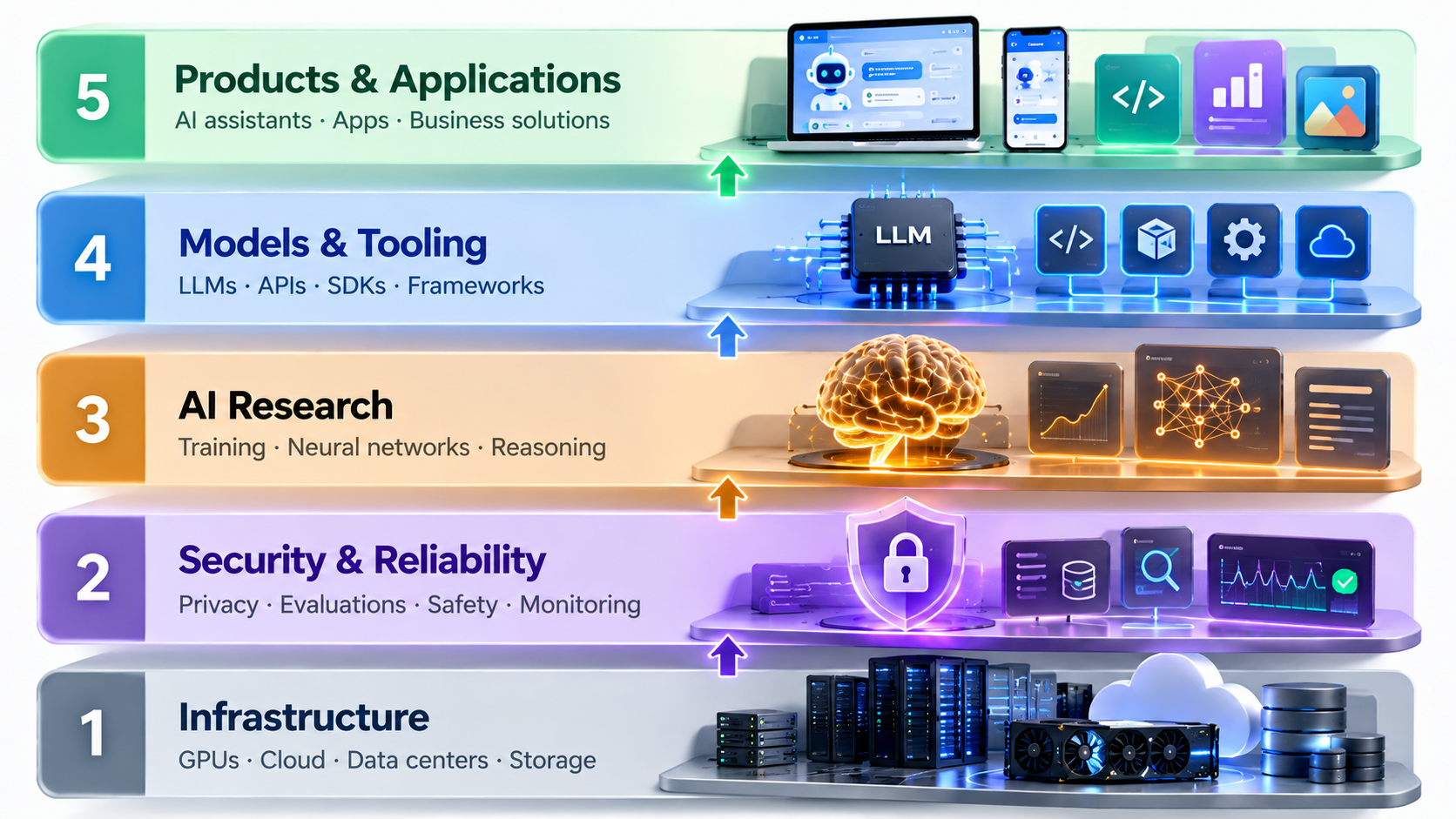
1. Infrastructure
First, infrastructure provides the computing resources required to develop and operate AI systems. These resources include GPUs, specialized AI chips, cloud platforms, servers, networking, and data storage.
Without reliable infrastructure, training large AI models and handling millions of user requests would become difficult and expensive. Therefore, organizations invest in scalable computing environments to support demanding AI workloads.
For example, NVIDIA GPUs, Google Cloud, and large-scale data centers provide resources for running AI applications. Depending on their requirements, businesses can use cloud services or maintain their own infrastructure.
2. Security and Reliability
Next, security and reliability help ensure that AI systems operate safely and consistently. This layer focuses on protecting sensitive data, controlling access, detecting vulnerabilities, and evaluating model behavior.
For example, AI applications may face risks such as prompt injection, unauthorized data access, and harmful outputs. Consequently, developers need safeguards to identify and reduce these threats.
Security also extends beyond the initial deployment. Teams must continuously test their systems, monitor performance, and respond to emerging risks. By integrating security throughout the AI lifecycle, organizations can build applications that are more trustworthy and resilient.
3. AI Research
Meanwhile, AI research develops the scientific methods and techniques behind modern artificial intelligence. Researchers investigate neural network architectures, training methods, reasoning capabilities, and multimodal learning. For professionals entering this field, continuous learning for career success helps them keep pace with emerging research methods and evolving AI technologies.
These advances help models understand information, generate content, and solve increasingly complex problems. In addition, researchers explore ways to improve model accuracy, reduce computing costs, and increase efficiency.
For example, improvements in model training can help AI systems perform better while using fewer resources. Similarly, research into multimodal learning enables models to process combinations of text, images, audio, and video.
Ultimately, AI research provides the foundation for more capable and efficient systems. Its discoveries influence the models and tools that developers use to build practical applications.
4. Models and Tooling
Once research produces usable techniques, models and developer tools help bring those capabilities into applications. This layer includes large language models, image-generation models, speech recognition systems, and other machine learning technologies.
These models perform tasks such as understanding language, generating content, analyzing images, and processing audio. However, developers usually need additional tools to integrate them into complete products.
For this reason, the tooling ecosystem includes APIs, software development kits (SDKs), orchestration frameworks, evaluation tools, and deployment platforms. These technologies simplify integration and help developers manage AI workflows.
For example, an application can use a language model through an API rather than training a new model from scratch. As a result, development becomes more accessible, although teams must still evaluate accuracy, security, and operating costs.
5. Products and Applications
Finally, the product layer turns AI capabilities into tools that people can use. It includes chatbots, coding assistants, productivity applications, customer-support systems, and AI-powered enterprise software.
For example, an AI assistant may use cloud infrastructure to run its model. It can also rely on research advances for improved capabilities, security controls to reduce risks, and APIs to connect its components.
Meanwhile, the user interacts with the assistant through a website, mobile application, or existing business platform. The application must present useful results clearly and respond reliably to user requests.
Therefore, successful AI products require more than capable models. They also need intuitive interfaces, dependable integrations, appropriate safeguards, and a clear purpose. When these elements work together, AI becomes a practical solution rather than an isolated technical feature.
How Do the Five Layers Work Together?
Although each layer has a different responsibility, all five contribute to the same goal. Infrastructure supplies computing power, while research improves AI techniques and models. Meanwhile, security protects information and helps teams manage risks.
Developer tools connect models with application logic, making AI capabilities easier to integrate. Finally, products deliver those capabilities to users through practical interfaces and workflows.
The relationship also works in reverse. For instance, feedback from users can reveal inaccurate answers, slow responses, or security weaknesses. Developers can then use these findings to improve their applications, adjust their models, or strengthen their infrastructure.
Similarly, new research may introduce more efficient models, allowing organizations to reduce costs or improve performance. As a result, the layers continue to evolve together throughout the application’s lifecycle.
In simple terms, Full Stack AI means understanding how the entire system works together, rather than focusing only on the AI model. Depending on their responsibilities, professionals may specialize in one layer or work across several layers of the stack.
Which 3 Jobs Will Not Survive AI?
No one can reliably predict which occupations will disappear completely because of AI. However, routine data entry, basic outbound telemarketing, and entry-level transcription face significant automation risks.
These jobs often involve repetitive tasks, predictable workflows, or converting information from one format into another. AI agents, speech recognition systems, and language models can automate many of these activities quickly and at relatively low cost.
For example, software can extract information from documents, generate transcripts, and conduct scripted customer interactions. Businesses may therefore need fewer workers for certain repetitive tasks.
However, automation does not automatically eliminate every position within an occupation. Human judgment, exception handling, relationship building, and accountability can remain important. Actual effects depend on the industry, the complexity of the work, and how organizations implement AI.
Workers should focus on developing skills that complement automation instead of assuming every job in an affected field will disappear.
The Shift Toward Human Oversight and Strategy
As automation expands, some workers may transition toward supervising AI systems, validating information, and handling complex customer interactions.
These responsibilities require more than checking whether software completed a task. Professionals must identify inaccurate outputs, recognize unusual situations, and determine when human intervention is necessary.
Communication, critical thinking, domain expertise, and ethical judgment can become increasingly valuable. For example, an automated transcription system may produce a transcript quickly, but a human reviewer might still need to verify specialized terminology or sensitive statements.
Workers can prepare by learning relevant AI tools and understanding their limitations. Developing analytical skills and practical industry knowledge can help professionals move toward responsibilities that require judgment rather than repetitive processing. Understanding upskilling vs reskilling can also help workers decide whether to improve their existing abilities or learn new skills for changing job requirements.
Which Is Better: AI/ML or Full Stack Development?
Neither AI and machine learning engineering nor traditional full stack development is universally better. The right choice depends on your interests, existing skills, preferred work, and career goals.
AI/ML engineering focuses on developing, evaluating, integrating, and maintaining machine learning systems. Depending on the position, it may require statistics, linear algebra, Python programming, data preparation, and model evaluation.
Full stack development focuses on building complete software applications. Developers typically work with frontend interfaces, backend services, databases, APIs, and deployment infrastructure.
Traditional full stack development can provide a practical starting point for people who enjoy creating user-facing products and solving application-level problems. AI/ML may suit people interested in mathematical modeling, experimentation, and data-driven systems.
However, job opportunities and salaries vary by location, experience, company, and specialization. Neither path guarantees better employment outcomes.
The Rise of the Hybrid Product Engineer
Many organizations need developers who can combine conventional software engineering with applied AI capabilities. These professionals can build web applications, integrate model APIs, and design workflows that use AI effectively.
For example, a hybrid engineer might develop a customer support platform with a React frontend, a .NET backend, a database, and an AI-powered response assistant.
This approach does not necessarily require training a foundation model from scratch. Engineers can often use existing models through APIs or deploy suitable open-source alternatives.
Learning system design, authentication, database management, API development, and AI integration creates a useful combination of skills. The key is to understand when AI adds value and how to implement it without compromising reliability, security, or cost.
What Is a Full Stack AI Architecture?
A Full Stack AI architecture is the collection of technologies and components required to build and operate an AI-powered application. It covers the journey from computing infrastructure and data processing to model execution and user interaction.
The architecture may include GPUs or other accelerators, data storage systems, preprocessing pipelines, foundation models, retrieval systems, orchestration frameworks, and application interfaces.
Each component serves a different purpose. Computing hardware supplies processing power, while data pipelines prepare information for use. AI models generate predictions or content, and orchestration systems connect those models with relevant context and external tools.
The application layer presents results to users through web applications, mobile apps, or other interfaces. Monitoring and security practices operate across these layers rather than belonging to only one component.
Not every application needs every technology. A small AI-powered application might use a hosted model API and a conventional database. A larger enterprise system may require vector search, distributed computing, access controls, and specialized monitoring.
Managing Latency, Cost, and System Architecture
Designing a Full Stack AI architecture requires balancing response time, operating costs, accuracy, and reliability.
A powerful model may deliver better results for complex tasks but cost more to operate. A smaller model may respond faster and use fewer resources, making it suitable for simpler requests.
Engineers must evaluate these trade-offs against actual product requirements. They should also consider data privacy, expected traffic, infrastructure availability, and the consequences of incorrect outputs.
For example, a company building an internal knowledge assistant might combine a smaller language model with retrieval-augmented generation. This design can provide relevant answers using company documents without requiring a custom foundation model.
Performance testing, caching, monitoring, and efficient resource allocation help keep the system responsive as usage grows. The best architecture is the one that meets the application’s requirements without unnecessary complexity.
What Are the 5 Layers of a Full Stack AI Architecture?
A practical Full Stack AI architecture can be divided into five major layers: compute infrastructure, data engineering, AI models, orchestration, and applications.
The compute layer provides the hardware and cloud resources needed to run AI workloads. The data layer prepares, stores, and retrieves information from databases, data lakes, and other sources.
The model layer contains the machine learning systems that generate predictions, analyze information, or create content. These systems may be hosted externally, deployed on private infrastructure, or trained by an organization.
The orchestration layer coordinates model requests, prompts, context retrieval, external tools, and workflow logic. It helps applications combine different services into a coherent process.
Finally, the application layer delivers AI capabilities through user interfaces and business software. Developers must consider accessibility, responsiveness, security, and user experience alongside model performance.
These five layers provide a useful mental model, although actual architectures vary. Some systems combine layers, while others introduce additional components for governance, evaluation, observability, or specialized computing.
Orchestration and Context as the Modern Linchpin
The orchestration layer connects AI models with application logic, relevant information, and external services. It determines how requests move through the system and how different components work together.
For example, an AI assistant answering questions about company policies may need to search internal documents before generating a response. The orchestration workflow can retrieve relevant passages, provide them to the model, and return the generated answer to the application.
This process is commonly associated with retrieval-augmented generation (RAG). Depending on the application, orchestration may also involve API calls, tool usage, workflow routing, validation, and retry handling.
Effective orchestration does not guarantee correct answers. Engineers must still evaluate retrieval quality, monitor model behavior, and handle failures safely.
Understanding this layer helps developers build useful AI features without training a large model from scratch. It also makes it easier to replace individual components as requirements, costs, or available technologies change.