
When Should AI Never Be Used? 5 Critical Boundaries
Artificial intelligence has become part of many modern workflows, but when should AI never be used? Although these tools can automate repetitive tasks, summarize information, and improve productivity, they can also create serious risks when used without proper oversight. Medical decisions, financial choices, sensitive personal matters, and other high-stakes situations may require human judgment that automated systems cannot replace.
Understanding when should AI never be used is increasingly important. Automated systems can produce inaccurate information, expose sensitive data, and make decisions without understanding human context. UNESCO’s Recommendation on the Ethics of Artificial Intelligence emphasizes human oversight, accountability, privacy, and ethical safeguards.
Organizations should be especially careful when technology is used for high-stakes decisions. Health, finances, legal rights, safety, and personal relationships all require appropriate human judgment.
This guide examines five important boundaries. It also explores concerns about excessive automation and changing attitudes toward these technologies. Finally, it looks at responsible use and the possible effects of excessive dependence on automated tools.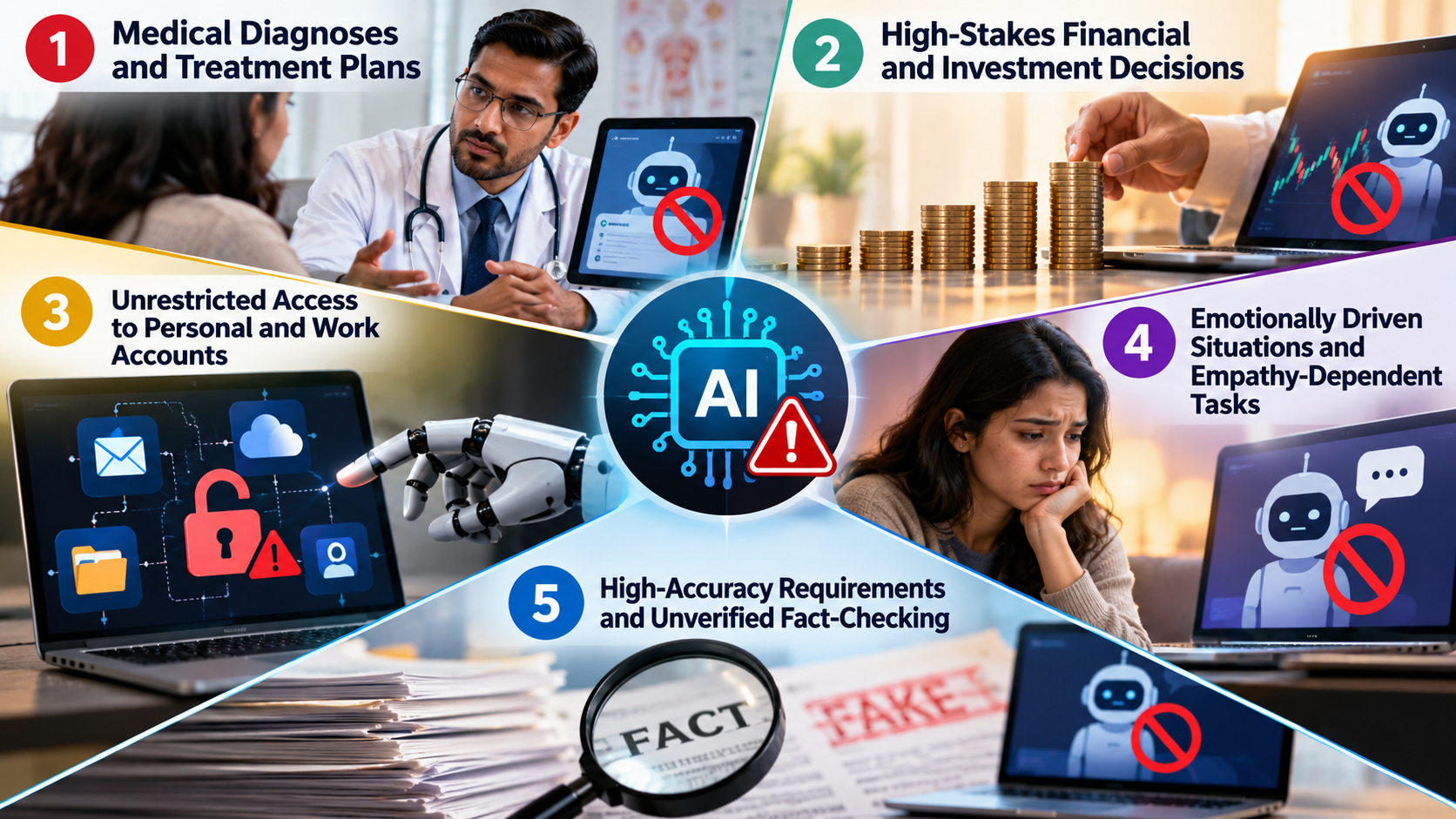
1. Making Medical Diagnoses and Treatment Plans
AI can explain medical information and summarize research. However, it should not replace a qualified healthcare professional. Medical decisions often require physical examinations, medical history, testing, professional judgment, and knowledge of individual circumstances.
Generative systems can also produce confident but incorrect information. A response may sound convincing while missing an important symptom or suggesting an unsuitable treatment.
People should not rely on chatbots for diagnoses or treatment plans. Emergency symptoms also require appropriate medical attention instead of an automated conversation.
These tools can still support healthcare discussions. For example, they can help patients prepare questions for an appointment. They can also explain unfamiliar medical terminology.
Those uses are different from allowing software to make the final clinical decision. Medical professionals must remain responsible for decisions that affect a patient’s health.
Keep a healthcare professional in control when:
- Diagnosing a medical condition
- Interpreting serious symptoms
- Choosing or changing treatment
- Assessing an emergency
- Deciding whether urgent care is necessary
The key principle is simple: technology can support medical understanding, but it should not replace qualified clinical judgment.
2. High-Stakes Financial and Investment Decisions
AI can help organize expenses, explain financial concepts, and analyze information. However, major financial decisions require more than pattern recognition. Income, debt, taxes, risk tolerance, investment goals, and changing regulations can all affect the appropriate decision.
An automated system may also work with incomplete or outdated information. It can misunderstand someone’s circumstances or present an uncertain prediction as reliable.
That does not mean these tools have no place in personal finance. They can help create budgets, categorize spending, compare financial concepts, or prepare questions for a qualified professional.
The risk increases when users give software final authority over important financial decisions. Human review becomes especially important when substantial money or long-term consequences are involved.
Extra caution is appropriate when technology is used to:
- Execute significant financial transfers
- Choose investments
- Manage financial accounts
- Make tax decisions
- Assess major borrowing decisions
- Act without human review
Financial software can assist with analysis, but people should remain responsible for important decisions. Professional advice may also be appropriate when the potential consequences are substantial.
3. Granting Unrestricted Access to Personal and Work Accounts
Giving an AI system access to email, cloud storage, business documents, or other accounts can create significant privacy and security risks. The danger increases when the system can both read sensitive information and take actions.
Automated agents may misunderstand instructions or encounter malicious content. Understanding how AI agents work can help explain why these systems need carefully controlled permissions and human oversight. Prompt injection attacks can also attempt to manipulate a system into ignoring its intended task. Poorly configured systems could therefore expose information or perform unwanted actions.
This does not mean every AI integration is unsafe. Many useful tools require limited access to perform legitimate tasks. The important issue is controlling what the system can access and what it can do.
Before connecting a tool to sensitive accounts, consider:
- What information can it access?
- Can it send, delete, or modify information?
- Can another person or system trigger actions?
- Is human approval required for sensitive operations?
- How is the data stored and protected?
Use the least amount of access necessary. Human approval should remain part of important workflows, especially when an action could expose confidential information or cause irreversible damage.
4. Emotionally Driven Situations and Empathy-Dependent Tasks
Some situations require more than accurate information. They require empathy, context, emotional awareness, and responsibility. AI can generate supportive language, but it does not have personal experiences or human relationships.
This matters when communication involves grief, conflict, counseling, sensitive workplace issues, or vulnerable people. A technically appropriate response can still feel inappropriate when it ignores emotional context.
Automated tools can assist with preparation. For example, they can help someone organize thoughts before a difficult conversation. They can also suggest different ways to communicate a message.
However, people should be cautious about allowing software to fully replace human interaction in sensitive situations.
Human involvement is particularly important for:
- Grief and emotionally sensitive conversations
- Counseling and mental health support
- Conflict resolution
- Sensitive performance discussions
- Client relationships
- Personal apologies or important relationship decisions
The issue is not whether a machine can produce empathetic language. Language generation is not the same as human empathy, responsibility, or lived experience.
Sensitive communication should therefore retain meaningful human involvement.
5. High-Accuracy Requirements and Unverified Fact-Checking
Generative AI produces likely responses rather than guaranteed facts. Understanding large language models and how they generate responses can help explain why these systems sometimes produce convincing but incorrect information. As a result, they can generate incorrect numbers, invented citations, misleading explanations, or inaccurate historical information.
This becomes especially risky when accuracy has serious consequences. A factual error in casual writing may be harmless. The same error could create problems in legal, scientific, financial, medical, or professional work.
These tools can still be useful for research. They can help identify topics, summarize documents, generate questions, or organize information. However, important claims should be checked against reliable primary or authoritative sources.
A useful verification process includes:
- Checking important facts against original sources
- Opening cited documents instead of trusting citations blindly
- Confirming numbers and calculations
- Checking publication dates
- Looking for relevant context
- Having a qualified person review high-stakes information
The safest approach is not to treat an automated response as an infallible fact-checker. Instead, use it as a research assistant whose output requires appropriate verification.
What Shouldn’t We Use AI For?
AI should not be treated as the final decision-maker when a task requires substantial empathy, professional accountability, or nuanced judgment. This includes medical care, counseling, legal decisions, emergency response, and sensitive interpersonal situations.
The important distinction is between using AI to assist a professional and using it to replace that professional. A doctor might use software to organize information. A lawyer might use a tool to locate documents. A manager might use it to draft a message.
These applications still require human review. Problems arise when people assume fluent output is automatically correct or appropriate.
Automated systems do not understand human situations in the same way people do. Security risks also increase when people give chatbots access to sensitive information, such as passwords. This is why letting an AI chatbot pick your password can create additional security concerns. These systems also cannot accept professional responsibility for the consequences of their decisions.
Extra caution is appropriate for:
- Medical and mental health decisions
- Legal or regulatory decisions
- Sensitive employee decisions
- Crisis situations
- Important relationship communications
- Decisions involving vulnerable people
The goal is not to eliminate technology from sensitive fields. Instead, human judgment, accountability, and professional oversight should remain central.
Why Is Gen Z Against AI?
It is too broad to say that Gen Z is simply “against AI.” Attitudes toward artificial intelligence vary among individuals, industries, and countries. Many younger people use these tools regularly while also expressing concerns about how companies deploy them.
Common concerns include creative ownership, privacy, employment, misinformation, environmental costs, and the quality of generated work. Some artists object to systems being trained on creative material without clear permission or compensation.
Some workers also worry that automation could reduce entry-level opportunities. Younger workers may have particular exposure to these issues because automated tools increasingly affect education, hiring, content creation, and workplace productivity.
At the same time, many Gen Z users view these technologies as practical tools. They may use them for studying, brainstorming, coding, research, writing, or administrative tasks.
The more accurate conclusion is that Gen Z has mixed views about AI. Concerns about excessive automation exist alongside widespread adoption.
Criticism does not necessarily mean rejecting the technology. Often, the debate concerns how it should be developed, governed, and used.
Should We Avoid Using AI?
Avoiding AI completely is not necessary for most people. A more practical approach is to understand where these tools provide useful assistance and where human judgment must remain in control.
They can be valuable for repetitive and low-risk tasks. Examples include summarizing documents, organizing information, brainstorming ideas, analyzing datasets, drafting code, and automating routine workflows. AI assistants can also support everyday productivity tools when used with appropriate human oversight.
However, convenience can create a dependency problem. If people accept generated answers without thinking, checking, or learning the underlying subject, they may become less engaged with the task.
A balanced approach involves using AI as an assistant rather than an unquestioned authority.
For example, you can:
- Use it to generate initial ideas
- Verify important factual claims
- Review generated code before deployment
- Protect confidential information
- Keep humans responsible for important decisions
- Perform important tasks yourself when learning is the goal
The objective is not total avoidance. It is intentional use with appropriate safeguards.
Technology should make people more capable without removing their responsibility to think, learn, and verify.
When Should AI Never Be Used?
The strongest boundaries apply when an error could cause serious or irreversible harm. High-stakes decisions involving health, safety, legal rights, or vulnerable people require meaningful human oversight.
Examples include medical emergencies, criminal justice decisions, military targeting, and child custody determinations. These areas involve complex facts, legal standards, ethical considerations, and human consequences.
Privacy creates another important boundary. People should not casually enter confidential customer information, trade secrets, passwords, financial records, or unreleased intellectual property into public or poorly understood systems.
However, the question when should AI never be used needs context. Some high-stakes organizations may use automated systems for limited supporting functions. The critical issue is whether the technology assists a qualified human or independently makes a consequential decision.
A useful rule is to ask:
- Could an error seriously harm someone?
- Does the decision affect someone’s rights or safety?
- Is sensitive information involved?
- Is professional accountability required?
- Can a qualified human review the result?
The greater the potential harm, the stronger the case for human control and independent verification.
Is AI Damaging the Human Brain?
Claims that AI directly damages the human brain are stronger than current evidence supports. A more defensible concern is cognitive offloading. People already use calculators, search engines, navigation systems, and other technologies to reduce mental effort.
AI may increase this effect because it can perform writing, research, problem-solving, and summarization almost instantly. If someone routinely accepts generated output without thinking, they may practice those skills less often.
That does not prove that AI physically damages brain tissue. It also does not mean every use reduces intelligence. The effects depend on how technology is used and what the person continues doing themselves.
Active learning remains important. Students may gain more from attempting a problem before asking for assistance. Writers may learn more by drafting their own ideas before using software for editing.
A healthier approach is to use these tools selectively:
- Solve problems yourself before checking an answer
- Explain concepts in your own words
- Verify information independently
- Use technology for feedback rather than automatic answers
- Continue practicing important skills without automation
The concern is therefore less about technology “destroying the brain” and more about which skills people stop practicing when software does the work for them.