
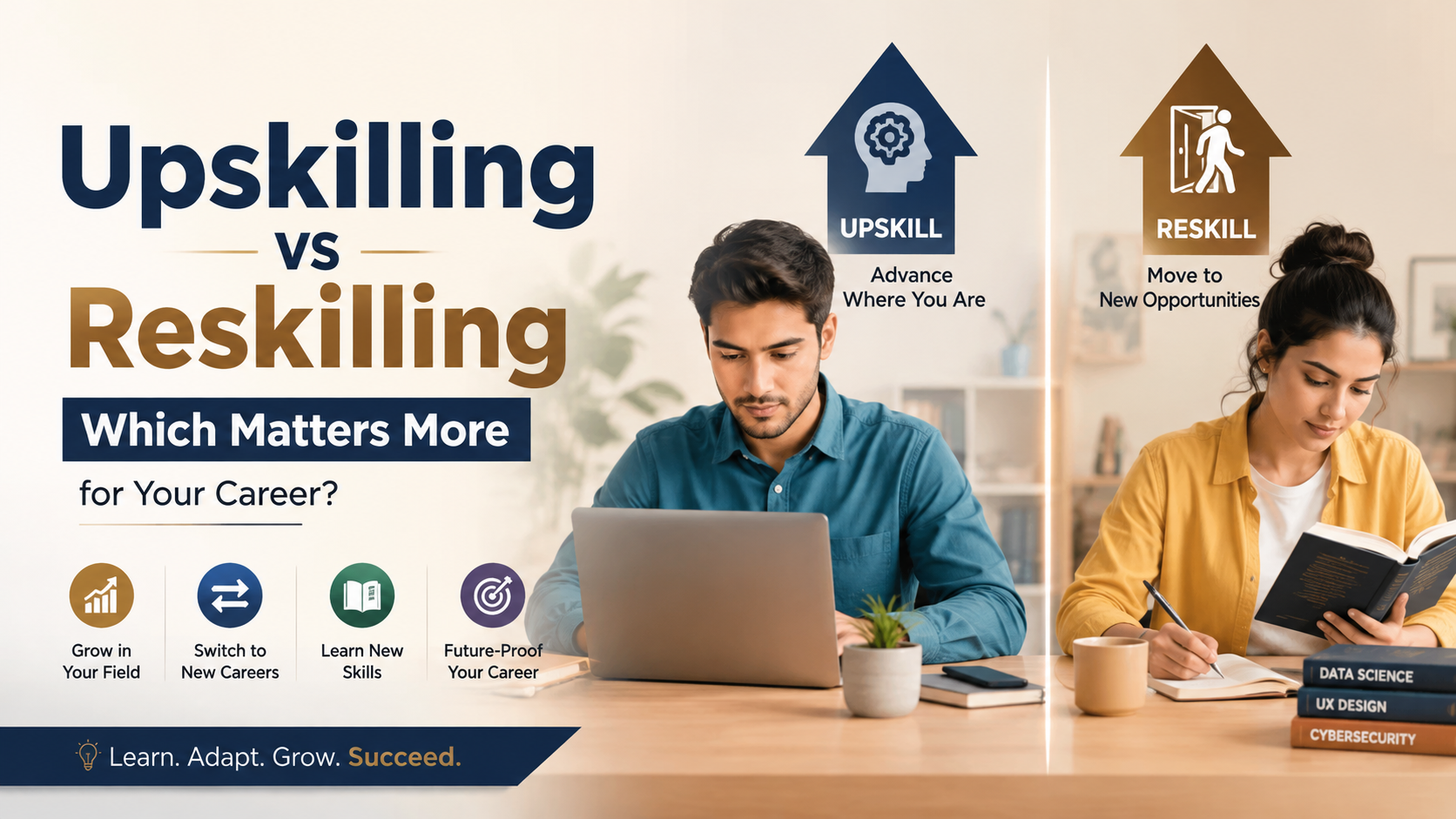
Upskilling vs Reskilling: Which Matters More for Your Career?
The modern professional landscape evolves faster than ever, making continuous learning essential for long-term career survival and growth. When professionals and leaders look for ways to stay competitive, they frequently encounter two distinct career development strategies. Understanding upskilling vs reskilling is crucial for navigating technological disruptions, shifting job markets, and organizational transformation successfully. According to the World Economic Forum, a significant portion of core worker skills will change over the next few years, forcing individuals and enterprises to adapt proactively. This comprehensive guide answers critical questions regarding these strategies, exploring their differences, real-world applications, educational integration, and their collective role in building a resilient workforce.

What are upskilling and reskilling differences?
Upskilling involves learning new skills within your current field to improve performance, increase productivity, or prepare for career advancement. Instead of changing professions, you build on your existing knowledge and become more valuable in your current role. For example, a digital marketer may learn advanced data analytics, AI prompt engineering, or marketing automation to create more effective campaigns.
Reskilling, by contrast, means learning an entirely new set of skills to transition into a different job or industry. It focuses on career change rather than career progression. An accountant who becomes a full-stack software developer is reskilling because the new role requires completely different technical knowledge and daily responsibilities. Understanding the difference between upskilling and reskilling helps professionals and employers choose the right learning strategy for long-term career growth and workforce development.
Core Distinctions in Professional Growth
The biggest difference between upskilling and reskilling is your career destination. Upskilling strengthens your expertise within your current profession. Reskilling prepares you for a completely different career path.
For employees, upskilling improves promotion opportunities and helps them stay competitive as industries evolve. To explore what expertise is currently trending, check out this guide on most in-demand skills for jobs in 2026. Reskilling creates opportunities when existing jobs disappear because of automation, business restructuring, or changing market demands.
Organizations also benefit from understanding these distinctions. Upskilling helps retain experienced employees while introducing new technologies. Reskilling allows businesses to fill critical talent shortages by moving existing employees into high-demand roles instead of hiring externally.
Choosing the right approach depends on career goals, business needs, and future workforce trends.
What is an example of Upskill and Reskill?
A simple upskilling example is a graphic designer who learns motion graphics, video editing, or 3D design software. Their profession remains the same, but they gain additional capabilities that increase their value in today’s multimedia-focused workplace. Similarly, a software developer who learns cloud computing or artificial intelligence is also upskilling.
A clear reskilling example is a retail cashier whose role becomes automated and who learns cybersecurity or software development to begin an entirely new career in technology. The person replaces their previous skill set with new technical competencies that match a different profession. These examples show how upskilling improves an existing career, while reskilling enables a complete career transition when industries or job markets change.
Real-World Application in Modern Industries
Modern organizations use both upskilling and reskilling to stay competitive in rapidly changing markets. Companies introduce upskilling programs when employees need to master new software, digital tools, or industry regulations without changing roles.
Reskilling programs become essential during business transformation, automation, or organizational restructuring. Instead of laying off employees, companies retrain them for positions where demand is growing.
Examples include:
- Healthcare: Nurses learn telemedicine platforms.
- Manufacturing: Workers train to operate robotic systems.
- Finance: Accountants learn data analytics.
- Technology: Support staff transition into cybersecurity roles.
These practical strategies reduce hiring costs, improve employee retention, and help businesses close critical skills gaps while supporting long-term workforce development.
Does the word upskilling exist?
Yes. The word upskilling is a legitimate and widely accepted term in modern English. It appears frequently in business publications, academic research, government workforce reports, and corporate training materials. Although older dictionaries did not always include it, its widespread use led major dictionaries to formally recognize both upskill and upskilling.
The word refers to learning additional skills that improve performance within an existing profession. As industries continue evolving through automation and artificial intelligence, discussions around upskilling vs reskilling have become common among employers, educators, HR professionals, economists, and career advisors. Today, the term accurately reflects the growing importance of continuous learning in a rapidly changing job market.
Linguistic Evolution and Modern Usage
Language evolves alongside society, technology, and the workplace. As new career challenges emerge, new words naturally become part of everyday communication. Upskilling is one example of this evolution.
The term gained popularity because it clearly describes continuous professional development without requiring lengthy explanations. Businesses, universities, government agencies, and training providers now use it regularly when discussing workforce planning and career development.
Today, phrases such as upskilling and reskilling, digital upskilling, and employee upskilling programs appear in recruitment campaigns, learning platforms, and economic reports worldwide.
Understanding this modern terminology improves communication and helps professionals participate confidently in discussions about lifelong learning, career mobility, and workforce transformation.
What is upskilling and reskilling in education and workforce development?
In education and workforce development, upskilling and reskilling are structured learning approaches designed to address growing skills shortages and prepare people for changing employment markets.
Educational institutions increasingly collaborate with employers to create degree programs, professional certifications, vocational courses, and micro-credentials that reflect current industry needs. Upskilling allows graduates and experienced professionals to strengthen existing expertise with specialized training. Reskilling focuses on helping learners transition into entirely new careers, especially in expanding industries such as technology, renewable energy, healthcare, and advanced manufacturing.
Together, these learning strategies help individuals remain employable while providing organizations with a workforce capable of adapting to rapid technological and economic change.
Preparing Students for the Future Economy
Today’s students will likely change careers several times throughout their working lives. As a result, educational institutions must prepare learners for continuous change rather than a single lifelong profession.
Many schools and universities now include flexible learning pathways, digital skills, and industry certifications alongside traditional academic programs. These initiatives encourage both upskilling and reskilling throughout a person’s career.
Students also benefit from practical experiences such as internships, project-based learning, and online certifications that strengthen workplace readiness.
By combining foundational knowledge with adaptable technical skills, educational institutions help graduates remain competitive and resilient in an economy driven by innovation, automation, and continuous technological advancement.
Upskilling and reskilling examples
Examples of upskilling and reskilling exist across nearly every industry. In healthcare, a registered nurse may upskill by learning telehealth systems, electronic health records, or remote patient monitoring. In finance, an accountant might study data visualization or artificial intelligence tools to improve financial reporting.
Reskilling involves a more significant career shift. A manufacturing worker may learn robotics programming to operate automated production systems. Likewise, a customer service representative could transition into digital marketing or cybersecurity through structured training programs.
These examples demonstrate how continuous learning helps professionals stay relevant while enabling organizations to adapt to evolving technologies, changing customer expectations, and future workforce demands.
Industry-Specific Training Frameworks
Every industry requires a different approach to workforce development. Technology companies often emphasize continuous upskilling because software frameworks, programming languages, and cybersecurity threats evolve rapidly.
Traditional industries such as manufacturing, logistics, and retail often invest heavily in reskilling initiatives as automation changes job requirements. Employees receive structured training before moving into technical, supervisory, or equipment management roles.
Common workforce development strategies include:
- Online certification programs
- Employer-sponsored training
- Technical bootcamps
- Professional workshops
- Mentorship and coaching
These targeted programs improve productivity, strengthen employee confidence, reduce recruitment costs, and build a more adaptable workforce for future business challenges.
Reskilling and upskilling for a future-ready workforce
Creating a future-ready workforce requires organizations to invest in both upskilling and reskilling rather than relying solely on external hiring. Businesses that promote continuous learning adapt more quickly to technological change, market disruption, and evolving customer expectations.
Upskilling ensures employees remain effective as tools, software, and processes improve. Reskilling provides new career opportunities when existing roles become obsolete because of automation or organizational change.
Together, these strategies strengthen workforce resilience, improve employee engagement, and create internal career mobility. Companies that encourage lifelong learning are better positioned to retain experienced talent while preparing employees for future responsibilities in an increasingly competitive global economy.
Strategic Leadership in Talent Mobility
Leadership plays a crucial role in building sustainable talent strategies. Successful organizations regularly assess future skill requirements and identify emerging capability gaps before they become major business challenges.
Executives can support workforce transformation by investing in structured learning programs, mentorship opportunities, and data-driven skills assessments. Encouraging continuous development also creates a culture where employees feel confident embracing change.
The long-term benefits include:
- Higher employee retention
- Reduced recruitment costs
- Greater workforce flexibility
- Improved innovation
- Stronger business resilience
Organizations that prioritize upskilling and reskilling develop stronger talent pipelines, improve internal mobility, and remain competitive despite rapid technological and economic changes.
Frequently Asked Questions
How do companies fund employee upskilling and reskilling programs?
Organizations typically fund these initiatives through dedicated internal learning and development budgets, federal workforce grants, and partnerships with specialized edtech platforms. Many forward-thinking enterprises view this spending as a crucial investment rather than a cost. By utilizing government subsidies and tax incentives for corporate training, businesses can scale their educational programs affordably while significantly boosting overall workforce productivity, employee satisfaction, and long-term organizational competitiveness.
What is the biggest challenge in employee reskilling?
The most significant hurdle is overcoming employee resistance to change and fear of failure associated with learning unfamiliar domains. Transitioning to a completely new career path requires immense psychological and cognitive effort. Furthermore, workers often struggle to balance demanding full-time jobs with rigorous retraining schedules. Employers can successfully mitigate these hurdles by offering paid learning hours, personalized mentorship, and clear pathways to internal career advancement.
How long does a typical reskilling program take to complete?
The duration varies widely depending on the complexity of the target role, prior foundational knowledge, and the intensity of the curriculum. Intensive bootcamps often take anywhere from three to six months of full-time study, whereas part-time professional programs can extend over a year. Upskilling initiatives are generally much shorter, ranging from a few weeks to a couple of months, because they build directly upon existing professional expertise and familiarity.
Can upskilling help prevent employee burnout in the workplace?
Yes, targeted upskilling can effectively prevent burnout by eliminating repetitive, tedious tasks through automation and modern workflow tools. When employees learn advanced techniques that streamline their daily responsibilities, they experience greater job satisfaction and less operational frustration. Furthermore, providing opportunities for professional growth signals to workers that the company values their future, which directly improves morale, engagement, and overall mental well-being.
Conclusion
Understanding upskilling vs reskilling is essential for anyone preparing for the future of work. The debate around upskilling vs reskilling isn’t about choosing one over the other—both strategies play a critical role in long-term career success.
While upskilling deepens your current expertise and helps you stay competitive in your existing role, reskilling prepares you for entirely new opportunities as industries evolve. Since strong interpersonal abilities remain valuable across nearly every profession, it’s also worth exploring jobs that require communication skills to understand how continuous learning and effective communication work together for long-term career growth. Embracing lifelong learning ensures you remain adaptable, resilient, and valuable regardless of how rapidly technology changes.
Whether you’re an employee planning your career or an employer developing talent, investing in upskilling vs reskilling creates a stronger, more future-ready workforce. By making upskilling vs reskilling part of your long-term learning strategy, you position yourself and your organization for sustainable success in the evolving global economy.