
Does Hair Hold Memories? The Truth About Hair, Energy, and Transformation
Have you ever left a salon after a dramatic haircut and felt as though a physical weight had lifted from your shoulders? Many people wonder, does hair hold memories, or is that feeling simply a psychological response to change?
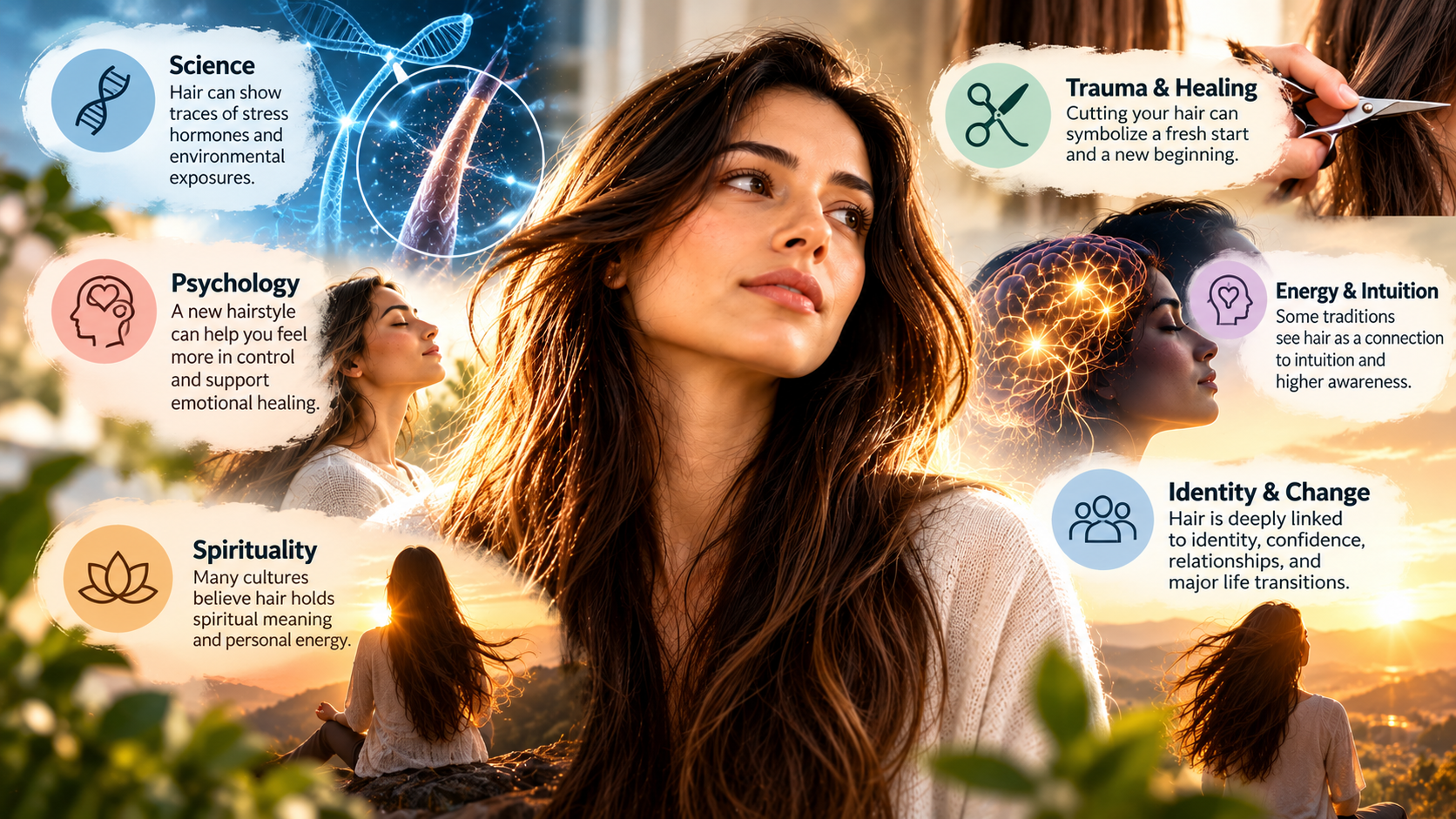
Hair has carried emotional, cultural, and spiritual significance for centuries. Scientifically, hair can preserve traces of certain biological markers and environmental exposures. For example, researchers can analyze hair cortisol to investigate patterns of stress hormone exposure over time. A scientific review of hair cortisol and stress explains how hair can help researchers investigate stress-related biological changes. However, hair does not store personal experiences or emotional memories like the brain does.
Beyond science, hair holds powerful symbolic meaning in many cultures. People associate their hair with identity, confidence, grief, relationships, and new beginnings. Major life events can also change how people feel about their appearance. According to the American Psychological Association’s overview of stress, stress can affect both mental and physical well-being, helping explain why emotional experiences may influence how people feel about themselves.
In this guide, we explore the relationship between hair, memory, psychology, and spirituality. You will discover whether cutting your hair can support emotional healing, how spiritual traditions interpret hair, and what the trending “3 hair rule” means. We will also examine possible reasons for Gen Z hair loss, religious perspectives on cutting hair, and why a new hairstyle can sometimes feel like a fresh start.

Does cutting your hair help with trauma?
Cutting your hair may support emotional healing for some people, although it is not a treatment for trauma. Hair itself does not physically store painful memories. However, its appearance can become associated with specific relationships, difficult experiences, or significant periods in life.
For example, someone who grew their hair during a challenging relationship might associate its length with that chapter. Choosing a new hairstyle can create a visible sense of change. This decision may help them feel more in control of their appearance and personal identity.
The psychological impact varies from person to person. Some people experience relief after cutting their hair, while others feel little emotional difference. A haircut can become a meaningful personal ritual, but it cannot automatically resolve deep emotional pain. Practices such as mindfulness and meditation may also help people manage stress and reconnect with themselves.
Reclaiming Control Through Somatic Agency
Personal appearance can become an important part of rebuilding confidence after a difficult experience. Trauma sometimes leaves people feeling powerless or disconnected from their choices. Making a deliberate decision about their hair can provide a small, tangible opportunity to exercise control.
This experience relates to personal agency, which means having the ability to make decisions about your own life and body. A haircut may symbolize a boundary between a painful chapter and a new beginning. However, the emotional impact depends on the individual’s circumstances and personal associations.
The term somatic relates to the body and bodily experiences. Although changing your hairstyle is not an established trauma treatment, it can form part of a personal self-care ritual. People recovering from trauma may also benefit from professional support, healthy relationships, and other evidence-based coping strategies.
Does hair hold energy spiritually?
Many spiritual traditions attach special significance to hair. Some people believe hair holds energy spiritually and connects the individual with intuition, personal power, or higher consciousness. These interpretations vary across cultures and religious practices.
For example, some practitioners of Kundalini yoga associate uncut hair with spiritual discipline and awareness. Certain Indigenous communities also maintain specific cultural teachings about hair, although beliefs differ widely between communities. These traditions should not be treated as one universal spiritual belief.
From a scientific perspective, there is no reliable evidence that hair stores spiritual energy or absorbs negative vibrations. Hair is primarily composed of keratin, a structural protein. However, spiritual practices involving hair can still carry personal, cultural, or emotional meaning.
For some people, washing, covering, or trimming their hair becomes a meaningful ritual. Such practices may provide comfort, encourage mindfulness, or reinforce a sense of identity.
Hair as an Intuitive Spiritual Antenna
In some spiritual belief systems, hair is described as an antenna that connects people with intuition, awareness, or the surrounding world. This is a symbolic interpretation rather than a scientifically established function of hair.
Hair does have physical properties that make it responsive to certain conditions. For example, static electricity can cause individual strands to stand up. Cold temperatures and strong emotions can also trigger changes in the skin and tiny muscles attached to hair follicles, producing goosebumps.
These physical reactions do not demonstrate that hair detects spiritual vibrations or protects an energy field. Nevertheless, people may find personal meaning in treating their hair with care and intention.
Mindful hair care can become a simple self-care practice. Taking time to wash, brush, or style your hair may help you slow down and reconnect with yourself. The benefits come from the experience and personal meaning of the ritual, rather than any proven supernatural property of hair.
What is the 3 hair rule?
The 3 hair rule is a beauty and styling concept that encourages people to coordinate three deliberate elements around their hair and face. It is often presented as an easy way to make an outfit look more polished without spending hours getting ready.
The exact definition can vary depending on the creator or trend. One interpretation involves combining a hairstyle with two complementary details, such as earrings and defined eyebrows. Another approach focuses on coordinating three visible elements, such as styled hair, accessories, and makeup.
For example, you could pair a sleek bun with small earrings and tinted lip balm. Alternatively, loose waves, simple jewelry, and well-groomed eyebrows can create a balanced everyday look.
The idea is to make your overall appearance feel intentional rather than overly complicated. However, the rule is not a scientific beauty principle or a strict fashion requirement. You can adapt it to your personal style, budget, and routine.
Ultimately, the best hairstyle is one that suits your features, feels comfortable, and reflects your preferences. You do not need three styling elements to look presentable or confident.
Why is Gen Z losing hair?
Hair thinning among younger adults can have several causes, but it is misleading to suggest that Gen Z is experiencing unprecedented hair loss without reliable comparative data. Many people wonder, does hair hold memories, when changes in their hair seem connected to stressful periods in life. Although hair does not store emotional memories, stress can affect the hair growth cycle.
Stress-related hair shedding is one possible cause. Significant physical or emotional stress can trigger a condition called telogen effluvium, in which more hair follicles than usual enter the shedding phase. This often becomes noticeable several months after the triggering event. Understanding how noise pollution impacts sleep can also help readers explore another factor that may affect overall well-being.
Nutrition also matters. Restrictive diets and inadequate intake of essential nutrients can contribute to hair loss. Iron deficiency, certain medical conditions, hormonal changes, and hereditary pattern hair loss are other possible causes. Managing everyday stress through music therapy may also support emotional well-being.
Daily hair practices can also play a role. Frequent high-heat styling, harsh chemical treatments, and tight hairstyles may damage hair or contribute to traction alopecia. However, vaping and poor sleep should not automatically be assumed to explain an individual’s hair loss.
If hair loss is sudden, persistent, patchy, or accompanied by scalp irritation, consult a healthcare professional or dermatologist. Identifying the underlying cause is more useful than relying on viral hair-growth trends or unverified remedies.
What did God say about cutting your hair?
Religious teachings about cutting hair differ across scriptures, traditions, and historical contexts. People exploring the question does hair hold memories may also wonder whether religious teachings connect hair with identity, devotion, or personal transformation. Biblical passages discuss hair in relation to religious vows, cultural identity, and appearance, but their meanings depend on their historical settings.
In the Old Testament, Numbers 6 describes the Nazirite vow. During this period of dedication, a person was instructed not to cut their hair. Samson is also associated with uncut hair in Judges 13–16, where his dedication plays an important role in his story.
Leviticus 19:27 contains instructions about trimming hair and beard edges within the religious and cultural practices of ancient Israel. Interpretations of this passage vary, particularly regarding its relevance to modern believers.
In the New Testament, 1 Corinthians 11:14–15 discusses hair length in the context of appearance and worship in the early Christian community. Paul’s words are interpreted differently across Christian traditions.
Therefore, the Bible does not provide one simple instruction that applies identically to every person and situation. If you follow a particular faith, consider its teachings, historical context, and guidance from trusted religious leaders.
Is it true that a girl’s life changes after a haircut?
A haircut can change how a woman feels about herself, but it does not automatically transform her life. The question does hair hold memories often arises when people associate a hairstyle with a relationship, a difficult experience, or a meaningful chapter in their lives. Although hair does not physically store personal memories, changing it can carry emotional significance.
For someone moving through a breakup, career transition, or difficult period, cutting their hair may symbolize a fresh start. Removing significant length creates a visible difference in appearance. That change may help them express a new identity or mark the end of an important chapter. For people navigating grief, creative tools for grieving students offer another way to express difficult emotions.
Haircuts can also affect everyday routines. A shorter style may require less washing and drying time, while another cut might need regular styling. These practical changes can influence how someone feels about their daily schedule and appearance.
However, a haircut alone cannot resolve relationship problems, heal trauma, or guarantee greater confidence. Meaningful personal changes usually involve decisions, habits, and actions beyond appearance.
If a new hairstyle helps you feel more comfortable or confident, it can be a useful form of self-expression. You do not need to make a dramatic change to move forward. Sometimes, the most important transformation comes from the meaning you give to a new beginning. Understanding does hair hold memories also means recognizing the difference between physical memory storage and the emotional meaning we attach to our appearance.
FREQUENTLY ASKED QUESTIONS
Can lab tests detect past health events from hair?
Yes, scientific testing reveals your biological history through hair strands. As hair grows, it absorbs chemicals, heavy metals, and hormones from your bloodstream. Scientists analyze hair segments to construct a chronological timeline of chronic stress, nutritional deficits, and toxin exposure over several past months or years.
How often should you trim hair to keep it healthy?
Most hair specialists recommend trimming hair every eight to twelve weeks to maintain structural health. Regular trims eliminate dry, split ends before cracks travel upward along the hair shaft. Consistent dusting keeps strands looking dense, prevents mechanical breakage, and preserves a clean, manageable shape.
Does cutting your hair make it grow back faster?
No, trimming your hair does not alter its biological growth rate. Hair growth originates beneath the scalp inside living follicles, while ends consist of non-living keratin. Trimming simply removes frayed, split edges, preventing breakage so your hair retains its natural length as it grows.
Why do people experience an urge to cut their hair during a crisis?
People crave haircuts during personal crises because hair offers immediate, visible control over an uncertain reality. When internal emotions feel overwhelming or unmanageable, altering your external appearance provides instant gratification. A quick salon visit establishes a tangible symbolic boundary between personal chaos and emotional renewal.
Conclusion
The human fascination with hair transcends simple vanity. While living hair shafts do not retain conscious memories, biological science demonstrates that each strand logs a factual chemical record of your past health and stress levels. Simultaneously, cultural traditions, sacred spiritual beliefs, and psychological insights remind us that our hair is deeply bound to personal identity. Whether you are using a sharp salon chop to process trauma, applying the practical 3 hair rule for effortless style, or exploring ancient covenants, hair remains an external mirror of our internal state.
When you find yourself asking does hair hold memories, listen closely to what your intuition is telling you. Your hair holds the milestones, transformations, and chapters you have walked through. If your current length carries the emotional weight of a past version of yourself that you have outgrown, do not hesitate to schedule a trim. Embrace the ritual of intentional grooming, nourish your scalp, and step forward into your next season refreshed.