
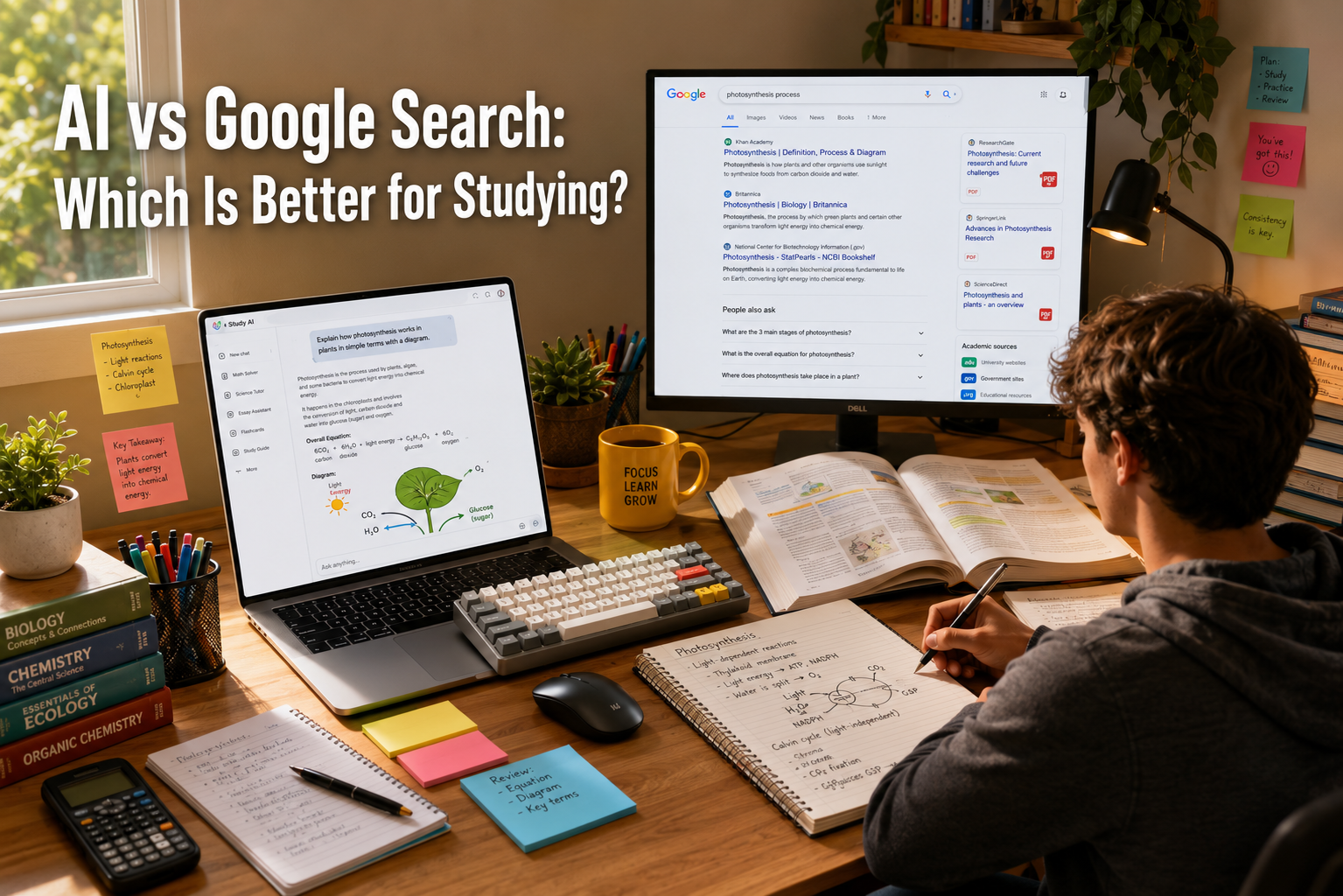
AI vs Google Search: Which Is Better for Studying?
The debate over AI vs Google Search for studying has completely transformed how students approach homework, research, and exam preparation. For decades, standard search engines served as the undisputed gateway to information, requiring users to sift through pages of links to find answers. However, modern generative platforms now offer instant, synthesized explanations tailored to individual needs. Navigating this shift requires understanding how these tools affect your learning efficiency and academic integrity. According to guidance on Google Search Central, the focus remains on finding helpful, high-quality information, whether created by humans or automation.
Choosing the right platform depends entirely on your immediate academic goal. While one tool excels at breaking down complex formulas, the other remains unmatched for finding primary research documents. This article explores the strengths, limitations, and practical applications of both methods to help you study smarter. We will also explain how both technologies process information so you can choose the best tool for your next big assignment. If you prefer listening to study notes instead of reading them, you can also explore our guide on AI voice generators without a subscription to make revision more convenient.
AI vs Google Search for Studying: The Main Differences
The fundamental difference lies in how these platforms retrieve and process data. Google operates as an indexer, pointing you toward existing live web pages. Conversely, artificial intelligence acts as a synthesizer, processing vast amounts of data to generate a cohesive response from scratch. This divergence fundamentally alters the user experience, changing you from a passive browser into an active conversationalist. When you search on a traditional platform, you must click multiple links, read through paragraphs of text, and compile the answers yourself.
Understanding this distinction changes how you approach assignments. When you use a search engine, you must evaluate multiple sources to verify accuracy. When you use an intelligent assistant, you receive a direct answer, but you must actively guard against potential misinformation or “hallucinations.” Traditional search engines respect the original context of the publisher, showing you exactly where the data lives. Artificial intelligence strips that context away to give you a clean, unified summary. Both methods possess clear advantages, but they require entirely different levels of critical thinking and source verification from the student.
Why AI Excels at Explaining Complex Concepts
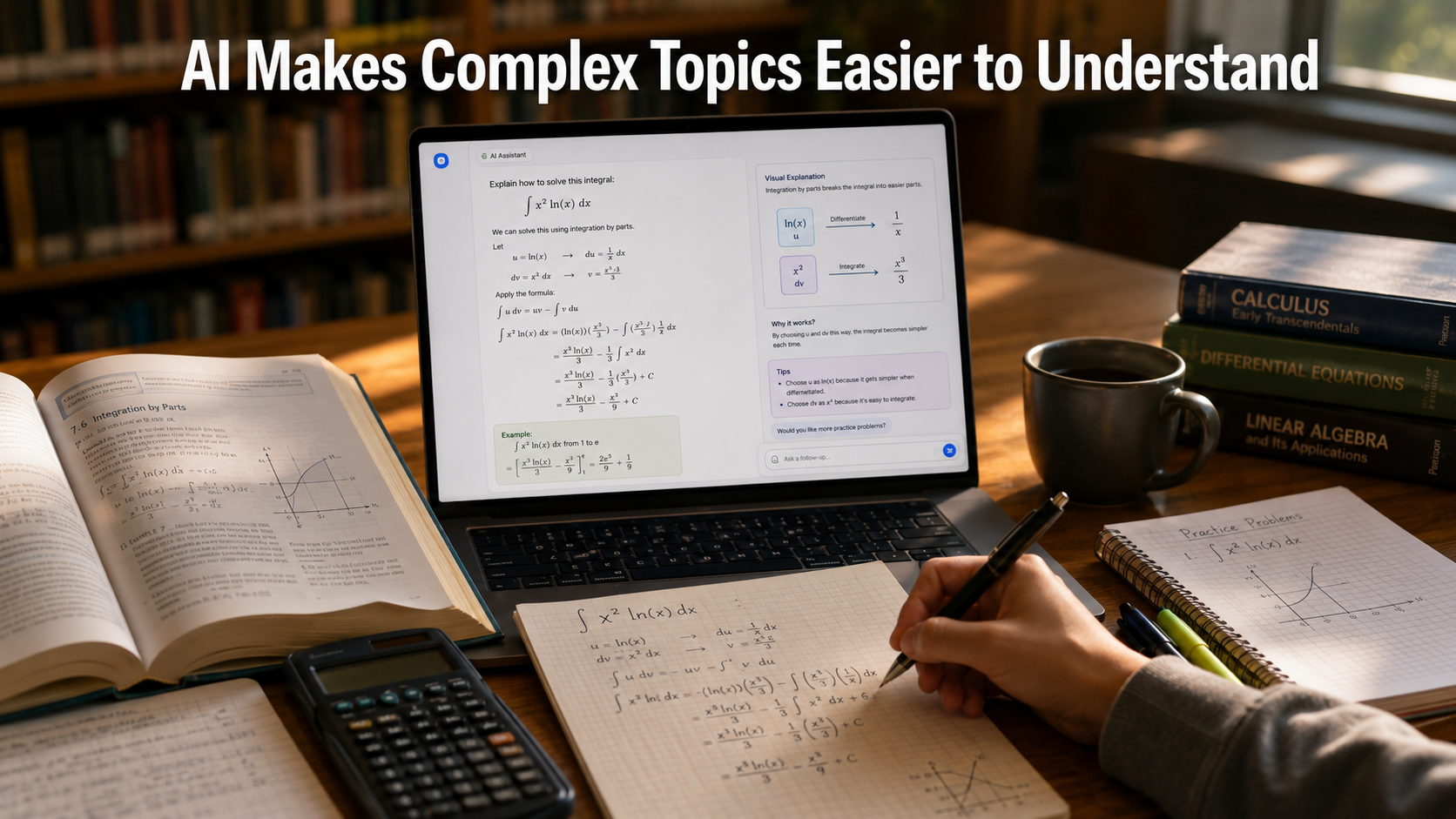
Artificial intelligence shines when you need to understand difficult, abstract topics. Instead of reading an entire academic paper, you can ask a tool to simplify the material. The technology acts as a personalized assistant that never runs out of patience, allowing you to ask the same question in ten different ways until you completely grasp the core concept. It eliminates the frustration of hitting paywalls or navigating cluttered, ad-heavy websites just to find a basic definition.
An intelligent assistant can adapt its explanation to your current learning level. If a textbook definition of quantum physics feels overwhelming, you can request an analogy suited for a high school student. This interactive, conversational dynamic mimics a private tutor, allowing you to ask follow-up questions until the concept clicks. You can easily paste a confusing paragraph from your syllabus and ask the machine to translate it into plain English, saving you hours of academic frustration.
For STEM subjects, generative models provide structured, sequential breakdowns of complex equations. They do not just give you the final answer; they detail the journey required to get there. For instance, computer science students can paste broken code blocks to find syntax errors instantly. Math students can view calculus workflows step by step, seeing exactly which algebraic rule applies to each line. This guided feedback helps you identify your mistakes, turning a simple homework session into an active, independent learning experience.
Where Google Search Remains Unmatched for Students
Despite the rapid growth of automation, traditional web search remains an essential asset for serious academic research. The open web holds billions of verified documents, real-time statistics, and primary sources that algorithms cannot reliably replicate from memory alone. When you need absolute factual certainty, historical accuracy, or official institutional data, standard indexing platforms remain the gold standard. They provide the necessary transparency that rigorous academic environments demand from researchers.
Traditional search connects you directly to the source code of global knowledge. If you need a specific government report, a historical archive, or real-time news data, search engines deliver the exact URL. This direct access ensures that you can cite your sources cleanly, which is a core requirement for university-level writing. It also allows you to discover niche forums, PDF datasets, and library catalogs that an artificial intelligence model might overlook or condense into a generic summary.
Because search engines display the exact website hosting the information, evaluating authority becomes straightforward. You can easily check if an article originates from a peer-reviewed journal or a personal blog. This transparency supports critical thinking, ensuring your study materials align with high academic standards. It forces you to look at author credentials, publication dates, and institutional backing. Ultimately, relying on verified search results protects your reputation and prevents you from building an entire research paper on automated fabrications.
How to Combine Both Tools for Maximum Study Efficiency
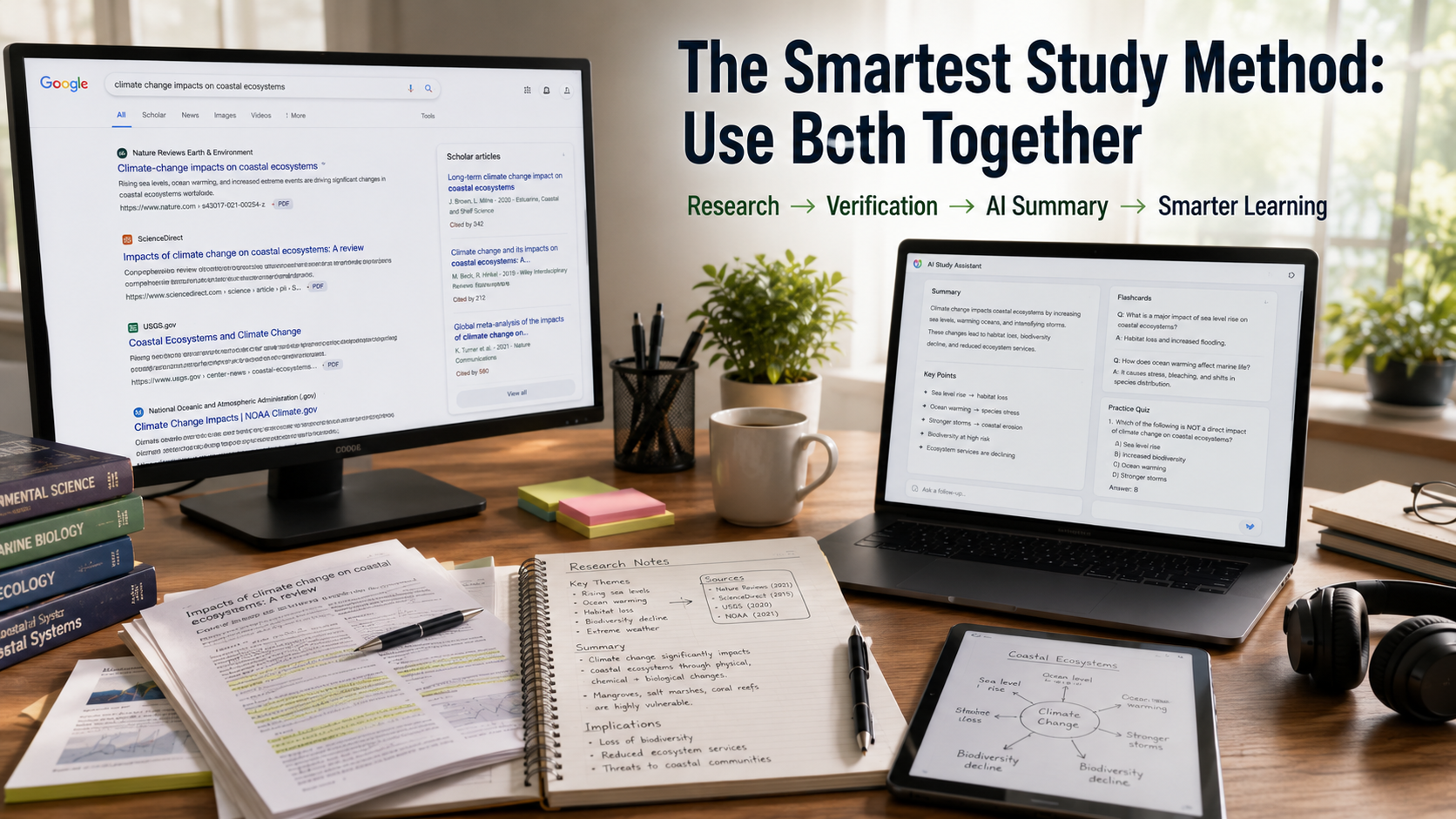
You do not have to choose just one platform. In fact, the most successful students use a hybrid strategy that leverages the unique strengths of both systems. By treating these technologies as complementary forces rather than direct rivals, you can build a highly optimized workflow. This balanced methodology allows you to maintain extreme academic accuracy while significantly reducing the time you spend reading, formatting, and organizing your study materials.
Start your assignment by using traditional search engines to gather high-quality sources, PDF studies, and data points. This ensures your foundation rests on verifiable, peer-reviewed facts. Once you compile your reading list, use an intelligent assistant to summarize long paragraphs, extract key themes, or generate flashcards for active recall. You can feed the verified search results directly into the generative model, asking it to quiz you on the specific data you discovered.
This hybrid approach protects the accuracy of your data while drastically accelerating your overall reading speed. For example, you can find a complex economic report via a standard search engine, then use an automation tool to break down the key financial metrics. By letting the search engine handle discovery and the intelligent tool handle synthesis, you protect yourself from misinformation while maximizing your productivity. It represents the ultimate modern blueprint for academic success.
FAQ Section
Is AI Better Than Google for Exam Preparation?
AI is generally better for active exam preparation. It can generate interactive practice quizzes, create custom flashcards, and simulate real testing conditions using your lecture notes. It also helps you test your memory through active recall. This learning method is scientifically proven to improve long-term retention. By turning static bullet points into multiple-choice questions, AI becomes a personalized study partner that adapts to your pace.
Google is better when you need official past exam papers, answer keys, or syllabus guidelines. It helps you find the exact materials published by your school or examination board. AI, on the other hand, helps you understand and practice that material. For example, you can use Google to find a past chemistry paper. Then, you can ask AI to explain why option C is correct, step by step. Using both tools together provides a more complete exam preparation strategy.
Can Using AI for Studying Cause Academic Dishonesty?
Yes, using AI can lead to academic dishonesty if you copy generated text and submit it as your own. Most schools and universities consider uncredited AI-generated content to be plagiarism. It does not reflect your own critical thinking, research, or writing skills. Academic integrity policies require that your work represents your own learning. Using AI to write an entire assignment bypasses that process. As a result, many institutions now use AI-detection tools.
Use AI ethically by treating it as a brainstorming partner or study assistant. It can explain difficult concepts, create essay outlines, and proofread your drafts. However, you should write your final essays, code, and lab reports yourself. Doing so helps you maintain academic integrity and avoid penalties such as failing a course or facing suspension.
Why Does AI Sometimes Give Incorrect Information When Studying?
AI systems do not actually know real-world facts. They predict the most likely sequence of words based on patterns in their training data. This design can produce “hallucinations.” These are responses that sound convincing but contain false information, incorrect dates, or made-up facts. AI models also write with confidence, even when they are wrong. This can mislead students who do not verify the information.
Always check important facts before using them in assignments or exams. Verify formulas, historical dates, and key concepts with trusted sources. Compare AI responses with your textbook or reliable educational websites. Never rely on AI alone for high-stakes academic work.
Which tool is better for finding academic papers?
Google, specifically Google Scholar, remains vastly superior for locating peer-reviewed academic papers, established journals, and official legal documents. It provides direct, unfiltered access to live institutional databases, original publisher links, and comprehensive citation counts. These metrics are absolutely essential for verifying a paper’s academic impact and tracing the chronological history of a specific scientific or historical debate.
While modern AI assistants can sometimes search the web or summarize uploaded PDFs, they frequently invent fake sources, hallucinate URLs, or misattribute authors, making them entirely unreliable for foundational source gathering. Serious academic research requires transparent tracking, stable bibliographies, and verified index links that only a dedicated academic search engine can provide. Using Google ensures that your literature review is built on legitimate, traceable scholarship, allowing you to cite real authors and defend your research paper’s bibliography under strict academic scrutiny.
Does Google Search Use AI to Help Students?
Yes. Modern search engines use AI to improve search results for students. In the debate over <strong>AI vs Google for studying, Google now combines both technologies. Features like AI Overviews summarize complex topics at the top of the results page. They also provide links to trusted sources for further reading. This gives students a quick overview and access to reliable information.
<p>The comparison of AI vs Google for studying is becoming less clear because Google now includes AI-powered features. Students can read a summary and then explore the original sources. This saves time while supporting fact-checking. When comparing AI vs Google for studying, Google offers both AI-generated explanations and traditional search results. As AI vs Google for studying continues to evolve, students benefit from using both approaches together. Overall, AI vs Google for studying is no longer about choosing one tool over the other. It is about using each tool for its strengths.
Conclusion
When evaluating AI vs Google Search for studying, the ideal solution is integration rather than exclusion. Artificial intelligence functions beautifully as a flexible, patient tutor that can simplify dense textbook jargon, format complex code, and build customized practice tests on demand. It streamlines your cognitive load, transforming overwhelming amounts of text into actionable, conversational insights that match your unique learning speed. By handling the heavy lifting of summarization and interactive testing, it makes study sessions far more dynamic and engaging than traditional reading.
Meanwhile, traditional web search serves as your anchor for factual accuracy, providing direct access to primary academic journals, live data, and verifiable citations. It ensures your academic foundation remains securely rooted in real-world evidence, keeping you safe from algorithmic errors and plagiarism concerns. Search engines preserve the critical human element of research, linking you directly to the experts, institutions, and peer-reviewed studies that drive global education forward.
By utilizing search engines to discover your core facts and intelligent tools to process them, you can build a highly efficient, reliable study routine. This dual approach saves time without sacrificing depth, allowing you to master complex subjects quickly while ensuring every claim in your homework is backed by genuine authority. Ultimately, the future of studying belongs to students who know how to navigate both technologies responsibly.