
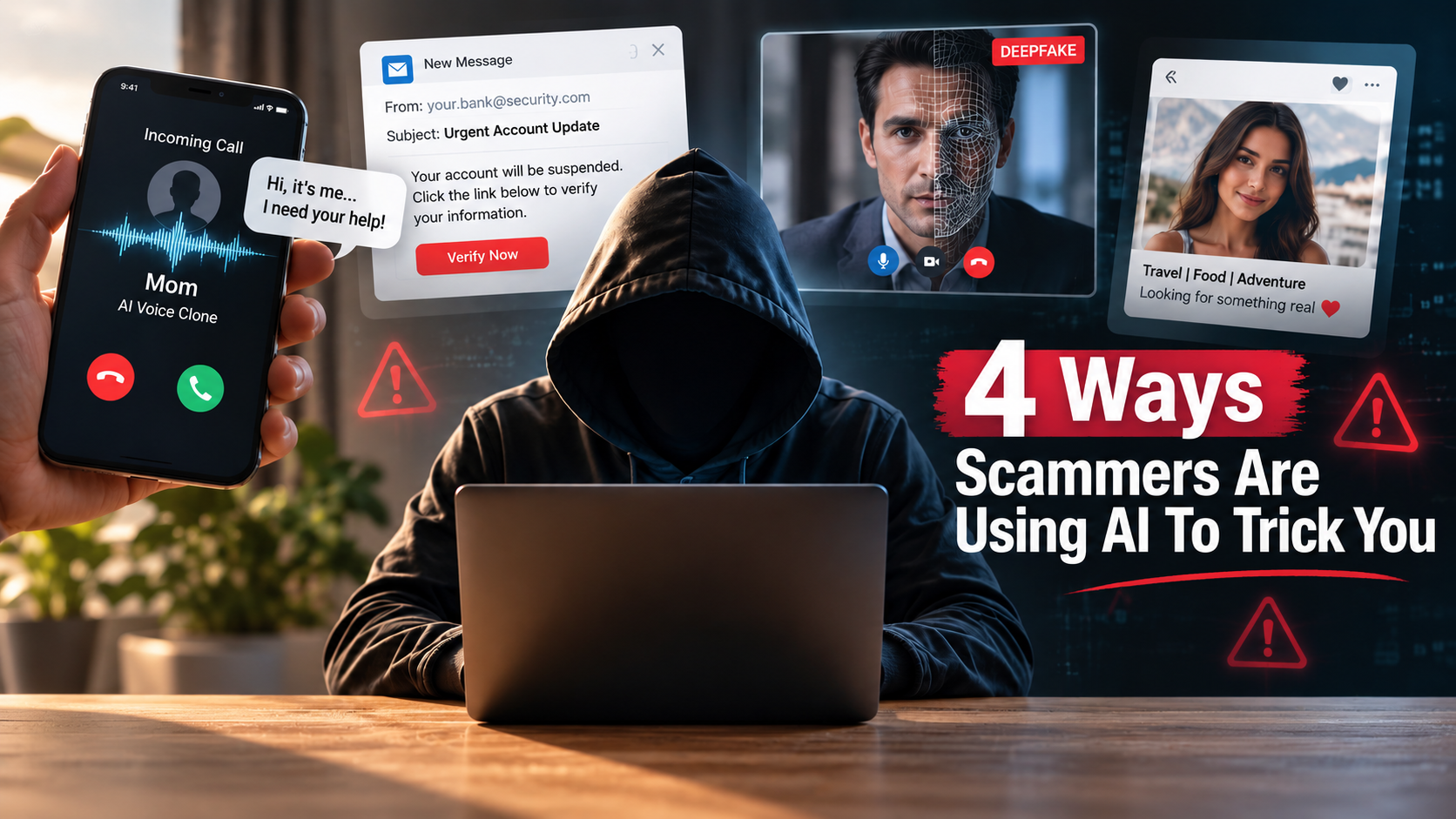
4 Ways Scammers Are Using AI to Trick You
Modern cybercriminals are becoming harder to spot because scammers are using AI to create convincing and highly personalized fraud. They use artificial intelligence to produce realistic emails, clone voices, generate deepfake videos, and create fake online personas. These AI scams can appear through phone calls, social media, emails, dating platforms, and business communications.
The Federal Trade Commission has warned consumers about scams involving artificial intelligence and impersonation. Generative AI allows criminals to create personalized deceptive content faster and at lower cost.
Understanding these threats can help protect your identity, money, and family. AI voice cloning, deepfake video, automated phishing, and personalized scams can make traditional warning signs harder to recognize.
This guide explains how scammers use AI to manipulate victims. You will learn how AI scams work, how criminals can clone voices, and how automated tools improve traditional fraud. You will also learn safer ways to handle suspicious calls and messages.
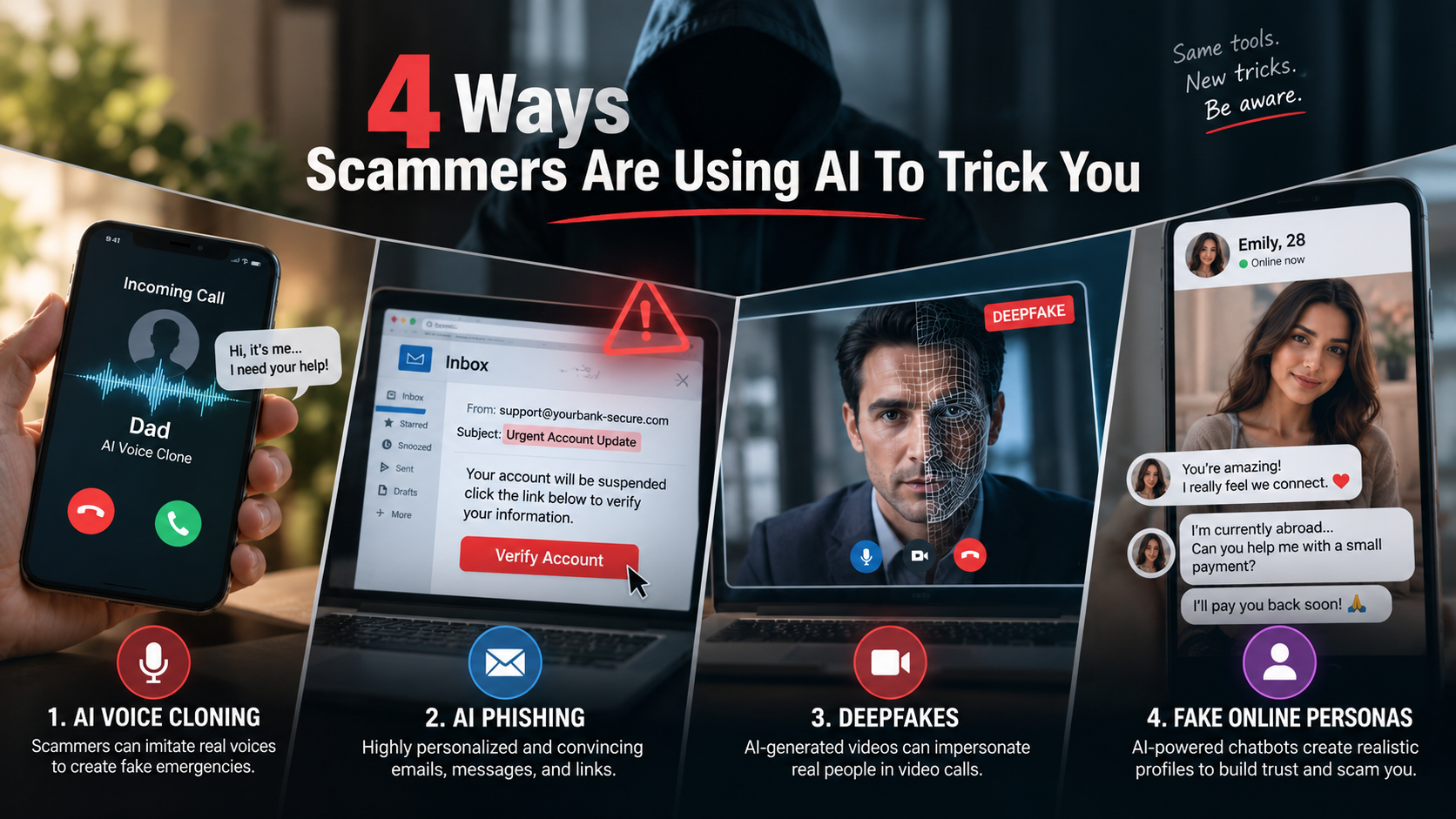
1. AI Voice Cloning and Audio Tricks
AI voice cloning allows scammers to imitate the voice of a real person. They may collect short audio clips from social media, public videos, podcasts, voicemail recordings, or other online sources. Modern systems can generate increasingly realistic speech from relatively small audio samples, although the amount required varies by tool and recording quality.
The scammer can then use the generated voice during a phone call. They may pretend to be a family member facing an emergency or a trusted professional handling a financial transaction. A fake emergency might involve an arrest, accident, kidnapping, or urgent medical situation.
These scams work because hearing a familiar voice can create a strong sense of trust. Criminals then add urgency and pressure to prevent careful verification.
Protect yourself by:
- Calling the person directly using a trusted number.
- Creating a private family safe word or verification phrase.
- Avoiding immediate money transfers during unexpected emergencies.
- Treating voice recognition as only one part of identity verification.
A familiar voice should never be the only reason you trust an urgent request.
2. Sophisticated and Flawless AI Phishing
AI has made phishing scams easier to personalize and scale. Older phishing emails often contained obvious clues, such as spelling mistakes, poor formatting, generic greetings, or unusual wording. Generative AI can help criminals produce polished messages that look much more professional. For a deeper look at this evolving threat, see how AI phishing attacks are becoming more dangerous.
Scammers can also combine AI with publicly available information. They may use details about your location, workplace, interests, professional relationships, or recent activities. AI can then turn those details into personalized messages that appear relevant to your situation.
A fraudulent message might imitate a colleague, financial institution, company executive, or government agency. The message may ask you to open a link, download an attachment, provide credentials, or approve a payment.
Be cautious when a message creates unexpected urgency. Pay particular attention to:
- Payment or bank-account changes
- Unexpected password-reset requests
- Requests for confidential documents
- Suspicious links or attachments
- Unusual requests from familiar contacts
Instead of replying directly, verify the request through a separate trusted channel. Perfect grammar does not prove that a message is legitimate.
3. Deepfakes and Real-Time Face Swaps
Deepfake scams use manipulated or AI-generated audio and video to impersonate real people. Unlike traditional text-based scams, these attacks can make victims believe they are seeing and hearing a trusted person. Understanding how deepfake technology works and how it can be detected can make these impersonation attempts easier to evaluate.
Scammers may create fake videos featuring celebrities, executives, public figures, or other recognizable individuals. They can use these videos to promote fraudulent investments, products, or financial opportunities. Some criminals can also use real-time face manipulation during video calls.
Businesses face another risk through business email compromise (BEC) and related impersonation attacks. A criminal may attempt to imitate an executive or business partner during a virtual meeting. The goal may be to persuade an employee to transfer money or change payment instructions.
Do not assume a video call proves someone’s identity. Watch for unusual requests and verify important instructions independently.
For high-risk transactions:
- Confirm the request through another communication channel.
- Contact the person using a known phone number.
- Follow established financial approval procedures.
- Never bypass normal verification because someone appears familiar on video.
AI-generated video can look convincing, so independent verification remains essential.
4. AI-Powered Chatbots and Fake Personas
Generative AI can help scammers create convincing fake online personas at a much larger scale. Instead of manually building one fictional identity, criminals can use AI to generate professional biographies, profile descriptions, images, messages, and other supporting content.
These fake identities may appear on dating platforms, social networks, marketplaces, or professional websites. Scammers can combine them with AI chatbots that maintain natural conversations over long periods. This makes it increasingly important to develop strong digital literacy skills when evaluating online identities and conversations.
Romance scams are one potential use. A criminal may create a believable profile and build trust before eventually requesting money. Similar techniques can appear in fake buyer or seller transactions, where the victim is pushed toward an unusual payment method or rushed through normal checks.
AI-generated conversation can make the scam feel personal. However, a natural conversation does not prove that the person is genuine.
Watch for:
- Requests to move conversations quickly to another platform.
- Reluctance to meet or verify identity.
- Unusual payment requests.
- Investment opportunities promising unrealistic returns.
- Profiles with inconsistent personal information.
Before sending money or sensitive information, verify the person’s identity independently. Take extra care when an online relationship develops unusually quickly.
How Do You Trick a Scammer Safely?
Trying to trick a scammer can feel satisfying, but engaging with them carries unnecessary risks. The safer goal is to protect yourself, verify the claim, and end the interaction. You do not need to waste the scammer’s time or prove that you recognized the fraud.
If you receive a suspicious call, avoid sharing personal information. Do not confirm your name, address, account details, passwords, or security codes. Instead, ask who is calling and why they need the information. You can then end the call and follow these steps if you click a suspicious link before contacting the organization independently.
How Do People Get Tricked by AI?
People can fall for AI scams because artificial intelligence makes deceptive content more convincing and easier to personalize. Generative AI can produce realistic emails, messages, images, audio, and video in seconds. Learning how to spot fake news and misinformation online can also help people question suspicious digital content before trusting or sharing it.
Traditional scams often contained obvious warning signs. Messages might have poor grammar, generic greetings, or unusual wording. AI tools can reduce those signs by producing polished content that resembles normal communication.
Scammers can also use publicly available information to create convincing stories. They may reference your workplace, relatives, interests, recent activities, or professional relationships. This creates a sense of familiarity that makes the request seem genuine.
How Is AI Perfecting Scamming Techniques?
AI is helping criminals make traditional scams more personalized. Instead of sending the same message to thousands of people, scammers can create different messages for specific targets.
Criminals may gather information from public social media profiles, company websites, professional directories, and other accessible sources. AI can then help organize that information and generate a message that appears relevant to the target.
For example, a fraudulent email might mention a real workplace project or imitate the communication style of a manager. The message may then request an urgent payment or sensitive information.
How Can Scammers Use My Voice?
Scammers can use AI voice cloning to create speech that resembles another person’s voice. They may obtain audio from public videos, social media posts, podcasts, voicemail recordings, or other sources.
Modern voice-generation systems can produce increasingly realistic speech from relatively small audio samples. However, the amount of audio required varies by technology and recording quality. A claim that every system needs only three to five seconds is too broad.
Once a voice model has been created, criminals may generate phrases that sound like the targeted person. They can then use the audio during phone calls or other communications.
What Should You Never Say to a Scammer?
There is a common warning that you should never say “yes” during an unfamiliar call. However, simply saying the word “yes” is not generally enough to authorize a transaction or create a valid contract. The larger risk is sharing information or confirming details that criminals can use.
Scammers may ask questions designed to collect personal information. They might request your full name, account number, password, one-time code, or other identifying details. Using two-factor authentication can add another layer of protection if a password is exposed.
Avoid providing information simply because the caller sounds convincing. Caller ID can also be spoofed, so the displayed number is not reliable proof of identity.