
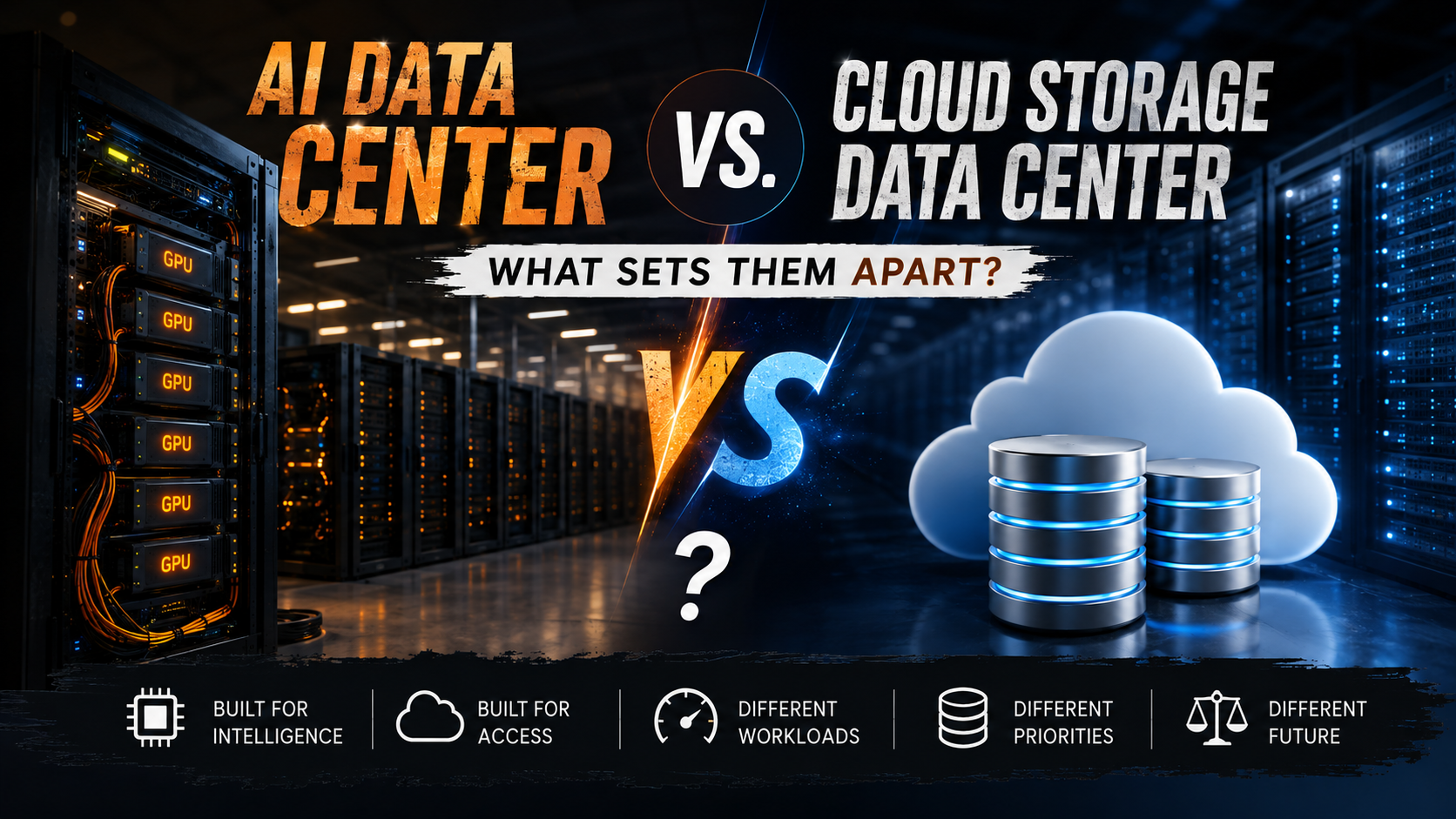
AI Data Center Vs. Cloud Storage Data Center: What Sets Them Apart?
The rapid growth of modern computing has brought the AI data center vs cloud storage data center comparison into focus. Both support digital services, but they serve different infrastructure needs.
Cloud environments support storage, applications, virtualization, and general-purpose workloads. AI data centers focus on intensive computing tasks, including model training and inference.
Understanding these differences can help businesses choose the right infrastructure. It can also clarify how cloud services, physical data centers, and AI workloads connect.
According to the NVIDIA , modern hardware architectures are fundamentally reshaping how heavy workloads are processed globally. Whether you are scaling an enterprise application or managing massive datasets, knowing your underlying infrastructure is vital
This guide explains the key differences between AI data centers and cloud-oriented infrastructure. It also answers common questions about data center types, AI workloads, and cloud storage.

Are Cloud Data Centers the Same as AI Data Centers?
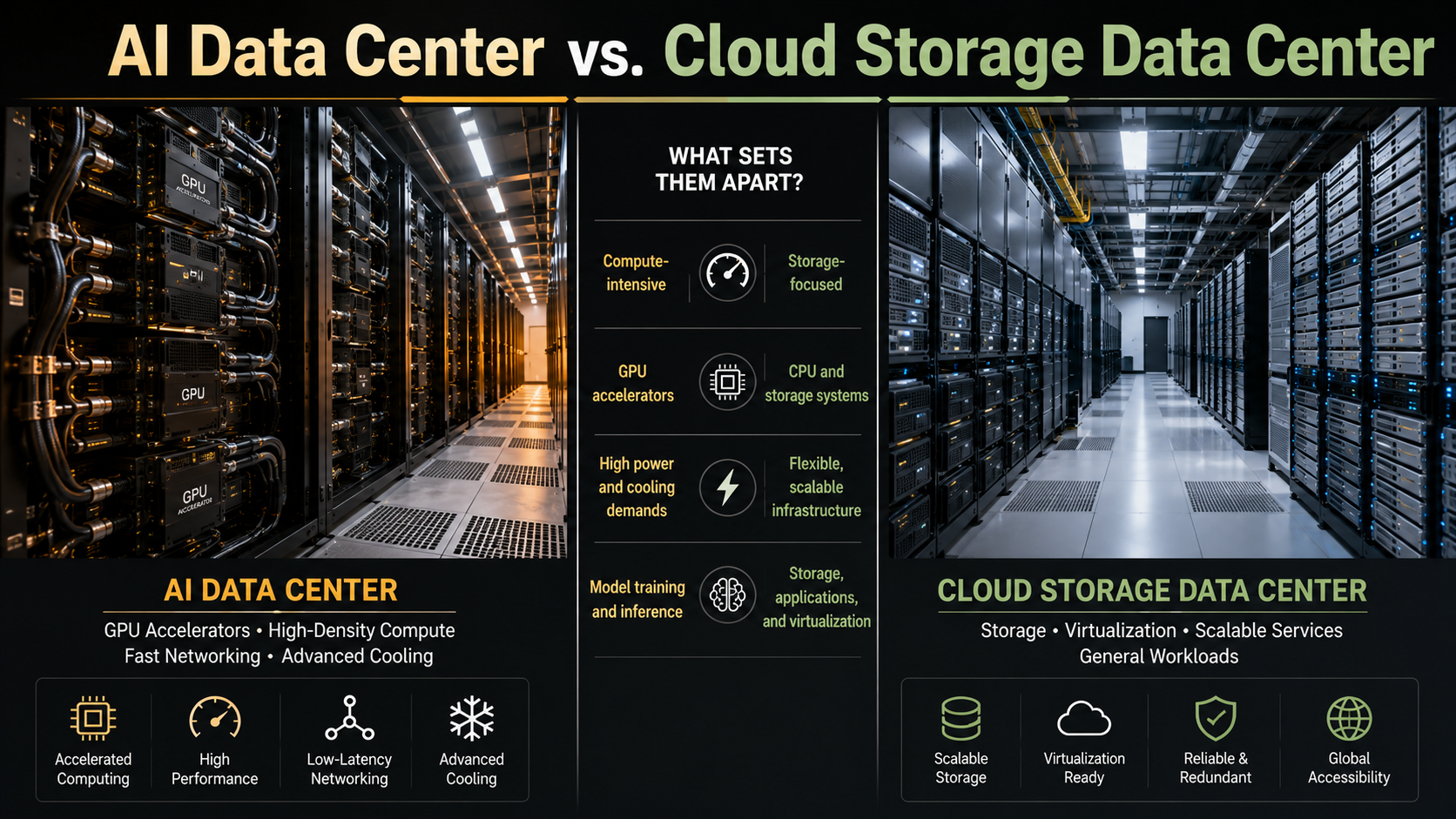
Cloud data centers and AI data centers can share the same physical facility. However, their workloads, hardware, and infrastructure priorities can differ significantly. A general-purpose cloud data center supports many workloads, including storage, web hosting, databases, virtualization, and enterprise applications.
An AI-focused data center is designed around demanding workloads such as model training, fine-tuning, and inference. These workloads often require large clusters of GPUs or other accelerators. They also depend on fast networking to move data efficiently between processors.
The main differences include:
- Cloud data centers: Support broad, mixed workloads and scalable virtual services.
- AI data centers: Prioritize high-performance computing and accelerated processing.
- Cloud infrastructure: Emphasizes flexibility, availability, and resource sharing.
- AI infrastructure: Emphasizes compute density, bandwidth, power delivery, and cooling.
Some hyperscale cloud providers operate AI-optimized facilities within their broader cloud infrastructure. Therefore, AI and cloud data centers are not always completely separate environments.
Specialized Hardware Requirements
The biggest hardware difference involves the type and density of processors used. Traditional cloud workloads can rely heavily on CPUs, while AI workloads often use GPUs, AI accelerators, and specialized networking equipment, including processors designed specifically for AI and high-performance computing such as Intel Core Ultra processors.
AI model training can require thousands of processors working together. These systems generate substantial heat and require efficient power delivery and cooling. High-speed interconnects also help processors exchange data with minimal delay.
Modern AI facilities may use liquid cooling because some accelerator systems produce far more heat than conventional server configurations. Air cooling vs. liquid cooling therefore becomes a major design consideration for high-density computing environments.
General-purpose cloud facilities still require robust cooling. However, their workloads may be more diverse, which can produce different power and thermal profiles.
The key distinction is not simply the building itself. It is the infrastructure optimized for the workload. AI data centers prioritize accelerated computing, high bandwidth, and thermal management, while hardware-rooted AI architecture can also influence how AI capabilities are implemented and secured. Cloud facilities prioritize flexible resource allocation across many applications and customers.
What Is the Difference Between Cloud Storage and Data Centers?
Cloud storage is a service, while a data center is a physical infrastructure environment. This distinction is important when comparing cloud storage with data centers.
Cloud storage lets users save and retrieve files through the internet. Providers manage the underlying servers, storage systems, networking equipment, security controls, and physical facilities.
A data center is the physical location where computing and storage equipment operates. It may contain servers, storage arrays, networking switches, power systems, cooling equipment, and backup generators.
Cloud storage can therefore operate on infrastructure distributed across multiple data centers. Users do not normally need to know where individual storage devices are located.
Cloud storage typically provides benefits such as:
- Remote accessibility from supported devices and applications.
- Scalability without purchasing physical storage equipment.
- Redundancy through replicated infrastructure.
- Managed maintenance handled by the service provider.
The relationship is straightforward. Data centers provide the physical foundation, while cloud storage provides an accessible service layer. This separation allows organizations to use large-scale infrastructure without directly operating the underlying hardware.
Physical vs. Virtual Infrastructure
Physical data centers contain tangible equipment such as server racks, cables, power distribution units, storage systems, and cooling equipment. These components form the foundation of digital services.
Cloud storage sits above this physical layer. Virtualization, software-defined storage, automation, and networking abstractions allow users to access resources without managing individual machines.
This abstraction makes cloud services easier to scale. Organizations can increase storage capacity without installing new drives or maintaining additional servers themselves.
However, cloud storage does not eliminate physical infrastructure. Every cloud service ultimately depends on physical computing, networking, and storage systems.
The distinction can be summarized simply:
Physical infrastructure: Provides the hardware, power, cooling, and connectivity needed to operate digital services.
Cloud storage: Provides software-based access to storage resources through a service model.
Understanding this relationship helps explain why cloud storage and data centers should not be treated as competing concepts. Cloud storage is built on top of physical infrastructure, including traditional, hyperscale, and increasingly AI-optimized data centers.
What Are the Two Types of AI Data Centers?
AI data centers can be broadly discussed in terms of training infrastructure and inference infrastructure. These environments support different stages of the artificial intelligence lifecycle.
Training infrastructure is designed to build and improve machine learning models. It processes enormous datasets while running computationally intensive algorithms. Training clusters often require large numbers of accelerators, high-speed networking, and substantial power capacity.
Inference infrastructure serves trained models to applications and end users. It focuses on running predictions or generating responses quickly and reliably. Depending on the application, inference systems may prioritize low latency, high throughput, or efficient resource utilization.
The two environments can therefore have different design priorities:
- Training: Maximum computing performance and large-scale parallel processing.
- Inference: Low latency, consistent availability, and efficient response times.
- Training clusters: Often handle intensive workloads for extended periods.
- Inference clusters: May operate continuously to serve production demand.
Both rely on specialized infrastructure. However, their requirements depend heavily on model size, workload patterns, application needs, and deployment scale.
Training Versus Inference Demands
AI training requires substantial computational resources because models repeatedly process large datasets during development. Training can involve thousands of accelerators operating together for extended periods.
High-speed interconnects are especially important. Processors need to exchange model and dataset information quickly. Slow communication can reduce overall cluster efficiency.
Inference has a different objective. Instead of improving the model, the system uses an existing model to produce predictions or responses.
Inference workloads may serve millions of requests. This makes latency, throughput, availability, and cost efficiency important considerations, particularly as AI agents increasingly rely on scalable infrastructure to process data and deliver results.
The difference can be summarized as follows:
Training: Builds or improves an AI model through repeated computation.
Inference: Uses an existing model to generate predictions, classifications, or responses.
Training environments often prioritize maximum sustained performance. Inference environments may prioritize fast response times and efficient scaling.
Neither approach is universally more demanding. Requirements vary based on model size, request volume, hardware, and application design. Large-scale AI operations may use separate infrastructure for training and inference. Others may run both workloads within shared facilities using different clusters.
What Are the Four Main Types of Data Centers?
Data centers are commonly classified by ownership, operating model, and intended use. Four widely discussed categories are enterprise, colocation, managed services, and hyperscale data centers.
Enterprise data centers are owned or operated for a specific organization. They typically support internal applications, databases, storage, and business operations.
Colocation data centers provide shared physical facilities for multiple customers. Organizations can rent space, power, cooling, and connectivity without building their own facilities.
Managed services data centers provide infrastructure and operational support through a third-party provider. The provider may manage servers, networking, security, maintenance, or other services.
Hyperscale data centers operate at enormous scale. Major technology companies use them to support cloud platforms, online services, storage, and increasingly intensive AI workloads.
These categories can overlap in practice. For example, a hyperscale provider may operate facilities that support both cloud services and AI workloads.
The classification helps explain who operates the infrastructure and how resources are delivered. It does not necessarily determine which workloads a facility can support.
Hyperscale Infrastructure Growth
Hyperscale data centers have become increasingly important as digital services expand. Their large scale allows operators to distribute computing, storage, and networking resources across massive infrastructure environments.
Major cloud providers, including Amazon Web Services, Microsoft Azure, and Google Cloud, operate extensive hyperscale infrastructure. These platforms support enterprise applications, consumer services, databases, analytics, storage, and artificial intelligence.
Hyperscale facilities can provide several advantages:
- Large-scale computing capacity for global workloads.
- Resource efficiency through centralized infrastructure.
- Geographic distribution for availability and latency management.
- Flexible scaling as demand changes.
- Specialized infrastructure for advanced workloads such as AI.
AI growth is also changing hyperscale facility design. High-density accelerator clusters require greater power capacity, faster networking, and more advanced cooling, making air cooling and liquid cooling important considerations for modern high-performance infrastructure.
As demand increases, operators are investing in new facilities and infrastructure upgrades. Energy efficiency is also becoming a major consideration because large data centers can consume significant amounts of electricity.
The result is a data center landscape that increasingly combines traditional cloud services with specialized AI computing capabilities.
What Are the Big 3 Data Centers?
The “Big 3” commonly refers to the three leading public cloud providers. They operate massive global networks of data centers and cloud infrastructure rather than being three individual data centers.
The three major providers are:
- Amazon Web Services (AWS) – Offers a wide range of cloud computing, storage, networking, database, and AI services.
- Microsoft Azure – Provides extensive enterprise cloud services and integrates closely with Microsoft’s software and business ecosystem.
- Google Cloud – Provides cloud computing, data analytics, storage, and advanced machine learning services.
Together, these providers operate infrastructure at a global scale. In addition, they continue investing in AI accelerators, high-speed networking, specialized computing systems, and advanced cooling technologies.
Therefore, it is more accurate to call them major hyperscale cloud providers rather than “the three biggest data centers.” Ultimately, their infrastructure supports both traditional cloud workloads and increasingly demanding AI applications.
Frequently Asked Questions
What makes AI data centers consume so much power?
AI data centers use substantial power because they run many specialized processors at high intensity. As a result, these processors generate significant heat, requiring advanced cooling systems.
Can a traditional data center be upgraded for AI workloads?
Yes, but upgrades can be challenging. For example, facilities may need more electrical capacity, higher-density racks, and advanced cooling systems to support modern AI hardware.
How does cloud storage ensure data security?
Cloud providers use encryption, authentication, access controls, and redundancy. In addition, data is commonly protected both during transmission and while stored.
What is the future outlook for data center growth?
AI and cloud demand continue to drive data center expansion. Meanwhile, operators are adopting efficient cooling, renewable energy, and improved power management to support sustainable growth.
Conclusion
The AI data center vs cloud storage data center comparison highlights two important layers of modern digital infrastructure. Cloud storage provides scalable access to data, while AI data centers support demanding artificial intelligence workloads.
In contrast, traditional cloud infrastructure handles diverse applications, storage, virtualization, and enterprise services. AI-focused facilities emphasize accelerated computing, high-speed networking, power capacity, and advanced cooling.
However, the distinction is not always absolute. Major hyperscale cloud providers increasingly operate infrastructure that supports both general cloud workloads and AI computing.
As a result, organizations must consider their computing, storage, networking, power, and cooling requirements when planning future infrastructure.
Ultimately, the right infrastructure provides a reliable foundation for scalable cloud services and AI deployment.