
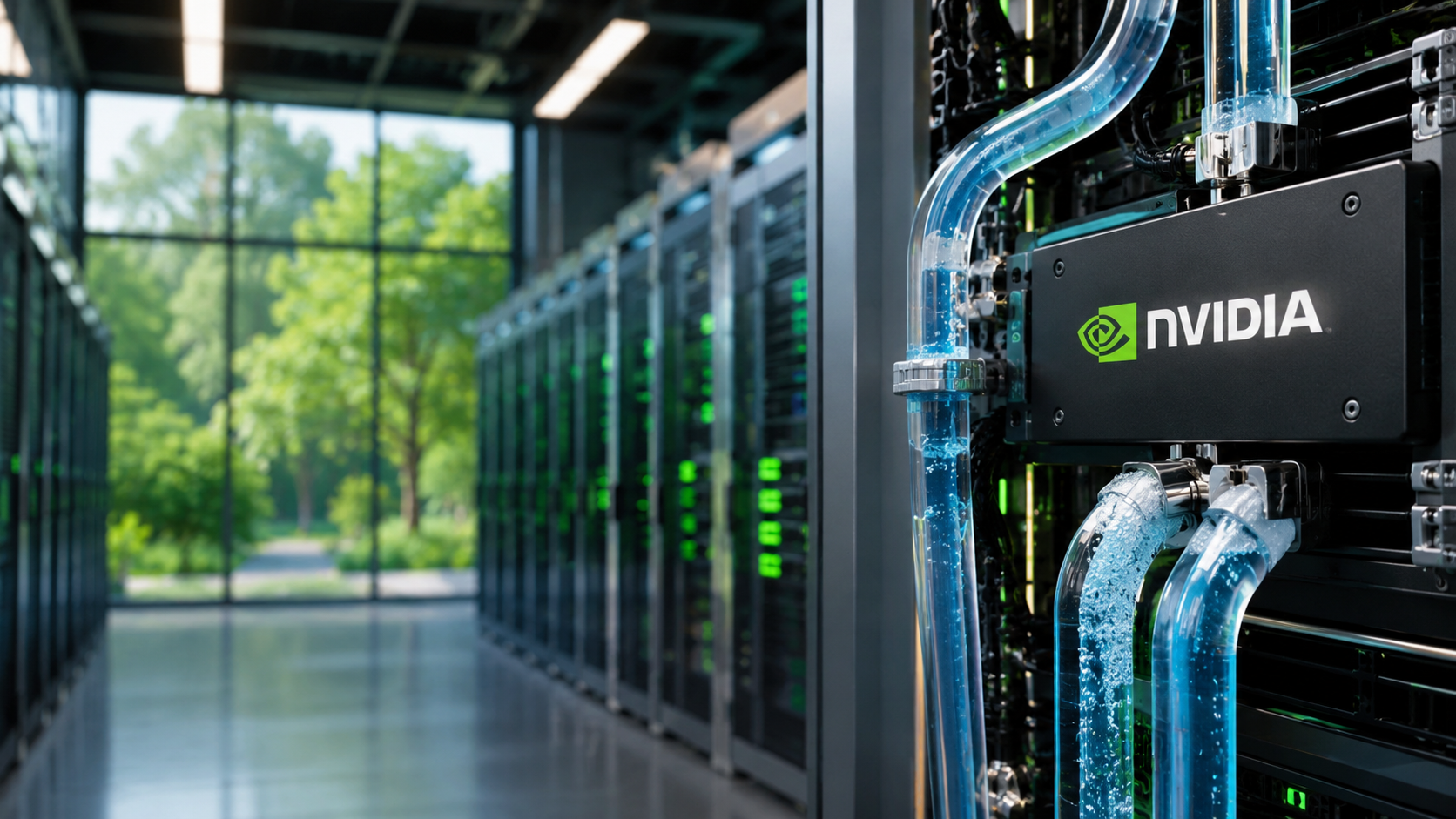
Does Nvidia’s Liquid Cooling Make Data Centers Use Less Water?
Nvidia liquid cooling water use is becoming an important topic as artificial intelligence drives demand for powerful data centers. Training advanced AI models requires enormous computing power and generates significant heat. Modern server racks need efficient cooling systems to maintain safe operating temperatures. This has raised questions about water consumption, energy efficiency, and the environmental impact of AI infrastructure.
High-density computing systems need advanced thermal management. Traditional cooling methods often rely on evaporation and continuous water replenishment. However, newer technologies are changing how facilities manage server temperatures. Direct-to-chip liquid cooling is becoming increasingly important for high-performance computing.
Understanding Nvidia liquid cooling water use helps explain whether modern AI infrastructure can reduce water consumption. Nvidia’s Blackwell architecture supports advanced cooling configurations for demanding computing workloads. These systems capture heat closer to the processors and improve thermal management.
However, liquid cooling does not automatically eliminate water consumption. The final cooling method determines how much water a facility needs. This guide explores direct-to-chip cooling, closed-loop systems, dry coolers, and AI data center water consumption.
Do Data Centers Actually Use Water for Cooling?
Yes, many conventional data centers consume significant amounts of water. However, consumption varies depending on their cooling infrastructure, location, and operating conditions. To understand the infrastructure behind these facilities, explore what a data center does and how its components work. Traditional facilities often use cooling towers alongside chillers and computer room air handlers. These systems remove heat generated by servers and other electrical equipment.
Cooling towers release heat through evaporation. As warm water circulates through the tower, some evaporates into the atmosphere. The remaining water returns to the cooling system. Operators must continuously replenish the evaporated water to maintain performance.
This process provides effective heat rejection, particularly in warmer climates. However, it creates ongoing demand for freshwater or alternative water supplies. Facilities also require periodic maintenance and water treatment.
Not every data center uses evaporative cooling. Some facilities rely on air-cooled chillers, dry coolers, or alternative designs. Therefore, actual water consumption depends heavily on the selected cooling technology.
The Role of Evaporative Cooling Towers
Cooling towers play an important role in traditional data center infrastructure. They remove unwanted heat by transferring thermal energy into the surrounding atmosphere. Warm water enters the tower and comes into contact with moving air. A small portion evaporates, carrying heat away from the remaining water. For an alternative approach to sustainable data center infrastructure, explore floating, wave-powered data center technology.
Although effective, this process requires continuous water replenishment. Operators must also manage mineral concentration inside the cooling system. As evaporation removes water, dissolved minerals become increasingly concentrated.
Facilities periodically discharge some circulating water through a process called blowdown. This prevents excessive mineral buildup and protects cooling equipment. However, blowdown creates additional water demand.
Several factors influence cooling tower consumption:
- Weather conditions: Hot and humid environments can increase cooling requirements.
- Cooling demand: Higher server workloads generate more heat.
- Water quality: Mineral content affects treatment and maintenance requirements.
- System efficiency: Proper maintenance helps reduce unnecessary water losses.
Consequently, evaporative cooling can create substantial water demand, especially at large facilities.
Does Nvidia’s Liquid Cooling Make Data Centers Use Less Water?
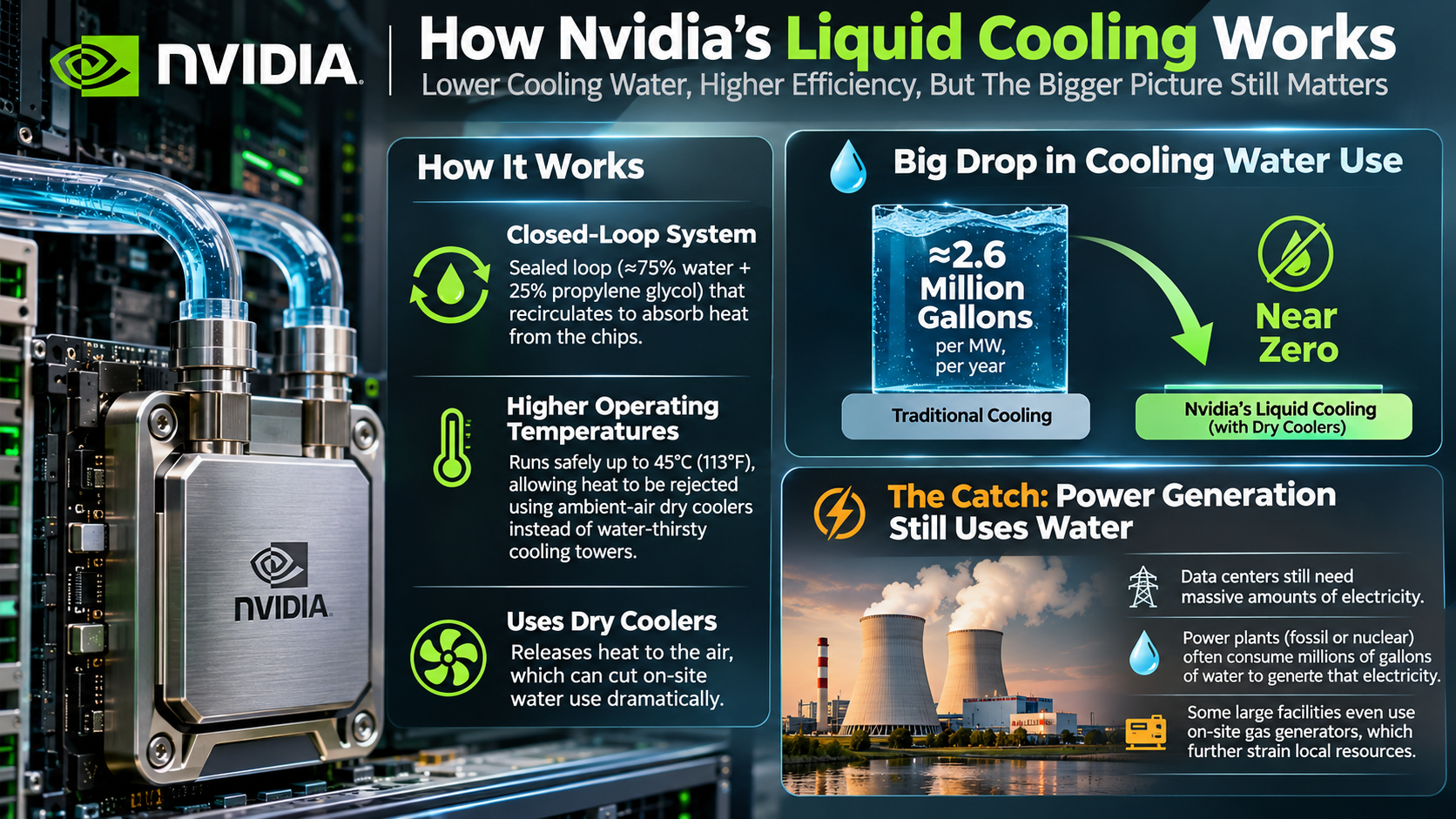
Yes, Nvidia-based liquid cooling infrastructure can help reduce data center water consumption. However, the actual savings depend on the facility’s complete cooling design. Direct-to-chip systems transfer heat away from processors using specialized cold plates. These plates connect directly to high-performance components inside servers.
A circulating coolant absorbs heat and carries it toward heat exchangers. This approach handles high thermal loads more efficiently than traditional air cooling alone. It also supports densely packed server racks and demanding AI workloads. Understanding how AI pipelines are optimized for demanding computing workloads provides additional context about the infrastructure behind these systems.
More importantly, operators can combine direct-to-chip cooling with closed-loop systems. When paired with dry coolers, these systems can reject heat without evaporative water losses. This reduces the facility’s dependence on municipal water supplies.
However, some facilities still use cooling towers for final heat rejection. Therefore, installing Nvidia liquid cooling equipment does not automatically make an entire data center water-free.
Closed-Loop Circulation and Dry Heat Rejection
Closed-loop circulation helps reduce water losses inside modern liquid cooling infrastructure. The system moves coolant through server cold plates, heat exchangers, and connected piping. This fluid repeatedly circulates instead of being continuously discharged.
The coolant absorbs heat directly from processors and transfers it elsewhere. A heat exchanger then transfers that energy into another cooling circuit. This arrangement keeps server-side coolant separate from external cooling equipment.
Facilities can connect the secondary circuit to dry coolers. These units use fans and radiator-like coils to release heat into outdoor air. Unlike evaporative cooling towers, dry coolers do not intentionally evaporate water during normal operation.
However, the distinction between closed-loop circulation and zero-water operation matters. A sealed server cooling circuit does not guarantee a water-free facility. If external equipment uses evaporative cooling, the facility still consumes water.
Therefore, operators must evaluate the entire heat-rejection system before claiming water savings.
Can Data Centers Cool Their Devices Without Water?
Yes, data centers can operate without consuming water for their primary cooling process. However, achieving this requires carefully selected cooling infrastructure. Air-cooled chillers and dry cooling systems provide alternatives to evaporative cooling towers.
Dry coolers circulate heated fluid through finned radiator coils. Powerful fans move outdoor air across these coils and remove thermal energy. The process resembles an automobile radiator. It transfers heat into the surrounding atmosphere without requiring continuous water evaporation.
Some facilities also use outside-air economization. This approach introduces suitable outdoor air to reduce mechanical cooling requirements. It can work particularly well in cooler climates.
However, water-free cooling involves certain trade-offs. Fans and mechanical chillers require electricity to operate. During extremely hot weather, cooling efficiency can also decrease.
Consequently, operators must balance water conservation against electricity consumption. The best solution depends on local weather, electricity prices, and environmental conditions.
The Trade-off Between Water and Electricity
Water-free cooling systems reduce dependence on evaporative water consumption. However, they can increase electricity requirements under certain operating conditions. This creates an important environmental trade-off for data center operators.
Dry coolers depend on fans to move air across heat exchangers. Air-cooled chillers may also require additional compressor power. During hot weather, these systems can work harder to maintain safe temperatures.
Consequently, reducing water consumption does not always reduce overall environmental impact. Electricity generation can also require significant water resources, depending on the power source.
Facility designers should evaluate several factors before selecting a cooling approach:
- Water availability: Regions experiencing drought may prioritize dry cooling.
- Electricity efficiency: Higher fan and compressor loads can increase operating costs.
- Climate conditions: Cooler environments generally support more efficient dry cooling.
- Carbon intensity: Electricity sources influence the system’s overall environmental footprint.
- Operating costs: Water prices and electricity tariffs affect long-term economics.
The objective is to optimize both water and energy consumption rather than minimizing only one resource.
How Much Water Is Used to Cool AI Data Centres?
AI data center water consumption varies significantly between facilities. There is no universal figure because cooling technologies, workloads, climates, and operating schedules differ. A large facility using evaporative cooling can consume substantial quantities of water daily. Another facility with similar computing capacity may require much less.
One useful measurement is Water Usage Effectiveness (WUE). This metric measures facility water consumption relative to IT equipment energy consumption. It is commonly expressed in liters per kilowatt-hour.
For example, a WUE of 1.8 liters per kilowatt-hour means the facility uses 1.8 liters of water for every kilowatt-hour consumed by IT equipment. This is an illustrative calculation, not a universal data center average.
AI workloads can also create indirect water consumption. Electricity generation may require water, depending on the energy source. Therefore, understanding the complete environmental footprint requires examining both direct and indirect water use.
Quantifying the Scope of AI Water Footprints
The water footprint of an AI data center extends beyond its server cooling equipment. Operators must consider water consumed by facility infrastructure and electricity generation. This distinction becomes increasingly important as AI computing capacity expands.
Large hyperscale campuses can operate thousands of servers simultaneously. Their cooling requirements depend on processor density, workload intensity, and environmental conditions. Facilities using evaporative cooling may experience higher water demand during hot weather.
Researchers also examine indirect water consumption associated with electricity production. Power plants using water-intensive cooling processes can increase the overall footprint. This means a data center’s location and electricity supply matter.
Several measurements help evaluate environmental performance:
- Direct water consumption: Water used for cooling and other facility operations.
- Indirect water consumption: Water associated with electricity generation.
- WUE: Water consumed relative to IT equipment energy use.
- PUE: Total facility energy divided by IT equipment energy.
Together, these measurements provide a clearer picture of AI infrastructure’s environmental impact. They also help operators identify opportunities to reduce resource consumption.
Conclusion: Does Nvidia Liquid Cooling Really Save Water?
Nvidia liquid cooling is changing how modern data centers manage heat. Direct-to-chip technology helps remove heat more efficiently from powerful AI processors. When combined with closed-loop systems and dry coolers, it can significantly reduce on-site water consumption.
However, Nvidia liquid cooling water use depends on the facility’s overall cooling infrastructure. Liquid cooling alone does not guarantee zero-water operation. Facilities that continue using evaporative cooling towers still require water replenishment.
As AI computing demand increases, data center operators must balance water conservation with energy efficiency. Research from UC Berkeley’s Center for Law, Energy & the Environment highlights the importance of cooling choices and transparent water reporting.
Ultimately, sustainable AI infrastructure depends on reducing both water consumption and electricity demand. Choosing efficient cooling technologies will become increasingly important as data centers expand worldwide.