

How to Write a Lesson Plan: A Practical Step-by-Step Guide
Stepping into a classroom without a roadmap can waste instructional time and reduce student engagement. Learning how to write a lesson plan gives educators a clear structure for teaching, discussion, practice, and assessment. A well-designed plan connects curriculum standards with meaningful classroom activities and measurable learning goals. The U.S. Department of Education emphasizes evidence-based curriculum design and structured learning objectives as important parts of effective education.
A purposeful lesson plan also makes teaching more consistent. It helps educators manage transitions, maintain appropriate pacing, and focus each activity on a specific learning outcome. When students understand what they need to learn, they can participate more actively and track their progress.
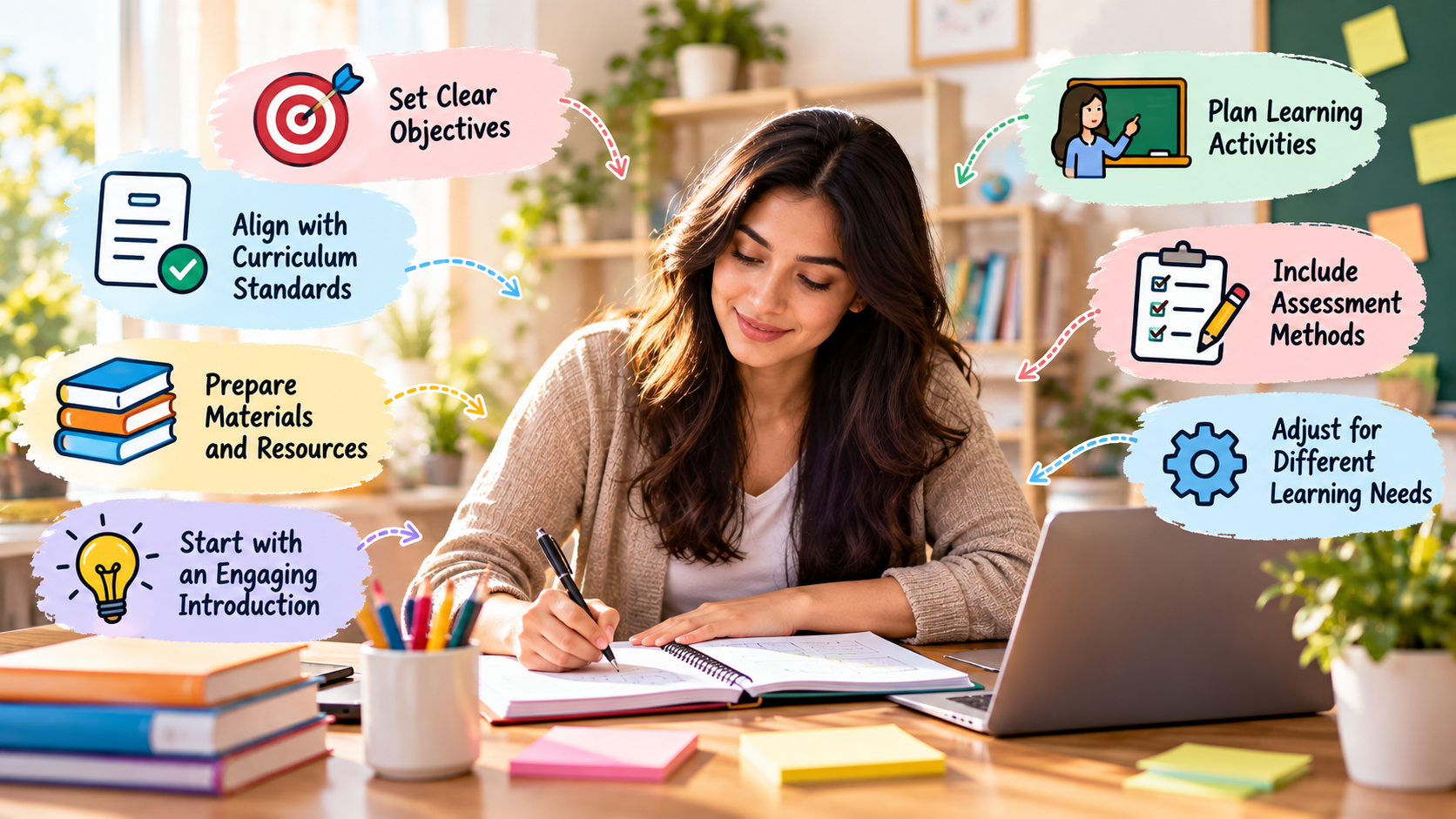
This guide explains the essential parts of lesson planning in simple terms. You will find a practical lesson plan example, guidance on using ChatGPT for lesson preparation, and an explanation of the seven common lesson plan elements. You will also learn how to create a lesson plan step by step using backward design, clear objectives, appropriate activities, and effective assessment methods.
What is an example of a lesson plan?
An example of a lesson plan could be a third-grade science lesson about plant photosynthesis. The lesson begins with a measurable objective: students will identify how sunlight, water, and carbon dioxide help plants produce glucose. The teacher then introduces the topic with a five-minute visual showing how plants respond to sunlight.
Next, the teacher provides 15 minutes of direct instruction using an interactive diagram. Students then work with partners to categorize photosynthesis inputs and outputs using flashcards. This activity gives learners an opportunity to apply the concept with guidance.
The lesson continues with independent practice. Each student labels a plant diagram and identifies the main elements involved in photosynthesis. Finally, students complete an exit ticket by listing two important elements plants need to survive.
This example shows how a lesson plan connects objectives, instruction, practice, and assessment.
Can Chatgpt create a lesson plan?
Yes, ChatGPT can help create a detailed lesson plan quickly when you provide clear instructional information. Teachers can use it to develop basic lesson structures, brainstorming activities, discussion questions, writing prompts, and differentiated learning tasks.
However, ChatGPT should support lesson planning rather than replace professional judgment. An AI-generated plan may not understand your students’ specific abilities, classroom environment, learning needs, or school requirements.
Teachers should review every generated lesson before using it. Check the information for factual accuracy, curriculum alignment, age appropriateness, and classroom practicality. Some suggested activities may also require changes based on available resources or class size.
ChatGPT works best as a drafting and brainstorming tool. It can reduce the time required to create an initial outline while leaving important instructional decisions with the teacher.
You can also ask it to modify a lesson for different learning levels. This can help educators create alternatives for students who need additional support or greater academic challenge.
Prompting AI for Educational Content
The quality of an AI-generated lesson plan depends heavily on the information included in the prompt. A vague request usually produces a generic lesson that may require significant editing.
Give ChatGPT specific details about the grade level, subject, topic, learning objective, curriculum standard, and lesson duration. You can also explain the students’ current knowledge and any classroom limitations.
For example, instead of asking for a lesson plan about fractions, specify that you need a 45-minute fifth-grade lesson on adding fractions with unlike denominators.
Ask the tool to include appropriate learning activities, formative assessment, differentiation, and required materials. You can also request accommodations for students who need additional support.
After generating the plan, review each section carefully. Make sure the activities actually support the objective and suit your students.
AI can accelerate the planning process, but the teacher remains responsible for making the final instructional decisions.
What are the 7 parts of a lesson plan?
The seven common parts of a traditional lesson plan create a complete instructional sequence. First, learning objectives explain what students should know or demonstrate by the end of the lesson. Second, curriculum standards connect the lesson with broader educational requirements.
Third, materials and resources identify the supplies, technology, worksheets, or other tools needed. Fourth, the anticipatory set introduces the topic and captures student attention.
Fifth, direct instruction gives students the essential information or skills required for the lesson. Sixth, guided and independent practice allow students to apply what they have learned with decreasing levels of teacher support.
Seventh, assessment measures student understanding and shows whether the objective was achieved. Teachers can strengthen this part of planning by using daily formative assessment strategies to monitor learning throughout instruction.
These elements can vary between schools and teaching approaches. Some teachers combine sections or use additional components, such as differentiation and reflection.
The key is maintaining a clear connection between objectives, instruction, practice, and assessment.
How do I create a lesson plan?
To create an effective lesson plan, start with the desired learning outcome rather than the activity. This approach is commonly known as backward design. First, select the relevant curriculum standard and identify what students should learn. For additional time-saving approaches, explore how to optimize lesson planning for more efficient preparation.
Next, write a measurable objective using an active verb. Then decide how you will determine whether students achieved that objective. Your assessment should provide clear evidence of learning.
Once the assessment is established, choose activities that prepare students for success. Include a mixture of explanation, guided practice, discussion, and independent work when appropriate. Selecting activities that encourage participation can also benefit from student engagement strategies that keep learners actively involved.
You should also plan the lesson’s timing. Give each activity a realistic time limit and leave enough time for assessment and transitions.
Finally, consider different student needs. Prepare scaffolding for learners who need additional support and extension activities for students who are ready for greater challenge. Understanding how students learn can also help teachers apply educational psychology theories when planning instruction and support.
A useful lesson plan should be clear, practical, flexible, and focused on student learning. It should guide teaching without making the classroom experience unnecessarily rigid.
Implementing Proactive Pacing Strategies
Effective pacing helps teachers use limited classroom time without rushing important learning activities. Start by dividing the lesson into clear time blocks before class begins.
For example, a 50-minute lesson might include 10 minutes of introduction and direct instruction. The next 20 minutes could focus on guided practice. Another 15 minutes could support independent work, followed by five minutes for assessment.
These times are only examples. The appropriate pacing depends on the subject, student age, lesson difficulty, and classroom environment.
Avoid spending too much time on the introduction. Students often need sufficient time to practice and demonstrate the skill themselves.
It is also useful to build small time buffers into your plan. Discussions can take longer than expected, and some students may need additional explanation.
A flexible approach allows teachers to adjust pacing without losing the lesson’s main objective. If an activity takes longer than planned, prioritize the tasks that provide the strongest evidence of learning.
How do I start writing a lesson plan?
To start writing a lesson plan, identify the curriculum standard or core skill students need to learn. This gives your planning process a clear starting point.
Avoid beginning with random worksheets, games, or activities. An attractive activity is not automatically useful if it does not support the learning objective.
Instead, identify one measurable outcome for the lesson. Decide what students should be able to explain, create, solve, identify, or demonstrate by the end of class.
Next, consider what students already know. Reviewing prior knowledge can help you identify concepts that need clarification before introducing new material. After teaching, teachers can use teacher self-reflection routines to evaluate what worked and what should be adjusted in future lessons.
You should then develop a guiding question or central idea. This question can shape your introduction, discussion, practice activities, and assessment.
Once these elements are clear, begin selecting teaching methods and classroom activities. Each activity should contribute directly to the intended learning outcome.
Starting with the learning goal rather than the activity makes lesson planning more focused. It also reduces unnecessary content and keeps the lesson easier to teach and assess.
Establishing the Essential Guiding Question
An essential guiding question gives your lesson a clear intellectual direction. It should encourage students to think about the central concept rather than simply recall isolated facts.
For example, a question such as “Why do ecosystems collapse?” can guide a lesson about environmental balance. It can influence the opening activity, classroom discussion, examples, and final assessment.
A useful guiding question should connect directly with the lesson objective. It should also be understandable for the students’ age and learning level.
Avoid questions that have only a simple yes-or-no answer when the lesson requires deeper thinking. Instead, use questions that encourage students to explain, compare, analyze, or apply ideas.
The question does not need to appear throughout every activity. However, it should provide a clear thread that connects the different parts of the lesson.
When teachers establish this direction before writing activities, the final plan becomes more coherent. Students also gain a clearer understanding of why the lesson matters and what they are expected to explore.