
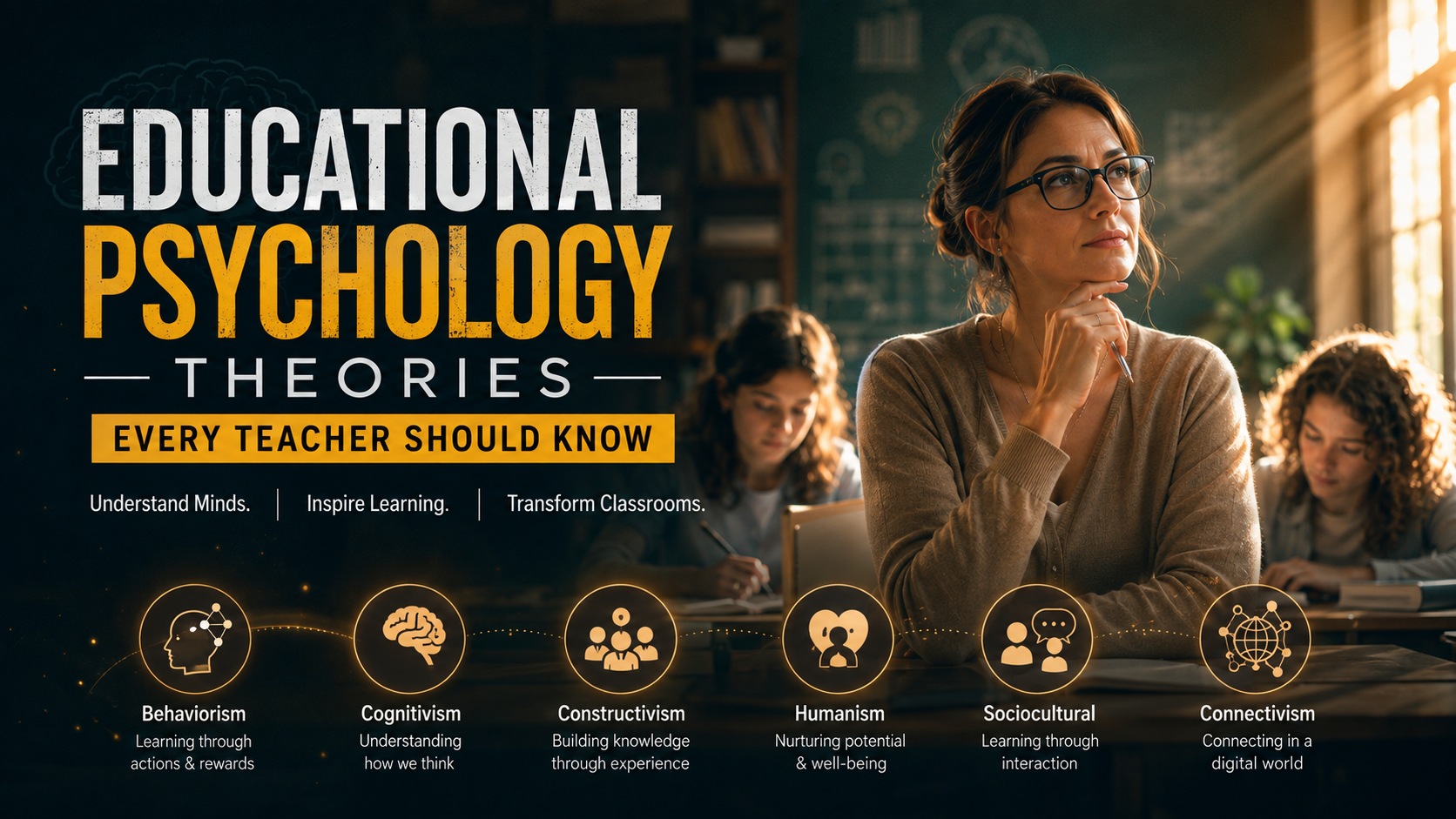
Educational Psychology Theories Every Teacher Should Know
Great teaching requires more than knowing a subject. It also requires an understanding of how students process, store, and apply knowledge. Exploring foundational educational psychology theories helps teachers adapt lessons to support different learning needs. The American Psychological Association also highlights the value of psychological science in teaching and learning across educational settings.
When teachers understand cognitive processes, they can design more effective learning experiences. They can also manage classroom dynamics with greater empathy and purpose.
This guide explores the essential psychological concepts behind modern education. You will learn about the five main teaching theories, major psychological perspectives, key learning theories, and practical teaching methods. Whether you teach kindergarten or high school chemistry, these principles can help you make more informed instructional decisions.
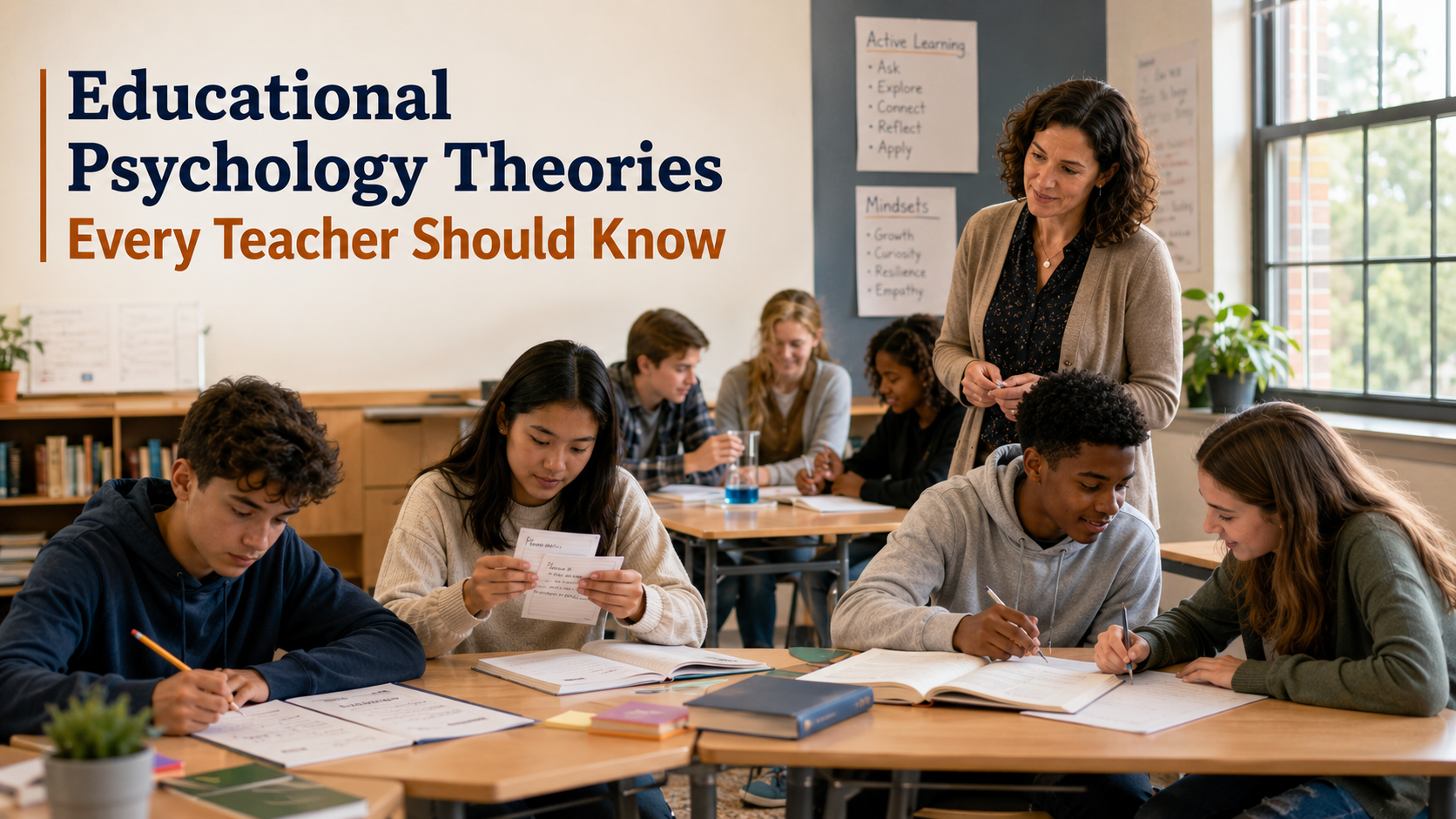
What are the 5 main teaching theories?
The five foundational teaching frameworks are behaviorism, cognitivism, constructivism, humanism, and connectivism. Together, they explain different ways students learn, respond to instruction, and develop knowledge. These approaches form an important part of educational psychology theories and can guide practical classroom decisions.
Behaviorism focuses on observable behavior, reinforcement, and consequences. Cognitivism examines how students process, organize, store, and retrieve information. Constructivism views learners as active participants who build understanding through inquiry and experience. Humanism emphasizes emotional well-being, motivation, personal growth, and student agency. Connectivism addresses learning in digital environments, where students must navigate networks and evaluate information.
Teachers do not need to choose only one framework. Each theory can support different learning goals and classroom situations. For example, reinforcement may support classroom routines, while constructivist activities can deepen conceptual understanding. Combining these perspectives helps educators create flexible lessons that address academic, social, emotional, and digital learning needs, especially when paired with modern classroom teaching approaches.
Implementing Constructivist Strategies in Classrooms
Constructivism helps students develop deeper understanding by connecting new ideas with prior knowledge. Teachers create opportunities for students to investigate questions, test ideas, explain reasoning, and solve authentic problems. This approach is closely connected to educational psychology theories that view learning as an active process.
Teachers can use constructivist strategies through experiments, discussions, case studies, problem-solving tasks, and collaborative projects. In science, students might predict an outcome before testing it. They can compare results with their assumptions and discuss what caused differences.
The teacher remains important but takes the role of facilitator. Instead of providing every answer, the teacher asks guiding questions and addresses misconceptions. Peer interaction can also strengthen learning because students explain concepts and encounter different perspectives.
Constructivist teaching works best when activities have clear goals and suitable support. Without guidance, open-ended tasks can overwhelm learners. Structured inquiry lets students explore while still receiving the direction they need to succeed.
What are the 7 main theories of psychology and their?
The seven major psychological perspectives are psychodynamic, behavioral, cognitive, biological, humanistic, evolutionary, and sociocultural. Each explains human behavior from a different angle. Understanding these perspectives gives teachers context for motivation, development, behavior, and social interaction.
Psychodynamic theory considers unconscious processes and early experiences. Behavioral psychology focuses on observable actions and environmental reinforcement. The cognitive perspective examines attention, memory, perception, reasoning, and decision-making. The biological approach connects behavior with genetics, brain structures, hormones, and neurological processes.
Humanistic psychology emphasizes free will, personal growth, meaning, and individual potential. The evolutionary perspective considers how inherited traits and behaviors may have developed through adaptation. The sociocultural perspective examines how culture, relationships, language, and social environments influence development.
These perspectives are not teaching methods by themselves. However, they can help educators understand why students respond differently to the same situation. Applying these insights carefully can support communication, classroom management, motivation, and instructional planning.
The Sociocultural Perspective in Modern Education
The sociocultural perspective shows that learning develops through social interaction and cultural contexts. This idea is central to several educational psychology theories, especially those associated with Lev Vygotsky. Language, relationships, communities, and classroom experiences can influence how students understand information.
Teachers can apply this perspective through collaborative activities. Group problem-solving, peer tutoring, classroom discussions, and shared projects let students explain ideas and hear different viewpoints. These interactions can reveal misunderstandings hidden during independent work and can be supported with STEM tools for modern classrooms.
Cultural responsiveness is another important part of sociocultural teaching. Educators can connect lessons with students’ experiences, languages, communities, and backgrounds. This does not lower academic expectations. It creates relevant pathways into challenging content.
Teachers should provide structure during collaboration. Clear roles, discussion prompts, and success criteria help students participate productively. When social learning is carefully supported, classrooms become environments where students build knowledge together. They also develop communication, confidence, and problem-solving skills through meaningful interaction.
What are the main theories in educational psychology?
The main educational psychology theories include Piaget’s stages of cognitive development, Vygotsky’s Zone of Proximal Development, Bandura’s social learning theory, and information processing theory. These frameworks help teachers understand development, observation, interaction, and information processing.
Piaget described cognitive development as progressing through distinct stages, with reasoning patterns changing over time. Vygotsky emphasized social support and introduced the Zone of Proximal Development. It describes tasks learners can complete with appropriate guidance. Bandura showed that students can learn behaviors, attitudes, and emotional responses through observation and modeling.
Information processing theory focuses on attention, working memory, and long-term memory. It highlights limits on attention and working memory.
These theories can guide decisions about lesson difficulty, modeling, questioning, practice, and classroom support. Teachers can use them together rather than treating one framework as a complete explanation of learning. The goal is to match instruction with students’ developmental, cognitive, and social needs, while helping them set academic goals that support purposeful learning.
Maximizing the Zone of Proximal Development
Vygotsky’s Zone of Proximal Development identifies the space between what a student can do independently and what they can accomplish with appropriate support. This concept is one of the most practical ideas within educational psychology theories because it helps teachers adjust instruction to readiness.
Teachers can use temporary scaffolds to make tasks manageable. Useful supports include worked examples, graphic organizers, sentence starters, demonstrations, guided questions, checklists, and partially completed problems. These tools reduce barriers while keeping the goal challenging.
The key is gradual release. A teacher may first model a process, then complete part of it with the class, and finally ask students to work independently. As students become capable, support should decrease.
Teachers should monitor responses. If a task is too easy, it may offer limited growth. If it is far beyond current ability, frustration may increase. Effective scaffolding keeps tasks challenging while providing enough guidance for meaningful progress. This approach supports independence without removing the productive challenge students need, and daily formative assessment strategies can help teachers monitor that progress.
What are the 7 types of learning theories?
The seven prominent learning theories include behaviorism, cognitivism, constructivism, humanism, experiential learning, transformative learning, and social learning theory. Each emphasizes a different way learning can develop.
Behaviorism focuses on conditioning and reinforcement, while cognitivism examines mental processes such as attention and memory. Constructivism emphasizes active knowledge building. Humanism considers motivation, self-worth, personal meaning, and growth. Experiential learning, associated with David Kolb, explains learning through experience, reflection, conceptual understanding, and experimentation.
Transformative learning emphasizes critical reflection that can lead learners to reconsider established assumptions. Social learning theory highlights observation, modeling, imitation, and social environments. These approaches overlap but are not interchangeable, but they can also support critical thinking and deeper learning when students are encouraged to question assumptions and reflect on their understanding.
Teachers can draw from several theories when planning instruction. A lesson might begin with explicit modeling, move into guided practice, and finish with reflection or independent application. Using educational psychology theories flexibly can help educators support different learning needs. It can also keep lessons purposeful, engaging, and connected to meaningful outcomes.
Applying Experiential Learning Cycles Daily
David Kolb’s experiential learning model describes learning as a cycle involving concrete experience, reflective observation, abstract conceptualization, and active experimentation. The model encourages students to connect what they do with what they think. It gives teachers a practical structure for turning activities into deeper learning.
A science teacher might begin with a hands-on experiment. Students then reflect on what happened and identify patterns in their observations. Next, they connect those observations with scientific concepts. Finally, they apply their understanding by testing another question or changing a variable.
The same cycle also works beyond science. History students can analyze a simulation, reflect on decisions, connect events with broader principles, and apply those insights to another situation. Vocational learners can practice realistic tasks before reviewing performance.
Experiential learning still needs clear objectives and teacher guidance. Simply doing an activity does not guarantee meaningful learning. Reflection and conceptual discussion help students turn experience into transferable knowledge.
What are the 10 methods of learning?
Ten useful learning methods include direct instruction, inquiry-based learning, project-based learning, cooperative learning, flipped classroom instruction, spaced repetition, retrieval practice, gamification, differentiated instruction, and peer tutoring. Students can also strengthen these approaches by using educational apps for students that support practice, organization, and independent learning.
Direct instruction provides clear explanations, modeling, and guided practice. Inquiry-based and project-based learning give students opportunities to investigate questions and create solutions. Cooperative learning uses structured collaboration, while peer tutoring lets students explain and practice concepts with classmates. Flipped instruction moves some content learning outside class so classroom time can focus on application.
Spaced repetition distributes practice over time, while retrieval practice asks learners to recall information without notes. Gamification adds challenges and feedback to increase engagement. Differentiated instruction adjusts content, process, support, or assessment based on learner readiness.
No single method works best for every lesson. Effective teaching combines methods according to the learning objective. Educational psychology theories can help teachers choose strategies that strengthen understanding, memory, participation, and independent learning. The best approach depends on the subject, students, goals, and available classroom resources.
Enhancing Long-Term Memory with Retrieval Practice
Retrieval practice asks students to actively recall information from memory. It differs from passive review because learners must produce an answer rather than reread material. This approach fits closely with information processing principles found in educational psychology theories.
Teachers can use retrieval practice in short, low-pressure activities. A lesson might begin with three questions about previous content. Students can use flashcards, brain dumps, practice tests, or short oral explanations. The goal is frequent recall, not high-stakes testing.
Retrieval practice also provides useful formative assessment information. When several students miss the same question, the teacher can revisit that concept before introducing new material. This makes assessment part of instruction.
The method works best when practice is spaced across time. Returning to ideas at increasing intervals gives students repeated retrieval opportunities. Teachers should provide feedback and encourage lifelong learning habits that make regular review and continued skill development part of the learning process.
Used consistently, retrieval practice can improve retention and identify what needs review. It also helps students become more aware of their own knowledge gaps, making study time more focused and productive.
Frequently Asked Questions
How do developmental stages influence classroom instruction?
Developmental stages determine a child’s cognitive capacity, attention span, and emotional regulation. Jean Piaget showed that younger children require concrete, tactile learning materials, while older students can process abstract, hypothetical concepts. When teachers align lessons with these developmental milestones, they prevent cognitive overload, reduce behavioral issues, and design age-appropriate instructional tasks that challenge students without causing academic distress.
What is the difference between behavioral and cognitive learning approaches?
Behavioral approaches focus purely on observable behaviors and external stimuli, using reinforcement, repetition, and rewards to establish specific habits. In contrast, cognitive approaches focus on internal mental structures. Cognitivism explores how the brain receives, organizes, stores, and retrieves information. While behaviorism modifies actions, cognitivism enhances comprehension, memory retention, and critical thinking skills.
Why is Bandura’s social learning theory vital for educators?
Albert Bandura’s social learning theory highlights that students learn by observing, imitating, and modeling the behaviors, attitudes, and emotional reactions of others. In the classroom, teachers serve as primary behavioral and academic models. Demonstrating enthusiasm, emotional regulation, and positive problem-solving encourages students to adopt those same beneficial traits naturally during daily collaborative learning activities.
How does differentiated instruction support diverse student needs?
Differentiated instruction adapts content, learning processes, products, and the physical learning environment to match individual student readiness, interests, and learning profiles. Instead of using a rigid, one-size-fits-all lesson plan, teachers offer tiered assignments, varied reading levels, and multiple assessment choices. This tailored approach ensures every student accesses grade-level concepts successfully.
Conclusion
Mastering the foundational educational psychology theories every teacher should know equips educators with the tools needed to build effective, responsive, and empathetic learning environments. When you understand how the human brain acquires, organizes, and retains information, you can make intentional pedagogical decisions that directly enhance student performance. From implementing Piaget’s developmental insights to leveraging Vygotsky’s scaffolding strategies, psychological principles provide a clear blueprint for instructional excellence.
These evidence-based frameworks bridge the gap between educational theory and real-world classroom practice. By combining cognitive strategies, constructivist inquiry, and dynamic teaching methods like spaced retrieval, you can design lessons that engage every learner.
Take time this week to assess your current instructional routines. Choose one psychological principle or teaching method from this guide and integrate it into your upcoming lesson plans. As you observe how your students respond, you will unlock new pathways for academic growth, deeper comprehension, and lasting classroom success.