
Does Wrapping Your Phone in Aluminum Foil Really Block Wireless Signals?
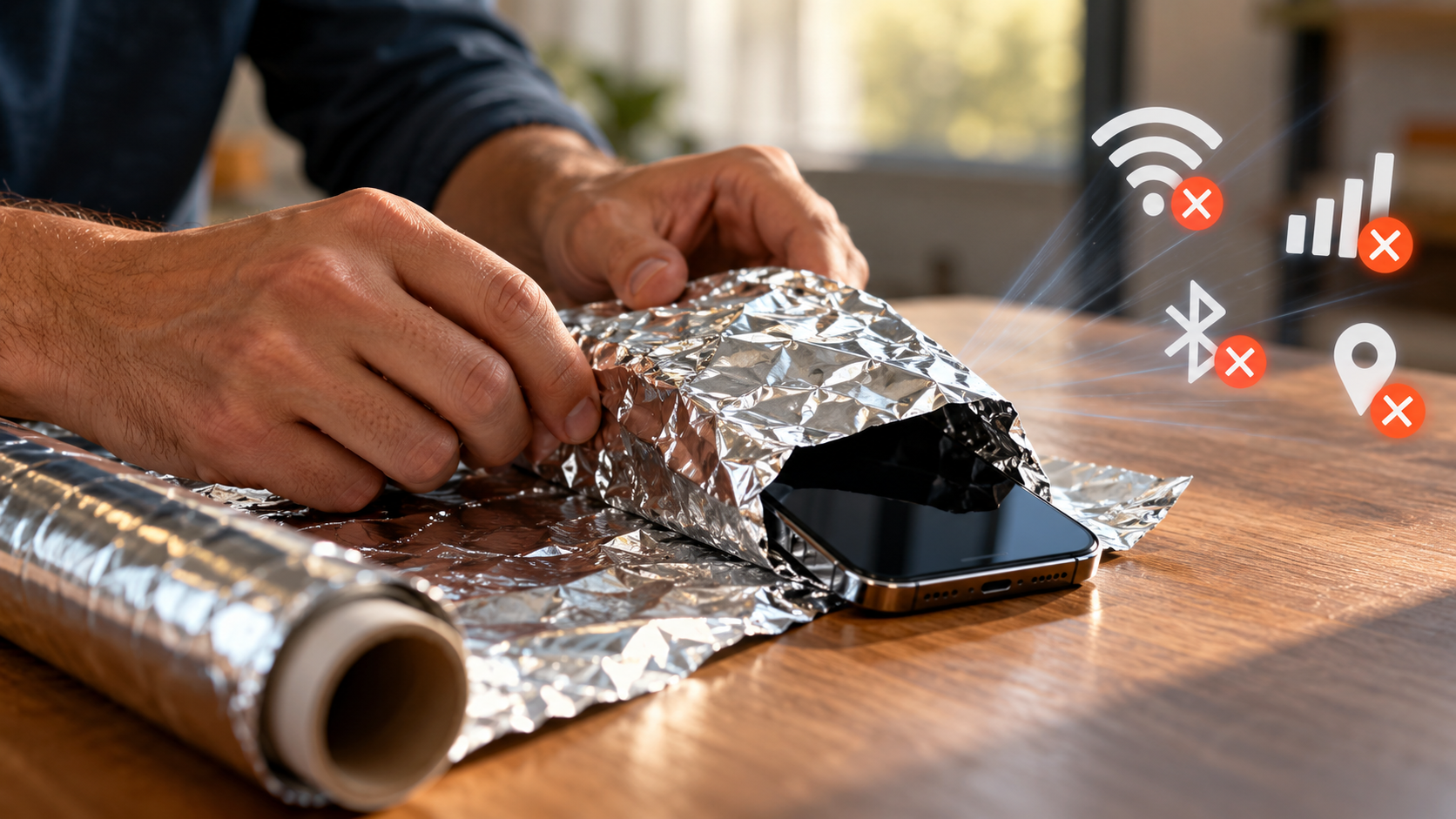
You have likely seen the classic movie trope of someone wrapping a phone in aluminum foil. The goal is usually to block signals or avoid detection. The idea sounds simple, but smartphones use several radio frequency bands.
Understanding how metal affects wireless signals matters for privacy, connectivity, and emergency preparedness. The basic physics of electromagnetic shielding is well established by organizations such as the National Institute of Standards and Technology (NIST).
Modern smartphones communicate through several wireless technologies. These include cellular networks, Wi-Fi, Bluetooth, and GPS. Each technology uses different frequencies and signal characteristics.
When you wrap a smartphone in aluminum foil, you create a basic form of a Faraday cage. A conductive enclosure can reduce electromagnetic energy reaching the device. However, the result depends heavily on the enclosure’s design.
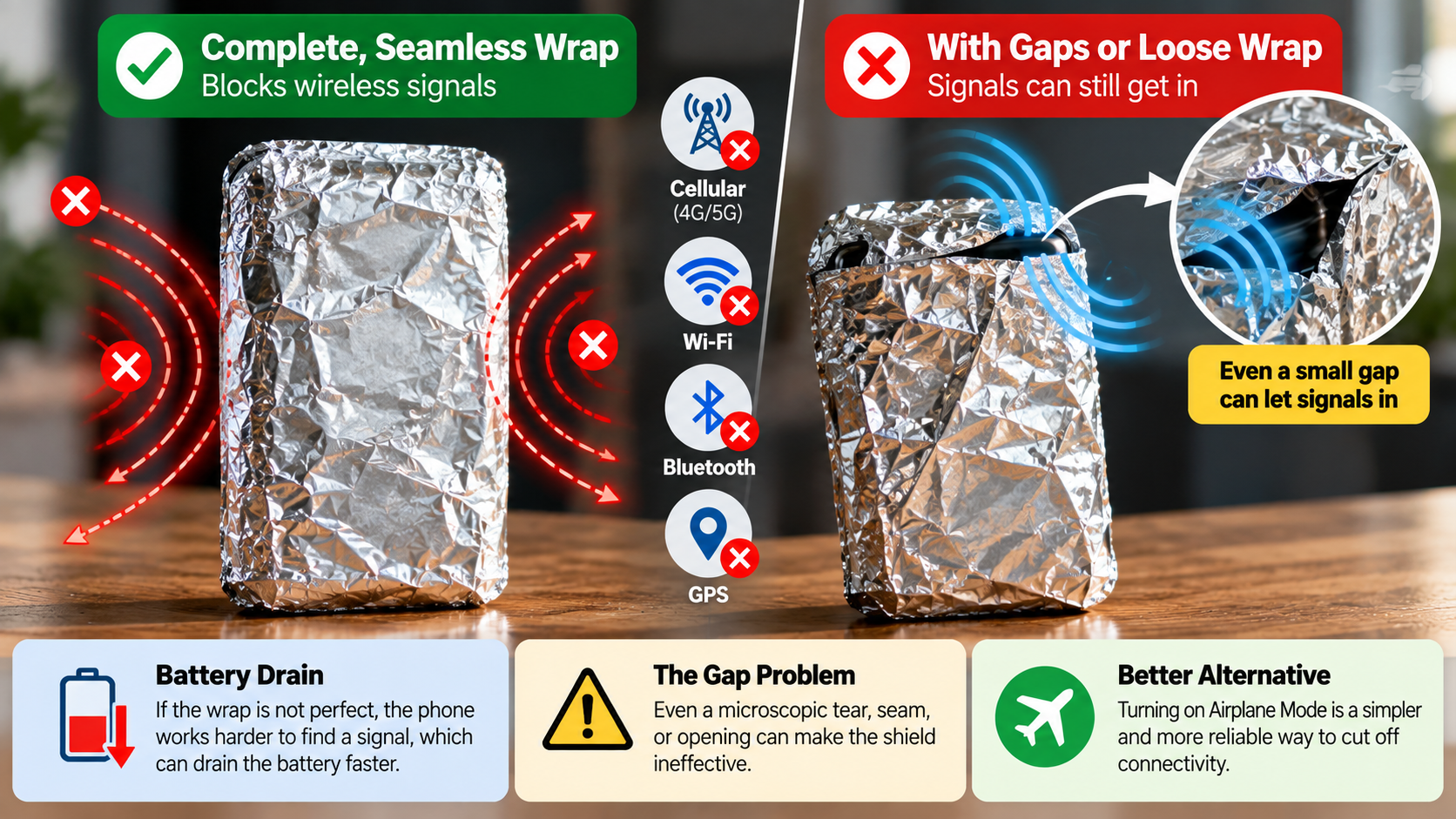
Small openings, gaps, or poorly sealed edges can reduce shielding effectiveness. The phone may also continue transmitting if enough signal reaches its antennas.
This guide explains what aluminum foil can and cannot block. It covers cellular signals, Wi-Fi, tracking, 5G, and signal reflection.
Can aluminum foil block phone signals?
Yes, aluminum foil can significantly reduce cellular signals when it forms a continuous conductive enclosure. However, saying that ordinary foil always blocks signals completely is too strong. The result depends on the frequency, enclosure design, gaps, and thickness.
Cellular networks use radio frequencies that interact strongly with conductive materials. Aluminum can reflect and absorb some electromagnetic energy. A properly constructed enclosure can therefore produce substantial signal attenuation.
The main weakness is incomplete coverage. A loose wrap may leave openings around the phone. Signals can then enter through those openings and reach the internal antennas.
A phone may also increase its transmission effort when reception becomes poor. This can increase battery use while the device continues searching for a usable connection.
For stronger shielding, the enclosure needs continuous conductive coverage. The important factors include:
- Sealed edges and seams
- Minimal openings
- Continuous conductive material
- Adequate coverage around the entire device
So, wrapping a phone in foil can reduce cellular reception. It should not be treated as a guaranteed signal blocker.
The Problem With Incomplete Seams
Gaps are one of the biggest problems with makeshift shielding. Radio waves can enter through openings in a conductive enclosure. The effectiveness of the shield therefore depends on its weakest point.
A loosely wrapped phone may still receive enough energy to communicate. This is especially possible when the nearby cellular signal is strong. A phone close to a cell tower may have an easier time maintaining connectivity.
The idea that a tiny gap automatically destroys all shielding is also misleading. Shielding does not behave like a simple on-or-off switch. Small openings usually reduce attenuation rather than instantly eliminating it.
The shape and size of an opening also matter. Its relationship to the wavelength affects how much energy can leak through.
For practical shielding, focus on continuous coverage rather than simply adding more foil. Multiple layers may improve durability, but they do not compensate for major openings.
A proper enclosure should therefore minimize:
- Open seams
- Torn foil
- Exposed edges
- Large gaps
- Direct openings around ports
A phone can still appear connected when the shielding is incomplete. Testing the device is more reliable than assuming the foil works perfectly.
Does aluminum foil stop Wi-Fi signals?
Aluminum foil can greatly reduce Wi-Fi reception when it forms a continuous conductive enclosure around a phone. However, the exact amount of attenuation depends on several factors. These include frequency, foil coverage, gaps, and the strength of the original signal.
Wi-Fi commonly operates in the 2.4 GHz and 5 GHz bands. Newer Wi-Fi systems can also use higher-frequency bands. Aluminum can reflect electromagnetic energy across these frequencies.
A properly enclosed phone may therefore lose its connection to a wireless router. However, a loose sheet of foil does not guarantee complete isolation.
The 2.4 GHz band generally travels farther and penetrates obstacles better than 5 GHz. This does not mean it will always pass through foil. It means the overall signal environment can affect the result.
The phone’s distance from the router also matters. A very strong nearby signal can behave differently from a weak distant signal. Understanding what your Wi-Fi router can do can also help you troubleshoot connection and coverage issues.
For reliable shielding, pay attention to:
- Complete conductive coverage
- Sealed edges
- Signal strength
- Frequency band
- Potential openings
So, aluminum foil can substantially weaken Wi-Fi signals. Complete disconnection depends on the specific shielding setup and surrounding radio environment.
Frequency Differences Between Wi-Fi Bands
Wi-Fi bands respond differently to obstacles because their frequencies and wavelengths differ. The commonly used 2.4 GHz and 5 GHz bands can therefore behave differently around physical barriers. This also relates to the differences between Wi-Fi 6 and Wi-Fi 7, which use newer wireless technologies.
The 2.4 GHz band generally has better range and obstacle penetration. It can travel farther through many ordinary building materials. However, conductive metal can still cause substantial attenuation.
The 5 GHz band generally has shorter wavelengths and less range. It can also experience greater attenuation from certain obstacles. A metal enclosure can reduce both bands significantly when coverage is continuous.
Still, frequency alone does not determine whether a phone remains connected. Signal strength, antenna placement, enclosure geometry, and openings all matter.
This is why simply adding another layer of foil does not provide a guaranteed result. A poorly sealed enclosure may perform worse than expected.
When evaluating Wi-Fi shielding, consider:
- 2.4 GHz Wi-Fi
- 5 GHz Wi-Fi
- Router distance
- Signal strength
- Foil coverage
- Gaps around the device
A continuous conductive enclosure can make Wi-Fi communication difficult or impossible. But the exact outcome must be tested under the conditions involved.
Can aluminum foil actually boost a Wi-Fi signal?
Aluminum foil can sometimes redirect Wi-Fi energy when it is positioned as a reflector. This is different from wrapping a phone in foil. A wrapped phone loses access to incoming radio energy rather than gaining signal strength.
A shaped metal reflector can redirect electromagnetic energy toward a particular area. For example, some DIY setups place conductive material behind a router antenna. The reflector can change the direction in which energy spreads.
This approach does not create additional wireless power. It simply changes the distribution of existing energy. The improvement depends heavily on the reflector’s shape, placement, antenna design, and surrounding environment.
A poorly designed reflector may provide little measurable benefit. It can also weaken coverage in other directions.
The key difference is the intended function:
- Phone wrapped in foil: Reduces exposure to radio signals.
- Foil reflector: Redirects some radio energy.
- Unmodified router: Distributes energy according to its antenna pattern.
Therefore, wrapping your smartphone in aluminum foil will not boost reception. A properly positioned reflector can sometimes improve coverage in a specific direction.
Designing a Directional Foil Reflector
A foil reflector works by changing the direction of electromagnetic energy. It does not amplify the router’s actual transmission power. Its effectiveness depends on geometry, placement, and the router’s antenna pattern.
A curved reflector can help direct more energy toward a selected area. However, the exact shape is important. A random piece of folded foil may produce unpredictable results.
Placement also matters. The reflector should be positioned relative to the antenna and the area where stronger coverage is needed. This is easier to understand when you know why routers have external antennas, since antenna placement affects how wireless signals are distributed.
Keep in mind that directional reflection creates trade-offs. Improving coverage in one direction can reduce coverage elsewhere.
For experimentation, compare signal strength before and after adding the reflector. Test the same location and conditions each time.
The basic principle is simple:
- Metal reflects electromagnetic energy.
- A shaped surface can redirect that energy.
- It does not generate additional transmission power.
- Results depend on antenna and reflector geometry.
This makes foil more useful as a simple reflector experiment than as a phone signal booster.
Can your phone be tracked if you wrap it in aluminum foil?
A properly shielded phone may lose its ability to communicate through cellular, Wi-Fi, Bluetooth, or GPS radio signals. However, saying that foil makes a phone completely untrackable is too broad. Tracking depends on the technology being used and what happens before and after shielding.
A phone normally uses several systems for location and communication. These can include cellular networks, Wi-Fi, Bluetooth, and satellite positioning.
If radio communication is effectively blocked, the phone cannot send or receive data through those blocked channels. However, the device can still collect information internally.
Applications may store location-related information locally. Sensors can also continue operating while the phone is isolated. Once connectivity returns, stored information may be transmitted.
There are also tracking methods that do not depend directly on the phone’s own cellular connection. For example, a nearby device could observe physical presence without communicating with the wrapped phone.
Therefore, foil should not be treated as a complete privacy solution. It can reduce radio communication, but it does not erase previously collected data. For broader online privacy, understanding what a VPN is and why you might need one can provide useful context.
Understanding Stored Offline Location Data
A shielded phone can continue performing many internal functions. GPS reception may be unavailable inside an effective shield, but sensors can still operate. Applications can also continue storing information locally.
For example, an application may record activity using the phone’s accelerometer or gyroscope. Offline maps may also retain previously downloaded information.
The important distinction is between blocking communication and preventing data collection. Aluminum foil mainly affects electromagnetic communication. It does not automatically disable software or internal sensors.
When the phone reconnects to a network, applications may transmit information that was stored earlier. Whether this happens depends on the application, operating system, permissions, and network connection.
For better privacy, shielding should not be viewed as the only measure. Users can also review:
- Location permissions
- Background activity
- Bluetooth settings
- Wi-Fi permissions
- Application data collection
- Cloud synchronization
These controls address the software side of privacy. Physical shielding addresses the radio side.
The two are different problems. Blocking signals does not automatically delete historical location information.
Can 5G go through aluminum foil?
Aluminum foil can significantly attenuate 5G radio signals, but the statement that all 5G signals simply cannot pass through foil is too absolute. 5G covers a wide range of frequencies, from lower bands to much higher millimeter-wave frequencies.
Lower-frequency 5G signals can travel farther and generally penetrate obstacles better. Higher-frequency signals have shorter wavelengths and are more easily weakened by physical barriers.
Conductive aluminum interacts strongly with electromagnetic waves. A continuous metal enclosure can therefore provide substantial shielding across many radio frequencies.
However, real-world shielding is not determined by frequency alone. Openings, seams, enclosure geometry, material properties, and signal strength all affect performance.
Millimeter-wave 5G is especially sensitive to physical obstructions. Buildings, foliage, and other objects can weaken these signals significantly.
A tightly enclosed phone may therefore lose its 5G connection. But the exact result depends on the network band and the quality of the enclosure.
It is more accurate to say that aluminum foil can strongly attenuate 5G signals rather than claiming every 5G signal is automatically blocked.
Why Millimeter Waves Fail Instantly
Millimeter-wave 5G uses frequencies above roughly 24 GHz. These signals have very short wavelengths compared with lower-frequency cellular signals. They can therefore experience significant attenuation from many physical obstacles.
However, saying that millimeter waves “fail instantly” is misleading. Their behavior depends on the material, thickness, geometry, angle, and presence of openings.
A continuous conductive metal barrier can strongly reflect and attenuate electromagnetic energy. This can make communication difficult for a phone inside the enclosure.
The result becomes less predictable when the foil has gaps or poor contact between overlapping sections. Openings can provide paths for radio energy to reach the phone’s antennas.
The same principles apply across many wireless technologies. Shielding effectiveness depends on the complete enclosure, not simply the fact that the material is aluminum.
For practical purposes, remember these points:
- Higher frequencies generally have shorter wavelengths.
- Millimeter-wave signals can be strongly affected by obstacles.
- Aluminum is electrically conductive.
- Continuous metal coverage can provide substantial attenuation.
- Gaps can reduce shielding effectiveness.
So, aluminum foil can be an effective barrier against many radio signals. It should not be described as an automatically perfect shield.
Conclusion
Wrapping a phone in aluminum foil can significantly reduce wireless signals, but it is not a perfect privacy solution. The effectiveness depends on the foil coverage, gaps, signal strength, frequency, and overall enclosure design.
If you wrap phone in aluminum foil carefully, you may block or greatly weaken cellular, Wi-Fi, Bluetooth, and other radio signals. However, incomplete seams or openings can allow signals to reach the phone.
It is also important to separate signal blocking from tracking protection. Foil can limit wireless communication, but it does not erase stored data or prevent apps from collecting information internally.
So, can you wrap phone in aluminum foil to block signals? Yes, it can work as a basic form of electromagnetic shielding. However, it should not be considered a guaranteed or complete method for digital privacy.
For more technical information, see the NIST research on electromagnetic shielding effectiveness.