
The Human Eye: Structure, Facts, and Function Explained
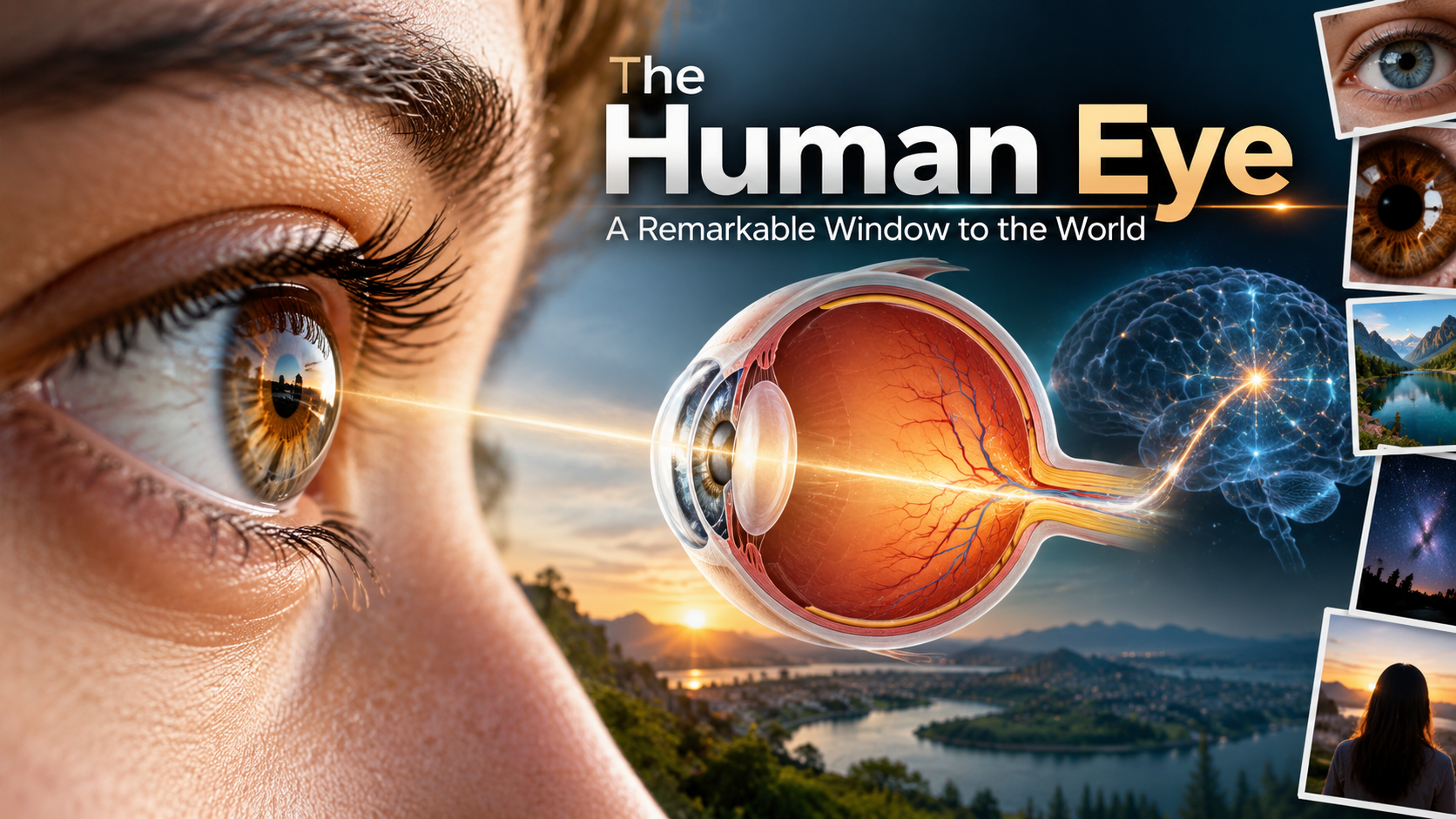
The human eye is one of the most complex organs in the body. It acts as our primary window to the world. The eye captures light, focuses images, and sends visual signals to the brain. These processes happen rapidly and continuously throughout the day.
Vision helps us recognize people, read information, judge distances, and navigate our surroundings. It also supports communication, learning, movement, and emotional expression. The National Eye Institute explains that vision involves the eyes, brain, and visual pathways working together.
Understanding the human eye reveals how several specialized structures perform different roles. The cornea and lens focus light. The iris controls light entry. The retina detects light and creates neural signals. The optic nerve then carries these signals toward the brain for interpretation.
This article explores important questions about the human eye, including its facts, functions, major parts, unique characteristics, appearance, and ability to sense pain.
What are 5 facts about the eye?
The human eye has several remarkable features that demonstrate the complexity of human vision. First, the eye can distinguish millions of color shades under suitable lighting conditions. However, the exact number varies with individual vision and viewing conditions. Second, the eyes can make extremely rapid movements called saccades. These movements help shift attention between different parts of a scene.
Third, the cornea has no blood vessels. Instead, it receives oxygen mainly from the surrounding air through the tear film. This transparency allows light to pass through with minimal obstruction. Fourth, the retina contains specialized photoreceptor cells called rods and cones. They help detect light, movement, and color.
Finally, both eyes work together to provide depth perception. The brain compares slightly different images from each eye. This difference helps estimate distance and understand the three-dimensional world around us.
The Incredible Speed of Eye Muscles
The muscles controlling eye movement are among the body’s most responsive muscles. Six external muscles coordinate the movement of each eyeball. They work together to help the eyes move upward, downward, sideways, and diagonally.
These muscles also support rapid movements called saccades. A saccade shifts the eyes quickly from one point to another. The brain then processes information from the new visual target. These movements happen many times during ordinary activities, including reading and observing a busy environment.
Eye muscles also support smooth pursuit movements. These movements allow the eyes to follow a moving object more steadily. For example, they help someone track a moving vehicle or watch a ball during a game.
The coordination between the eye muscles and brain is highly precise. Small changes in muscle activity can redirect the eyes toward important visual information. This constant coordination helps maintain useful visual awareness throughout the day.
What are 10 uses of the human eye?
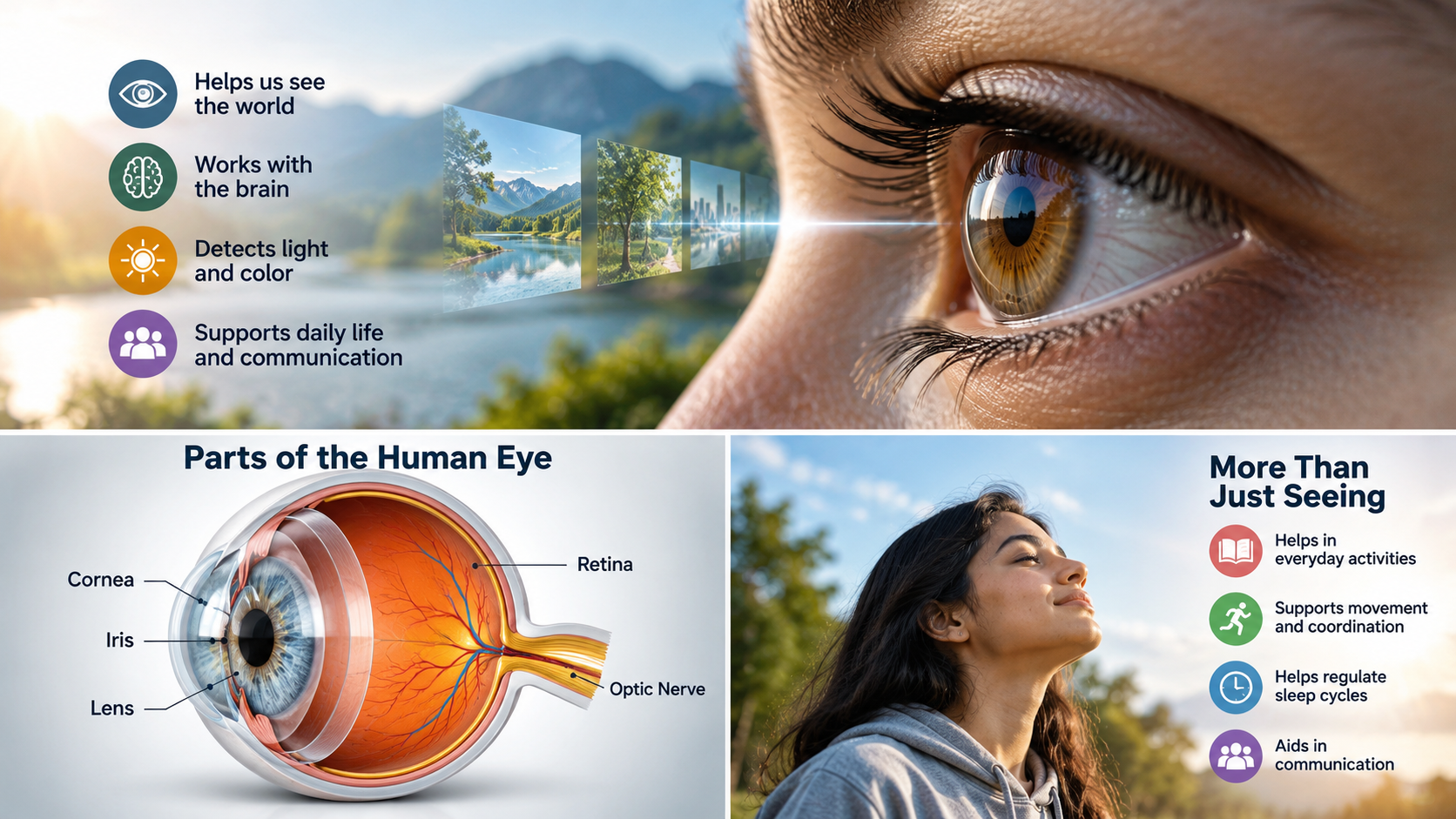
The human eye performs many functions beyond simply allowing us to see. Its primary role is to detect light and provide visual information to the brain. This information helps people recognize objects, identify colors, and understand their surroundings.
Vision also supports everyday activities such as reading, writing, driving, walking, and using digital devices. The eyes help people judge distances and detect movement. They also contribute to hand-eye coordination, which is important for sports, writing, cooking, and many practical tasks, including activities that benefit from reaction time drills for sports.
The human eye also supports communication. Eye contact can provide information about attention, emotion, and social interaction. Specialized retinal cells additionally detect changes in light that help regulate the body’s internal clock.
Key functions of the human eye include:
- Detecting light and color
- Supporting depth and distance perception
- Recognizing faces and objects
- Helping maintain spatial awareness
- Supporting hand-eye coordination
- Contributing to balance and movement
- Reading and interpreting visual information
- Supporting non-verbal communication
- Detecting environmental changes
- Helping regulate the sleep-wake cycle
Regulating Sleep Cycles Through Light Detection
The retina contains specialized cells called intrinsically photosensitive retinal ganglion cells. These cells respond particularly to blue-enriched daylight. They send information about environmental light to a brain region called the suprachiasmatic nucleus.
This pathway helps synchronize the body’s circadian rhythm with the day-night cycle. Light exposure during the daytime generally supports alertness and helps regulate the timing of melatonin production. Darkness, meanwhile, promotes conditions that support normal evening melatonin release. This is one reason the screen-free technology trend has attracted attention as people look for ways to reduce unnecessary exposure to screens.
This function is different from ordinary image-forming vision. A person does not need to consciously see an object for light to influence the biological clock.
Because of this system, the human eye plays an important role in maintaining regular sleep patterns. Exposure to natural daytime light can provide strong signals for the circadian system. Bright light late at night, particularly when using screens, can have the opposite effect by delaying normal sleep-related biological signals. Practicing digital detox for better mental health can also reduce unnecessary nighttime digital exposure.
What are the main parts of an eye?
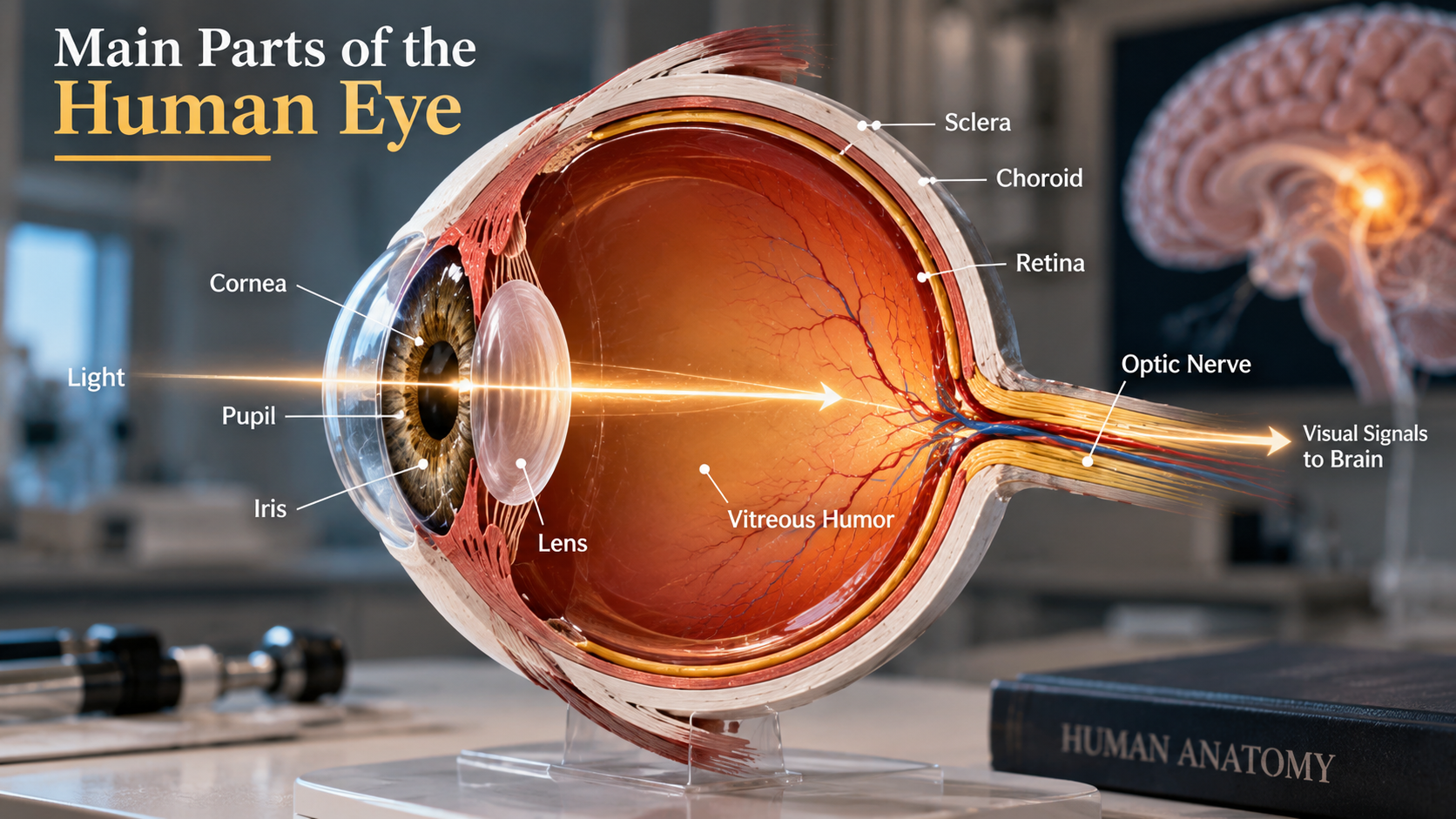
The human eye contains several specialized structures that work together to create vision. Light first passes through the cornea, the transparent outer surface at the front of the eye. The cornea provides much of the eye’s focusing power.
Behind it sits the iris, the colored structure that surrounds the pupil. The pupil is an opening that changes size according to available light. The lens lies behind the iris and changes shape to help focus images at different distances.
Light then passes through the vitreous humor before reaching the retina. The retina contains rods and cones that respond to light. These cells convert visual information into electrical signals.
The signals travel through retinal nerve fibers and leave the eye through the optic nerve. The brain receives and interprets these signals to create the visual experience.
Other important structures include the sclera, which forms the strong outer wall, and the choroid, which contains blood vessels that nourish the eye’s tissues.
The Vital Role of the Retina
The retina is a light-sensitive layer located at the back of the eye. It plays a central role in converting light into signals that the nervous system can process. The retina contains two main types of photoreceptors: rods and cones.
Rods are highly sensitive to light and are especially useful in dim conditions. They contribute strongly to night and peripheral vision. Cones work best in brighter conditions and support detailed and color vision.
After photoreceptors respond to light, retinal neurons process the information. Signals eventually reach retinal ganglion cells. Their axons form the optic nerve, which carries visual information toward the brain.
The brain then processes these signals through several visual pathways. It interprets information about shape, color, movement, and location. Therefore, the retina does more than simply act like photographic film. It performs important stages of visual processing before information leaves the eye, contributing to how we interpret visual hierarchy in graphic design and other visual information.
Why is the human eye so special?
The human eye is special because it combines precise optical structures with a highly sophisticated nervous system. It does not simply capture an image. Instead, it gathers light and sends complex signals that the brain interprets as meaningful visual information.
The eye also has an important role in human social behavior. One noticeable feature is the relatively visible white sclera surrounding the iris. Compared with many other primates, humans typically show a strong contrast between the sclera, iris, and surrounding facial structures.
This contrast can make the direction of another person’s gaze easier to detect. Gaze information can support shared attention and help people understand where another person is looking.
The phrase “window to the soul” is cultural rather than a scientific description. However, eyes can communicate attention and emotion through gaze, pupil changes, facial expressions, and coordinated movements.
The human visual system is therefore important for much more than sight. It connects perception with movement, learning, communication, and social interaction.
Enhanced Social Communication Through the Sclera
The sclera is the white outer portion of the eye surrounding the iris and pupil. In humans, it is often highly visible because of its strong contrast with the darker iris. This feature can make eye direction easier for other people to recognize.
Gaze direction is important during social interaction. People often look toward the same object to establish joint attention. This ability helps individuals coordinate activities and understand another person’s focus.
The visible sclera may therefore support efficient non-verbal communication. It can provide useful information without requiring spoken words. For example, someone can indicate attention, surprise, interest, or avoidance partly through eye direction.
However, the sclera is not solely responsible for human communication. Facial expressions, head position, body language, and voice also contribute important information.
The appearance of the sclera can vary naturally between individuals. Lighting, age, genetics, and eye health can also affect how it looks.
The combination of visible sclera, mobile eyes, and expressive facial muscles makes the human eye particularly important in everyday social interaction.
Why are girls’ eyes so pretty?
There is no single scientific reason why girls’ eyes, or anyone’s eyes, are considered beautiful. Perceptions of attractive eyes depend on several factors. These can include facial symmetry, eye shape, contrast, expression, and individual preferences.
Genetics influence characteristics such as eye color, eyelash growth, eyebrow shape, and facial structure. These features can interact with one another to create different visual appearances.
Cultural standards also influence how people judge beauty. Makeup can emphasize eyelashes, eyebrows, eye shape, or the contrast around the eyes. Lighting and facial expressions can further change how eyes appear. The way light interacts with visual perception is also relevant when understanding how AI generates images and creates realistic visual details.
Expression is often especially important. Eyes can appear warm, alert, confident, calm, or expressive depending on the surrounding facial muscles and the person’s emotional state.
Therefore, the idea that girls’ eyes are naturally prettier than others is subjective rather than biological. Attractive eyes can occur across all genders and physical appearances.
Ultimately, the human eye can appear visually appealing because of its combination of color, structure, contrast, movement, and expression. Personal preference plays a major role in determining what someone considers beautiful.
The Art of Framing with Eyelashes
Eyelashes and eyebrows help frame the eyes and influence how facial features appear. Eyelashes also perform an important protective function. They can help detect nearby particles and trigger protective blinking when something approaches the eye.
Eyebrows similarly help protect the eye area by helping direct sweat and moisture away from the eyes. Their shape also contributes to facial expression and visual appearance.
From an aesthetic perspective, eyelashes can make the eyes appear more defined. Longer or darker lashes may increase the visual contrast around the eyes. Well-defined eyebrows can create a stronger frame around the upper portion of the face.
However, beauty standards for eyelashes and eyebrows vary widely between individuals and cultures. There is no universal measurement that makes one eye more attractive than another.
The appearance of the eye also depends on factors such as eye shape, iris color, facial proportions, expression, and lighting. These elements work together rather than functioning independently.
As a result, eyelashes and eyebrows contribute both practical protection and visual framing. Their combination helps make the eye area one of the most noticeable features of the human face.
Can the human eye feel pain?
Yes, the human eye can feel pain, especially when the surface is irritated or injured. The cornea contains a dense network of sensory nerve endings. These nerves make it highly sensitive to physical irritation, dryness, inflammation, and injury.
When dust or another foreign particle touches the cornea, sensory nerves can quickly trigger discomfort and protective reflexes. These responses may include blinking and increased tear production. A corneal scratch can also cause significant pain, sensitivity to light, and watering.
Different parts of the eye and surrounding tissues have different levels of pain sensitivity. The retina itself does not contain the same type of pain-sensitive nerve endings found in the cornea. As a result, some internal eye conditions may cause pressure, aching, or headache-like discomfort rather than sharp surface pain.
Eye pain should not be ignored when it is severe, persistent, or accompanied by vision changes. Sudden pain, significant redness, injury, or loss of vision can require urgent medical evaluation.
Understanding Corneal Sensitivity and Irritation
The cornea is one of the most sensitive tissues in the human body. Its dense network of sensory nerves helps protect the eye from potential damage. Even a small particle can stimulate these nerves and produce a strong protective response.
When the cornea becomes irritated, the nervous system can trigger rapid blinking and increased tear production. Tears help wash away foreign material while keeping the corneal surface moist.
A scratch on the cornea can cause sharp pain, watering, redness, and sensitivity to light. Dryness can also produce burning, irritation, or a gritty sensation.
This sensitivity serves an important protective purpose. The cornea is the eye’s main transparent front surface, so maintaining its health is essential for clear vision.
Although mild irritation may resolve after the cause is removed, persistent or severe symptoms should receive professional attention. Avoiding unnecessary eye rubbing can also reduce the risk of worsening irritation or injury.
The eye’s sensitivity demonstrates how closely vision and protection are connected. The same structure that allows light to enter must also detect potential threats quickly.
Frequently Asked Questions
How does the human eye adapt to darkness?
The human eye adapts to darkness by dilating the pupil to let in more light and activating specialized photoreceptor cells called rods. Rods are extremely sensitive to low light levels, allowing people to see outlines and shapes in dim environments, though color perception decreases significantly during this nocturnal adjustment phase.
Why do people get red eyes?
Red eyes typically occur when tiny blood vessels on the surface of the eye become dilated or inflamed. Common triggers include environmental allergies, lack of sleep, eye strain from screens, dry air, or minor bacterial infections like conjunctivitis that require proper medical attention.
Can vision improve naturally over time?
While natural aging often leads to presbyopia and the need for reading glasses, adopting healthy habits can protect overall visual wellness. Eating a balanced diet rich in leafy greens, protecting eyes from ultraviolet rays with sunglasses, and taking regular screen breaks help maintain optimal long-term eye health.
What causes different eye colors?
Eye color is determined by the amount and distribution of melanin pigment located within the iris. Higher concentrations of melanin produce brown eyes, while lower amounts result in green, hazel, or blue eyes depending on how light scatters through the iris tissue layers.
Conclusion
The human eye is an extraordinary masterpiece of biological engineering that connects us deeply to the world around us. From complex anatomical parts like the cornea and retina to specialized functions that regulate sleep and communication, vision remains vital. Understanding how the human eye works, why it feels pain, and what makes it unique highlights the importance of proactive eye care. By protecting your vision through healthy daily habits and regular professional checkups, you ensure this remarkable sensory organ remains sharp and vibrant throughout life.