What Is Archaeology: A Complete Guide to Studying the Human Past
Have you ever wondered how historians discover what daily life looked like thousands of years ago? Understanding what is archaeology opens a fascinating window into human history. According to the Society for American Archaeology, archaeology studies past human cultures through the physical remains people left behind. Instead of relying only on written records, researchers uncover stories hidden beneath the ground.
Understanding this discipline matters because physical remains reveal details about ordinary people. Written records often focus on kings, wars, and wealthy families. However, ancient artifacts show how everyday people cooked, built homes, traded goods, and adapted to environmental changes. Preserving these discoveries also helps modern societies protect cultural heritage and understand historical challenges.
In this guide, we explore what archaeology means in simple words. You will discover its four main branches and learn about the person often recognized as the first archaeologist. We will also examine whether archaeology is a science, how old the discipline is, and how you can pursue it after completing 12th grade.
What is archaeology in simple words?
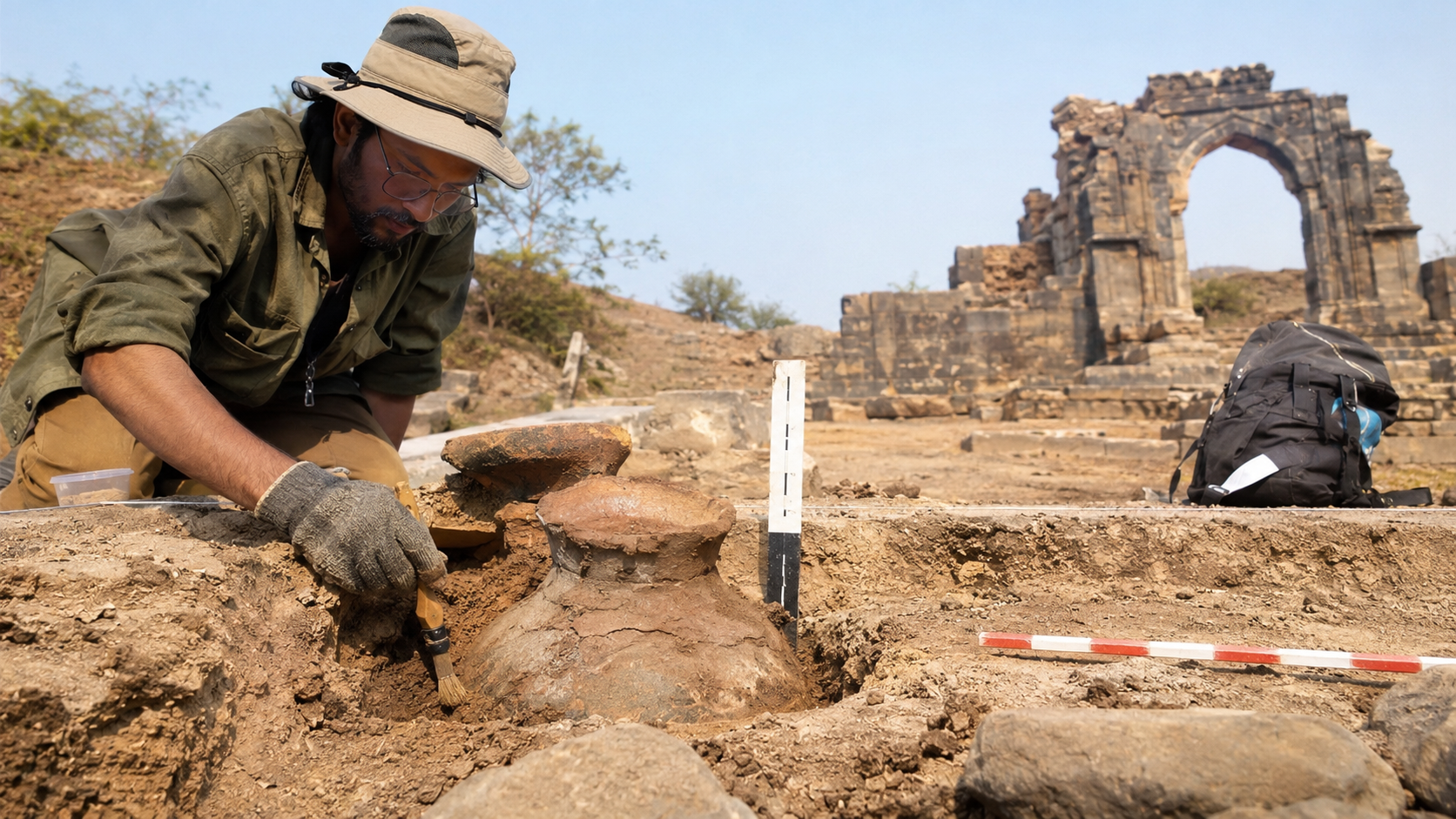
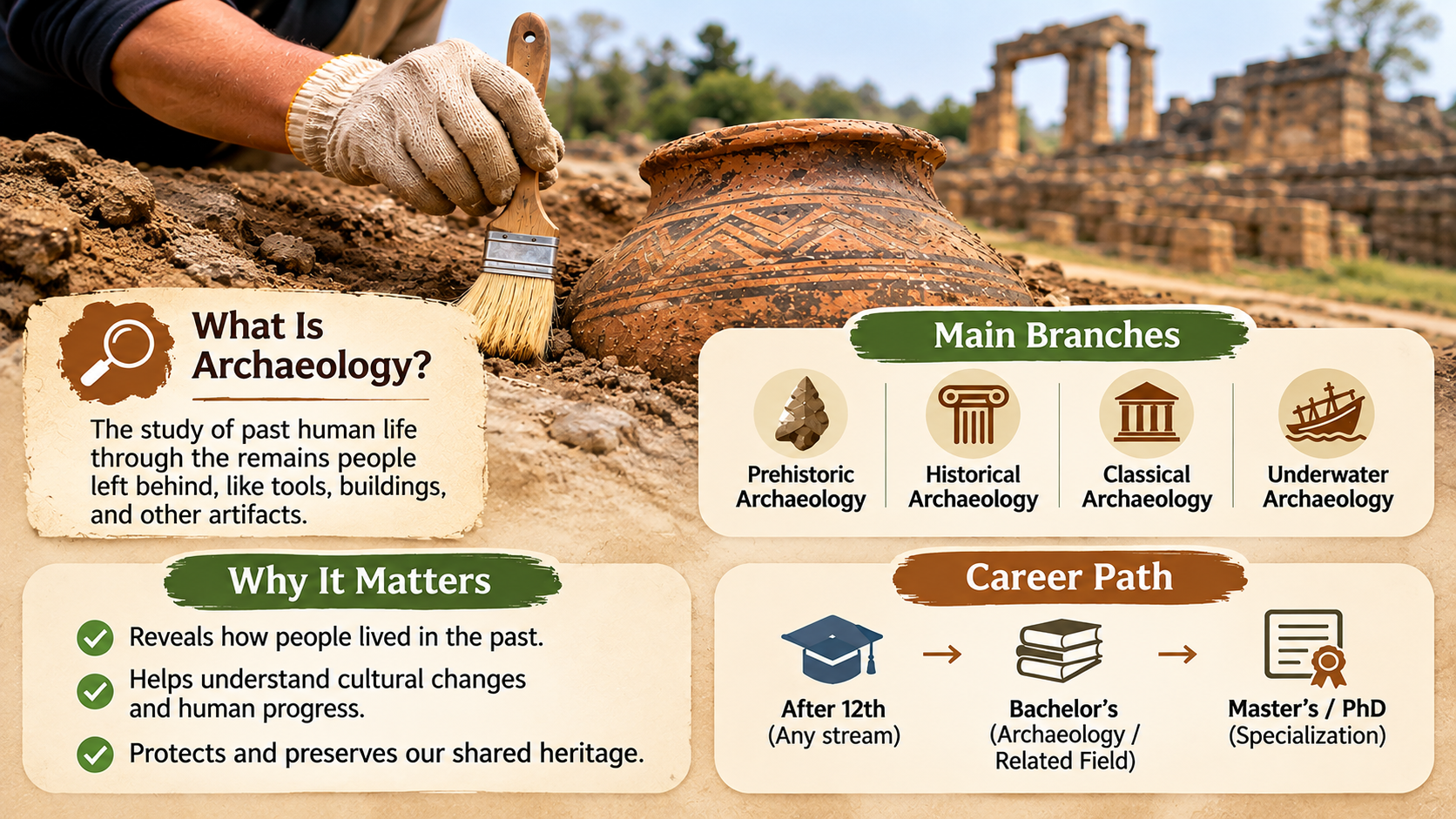
In simple words, archaeology is the study of human history through physical remains. These remains include objects, buildings, tools, and other materials left behind by earlier societies. Think of it as detective work that investigates the ancient world. Instead of interviewing witnesses, archaeologists examine physical evidence to understand how people lived.
Every discovery can reveal something important about the past. For example, finding charred seeds inside an ancient fireplace can show which crops people cultivated. Similarly, discovering foreign shells far from the ocean can provide evidence of ancient trade networks. Researchers carefully examine these objects to understand past communities.
Archaeology also studies how people interacted with their surroundings. Researchers investigate settlements, burial sites, monuments, and ancient landscapes. Their findings help explain technological developments, cultural traditions, and changes in human societies. This makes archaeology especially valuable for understanding communities that existed before written records became common.
Material Culture vs. Written History
Written history provides information about societies through documents, inscriptions, letters, and manuscripts. However, written records cover only a relatively small part of human existence. Many ancient communities never developed writing systems. Others left behind records that have disappeared over time. Researchers studying these records can benefit from finding the best references for ancient history to understand historical evidence more accurately.
This is where material culture becomes important. It includes physical objects and structures created, modified, or used by people. Examples include pottery, clothing, tools, weapons, buildings, and household objects.
Material culture helps researchers investigate aspects of life that written documents often overlook. For instance, household remains can reveal cooking habits, family activities, and economic conditions. Comparing physical discoveries with historical documents also helps archaeologists identify missing details and challenge inaccurate historical accounts. Together, these sources provide a more complete understanding of human civilization.
What are the four types of archeology?
Archaeology includes several specialized branches that examine different periods, cultures, and environments. Four commonly discussed areas are prehistoric, historical, classical, and underwater archaeology. Each branch uses archaeological evidence to investigate different aspects of human development.
- Prehistoric archaeology: Studies human communities that existed before written records. Researchers examine stone tools, pottery, bones, and ancient settlements to understand early human life.
- Historical archaeology: Combines physical discoveries with written documents. It investigates societies with historical records and uses material evidence to explore everyday experiences.
- Classical archaeology: Focuses primarily on ancient Mediterranean civilizations, particularly Greece and Rome. Researchers study temples, sculptures, inscriptions, and ancient cities.
- Underwater archaeology: Investigates submerged archaeological sites, including shipwrecks, sunken settlements, and ancient harbor structures.
These branches sometimes overlap, depending on the archaeological site and research objectives. For example, an underwater excavation might uncover a shipwreck from the Roman period. Researchers could then combine underwater and classical archaeological methods. Each specialization contributes valuable evidence to our understanding of the human past.
Can I do archeology after 12th?
Yes, you can pursue archaeology after completing your 12th grade. However, admission requirements depend on the university and the specific undergraduate program. Students from Arts, Science, and Commerce backgrounds may qualify for certain archaeology-related courses.
Many institutions offer undergraduate programs in archaeology, ancient history, or anthropology. A Bachelor of Arts (BA) in Archaeology is one possible starting point. Some universities also offer Bachelor of Science (BSc) programs or related interdisciplinary degrees.
Before applying, check the institution’s eligibility criteria, entrance examinations, and subject requirements. Some universities require at least 50% marks in 12th-grade examinations, while others follow different admission rules.
After completing your bachelor’s degree, you can consider postgraduate studies in archaeology or a related specialization. Advanced qualifications can help you pursue opportunities in:
- Archaeological research and field excavations.
- Museums and cultural heritage organizations.
- Historical preservation projects.
- Academic research and teaching.
- Government archaeological departments.
Practical excavation experience and research skills can also strengthen your career opportunities.
What is the best definition of archeology?
The best definition of archaeology is the systematic study of past human societies through the discovery, examination, and interpretation of material remains. These remains include artifacts, structures, human remains, and archaeological landscapes. The discipline investigates how people lived, interacted, and developed across different periods.
Unlike treasure hunting, archaeology follows established research methods. Researchers document the exact location and surroundings of every discovery. This information is essential because an artifact’s historical significance depends partly on where researchers find it.
Archaeology also combines knowledge from several academic disciplines. It connects history and anthropology with scientific fields such as geology, chemistry, and biology. Researchers use these different perspectives to investigate ancient environments, technologies, and cultural practices.
Ultimately, archaeology aims to reconstruct human experiences and explain changes in societies over time. It also emphasizes preservation, responsible excavation, and ethical research. Simply collecting ancient objects is not enough. Understanding their context is what makes archaeological discoveries valuable.
Why study archaeology?
Studying archaeology helps you understand humanity beyond the stories recorded in traditional history books. Historical accounts frequently focus on powerful leaders, political events, and major wars. Archaeological discoveries provide evidence about ordinary workers, families, women, and children. Ancient homes, tools, and household objects reveal how these communities actually lived. Understanding these discoveries becomes easier when you explore the basic facts about human history.
The discipline also offers valuable lessons for modern societies. Researchers examine how ancient civilizations responded to droughts, environmental changes, resource shortages, and urban development. These discoveries can help researchers understand why certain communities adapted successfully while others experienced major difficulties.
Archaeology also develops practical and intellectual skills. Students learn to examine evidence, interpret information, conduct research, and solve complex problems. These abilities are useful in several professional fields.
Other important reasons to study archaeology include:
- Understanding ancient civilizations and cultural development.
- Preserving historical monuments and archaeological sites.
- Discovering forgotten communities and traditions.
- Developing research and critical thinking abilities.
- Contributing to museums, education, and cultural heritage projects.
The discipline connects past experiences with present-day knowledge.
Protecting Cultural Heritage
Cultural heritage includes historical buildings, monuments, archaeological sites, traditional objects, and other evidence of human history. Unfortunately, many important sites face threats from urban development, environmental damage, climate change, and illegal excavation.
Archaeologists help protect these valuable resources through research, documentation, and preservation. Before construction projects affect historically important locations, archaeological surveys can identify sites that require further investigation. Specialists then record important discoveries and recommend appropriate conservation measures.
Preserving cultural heritage is not simply about protecting old buildings. It also means safeguarding the stories, traditions, and identities connected to historical communities. Archaeological research helps future generations understand their shared human past.
Professionals also work with museums, government departments, and conservation organizations. Their efforts support responsible site management and public education. By protecting archaeological evidence today, societies ensure that future researchers can continue studying human history tomorrow.
Who was the first archaeologist?
King Nabonidus of Babylon is often described as one of the earliest known archaeologists. He ruled the Neo-Babylonian Empire during the sixth century BCE and developed a strong interest in the ancient history of Mesopotamia.
Unlike rulers who focused mainly on constructing new monuments, Nabonidus investigated much older religious buildings. He ordered excavations at ancient temple sites to uncover their original foundations. These investigations helped him understand the rulers and civilizations responsible for constructing them centuries earlier.
Nabonidus also documented his discoveries through inscriptions on clay cylinders. These records described earlier kings, religious structures, and restoration activities. Researchers interested in historical writings can also explore ancient transcripts available for free to learn more about historical records. His work at the ancient city of Ur is particularly notable.
He investigated and restored the temple complex associated with the moon god Nanna. His interest in preserving ancient structures makes him an important figure in the history of archaeology.
However, archaeology developed gradually over many centuries. Nabonidus did not practice modern scientific archaeology. Nevertheless, his systematic interest in investigating and documenting earlier civilizations earned him recognition as an early archaeological pioneer.
Is archaeology 100% science?
No, archaeology is not entirely a science. It is an interdisciplinary field that combines scientific investigation with historical interpretation and knowledge of human cultures. Researchers use scientific methods to examine physical evidence. However, understanding the meaning behind ancient discoveries also requires knowledge of human behavior.
The scientific side of archaeology involves several important techniques:
- Radiocarbon dating: Estimates the age of suitable organic materials.
- DNA analysis: Helps investigate ancient populations and biological relationships.
- Satellite imaging: Identifies archaeological features and potential excavation sites.
- Chemical analysis: Examines the composition and possible origins of archaeological materials.
- Stratigraphy: Studies soil layers to understand the relative sequence of archaeological deposits.
However, scientific measurements cannot independently explain every aspect of ancient life. For example, identifying the age of a cave painting does not explain its cultural or symbolic meaning.
Archaeologists also use anthropology, history, sociology, and other humanities disciplines. Combining these approaches helps researchers develop evidence-based interpretations of ancient beliefs, traditions, and social structures. This balance makes archaeology both scientifically rigorous and deeply connected to human experiences.
How old is archaeology?
Archaeology as a modern academic discipline is roughly 200 years old. However, people’s interest in investigating ancient civilizations dates back thousands of years. Long before modern excavation techniques existed, rulers, collectors, and scholars explored historical monuments and collected ancient objects.
One early example is King Nabonidus of Babylon, who investigated ancient Mesopotamian structures around 550 BCE. During the Renaissance, European antiquarians also collected classical sculptures, inscriptions, and historical objects. However, these early activities did not follow the systematic research methods used today.
Modern archaeology began developing more clearly during the 18th and 19th centuries. Researchers introduced more organized excavation techniques and improved methods for studying archaeological discoveries. The Three-Age System, which divides prehistory into the Stone Age, Bronze Age, and Iron Age, became an important framework for understanding technological development. To explore these historical divisions further, see the complete timeline of human history and its different eras.
During the 19th century, advances in geology and the growing acceptance of humanity’s deep antiquity transformed archaeological research. By the late 1800s, systematic excavation and archaeological documentation had become increasingly established.
Today, archaeology uses advanced scientific technologies alongside traditional field research. These developments continue to improve how researchers investigate, interpret, and preserve evidence of the human past.
Conclusion
Understanding what is archaeology reveals how much we can learn from the physical objects left behind by our ancestors. Far beyond simple treasure hunting, this fascinating discipline blends hard laboratory science with human history to reconstruct everyday life across thousands of years. From King Nabonidus’s earliest excavations in ancient Babylon to modern laser-scanning technologies, researchers continue to uncover hidden stories beneath our feet.
Whether you want to explore the four major branches, understand how material culture fills gaps in written records, or start a career after 12th grade, archaeology offers endless discoveries. Every broken pot and buried foundation connects us directly to the people who shaped our world.
If this field sparks your curiosity, take the next step today. Visit a local history museum, read an excavation report, or explore introductory university courses to start uncovering the past for yourself.